
June 12, 2026
The Governance Fault Lines That Shape Mining Giants
Few forces reshape the trajectory of a major resource company as decisively as a fracture at board level. When the individuals responsible for setting strategic direction, approving capital allocation, and safeguarding shareholder interests become the subject of contested removal, the consequences extend well beyond the boardroom. They ripple through commodity markets, sovereign wealth calculations, and the long-term investment theses of institutional funds spanning multiple continents.
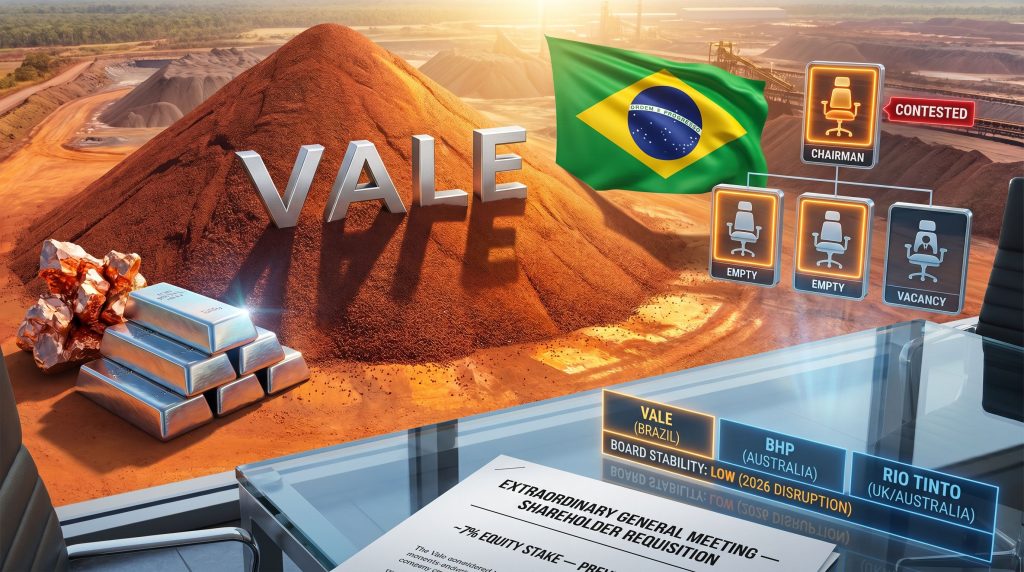
This is precisely the dynamic now unfolding at Vale, one of the world's three largest iron ore producers and a company whose output directly influences global steel supply chains. The push to replace the chairman of Vale's board has crystallised into one of the most consequential governance battles in Latin American mining in recent years, with implications that reach far beyond Brazil's borders.
When big ASX news breaks, our subscribers know first
What Is Actually Happening at Vale's Board Level in 2026?
The immediate trigger is a formal request by Previ, the pension fund for employees of Banco do Brasil, to convene an extraordinary general meeting at which shareholders would vote on replacing incumbent board chairman Daniel André Stieler. Previ's preferred candidate for the chairmanship is Manuel Lino Silva de Sousa Oliveira, with José Maurício Coelho simultaneously proposed as an additional board appointee.
What makes this situation structurally unusual is that the chairmanship contest is not unfolding in isolation. Two independent directors have separately resigned from Vale's board, creating a simultaneous multi-front governance disruption. Vale has publicly indicated its intention to move swiftly to fill these vacancies, signalling awareness that prolonged board incompleteness creates compliance risks under the company's own bylaws.
| Board Event | Current Status |
|---|---|
| Chairman replacement request | Formally submitted by Previ; board reviewing |
| Proposed incoming chairman | Manuel Lino Silva de Sousa Oliveira |
| Additional proposed director | José Maurício Coelho |
| Independent director resignations | Two seats vacated; replacement underway |
| Vale's formal response | Reviewing request; assessing EGM pathway |
Why Previ's 7% Stake Carries Influence Beyond Its Size
The Institutional Weight of Brazil's Most Powerful Pension Fund
Previ's ownership position of approximately 7% of Vale's equity would appear modest by the standards of concentrated ownership structures in other markets. However, in Brazil's institutional landscape, Previ operates with an influence profile that exceeds what that percentage alone would imply.
As the pension fund for employees of Banco do Brasil, Brazil's largest state-owned bank, Previ manages assets on behalf of hundreds of thousands of current and retired public sector workers. Its investment decisions carry a semi-institutional character that blurs the line between private financial stewardship and state-adjacent policy expression. This is not an abstract distinction. Previ's long history of active involvement in Vale's corporate governance stretches back to the company's privatisation in 1997, when state-aligned funds were given structured roles as anchor shareholders to ensure continuity of Brazilian interests in the newly private entity.
Furthermore, understanding the broader context of iron ore demand trends helps explain why institutional investors are particularly sensitive to governance stability at a producer of Vale's scale.
Under Brazilian corporate law (Lei das S.A.), shareholders controlling 5% or more of a company's voting capital hold the legal right to formally requisition an extraordinary general meeting to address board composition. Previ's approximately 7% stake comfortably clears this threshold, making its formal request legally unambiguous and operationally binding on Vale's board to respond.
The significance of Previ formally exercising this right, rather than continuing quiet back-channel negotiations, should not be underestimated. In Brazilian corporate culture, the decision to escalate to a public shareholder requisition typically signals that informal dialogue has broken down and that the activist shareholder has calculated it holds sufficient coalition support to prevail at a vote. Investors tracking management red flags at major commodity companies will recognise this pattern as a material escalation indicator.
How Brazilian Shareholder Activism Compares Internationally
The mechanisms available to activist shareholders differ meaningfully across major mining jurisdictions:
- Brazil (Lei das S.A.): Shareholders with 5%+ voting capital can requisition extraordinary general meetings directly, with binding legal effect on the company to schedule the vote.
- Australia (Corporations Act 2001): Shareholders with 5%+ of votes, or a group of at least 100 members, can requisition an extraordinary general meeting, though timelines and procedural requirements differ.
- United Kingdom (Companies Act 2006): Shareholders holding 5%+ of paid-up voting capital can demand a general meeting, with the company required to convene within 21 days of the requisition.
- Canada: Shareholder requisition rights vary by province and corporate charter but generally require 5% ownership thresholds with prescribed notice periods.
Brazil's mechanism is notably direct, giving Previ a powerful formal lever that functions independently of board goodwill.
The Strategic and Political Forces Underneath the Governance Surface
Vale's Unresolved Relationship with Brazilian Political Cycles
Understanding why the push to replace the chairman of Vale's board matters requires appreciating Vale's unusual post-privatisation identity. Despite being a nominally private corporation, Vale has never fully escaped the gravitational orbit of Brazilian federal politics. State-aligned pension funds, including Previ and Funcef (the pension fund for Caixa Econômica Federal employees), retained significant shareholdings after the 1997 privatisation, creating an ownership structure that functions as a soft nationalisation instrument even in the absence of formal government control.
When Brazil's federal government orientation shifts, as it did with the return of the Lula administration, expectations around board composition at strategically significant companies historically shift with it. State-aligned institutional investors in this environment frequently become conduits through which policy preferences are expressed without requiring direct government intervention.
This dynamic is not unique to Vale. It reflects a broader pattern across Latin American resource majors where the distinction between private corporate governance and state industrial policy remains porous. In addition, the broader environment of mining taxes and royalties across major jurisdictions adds another layer of political sensitivity to board-level decision-making at companies of this scale.
Capital Allocation as the Real Battleground
Beneath governance language around independence and board composition, capital allocation disagreements typically drive the most serious shareholder confrontations at commodity companies. Vale's current position creates several natural tension points:
- Iron ore infrastructure investment: Vale's Carajás mining complex in Brazil's Pará state is among the world's highest-grade iron ore deposits, with average iron content around 67% Fe, substantially above the global benchmark of approximately 62% Fe used in futures pricing. Maintaining and expanding this advantage requires sustained heavy CAPEX commitments that create tension with short-term return expectations.
- Nickel market headwinds: Vale's nickel operations face structural pressure from Indonesian supply growth, which has driven a sustained oversupply condition in the Class 1 nickel market. Indonesian nickel production has grown dramatically, with the country now accounting for more than 50% of global mined nickel output, fundamentally altering the competitive economics for higher-cost operations elsewhere.
- Copper's emerging priority: As decarbonisation drives copper demand projections upward, Vale's copper assets are becoming strategically more important. However, developing these assets to production maturity requires CAPEX commitments over multi-year horizons that may conflict with dividend maximisation preferences held by return-focused institutional shareholders.
Institutional shareholders at resource majors rarely escalate governance disputes purely over interpersonal or procedural disagreements. When a pension fund triggers a formal chairman removal process, it almost invariably reflects a deeper disagreement about the direction of capital at a company whose free cash flow profile determines the fund's own liability-matching capacity.
Comparing Vale's Governance Structure to Global Mining Peers
| Governance Dimension | Vale (Brazil) | BHP (Australia) | Rio Tinto (UK/Australia) |
|---|---|---|---|
| Dominant shareholder influence | High (state-aligned pension funds) | Moderate (institutional dispersion) | Moderate (institutional dispersion) |
| Political exposure | High | Low to moderate | Low to moderate |
| Board chair selection mechanism | Shareholder vote (EGM eligible) | Board nomination plus AGM vote | Board nomination plus AGM vote |
| Independent director requirements | Lei das S.A. framework | ASX Corporate Governance Principles | UK Corporate Governance Code |
| Recent board stability | Low (2026 multi-front disruption) | High | High |
The contrast with BHP and Rio Tinto is instructive. Both companies operate under governance frameworks that prioritise board-led director nominations, with shareholder votes functioning primarily as ratification mechanisms rather than originating authority. Vale's structure, combined with the concentrated ownership of state-aligned pension funds, creates a materially different governance dynamic where shareholder-initiated board changes are a credible and legally accessible tool. Consequently, understanding iron ore industry advantages in more stable governance environments provides a useful comparative lens.
The Independent Director Deficit and Its Cost-of-Capital Implications
The simultaneous resignation of two independent directors compounds the chairmanship dispute in ways that matter specifically to international investors and credit analysts. ESG governance scoring frameworks used by major rating agencies, including MSCI and Sustainalytics, treat periods of contested board leadership and below-threshold independent director representation as governance risk factors that can trigger score downgrades.
A lower governance score translates directly into a higher cost of equity through the risk premium international investors apply to companies with elevated governance uncertainty. For a company of Vale's scale, even a modest increase in the equity risk premium has meaningful implications for valuation multiples and project financing economics.
Three Scenarios: What Happens Next
Scenario 1: Previ Succeeds and Installs a New Chairman
If Previ assembles sufficient shareholder support at the extraordinary general meeting, Manuel Lino Silva de Sousa Oliveira assumes the chairmanship. The most likely immediate consequences include:
- A capital allocation review with particular scrutiny applied to CAPEX priorities and dividend policy
- A recalibration of Vale's relationship with the federal government, potentially smoothing tensions under the current political administration
- Short-term share price volatility as markets reprice the strategic risk premium associated with new leadership uncertainty
Scenario 2: The Incumbent Chair Survives
A failed vote would signal that Previ's shareholder coalition lacks the arithmetic to force change, potentially because other significant institutional shareholders declined to align with the requisition. This outcome would:
- Temporarily stabilise board dynamics while leaving underlying tensions structurally unresolved
- Prompt Previ to explore alternative governance pressure mechanisms, including proxy campaigns ahead of the next annual general meeting
- Send a signal to markets that Vale's board retains independence from state-aligned shareholder pressure
Scenario 3: Negotiated Compromise Emerges
Historically, the most common resolution pattern in Brazilian corporate governance disputes of this character is a negotiated outcome that partially satisfies the activist shareholder without requiring a complete leadership transition. This might involve:
- Accelerated appointment of agreed independent directors to restore bylaw compliance
- Voluntary board refreshment commitments from the incumbent chairman
- Concessions on capital allocation priorities or governance transparency standards
Regardless of which path materialises, the fact that a formal extraordinary general meeting requisition has been submitted creates a structural accountability moment. Vale's leadership cannot simply allow the situation to quietly dissolve. Demonstrable action on institutional shareholder concerns is now a minimum expectation.
The next major ASX story will hit our subscribers first
What This Means for Investors and Commodity Market Participants
Governance Risk as a Pricing Variable
Investors monitoring the attempt to replace the chairman of Vale's board should treat this episode as a material governance event requiring active portfolio attention rather than passive observation. The specific indicators worth tracking include:
- EGM scheduling announcements and proxy voting disclosures from major institutional shareholders
- Independent director appointment timelines as a signal of governance stabilisation pace
- Any formal statements from Vale's board addressing capital allocation strategy or dividend policy in response to institutional pressure
- Commodity price movements, particularly iron ore benchmarks, which directly govern Vale's free cash flow and therefore its capacity to satisfy competing shareholder return demands
Downstream Industry Implications
Vale's iron ore production volumes are not directly at risk from board-level changes in the near term. Executive management handles operational continuity independently of board composition shifts. However, longer-term CAPEX decisions, particularly around the expansion of higher-grade production capacity at Carajás, may face review delays during a governance transition period.
For steel producers dependent on consistent supply of premium-grade iron ore, the China steel and iron ore demand picture adds further complexity to the supply certainty calculus during periods of governance uncertainty at major producers. For battery supply chain investors tracking Vale's nickel and copper asset development timelines, the board resolution outcome serves as a proxy signal for the company's investment appetite over the next three to five years.
This article contains forward-looking analysis and scenario modelling for informational purposes only. It does not constitute financial advice. Investors should conduct independent research and consult qualified financial advisers before making investment decisions related to Vale or any other entity discussed.
Want to Spot the Next Major Mineral Discovery Before the Market Does?
Discovery Alert's proprietary Discovery IQ model delivers real-time alerts on significant ASX mineral discoveries, transforming complex mineral data into clear, actionable insights for investors at every experience level — start your 14-day free trial today and see why subscribers to Discovery Alert have been positioned ahead of historic discoveries like those made by De Grey Mining and WA1 Resources, or explore the dedicated discoveries page to understand the remarkable returns that major mineral finds have historically generated.