June 12, 2026
The Invisible Mineral Holding Western Industry Together
Few industrial commodities operate as invisibly yet as indispensably as fluorspar. It does not command the headlines that lithium or cobalt attract, yet virtually every technology considered central to the modern economy, from semiconductor chips to electric vehicle batteries, from nuclear fuel rods to aerospace-grade coatings, depends on fluorine chemistry derived from this single mineral. For decades, Western nations outsourced the production of fluorspar to China with little strategic concern. That calculus has now shifted dramatically, and junior explorers capable of identifying historically productive, acid-grade fluorspar assets within low-risk Western jurisdictions are suddenly operating in a very different market environment.
Furthermore, the broader critical minerals demand surge has made supply chain security a top-tier policy and investment priority across the Western world.
It is within this context that the West Cobar Baxter fluorspar project acquisition in Nevada emerges not merely as a corporate transaction, but as a calculated strategic repositioning at the intersection of supply chain vulnerability and exploration upside.
When big ASX news breaks, our subscribers know first
What the Baxter Fluorspar Project Actually Represents
Geographic Setting and Geological Significance
The Baxter fluorspar project sits within the state of Nevada, a jurisdiction consistently ranked among the world's most mining-friendly regulatory environments. Nevada's combination of established mineral tenure frameworks, existing infrastructure corridors, and a long institutional history of hard-rock mining makes it a preferred destination for exploration-stage companies seeking to minimise sovereign risk while maximising prospectivity.
Geologically, the project hosts structurally controlled fluorite mineralisation, meaning the ore-forming fluids followed fault and fracture networks to deposit high-grade fluorite within breccia zones and vein systems. This style of mineralisation is particularly important because it tends to produce concentrated, high-grade pockets rather than diffuse, low-grade halos, which directly supports the potential for acid-grade material.
The Kaiser Mine's Legacy and What It Tells Modern Explorers
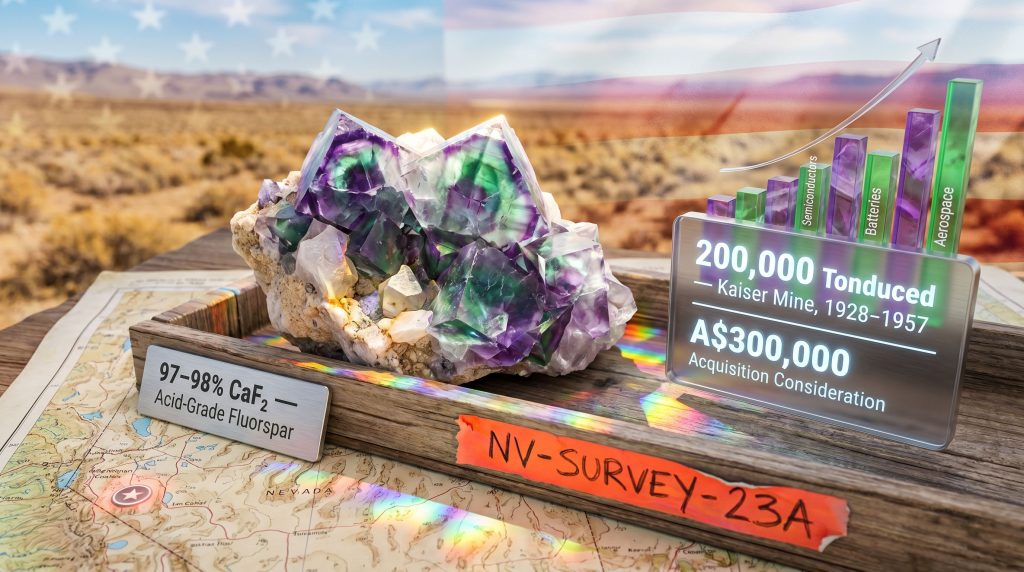
Embedded within the Baxter project boundary is the Kaiser Mine, a historically significant underground operation that produced approximately 200,000 tonnes of fluorspar between 1928 and 1957. Critically, documented production grades reached 97% to 98% calcium fluoride (CaF₂), firmly placing the output within the acid-grade classification, which represents the highest and most commercially valuable category of fluorspar.
What makes this historical record particularly instructive for modern exploration is not just the volume, but the structural signature it reveals. Mining records from the Kaiser operation indicate that the fluorite mineralisation remains open both along strike and at depth, suggesting that the underground workings extracted only a portion of what the structural system may contain.
Historical production data from the Kaiser Mine points to a mineralising system that was not exhausted by nearly three decades of underground extraction, an unusual characteristic that meaningfully elevates the project's exploration priority.
Additionally, similar structural controls to those that governed the Kaiser Mine have been identified across multiple historical prospects within the claim boundary, covering at least 3 kilometres of strike length that have not been tested by modern drilling techniques. This untested corridor represents the core exploration opportunity.
Understanding Acid-Grade Fluorspar and Why It Commands a Premium
The fluorspar market is segmented by purity, and the distinction between grades has profound commercial implications.
| Grade Classification | CaF₂ Content | Primary Use | Market Premium |
|---|---|---|---|
| Acid-Grade (Acidspar) | ≥97% CaF₂ | HF acid, semiconductors, batteries | High |
| Ceramic-Grade | ~96% CaF₂ | Optics, precision ceramics | Moderate to High |
| Metallurgical-Grade (Metspar) | 60–96% CaF₂ | Steel flux, cement production | Moderate |
Acid-grade fluorspar is processed into hydrofluoric acid (HF), the foundational chemical from which the entire fluorochemical supply chain is built. Without HF, there is no etching of silicon wafers in semiconductor fabrication, no production of lithium hexafluorophosphate electrolyte for lithium-ion batteries, and no uranium hexafluoride for nuclear fuel conversion. The Kaiser Mine's documented output at 97–98% CaF₂ places it firmly in the acid-grade tier, a significant differentiator from the majority of historical mining districts where metallurgical-grade material was the primary product.
How the Acquisition Was Structured
Deal Economics and Capital Efficiency
West Cobar Metals structured the West Cobar Baxter fluorspar project acquisition in Nevada with deliberate capital efficiency, keeping total consideration to approximately A$300,000 while preserving the flexibility to fund a meaningful initial exploration programme.
| Component | Detail |
|---|---|
| Non-Refundable Exclusivity Fee | A$60,000 (cash) |
| Share-Based Consideration | A$200,000 in WC1 ordinary shares |
| Placement Price Per Share | 1.7 cents per share |
| Shares Issued | 11,764,705 ordinary shares |
| Total Consideration | ~A$300,000 |
| Net Smelter Return Royalty | 3.0% NSR to seller or nominee |
| Capital Raise | USD$1,000,000 placement to fund exploration |
The share-based component of the consideration reduces immediate cash outflow while aligning the seller's interests with the project's long-term success. The 3% net smelter return (NSR) royalty retained by the vendor is a standard feature of junior mining acquisitions. An NSR royalty entitles the holder to a percentage of gross revenue from mineral sales after deducting smelting and refining costs, without any exposure to operating expenses. For the acquiring company, royalty obligations of this nature become meaningful only once the project reaches production, meaning they impose no burden during exploration phases.
The acquisition remains subject to a 30-day due diligence period, during which West Cobar must validate tenure, conduct ground inspection, review historical mining records, and complete a technical assessment sufficient to confirm the geological basis for proceeding.
What the USD$1 Million Capital Raise Signals
The concurrent placement to raise USD$1,000,000 is not a routine capital management exercise. A strongly supported placement at the time of a project announcement indicates genuine investor conviction in the commodity thesis and the specific asset. The proceeds will fund the initial work programme, which is structured around six core deliverables:
-
Compilation and digitisation of all historical Kaiser Mine and Spar Dome Mine production records
-
Legal tenure verification and title review across the claim boundary
-
Physical ground inspection and structural geological mapping
-
Surface sampling across identified mineralised corridors
-
Detailed technical review of the Kaiser Mine and Spar Dome Mine geology
-
Generation of priority drill targets beneath alteration zones and shallow cover sequences
Digitising historical mine records is a critical first-phase task that is often underestimated by outside observers. Pre-digital era mining data is frequently held in handwritten logs, analogue survey maps, and physical assay certificates that have never been cross-referenced with modern coordinate systems or geological models. Converting this archive into a spatially referenced digital dataset allows geologists to overlay historical high-grade intercepts against modern geophysical interpretations, dramatically improving the precision of target generation before a single drill hole is committed.
The US Fluorspar Supply Crisis in Context
A Nation Almost Entirely Dependent on Imports
The United States currently produces negligible quantities of domestic fluorspar, making it structurally dependent on external supply for one of its most industrially critical minerals. The primary sources of US fluorspar imports are China and Mexico, a concentration that introduces significant supply chain fragility given the geopolitical tensions shaping trade policy in 2025 and 2026.
China controls an estimated 60% or more of global fluorspar production and an even larger share of downstream fluorochemical processing capacity. This concentration means that any disruption to Chinese export flows, whether through export controls, trade restrictions, or geopolitical escalation, would reverberate immediately through US semiconductor fabs, battery gigafactories, and defence manufacturing facilities. Consequently, the Trump administration's critical minerals executive order has placed renewed urgency on identifying and developing domestic sources of supply.
The Seven Industrial Sectors Driving US Fluorspar Demand
| End-Use Sector | Fluorspar Application |
|---|---|
| Semiconductors | Hydrofluoric acid etching of silicon wafers |
| Lithium-Ion Batteries | Fluorine compounds in electrolyte chemistry |
| Nuclear Fuel Processing | Uranium hexafluoride conversion |
| Aerospace and Defence | High-performance fluoropolymers and coatings |
| Steel and Aluminium Production | Flux agent in smelting operations |
| Advanced Refrigerants | Hydrofluorocarbon (HFC) feedstock |
| Hydrofluoric Acid Manufacturing | Primary downstream derivative of acid-grade fluorspar |
The breadth of this demand profile is what distinguishes fluorspar from single-sector critical minerals. It is simultaneously essential to the energy transition, to defence manufacturing, and to legacy industrial processes, making its supply chain security a cross-departmental policy priority rather than a niche concern.
The US fluorspar situation represents one of the most acute critical mineral supply vulnerabilities in the Western world precisely because it is so rarely discussed relative to lithium or rare earths, yet its industrial tentacles reach further than either.
How the Baxter Project Fits West Cobar's Portfolio Architecture
A Diversified Critical Minerals Footprint
West Cobar's existing portfolio prior to the Baxter acquisition was already oriented toward critical and strategic commodities, with exposure across:
- Copper projects based in Australian operations
- Antimony assets within Australian operations, a commodity that has itself attracted significant strategic attention given its applications in military-grade munitions and flame retardants, and one where the antimony shortage risks are particularly acute for Western defence industries
- Scandium and rare earth mineral interests
- Silver project exposure
- Baxter Fluorspar Project in Nevada, USA (new addition)
The addition of a US-based fluorspar asset introduces meaningful geographic diversification that was previously absent from the portfolio. Australian-domiciled explorers with exclusively domestic assets carry an implicit concentration of sovereign, regulatory, and currency risk. A producing or near-production US asset denominated in USD creates a natural hedge against Australian dollar fluctuations while accessing a commodity market with structurally higher domestic price premiums due to import dependence.
Importantly, the West Cobar Baxter fluorspar project acquisition in Nevada does not represent a reallocation of capital away from existing Australian operations. At a total consideration of approximately A$300,000, the transaction is structured to sit alongside, rather than compete with, the existing programme of work. West Cobar has indicated it will continue advancing its copper, antimony, scandium, and rare earth projects concurrently. In addition, the Speewah fluorite project provides a useful comparative reference point for how Australian-listed companies are approaching fluorite exploration strategy more broadly.
The next major ASX story will hit our subscribers first
Key Risk Factors Investors Should Evaluate
Exploration-Stage Reality
Despite the strength of the historical production record, the Baxter project remains at an early exploration stage. Historical production at the Kaiser Mine establishes geological credibility, but it does not constitute a modern mineral resource estimate under current reporting standards such as JORC or NI 43-101. The gap between historical mine output and a drilled, modelled, and classified resource is substantial and requires both capital and time to bridge. However, a well-structured definitive feasibility study process can provide a clear pathway from exploration data to investment-grade resource confidence when the time comes.
Conditions and Completion Risk
The acquisition remains subject to satisfactory completion of due diligence. Should the technical review or tenure assessment reveal material issues, West Cobar retains the right not to proceed, though the A$60,000 exclusivity fee is non-refundable regardless of outcome.
Royalty Economics Over the Long Term
A 3% NSR royalty, while standard for transactions of this nature, represents a meaningful ongoing cost once a project reaches production. At elevated fluorspar prices, the royalty burden increases proportionally, which should be factored into any long-term project economic modelling.
Permitting and Regulatory Timelines
Nevada's mining permitting framework is generally regarded as transparent and commercially reasonable, but no US mining project is immune to regulatory delay. Environmental baseline studies, water use assessments, and reclamation bonding requirements all add time and cost to the pathway from exploration to production that investors should account for in their scenario modelling. Furthermore, industry analysts covering Nevada fluorspar have noted the project's favourable jurisdiction as a mitigating factor against many of these typical regulatory risks.
This article is intended for informational purposes only and does not constitute financial advice. Readers should conduct their own due diligence and consult a licensed financial adviser before making any investment decisions. All figures referenced are drawn from publicly available company announcements and independent industry data.
Frequently Asked Questions: West Cobar Baxter Fluorspar Project Acquisition
What is the Baxter Fluorspar Project?
The Baxter Fluorspar Project is a historically producing fluorspar asset located in Nevada, USA, containing the Kaiser Mine and Spar Dome Mine, both of which generated documented acid-grade fluorite output during the 20th century.
How much did West Cobar pay to acquire the Baxter project?
The total acquisition consideration is approximately A$300,000, comprising a A$60,000 non-refundable cash exclusivity fee and A$200,000 in West Cobar ordinary shares issued at 1.7 cents per share, plus a 3% NSR royalty retained by the seller.
What is acid-grade fluorspar?
Acid-grade fluorspar, also called acidspar, contains at least 97% CaF₂ and is the feedstock for hydrofluoric acid production. It commands the highest market premiums within the fluorspar classification system and is essential for semiconductor manufacturing, battery electrolyte chemistry, and nuclear fuel processing.
How much fluorspar did the Kaiser Mine historically produce?
The Kaiser Mine produced approximately 200,000 tonnes of fluorspar from underground operations between 1928 and 1957, with documented concentrate grades of 97% to 98% CaF₂.
Why is fluorspar classified as a critical mineral in the United States?
Fluorspar appears on the US critical minerals list because the country produces negligible quantities domestically while depending on it for defence manufacturing, semiconductor fabrication, nuclear fuel processing, and advanced battery supply chains. The concentration of global supply in China further elevates its strategic risk profile.
When is the acquisition expected to complete?
Completion is subject to a 30-day due diligence period and the satisfaction of associated conditions, including technical review, tenure verification, and ground inspection.
Want to Know When the Next Major Mineral Discovery Hits the ASX?
Discovery Alert's proprietary Discovery IQ model scans ASX announcements in real time, delivering instant alerts on significant mineral discoveries across more than 30 commodities — including the critical minerals reshaping Western supply chains — so subscribers can act before the broader market reacts. Explore historic discoveries and their returns, then start your 14-day free trial at Discovery Alert to position yourself ahead of the next major find.