
June 12, 2026
The Quiet Recalibration Happening Inside America's Diamond Market
Luxury markets rarely transform overnight. More often, they shift incrementally, driven by generational wealth transfers, evolving value systems, and the slow replacement of one dominant consumer cohort with another. The natural diamond industry is in the middle of precisely this kind of structural transition, and Gen Z natural diamond demand in the U.S. tells a story that cuts against several prevailing assumptions about where younger consumers stand on natural stones.
For much of the past decade, the narrative around Gen Z and diamonds has been framed primarily as a defection story, with younger buyers assumed to be gravitating toward lab-grown alternatives on price and ethics grounds. The reality, as detailed in De Beers' latest U.S. Diamond Acquisition Study, is considerably more nuanced and, for the natural diamond sector, considerably more encouraging.
When big ASX news breaks, our subscribers know first
America's Structural Role in Global Diamond Demand
The United States has long occupied a position of singular importance in the global diamond jewelry ecosystem. No other single-country market comes close to matching American consumer appetite for diamond jewelry, and that primacy means that shifts in U.S. buyer behaviour ripple outward through the entire supply chain, from cutting and polishing centres to primary mining operations among global diamond producers.
When U.S. consumer sentiment toward natural diamonds strengthens, the effects are felt upstream in production economics, polished diamond pricing benchmarks, and rough stone valuations at tender. Conversely, when demand contracts, the consequences cascade across producer nations whose fiscal positions are directly tied to diamond export revenues.
This is why understanding which Americans are buying diamonds, how much they are spending, and why they are making those purchases matters well beyond the retail level. The generational composition of U.S. diamond demand is not a marketing footnote. It is a leading indicator for the industry's medium-term trajectory.
Gen Z Natural Diamond Demand in the U.S.: What the Numbers Reveal
Spending Power That Defies Generational Stereotypes
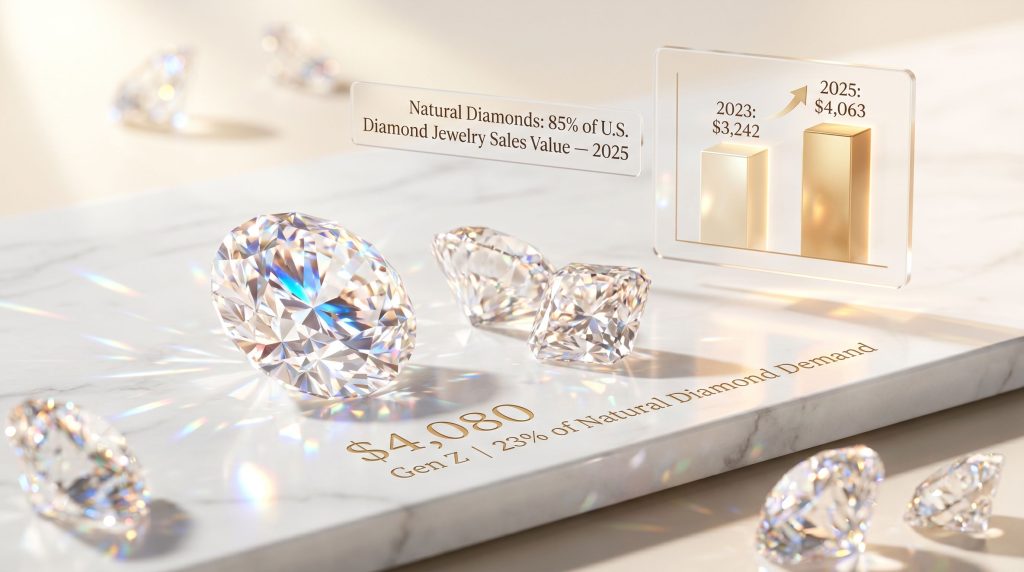
Perhaps the most striking finding from the De Beers U.S. Diamond Acquisition Study is the spending intensity of Gen Z buyers relative to older cohorts. Despite representing just 18% of the U.S. population, Gen Z now accounts for 23% of natural diamond demand by value, a disproportionate footprint that signals strong per-capita purchasing intensity rather than mere numerical presence.
More revealing still is the average transaction value. Gen Z buyers are spending an average of $4,080 per natural diamond jewelry purchase, compared with just $2,250 for Baby Boomers. That is an 81% premium paid by the youngest adult consumer cohort over the oldest, which inverts the assumption that younger buyers are primarily budget-constrained and therefore less valuable to the premium end of the market.
| Consumer Cohort | Average Spend Per Natural Diamond Purchase |
|---|---|
| Gen Z | $4,080 |
| Overall Market Average (2025) | $4,063 |
| Overall Market Average (2023) | $3,242 |
| Baby Boomers | $2,250 |
The broader market average itself has climbed substantially, rising approximately 25% between 2023 and 2025, from $3,242 to $4,063. Average carat weights tracked upward over the same period, moving from 1.65 carats to 1.86 carats. This simultaneous increase in both price and stone size points toward a structural shift in purchasing preferences toward larger, higher-quality pieces rather than simply inflationary price movement.
Natural Diamonds vs. Alternatives: The Preference Rankings
The study surveyed 18,500 U.S. women on their luxury jewellery preferences, producing a clear ranking that places natural diamonds at the top of the desirability hierarchy.
| Jewelry Category | Share Ranking It Most Desired |
|---|---|
| Natural Diamond Jewelry | 11% |
| Lab-Grown Diamond Jewelry | 8% |
| Other Gemstones | 5% |
| Plain Gold Jewelry | 4% |
Natural diamonds led lab-grown alternatives by a 3-percentage-point margin in top-tier desirability rankings. At the retail transaction level, data sourced from 950 independent U.S. jewelers confirmed that natural diamonds captured 85% of total diamond jewelry sales value in 2025, with lab-grown stones accounting for the remaining 15%.
Furthermore, according to Fortune Business Insights, the U.S. diamond market continues to demonstrate resilience driven by sustained consumer appetite for premium natural stones. It is worth noting that while lab-grown diamonds have captured significant volume in lower price-point transactions, their share of value remains substantially smaller. This reflects the enduring price premium commanded by natural stones at the top of the market.
The Occasion Expansion: Why Gen Z Is Broadening the Diamond Purchase Calendar
Beyond Bridal: A Structural Shift in When Diamonds Are Bought
Historically, the U.S. diamond market was heavily anchored to bridal and engagement occasions, creating a demand cycle that was inherently tied to marriage rates and life-stage transitions. This concentration made the market vulnerable to demographic headwinds, including declining marriage rates and later average ages at first engagement among younger generations.
Gen Z is actively dismantling this structural dependency by expanding the range of occasions for which a diamond purchase is considered appropriate. While bridal transactions still account for approximately 45% of Gen Z's natural diamond demand, the remaining 55% now flows through entirely different purchase triggers:
- Career advancement and professional milestone celebrations
- Personal achievement rewards and self-gifting outside relationship contexts
- Birthday and lifestyle occasion purchases
- Purchases framed as long-term value assets rather than sentimental gifts
This diversification represents a structural demand driver that is independent of marriage rates and relationship status, meaningfully de-risking the addressable market for natural diamond jewellers targeting younger consumers.
The Self-Gifting Economy and Its Implications
The rise of self-gifting among younger consumers is one of the most underappreciated structural shifts in the luxury goods sector. For natural diamonds specifically, self-gifting purchases carry distinct characteristics that favour premium positioning:
- The buyer and recipient are the same person, meaning the purchase decision is driven entirely by the buyer's own preferences rather than assumptions about another person's tastes.
- Self-gifting occasions are not constrained by social calendars or life events, creating demand that is more evenly distributed across the year.
- The symbolic weight attached to a self-gifting diamond purchase, particularly for achievement or career milestones, maps closely onto the rarity and permanence narrative that natural diamonds are uniquely positioned to own.
For jewellers and brands, this occasion expansion is a significant untapped growth opportunity. Marketing frameworks built around bridal and romance are poorly positioned to capture self-gifting demand, requiring a meaningful repositioning of how natural diamonds are communicated to Gen Z consumers.
The Lab-Grown Challenge: Where the Loyalty Gap Actually Lives
A More Honest Reading of Gen Z's Diamond Preferences
The preference data from the De Beers study presents a favourable picture for natural diamonds, but a complete analysis requires engaging with the full complexity of Gen Z buying behaviour. Broader market research suggests that a substantial portion of Gen Z diamond purchasers, potentially in the range of two-thirds, have either chosen lab-grown stones or remain meaningfully open to them. Three interconnected factors explain this openness:
- Price accessibility: Lab-grown diamonds typically retail at a significant discount to comparable natural stones, often exceeding 70–80% below natural prices at similar carat weights, making them accessible to buyers who want the visual and symbolic attributes of a diamond without the natural stone price point.
- Ethical positioning: Supply chain transparency and mining practice concerns resonate strongly with Gen Z value frameworks, and lab-grown stones benefit from a simpler ethical narrative even if the full lifecycle environmental picture is more complicated.
- Sustainability perception: The perception of lab-grown diamonds as lower-impact alternatives is widespread among younger consumers, even though the energy intensity of chemical vapour deposition (CVD) and high-pressure high-temperature (HPHT) production methods means that real-world environmental comparisons are more nuanced than the marketing often implies.
The critical insight here is that Gen Z is not abandoning natural diamonds. It is applying a higher standard of scrutiny to the purchase decision. Natural diamonds must now earn loyalty rather than inherit it.
Where Natural Diamonds Retain a Durable Competitive Advantage
Despite the lab-grown challenge, natural diamonds retain several structural advantages that are difficult for synthetic alternatives to replicate:
- Geological uniqueness: Every natural diamond is a product of approximately one to three billion years of geological processes under conditions of extreme pressure and temperature, typically at depths of 150 kilometres or more within the Earth's mantle. This geological biography is, by definition, irreproducible.
- Rarity and finite supply: Natural diamond production is geologically constrained in ways that lab-grown production is not. As legacy mines approach end-of-life and new large-scale kimberlite pipe discoveries remain rare, natural supply faces structural contraction. Recent exploration efforts, such as the Arctic diamond discovery by Rio Tinto, underscore just how challenging and capital-intensive new finds have become.
- Long-term value retention: Natural diamonds are more consistently associated with value retention in secondary markets, particularly for high-quality stones. Lab-grown diamonds, by contrast, have seen resale values compress significantly as production costs have fallen.
- Emotional and symbolic resonance at milestone occasions: For the highest-significance purchases, particularly engagement and bridal contexts, many Gen Z consumers still associate natural diamonds with permanence, authenticity, and geological heritage in ways that lab-grown alternatives have not fully displaced.
Purchase Occasion Dynamics: Natural vs. Lab-Grown Competitive Positioning
| Purchase Occasion | Natural Diamond Preference Strength | Lab-Grown Competitiveness |
|---|---|---|
| Engagement and Bridal | High | Moderate (price-sensitive segment) |
| Investment-Oriented Purchases | High | Low |
| Self-Gifting and Career Milestones | Moderate | High |
| Birthday and Lifestyle Gifts | Moderate | High |
Supply Constraints and the Long-Term Price Support Thesis
Why Natural Diamond Supply Is Structurally Constrained
One dimension of the natural diamond market that receives insufficient attention in consumer-facing analysis is the geological and operational reality of supply. Natural diamond production is not simply a function of investment and extraction effort. It is constrained by the fundamental rarity of kimberlite pipes, the specific geological conditions required to produce gem-quality stones, and the decades-long lead times involved in developing new mines from discovery through to commercial production.
Several dynamics are converging to tighten supply over the medium term. For instance, major legacy mines, including assets in southern Africa and Russia's Yakutia region, are progressing through resource depletion curves. Furthermore, new large-scale kimberlite discoveries capable of supporting major mining operations have become increasingly rare. The last decade has not produced a discovery of the scale seen in earlier eras of diamond exploration, even as a recent Canadian diamond discovery has attracted renewed attention to the geological potential of frontier regions.
Processing grades at many operating mines have also trended downward over time as higher-grade ore zones are depleted and mining transitions to lower-grade material deeper within pipe structures. This reduces recoverable carats per tonne of ore processed, adding cost and compressing recoverable volumes. Understanding these dynamics requires a solid grasp of mining economics and the interplay between geological grade and operational viability.
This supply-side constraint creates an inherent scarcity premium that supports natural diamond pricing independent of demand fluctuations, and it underpins the long-term value retention narrative that resonates with investment-minded buyers driving Gen Z natural diamond demand in the U.S.
Demand Stabilisation Signals From the U.S. and China
After a period of softness driven by post-pandemic demand normalisation and the rapid market penetration of lab-grown alternatives, U.S. natural diamond demand appears to be stabilising at a healthier base. Simultaneously, early signals from China, historically the world's second-largest diamond consumer market, suggest that demand there may also be finding a floor after an extended contraction driven by economic headwinds and shifting luxury preferences.
When supply contraction and demand stabilisation converge simultaneously, the conditions for sustained price support become materially stronger. Consequently, for investors and producers tracking natural diamond fundamentals, this combination is worth monitoring closely. Indeed, mining industry consolidation trends suggest that major players are already repositioning to capture the upside from tightening supply conditions.
The next major ASX story will hit our subscribers first
What the Industry Must Do to Retain Gen Z Loyalty
Provenance Transparency as a Competitive Requirement
Gen Z's heightened scrutiny of purchase decisions extends to supply chain visibility. For natural diamonds to compete effectively with lab-grown alternatives on values-alignment, the industry needs to invest in verifiable provenance frameworks that allow consumers to trace a stone from its origin mine through to the retail counter.
Technologies including blockchain-based certification and laser inscription registries are already being deployed by segments of the industry to address this need. The challenge is achieving the kind of universal adoption that makes provenance transparency a baseline expectation rather than a premium feature.
Repositioning Natural Diamonds for a Values-Driven Consumer
The most effective long-term strategy for retaining Gen Z engagement is likely to involve repositioning natural diamonds not as inherited luxury objects but as traceable, rare, and purpose-laden assets with multi-dimensional value:
- Emotional value rooted in geological uniqueness and permanence
- Financial value supported by supply scarcity and secondary market depth
- Ethical value demonstrated through transparent sourcing and responsible mining community contributions
- Symbolic value tied to achievement, identity, and self-expression rather than exclusively to romantic occasions
Brands that succeed in communicating across all four of these value dimensions will be best positioned to convert Gen Z's conditional interest into durable category loyalty through the late 2020s and beyond. As McKinsey notes, the diamond industry is at a genuine inflection point where consumer trust and provenance authenticity will increasingly determine which brands win long-term loyalty.
Frequently Asked Questions: Gen Z and Natural Diamond Demand in the U.S.
Does Gen Z prefer natural diamonds or lab-grown diamonds?
Gen Z preferences are divided but not uniformly hostile to natural diamonds. Survey data from the De Beers U.S. Diamond Acquisition Study indicates that natural diamond jewellery remains the most desired luxury jewellery category among U.S. consumers overall, with Gen Z accounting for 23% of natural diamond demand by value. However, broader purchasing data suggests a significant portion of Gen Z buyers are open to or actively selecting lab-grown alternatives, primarily on price, ethical, and sustainability grounds. Natural diamonds retain stronger preference in high-value bridal, engagement, and investment-adjacent purchase contexts.
How much does Gen Z spend on natural diamond jewelry?
Based on the De Beers U.S. Diamond Acquisition Study, the average Gen Z natural diamond jewellery purchase in the U.S. reaches approximately $4,080 per piece, which is substantially above the Baby Boomer average of $2,250 and broadly in line with the overall U.S. market average of $4,063 recorded in 2025.
Why are natural diamond prices rising despite lab-grown competition?
Average natural diamond jewellery prices increased approximately 25% between 2023 and 2025, from $3,242 to $4,063, driven by a combination of constrained natural supply, rising average carat weights from 1.65 to 1.86 carats, and sustained premium demand from high-spending younger consumers. Natural diamonds continue to command 85% of total U.S. diamond jewelry sales value despite the growing presence of lab-grown alternatives.
What occasions are Gen Z buying natural diamonds for?
While bridal and engagement purchases still represent around 45% of Gen Z natural diamond demand, the generation is increasingly purchasing diamonds for career milestones, personal achievements, self-gifting, and lifestyle celebrations. This occasion diversification expands the addressable market for natural diamond jewellery well beyond traditional bridal retail channels.
Are lab-grown diamonds taking significant market share from natural diamonds?
In value terms, lab-grown diamonds accounted for 15% of total U.S. diamond jewellery sales value in 2025, based on data from 950 independent jewellers. In volume and unit terms, lab-grown stones are likely capturing a larger share of lower-price-point transactions, particularly among price-sensitive buyers. The value gap between natural and lab-grown market share reflects the significant per-carat price premium still commanded by natural stones.
Disclaimer: This article contains forward-looking statements, forecasts, and market analyses that involve inherent uncertainty. Past performance and historical data do not guarantee future outcomes. Readers should conduct independent research before making any investment or commercial decisions related to the diamond industry or associated sectors.
Want to Invest in the Next Major Mineral Discovery Before the Market Catches On?
Discovery Alert's proprietary Discovery IQ model delivers real-time alerts on significant ASX mineral discoveries — instantly turning complex geological data into actionable investment insights for both new and experienced investors. Explore Discovery Alert's dedicated discoveries page to understand how historic mineral finds have generated substantial market returns, and begin your 14-day free trial today to position yourself ahead of the market.