June 12, 2026
The Battery Materials Gap That Africa Is Finally Starting to Fill
For decades, the global battery supply chain has operated on a fundamental imbalance: the countries richest in critical mineral resources have exported raw or semi-processed materials, while the nations with the most sophisticated processing infrastructure captured the majority of the value. Nowhere is this pattern more visible than in manganese, where South Africa sits atop one of the planet's most significant ore reserves yet has historically shipped the bulk of its production outward in relatively low-value forms. That dynamic is now shifting, and the Manganese Metal Company new plant in Mpumalanga represents one of the clearest expressions of that structural change.
When big ASX news breaks, our subscribers know first
What Is High-Purity Manganese Sulphate Monohydrate and Why Does It Matter?
Before understanding why this facility is significant, it helps to understand what it actually produces. High-purity manganese sulphate monohydrate, commonly referred to as HPMSM, is a refined chemical compound that serves as a direct input into the cathode manufacturing process for lithium-ion batteries. It is not manganese ore, nor is it the ferromanganese alloy used in steelmaking. HPMSM occupies a chemically specific, high-value position in the battery materials value chain.
Two cathode chemistries in particular rely on HPMSM as a critical feedstock:
- NMC (nickel-manganese-cobalt) cathodes, which dominate the premium electric vehicle segment due to their high energy density
- LMFP (lithium-manganese-iron-phosphate) cathodes, an emerging chemistry designed to reduce cobalt dependency while improving thermal stability at scale
The purity threshold for battery-grade qualification is stringent. Industrial-grade manganese compounds used in fertilisers or steel additives operate at far lower purity specifications. Battery manufacturers require HPMSM with metal impurity levels measured in parts per million, and they typically mandate a formal supplier qualification process before any procurement contract is activated. This accreditation process is an industry-specific bottleneck that separates the commissioning of a new plant from the commencement of meaningful commercial revenue.
Furthermore, the broader battery raw materials market is undergoing significant structural shifts, making the timing of MMC's investment particularly well-judged.
Battery-grade qualification timelines in the global EV supply chain commonly span twelve to twenty-four months after first production, as cathode manufacturers conduct extensive electrochemical testing across multiple production batches before approving a new source material supplier.
What MMC Is Building in Mbombela: Plant Specifications and Timeline
The Manganese Metal Company new plant in Mpumalanga is located in Mbombela, the provincial capital formerly known as Nelspruit, and sits on the same site as MMC's existing manganese metal refinery. This co-location is strategically important: rather than sourcing feedstock from a distant mine or external supplier, the HPMSM plant draws directly from MMC's existing high-grade manganese metal output.
Key Technical Specifications
| Parameter | Detail |
|---|---|
| Product | Battery-grade HPMSM |
| Feedstock input | Approximately 2,000 tonnes of high-grade manganese metal per year |
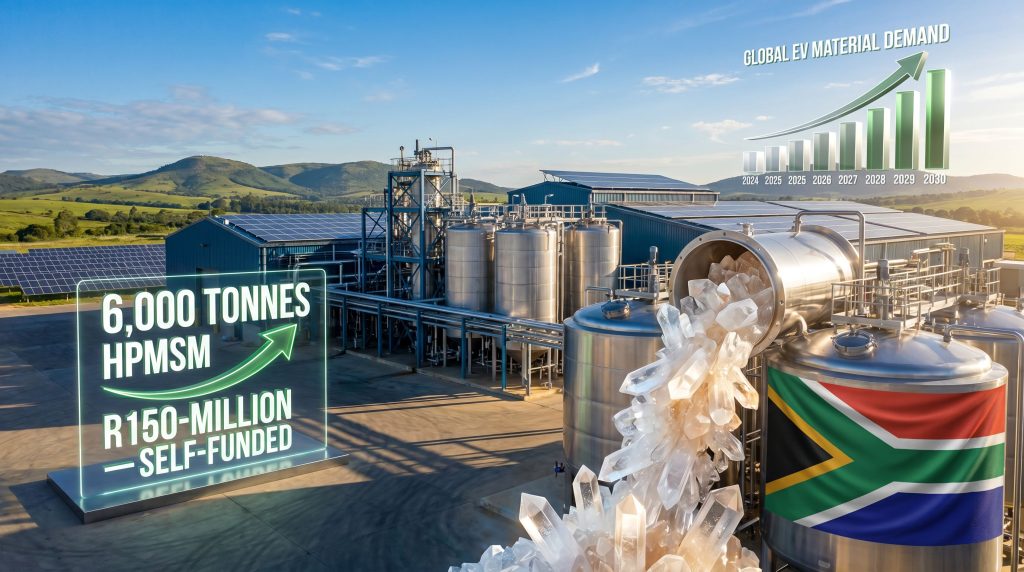
| HPMSM output | Approximately 6,000 tonnes per year |
| Phase one capital cost | R150-million |
| Funding structure | Entirely self-funded, no external debt or equity dilution |
| Energy design | Renewable energy integration as a core operational principle |
| Location | Mbombela (Nelspruit), Mpumalanga, South Africa |
The conversion ratio of roughly 1:3 from manganese metal to HPMSM output reflects the chemical transformation involved in the sulphation process, where manganese metal reacts with sulphuric acid under controlled conditions to produce the final crystalline monohydrate compound. This is a technically demanding process requiring precise temperature and pH management to achieve battery-grade purity consistency.
Project Execution Timeline
| Milestone | Target Period |
|---|---|
| Project execution commenced | September 2024 |
| Long-lead equipment ordered | September 2024 onward |
| Commissioning target | Q1 2026 |
| Battery-grade accreditation process | 2026 (post-commissioning) |
| Commercial sales commencement | From 2027 onward |
The gap between the Q1 2026 commissioning target and the 2027 commercial sales timeline is not a delay. It reflects the standard qualification pathway required by battery manufacturers globally. MMC's existing standing as a high-grade manganese metal producer with an established quality record may provide some advantage during this accreditation window, as potential customers can draw on prior material testing data.
MMC's Unique Position in the Global Manganese Market
One detail about MMC that is not widely appreciated outside specialist industry circles is the company's singular position in global production geography. MMC describes itself as the world's only producer of high-grade manganese metal operating entirely outside of China. This distinction matters enormously in the current geopolitical context.
China dominates not just HPMSM production but the entire manganese processing value chain, from ore beneficiation through to battery cell integration. Western EV manufacturers and battery cell producers operating in Europe, North America, and South Korea face growing pressure from regulators and investors to diversify their material sourcing away from single-geography concentration. MMC's Mbombela facility enters this market at precisely the moment when non-Chinese, traceable, high-purity manganese supply is most in demand.
The critical minerals demand outlook for 2025 and beyond further reinforces why MMC's positioning is so strategically timely. The strategic calculus for a European or North American battery manufacturer evaluating MMC as a supplier is not purely commercial. Supply chain sovereignty considerations, traceability requirements under emerging battery passport regulations, and ESG-linked financing conditions are all converging to make geographic diversification of critical material sourcing a procurement priority rather than a preference.
Competitive Landscape: Non-China HPMSM Producers
| Producer / Region | Status | Notes |
|---|---|---|
| MMC (South Africa) | Operational refinery, HPMSM plant in commissioning | Only non-China high-grade manganese metal producer globally |
| Chinese producers | Dominant global HPMSM supply | Vertically integrated, estimated to control over 90% of global HPMSM output |
| Australian projects | Pre-feasibility to development stage | Limited near-term commercial production capacity |
| European projects | Early development and feasibility | Dependent on imported feedstock in most cases |
The R150-Million Self-Funded Model: What It Signals
The financing structure of the MMC Mbombela plant deserves focused attention from investors and industry observers. A R150-million capital commitment funded entirely from internal cash generation, without recourse to debt markets or equity issuance, communicates several things simultaneously.
First, it demonstrates that MMC's existing manganese metal refinery generates sufficient operating cash flow to fund meaningful downstream capital expenditure. This is not a speculative junior miner stretching its balance sheet; it is an established operator using commodity revenue to climb the value chain.
Second, self-funding eliminates the dilution risk and covenant constraints that typically accompany external financing in the mining and processing sector. For a company positioning itself as a long-term anchor supplier to battery manufacturers, maintaining clean balance sheet optionality is strategically valuable, particularly as it prepares for what may be a more capital-intensive phase two expansion once accreditation is achieved and offtake agreements are secured.
Third, the R150-million envelope is calibrated for a phase one proof-of-concept scale. At approximately 6,000 tonnes per year of HPMSM, this is not yet a facility that reshapes global supply balances. It is a platform for qualification, relationship building, and technical demonstration. The implicit logic is that a successful phase one, underpinned by battery manufacturer accreditation and initial offtake, creates the commercial foundation to justify a significantly larger phase two investment.
Why This Model Is Replicable for Junior Miners
The MMC approach offers a template that has been increasingly discussed at industry forums including the Junior Indaba. The core insight is that junior and mid-tier miners with established commodity revenue streams do not necessarily need to access capital markets to fund beneficiation investment. A phased model, where phase one is sized to fit internal cash generation capacity while delivering the technical and commercial milestones needed to underwrite a larger subsequent investment, reduces execution risk substantially.
In addition, battery storage expansion trends are creating a growing addressable market for exactly the kind of high-purity materials that MMC is positioning itself to supply.
Key barriers that must be acknowledged for miners seeking to replicate this model include:
- Technical expertise: HPMSM production requires specialised chemical engineering capability not typically found within mining company skill sets
- Offtake certainty: Battery manufacturers are cautious about committing to new suppliers before accreditation is complete, creating a commercial chicken-and-egg dynamic
- Capital intensity at scale: Phase two expansions that achieve meaningful global supply relevance will likely require hundreds of millions of rand, requiring either strong cash generation or strategic partnership structures
South Africa's Manganese Endowment: The Broader Context
South Africa's Kalahari Manganese Field in the Northern Cape represents approximately 80% of the world's known land-based manganese ore reserves, making it the single most significant manganese resource endowment on the planet. For most of its production history, this extraordinary geological inheritance has been monetised primarily through ore export and ferromanganese alloy production, both of which sit at the lower end of the value curve.
The establishment of battery-grade processing capacity in Mpumalanga, drawing on refined manganese metal from South African ore, represents a genuine shift in the country's industrial positioning within the energy transition minerals landscape. Whether this becomes a transformational moment or remains an isolated case study depends on whether the MMC model attracts complementary investment in regional processing infrastructure, logistics capability, and the chemical supply inputs that a scaled HPMSM industry would require.
Mpumalanga's existing industrial infrastructure, including established road and rail corridors and proximity to industrial utilities, provides a more viable foundation for processing operations than many alternative South African locations. The co-location of the HPMSM plant with an existing refinery also reduces infrastructure duplication costs and accelerates the path to operational readiness.
The next major ASX story will hit our subscribers first
The Rare Earths Parallel: Junior Mining's Broader Beneficiation Opportunity
The MMC development does not exist in isolation. At the Junior Indaba, rare earth project activity in the Northern Cape drew significant attention as an adjacent critical minerals opportunity. The structural logic is similar: South Africa holds geological endowments in rare earth elements that have largely been explored but not processed domestically, with downstream separation and refining capacity absent from the local industrial base.
The parallel between manganese beneficiation and rare earth processing is instructive for investors evaluating South Africa's critical minerals pipeline. Both involve:
- Moving from ore or intermediate product to battery or technology-grade compounds
- Navigating technically demanding chemical processing steps
- Building commercial relationships with qualification-driven end-users in the global clean energy supply chain
- Competing with entrenched Chinese processing dominance
The difference is that rare earth separation is arguably more technically complex and capital intensive than HPMSM production, raising the bar for the self-funded phased model that MMC has employed. However, Australia's green metals innovation fund demonstrates that government-backed financing mechanisms are increasingly being developed to help bridge precisely these kinds of capital gaps in allied nations.
Frequently Asked Questions: MMC's Mpumalanga HPMSM Plant
What is the Manganese Metal Company's new plant in Mpumalanga producing?
The facility produces battery-grade high-purity manganese sulphate monohydrate, a refined chemical compound used directly in lithium-ion battery cathode manufacturing for electric vehicles.
Where is the MMC plant located?
The plant is situated in Mbombela, the capital of Mpumalanga province, co-located with MMC's existing manganese metal refinery on the same site.
How is the R150-million project being funded?
Phase one is entirely self-funded by MMC from internal cash generation, without external debt financing or equity issuance.
When will commercial sales begin?
Commissioning was targeted for Q1 2026, with the battery-grade supplier accreditation process expected to enable ongoing commercial sales from 2027 onward.
What is the plant's production capacity?
The phase one facility is designed to process approximately 2,000 tonnes of manganese metal feedstock into approximately 6,000 tonnes of HPMSM annually.
Why is MMC's market position considered unique?
MMC operates as the only producer of high-grade manganese metal with a facility located entirely outside of China, giving it a structurally differentiated position at a time when battery supply chain diversification away from Chinese processing is an active priority for Western manufacturers and policymakers. Indeed, Engineering News has reported that South Africa's battery materials supply status is surging ahead on the back of developments such as this new facility.
Why This Plant Is a Landmark Moment for African Battery Materials
The significance of the Manganese Metal Company new plant in Mpumalanga extends well beyond its initial 6,000-tonne annual output. It establishes, for the first time, a non-Chinese, African-produced, battery-grade manganese compound available for qualification by global EV manufacturers. Furthermore, it demonstrates that the beneficiation model, where a mining-adjacent nation processes its own critical minerals to finished battery material specification, is financially viable without relying on external capital.
Consequently, this places South Africa in a conversation about supply chain sovereignty that is increasingly shaping procurement decisions across the global automotive and battery industries. MMC's achievement of stable power supply using advanced technology at its South African plant further underscores the company's commitment to operational excellence as it scales into battery-grade materials production.
Disclaimer: This article contains forward-looking statements and projections regarding production timelines, commercial milestones, and market conditions. These involve inherent uncertainties and should not be construed as financial advice. Readers should conduct independent research and consult qualified advisers before making investment decisions.
Want to Invest in the Critical Minerals Driving the Battery Revolution?
Discovery Alert's proprietary Discovery IQ model delivers real-time alerts on significant ASX mineral discoveries — including battery materials like manganese — instantly transforming complex geological data into actionable investment insights for both short-term traders and long-term investors. Explore historic discoveries and their remarkable returns, then begin your 14-day free trial to position yourself ahead of the market.