
June 12, 2026
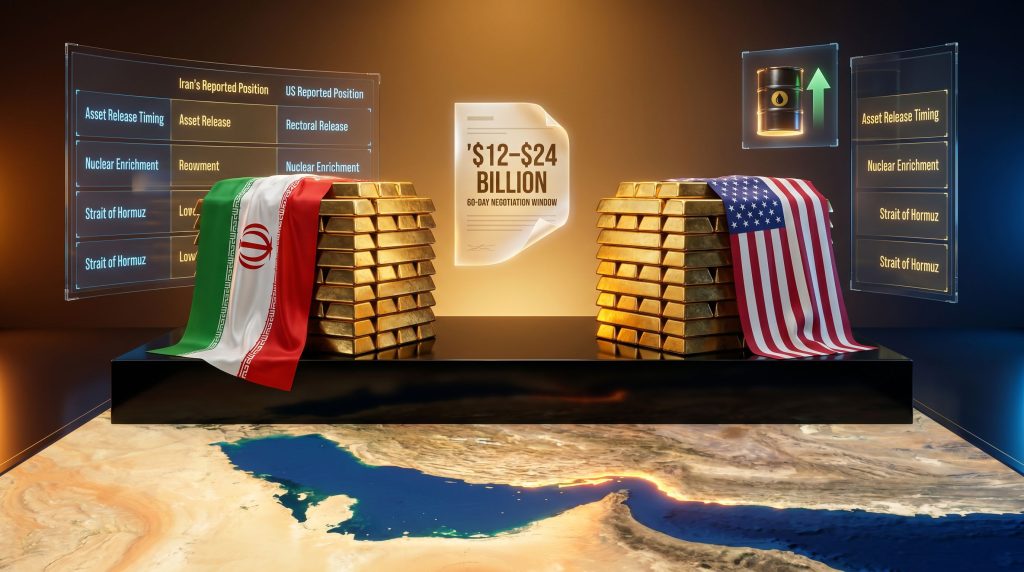
When Diplomacy Meets Financial Coercion: Decoding the Iran Draft US Deal on Frozen Assets
Sovereign asset freezes occupy a peculiar space in international relations. Unlike military blockades or trade embargoes, they are simultaneously invisible and devastating, locking away national wealth through the mechanics of correspondent banking and jurisdictional reach rather than physical force. Understanding how these instruments function reveals why the reported Iran draft US deal involving $24 billion in frozen assets is not simply a financial negotiation. It is a proxy war over trust, sovereignty, and the architecture of future compliance.
When a government's assets are frozen under a sanctions regime, they do not disappear. They sit in third-party financial institutions, accruing complexity while the sanctioned nation's economy deteriorates. The funds remain technically present but operationally inaccessible, creating a pressure gradient that sanctions architects deliberately design to intensify over time. Iran has experienced this dynamic for decades, and the current negotiation reflects that accumulated frustration in every disputed clause.
When big ASX news breaks, our subscribers know first
The Geopolitical Architecture Behind the Iran-US Negotiation Framework
How Frozen Asset Releases Function in Sanctions Diplomacy
The legal mechanisms governing frozen Iranian assets operate across multiple sovereign jurisdictions simultaneously, creating a complex web that no single government can unilaterally resolve. Assets held in South Korean banks, for example, are denominated in euros and dollars, subjecting them to US jurisdiction through the correspondent banking relationships those Korean institutions maintain with American financial entities. This extraterritorial reach of US sanctions law is what makes Washington the central actor even when the frozen funds are physically located elsewhere.
Historically, the phased release of frozen assets has served as a sequenced trust-building mechanism in Iran-related negotiations. During the 2015 JCPOA process, sanctions relief was carefully structured to follow verified Iranian actions on nuclear restrictions rather than precede them. This sequencing was deliberate: it preserved leverage for the negotiating party offering relief while giving the sanctioned party an incentive to maintain compliance through each verification milestone.
The current reported draft inverts this logic in a significant way. According to Iran's Mehr news agency, which cited a source close to Tehran's negotiating team, the proposed memorandum of understanding would release $24 billion in frozen Iranian assets across a 60-day negotiation period, with half that sum made available before formal talks even begin. This front-loading is structurally unusual and reflects Tehran's insistence on receiving concrete proof of US commitment before engaging substantively, a demand rooted in the Trump administration's 2018 withdrawal from the JCPOA despite verified Iranian compliance.
The Scale of Iran's Frozen Asset Problem: A Global Snapshot
| Jurisdiction | Estimated Frozen Assets | Status |
|---|---|---|
| South Korea | ~$7 billion (prior releases) | Partially released (2023) |
| Iraq | Multi-billion | Restricted access |
| European institutions | Undisclosed | Subject to sanctions |
| United States (direct/indirect) | Varies by estimate | Contested |
| Total (draft deal figure) | $12-$24 billion | Unconfirmed, draft stage |
The discrepancy between figures of $12 billion and $24 billion in various reports reflects a distinction between the funds immediately accessible under temporary sanctions waivers and the broader total of frozen assets across all jurisdictions. The draft reportedly addresses the full $24 billion figure through its phased release structure, with the first tranche serving as a pre-negotiation confidence mechanism and the remainder tied to progress across the 60-day window.
Intermediary states including Qatar and Pakistan have reportedly served as financial conduits in facilitating asset access discussions, reflecting a recognition that direct financial transfers between Washington and Tehran remain legally and politically untenable under existing sanctions and supply chains architecture.
What the Draft Memorandum of Understanding Actually Proposes
Breaking Down the Core Terms
Iranian state media's disclosure of the reported draft terms on June 12, 2026 revealed a framework with several interlocking components, each carrying distinct strategic significance:
- Asset release timeline: $24 billion to be released across a 60-day window, with $12 billion available before negotiations formally commence
- Cessation of hostilities: The draft reportedly includes language mandating a permanent and immediate end to active conflict across all regional fronts, including Lebanon
- Nuclear program scope: Tehran's nuclear infrastructure is included within the 60-day negotiation agenda, though no pre-commitment to dismantlement is confirmed at draft stage
- Strait of Hormuz: Iranian state outlet IRNA explicitly noted the draft contains no clause requiring Tehran to cede management authority over the strait or restore pre-conflict conditions
The official IRNA agency stated that Iran makes no commitment in the current text to cede management of the strait or to restore conditions that existed before the onset of military conflict, language that carries significant implications for global LNG flows given the waterway's role as a transit corridor for approximately 20% of global oil and LNG traffic.
The $24 Billion Figure: What It Represents Strategically
When one party to a high-stakes negotiation releases draft terms through state-aligned media before an agreement is finalised, it typically functions as a pressure tactic, locking in public expectations and constraining the opposing side's flexibility in subsequent rounds.
The front-loading of $12 billion before talks begin deserves particular analytical scrutiny. Washington has historically resisted pre-concession financial transfers without verifiable Iranian actions, a position rooted in concerns about providing economic relief that could be redirected toward proxy network funding or nuclear programme advancement. Iran's insistence on upfront access reflects a fundamentally different framing: not a concession to be earned, but compensation for economic damage already sustained under years of sanctions pressure.
Adding further complexity, the White House had previously characterised similar Iranian media reports as fabrications, and Iran's own Foreign Ministry acknowledged that new US demands introduced late in the process disrupted finalisation of the text. Foreign Ministry spokesman Esmaeil Baqaei indicated that whilst most of the agreement's text had been completed, the process stalled when the US side introduced new requirements and altered previously agreed positions.
Why the Asset Dispute Has Become the Central Sticking Point
Economic Leverage vs. Verification Demands
The core disagreement over frozen assets is not simply about money. It is a structural argument about sequencing and proof of intent. Tehran's position frames asset release as a prerequisite for meaningful engagement, compensation for economic harm inflicted through sanctions. Washington's position treats asset access as contingent on verifiable concessions including the removal of enriched material, restrictions on enrichment infrastructure, and curtailment of proxy network funding.
A Tehran resident, identified as a 35-year-old pharmacist named Majid, described the economic consequences of the conflict as crippling to normal daily life, expressing deep scepticism that any agreement would be finalised given what he described as an excessively wide gap between the two parties' positions. His pessimism reflected a broader civilian reality: that diplomatic theatre conducted at the highest levels of government has tangible consequences for ordinary economic life, including currency instability, import disruption, and domestic inflation.
Key Demands on the Table: A Comparative Policy Matrix
| Issue | Iran's Reported Position | US Reported Position |
|---|---|---|
| Asset release timing | Pre-negotiation (50% upfront) | Post-verification milestones |
| Nuclear enrichment | Subject to 60-day talks | Dismantlement required |
| Strait of Hormuz | No cession of control | Restoration of pre-war conditions |
| Proxy networks | Not addressed in draft | Termination required |
| Hostilities | Immediate cessation | Tied to broader regional framework |
| Gulf state compensation | Explicitly opposed by Tehran | US reportedly considering this |
One particularly contentious reported element involves the potential use of frozen Iranian assets to compensate regional Gulf allies for damages sustained during the conflict, a provision that Tehran has explicitly opposed. This triangulation introduces a third-party financial claim into what Iran regards as a bilateral economic dispute, consequently complicating the path to agreement.
The Credibility Problem: Why 38 Announcements Matter
The Tasnim news agency's documented count of Trump announcing an imminent deal 38 times in the two months preceding June 12, 2026 introduces a dimension that extends beyond typical negotiation noise. Repeated false declarations of imminent agreement create a specific form of credibility erosion that affects not just the opposing negotiating party but also domestic audiences, regional allies, and financial markets that price in geopolitical risk.
Tasnim's pointed observation that until Iran formally announces any understanding, statements from Trump on the subject should be evaluated in light of his established pattern of messaging captures a strategic communications reality: when a negotiating party's signals have been repeatedly proven premature, the signal-to-noise ratio collapses for all observers.
Regional and Global Implications of the Draft Deal's Key Clauses
What a Release of This Scale Would Mean for Iran's Economy
A $12-$24 billion liquidity injection into Iran's heavily sanctioned economy would carry substantial macroeconomic consequences. Sustained sanctions have constrained Iran's oil export capacity, disrupted its import channels, and placed severe pressure on the rial, driving domestic inflation to levels that have materially degraded living standards for ordinary citizens. Access to frozen funds would theoretically enable currency stabilisation efforts, restore import capacity for essential goods including pharmaceuticals and industrial components, and reduce the acute fiscal pressure on the Iranian government.
However, the operational reality of channelling these funds through international financial systems remains complex. Even with sanctions waivers in place, Iranian entities face significant correspondent banking challenges, as international financial institutions remain cautious about Iran-related transactions due to secondary sanctions exposure and reputational risk concerns.
Israel's Position and the Multi-Track Ratification Problem
Prime Minister Netanyahu's office issued a statement following his conversation with Trump confirming that Israel was not a party to the memorandum of understanding. Netanyahu's expressed conditions for supporting any agreement include removing enriched uranium from Iranian territory, physically dismantling enrichment infrastructure, limiting ballistic missile production capacity, and ending material support for regional proxy organisations.
These conditions create what can be described as a multi-track ratification problem. Even if the US and Iran reach bilateral agreement on the terms of a memorandum of understanding, Israel's separate requirements function as an effective veto on regional stability, given that Washington jointly launched the conflict with Israel in February and cannot politically separate its diplomatic outcomes from Israeli security concerns.
Trump's claim that the arrangement had been approved by all parties including the United States, Israel, and Gulf states stands in direct contradiction to Israel's formal denial of party status, creating a significant factual discrepancy that undermines confidence in the reported framework's actual state of completion.
The Hormuz Closure: A Structural Energy Risk That Outlasts Diplomacy
Iran's newly established body overseeing the Strait of Hormuz stated that the waterway would remain closed until further notice, a declaration that carries consequences far exceeding the bilateral Iran-US dispute. The strait serves as the primary transit route for petroleum exports from Saudi Arabia, Iraq, Kuwait, and the UAE, in addition to Iranian crude. Its continued closure represents a structural supply shock to global energy markets that operates independently of any diplomatic progress.
Oil price volatility had already seen prices rise more than $1 per barrel on escalation news related to the conflict, demonstrating the market's sensitivity to developments in the region. The draft deal's reported exclusion of explicit Hormuz reopening language means that even a successfully concluded asset agreement would leave the world's most critical maritime energy corridor in a state of strategic uncertainty.
The Strait of Hormuz closure represents a supply-side energy shock that no financial arrangement alone can resolve. Until formal reopening conditions are embedded in treaty language, global energy markets will continue pricing in structural risk regardless of diplomatic progress on frozen assets.
How Reliable Is the Reported Draft? Assessing the Information Landscape
State Media, Strategic Leaks, and Negotiation Theatre
Mehr News Agency and IRNA function as instruments of Iranian state communication, and their selective disclosure of draft terms on June 12 serves identifiable political purposes on multiple levels. Domestically, publishing favourable draft terms signals to an economically exhausted Iranian population that the government is actively pursuing relief. Internationally, it creates pressure on Washington by establishing public expectations around specific financial figures and timeline commitments that become politically costly to reject.
This pattern of strategic pre-finalisation disclosure is not unique to Iran. In high-stakes diplomacy across multiple historical contexts, the release of draft terms before finalisation typically signals that one party is attempting to consolidate narrative advantage and constrain the other side's room to introduce new demands, precisely the behaviour Iran's Foreign Ministry attributed to the US side when it described late-stage American demands as the proximate cause of the negotiation's stall.
What Genuine Verification Would Require
For any agreement of this complexity to function credibly, implementation would require mechanisms operating across several domains simultaneously:
- Nuclear verification: IAEA inspection protocols with enhanced access provisions to confirm enriched material removals and infrastructure restrictions
- Financial escrow arrangements: Third-party staging of asset transfers tied to discrete compliance milestones rather than blanket releases
- Ceasefire monitoring: Independent mechanisms capable of verifying hostilities cessation across multiple regional fronts including Lebanon
- UN Security Council notification: Formal multilateral registration of any agreement to provide international legal standing
- Secondary sanctions management: Coordinated waivers for financial institutions involved in asset transfer channels to reduce legal exposure
The proposed 60-day timeline raises legitimate questions about operational sufficiency. The 2015 JCPOA, which covered a narrower set of nuclear-specific commitments, required years of negotiation and months of technical implementation planning before reaching the Implementation Day that triggered initial sanctions relief. Compressing nuclear verification, ceasefire monitoring, and multi-jurisdictional asset transfers into a single 60-day framework would represent an unprecedented compression of diplomatic process.
The next major ASX story will hit our subscribers first
Frequently Asked Questions: Iran Draft US Deal and Frozen Assets
What is the $24 billion figure in the Iran-US draft deal?
The $24 billion represents the total value of Iranian sovereign assets reportedly frozen across multiple foreign jurisdictions as a result of US-led sanctions. The draft memorandum of understanding, as reported by Iranian state media, proposes releasing these funds across a 60-day negotiation period, with approximately $12 billion made available to Tehran before formal talks begin.
Has the US confirmed the draft deal terms?
No. As of June 12, 2026, the White House had not formally confirmed the specific terms reported by Iranian state media. US officials had previously described similar Iranian media disclosures as inaccurate. Iran's own Foreign Ministry acknowledged that new US demands disrupted the finalisation process, suggesting the reported draft reflects a pre-final state of the text rather than an agreed framework.
Why does Iran want asset releases before negotiations begin?
Tehran frames the upfront release of frozen assets as a necessary demonstration that Washington is negotiating in good faith after years of maximum-pressure sanctions and, critically, following the 2018 US withdrawal from the JCPOA despite verified Iranian compliance at that time. Iranian officials have described it as a trust-testing mechanism rather than a concession, reflecting structural scepticism about US commitment to any agreement.
What is the Strait of Hormuz's role in these negotiations?
The Strait of Hormuz, through which approximately 20% of global oil and LNG flows transit, has been effectively closed by Iran since early in the conflict. The draft deal reportedly contains no requirement for Iran to relinquish control over the strait or restore pre-conflict transit conditions, leaving a critical unresolved variable with direct consequences for global energy markets. Its continued closure functions as both a military deterrent and an economic pressure instrument.
Is Israel part of the Iran-US memorandum of understanding?
No. Israel formally stated it is not a party to the memorandum of understanding, directly contradicting Trump's claim that the arrangement had been approved by all parties including Israel. Prime Minister Netanyahu outlined separate conditions he expects any final deal to include, creating parallel requirements that Washington must navigate alongside its bilateral negotiations with Tehran.
What happens if the deal falls through?
A collapse of negotiations would likely intensify the Strait of Hormuz closure, placing further upward pressure on global oil prices amid already elevated geopolitical oil tensions. Iran has previously signalled that renewed US military escalation would trigger a harsher response, broadening regional instability. For ordinary Iranians, a breakdown would deepen the economic devastation already described by Tehran residents as making daily life unmanageable.
Key Takeaways: The Policy Calculus of the Iran-US Frozen Asset Negotiation
The reported Iran draft US deal on frozen assets cannot be evaluated purely as a financial transaction. Each disputed clause encodes a deeper argument about trust, sovereignty, and the conditions under which economic normalisation becomes possible after sustained military and sanctions conflict. Furthermore, the broader geopolitical risk landscape surrounding this negotiation extends well beyond the bilateral US-Iran dynamic.
- The $12-$24 billion frozen asset figure is the central trust mechanism in a broader geopolitical settlement framework, not a simple debt repayment
- The front-loading of 50% of assets before negotiations begin reflects Tehran's structural scepticism of US follow-through, rooted in concrete historical experience
- The exclusion of Hormuz cession language, combined with Iran's declared indefinite closure of the strait, means global energy market risk remains elevated independent of diplomatic progress
- Israel's non-party status combined with Netanyahu's separate conditions introduces a multi-track ratification problem no bilateral US-Iran agreement can resolve alone
- The 38-announcement credibility deficit attributed to the Trump administration signals that verifiable, sequenced actions rather than declarations will be required to move this process forward
- The 60-day implementation timeline raises serious operational questions about whether nuclear verification, ceasefire monitoring, and multi-jurisdictional asset transfers can realistically be completed within this compressed window
According to Iranian state media reports, the Iran draft US deal on frozen assets remains in a fluid state, with key terms still contested and the gap between the two parties' positions remaining considerable despite months of reported progress.
Disclaimer: This article is intended for informational purposes only and does not constitute financial, legal, or investment advice. The events described reflect reporting from June 12, 2026. Diplomatic negotiations of this nature involve rapidly evolving facts, contested claims, and significant uncertainty. Readers should consult primary sources and independent analysis before drawing conclusions about outcomes or implications. Forecasts and scenario projections referenced in this article are speculative in nature and subject to material change.
Want to Stay Ahead of the Market Opportunities Created by Geopolitical Shifts Like This?
When sanctions regimes unravel and frozen assets flow, commodity markets — from oil to critical minerals — can reprice rapidly, and Discovery Alert's proprietary Discovery IQ model delivers real-time ASX mineral discovery alerts that help investors identify actionable opportunities before the broader market catches on. Explore how historic discoveries have generated substantial returns by visiting Discovery Alert's dedicated discoveries page, and begin your 14-day free trial today to position yourself ahead of the next major market move.