
May 10, 2026
Understanding the Regulatory Framework Behind Energy Independence
Energy security mandates represent a fundamental shift in how governments approach critical resource management, moving beyond market-driven allocation toward strategic policy intervention. These regulatory frameworks establish binding requirements for states and federal agencies to develop comprehensive energy resilience plans, addressing vulnerabilities across production, transmission, and distribution networks.
Under the Bipartisan Infrastructure Law, enacted on November 15, 2021, with a total funding commitment of $1.2 trillion over 10 years, energy security planning has become increasingly institutionalized following geopolitical tensions and renewable energy integration challenges. The legislation provides general guidance for State Energy Security Plans, though implementation varies significantly across jurisdictions rather than following a unified federal mandate.
Energy security mandates create regulatory complexity that requires coordination across multiple federal agencies, state governments, and private sector stakeholders. States are developing security frameworks addressing infrastructure vulnerabilities, but standardization remains inconsistent across jurisdictions. Each state maintains an energy office, often under commerce or public utility commission authority, coordinating with the U.S. Department of Energy's State Energy Program.
When big ASX news breaks, our subscribers know first
What Are the Core Elements of Energy Security Compliance?
Comprehensive Energy Source Assessment Requirements
Regulatory compliance begins with mandatory evaluation of all energy sources within state jurisdictions, including both regulated utilities and independent power producers. The North American Electric Reliability Corporation (NERC) provides reliability frameworks through NERC CIP Standards (Critical Infrastructure Protection), enforced by the Federal Energy Regulatory Commission (FERC) under 16 U.S.C. § 824 (Federal Power Act).
These standards apply specifically to bulk electric systems rather than all energy infrastructure uniformly. States must document energy flows, identify critical infrastructure nodes, and establish baseline metrics for measuring security improvements, though the specific requirements vary by state jurisdiction rather than following standardized federal mandates.
Table: NERC CIP Standards Application
| Standard | Focus Area | Application Scope | Enforcement Authority |
|---|---|---|---|
| CIP-002 | Asset Identification | Bulk Electric Systems | FERC/NERC |
| CIP-005 | Electronic Security | Cloud Computing Security | FERC/NERC |
| CIP-013 | Supply Chain Management | Critical Infrastructure | FERC/NERC |
Infrastructure Vulnerability Analysis Protocols
Energy security mandates establish systematic methodologies for identifying physical and cybersecurity vulnerabilities across energy infrastructure networks. FERC Order 889 & 890 established cybersecurity requirements for utilities under 18 CFR § 39 (2006-present), applying to registered entities within NERC's jurisdiction.
The Cybersecurity and Infrastructure Security Agency (CISA) provides cross-sector critical infrastructure guidance, identifying 16 critical infrastructure sectors including energy, water, transportation, telecommunications, and financial services. However, cascade failure analysis requirements are not uniformly mandated across all federal jurisdictions but represent best practice recommendations.
States operate under distinct regulatory frameworks rather than federal mandate templates:
• Texas: ERCOT manages grid reliability under state Public Utility Commission authority
• California: Develops energy security plans through California Public Utilities Commission
• Regional variations: Each operates under unique state-specific requirements
How Do Federal Funding Mechanisms Support Mandate Implementation?
Advanced Nuclear Technology Development Framework
The ADVANCE Act (H.R.1129, 118th Congress, 2023) provides loan guarantee authority and research and development funding for advanced reactors, representing the most significant recent federal commitment to nuclear fuel supply chain development. This legislation creates regulatory pathways for accelerated permitting, production incentives, and supply chain development through the Department of Energy.
The Bipartisan Infrastructure Law allocated substantial funds for nuclear fuel supply chain development, though specific funding allocations require verification through Department of Energy budget documents and Congressional appropriations records. Industry analysts project uranium futures approaching $93.75 per pound over the next twelve months, improving project economics for permitted operations. Furthermore, effective uranium investment strategies require understanding these regulatory developments and their impact on market dynamics.
Table: Nuclear Technology Development Funding Mechanisms
| Program Category | Implementation Timeline | Regulatory Requirements | Status |
|---|---|---|---|
| Advanced Reactor R&D | 2023-2035 | Technology demonstration standards | Active |
| Loan Guarantee Programs | 2024-2030 | Fast-41 permitting compliance | Available |
| Supply Chain Development | 2024-2028 | Environmental impact assessments | Under review |
| Domestic Content Requirements | 2024-2027 | Tier-1 jurisdiction requirements | Implemented |
Fast-41 Permitting: Regulatory Acceleration Framework
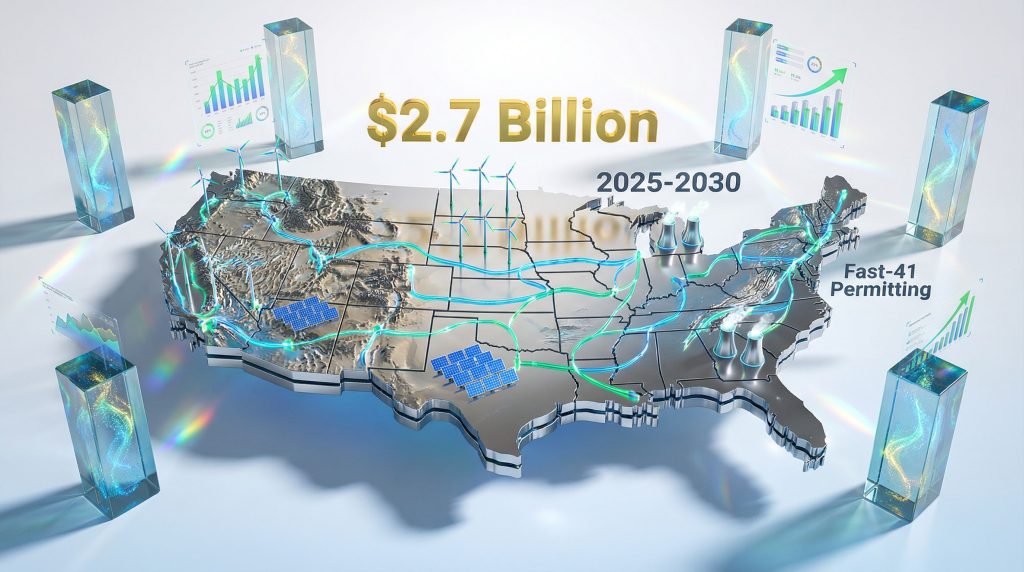
Fast-41 designation, established under the Fixing America's Surface Transportation Act (FAST Act), Pub. L. 114-94, § 41001-41009 (2015), creates expedited regulatory pathways for critical infrastructure projects. Federal agencies must prepare environmental reviews within defined timelines for designated projects, reducing permitting timelines from traditional multi-year processes to streamlined 24-month frameworks.
Projects receiving Fast-41 designation benefit from coordinated federal agency review, predictable timeline enforcement, and dispute resolution mechanisms that prevent regulatory delays from compromising energy security goals. This regulatory mechanism prioritizes projects that demonstrate strategic importance to energy security objectives, and companies seeking streamlined permitting insights can better understand these accelerated pathways.
Key Fast-41 Benefits:
• Coordinated federal agency review processes
• Predictable permitting timeline enforcement
• Dispute resolution mechanisms for regulatory delays
• Priority status for strategic infrastructure projects
What Role Do State-Level Implementations Play in Federal Mandate Success?
State Energy Security Plan Development Requirements
Energy security mandates require states to develop comprehensive plans that align with federal frameworks while addressing region-specific vulnerabilities and resources. State energy planning occurs through various mechanisms coordinated by State Energy Offices, though no uniform federal mandate requires identical structures across all states.
The U.S. Department of Energy provides general planning guidelines through the State Energy Program, but implementation varies significantly based on existing energy portfolios, geographic vulnerabilities, and regulatory capacity. States with substantial nuclear generation face different compliance considerations than those dependent on renewable or fossil fuel resources.
State implementation frameworks typically address:
• Energy source diversification strategies
• Infrastructure resilience planning
• Emergency response capability development
• Cybersecurity protocol implementation
Moreover, understanding critical minerals energy-security becomes increasingly important as states develop their comprehensive security frameworks.
Cross-Sector Interdependency Analysis
States analyse interdependencies between energy systems and other critical infrastructure sectors, including transportation, telecommunications, water systems, and financial networks. This analysis identifies cascade failure risks and informs mitigation strategy development, though specific requirements vary by state jurisdiction.
Energy security mandates create regulatory complexity that requires coordination across multiple federal agencies, state governments, and private sector stakeholders. Successful implementation depends on clear regulatory guidance, adequate funding mechanisms, and consistent enforcement standards.
The Department of Homeland Security coordinates cross-sector information sharing through Information Sharing and Analysis Centers (ISACs), providing voluntary frameworks for public-private coordination rather than mandatory compliance requirements. In addition, Australia's approach to energy security demonstrates international best practices in cross-sector coordination.
How Do Cybersecurity Requirements Shape Energy Infrastructure Investment?
CESER Guidelines and Implementation Standards
The Office of Cybersecurity, Energy Security and Emergency Response (CESER), established within the U.S. Department of Energy in 2021, provides advisory and coordination guidance for cybersecurity implementation across energy infrastructure. While CESER publishes cybersecurity guidance, mandatory compliance standards are primarily established through FERC and NERC for utilities under their jurisdiction.
Energy companies operating within NERC's jurisdiction must demonstrate compliance with cybersecurity frameworks through regular audits, vulnerability assessments, and incident response testing. NERC CIP standards have evolved through multiple iterations from 2006 to present, demonstrating regulatory adaptation in the energy sector.
Current NERC CIP Evolution Examples:
• NERC CIP-005 amendments (2021): Addressing cloud computing security requirements
• FERC Order 881 (2019): Modernising generator interconnection procedures
• Ongoing updates: Continuous adaptation to emerging cybersecurity threats
Public-Private Partnership Coordination Mechanisms
Rather than a unified federal regulatory framework, energy security coordination operates through multiple mechanisms:
• DHS/CISA Information Sharing Program: Voluntary information sharing through ISACs
• State Public Utility Commission regulation: Varies by state jurisdiction
• Federal coordination structures: CISA and DOE provide guidance and coordination
• Memoranda of Understanding: Between government and private utilities on case-by-case basis
These coordination mechanisms balance private sector innovation with public sector security requirements, creating pathways that encourage investment while maintaining oversight of critical infrastructure. However, global energy security risks continue to evolve, requiring adaptive coordination frameworks.
What Are the Enforcement Mechanisms for Energy Security Compliance?
Federal Oversight and State Accountability
Energy security compliance operates through multiple enforcement channels with varying jurisdictional authority. The Federal Energy Regulatory Commission (FERC) enforces reliability standards for bulk systems under 16 U.S.C. § 824 (Federal Power Act), though this authority is limited to specific jurisdictional entities rather than all state and local energy systems.
The North American Electric Reliability Corporation (NERC) enforces CIP standards with penalty authority through established rules of procedure. Federal agencies maintain authority to withhold funding and impose corrective action requirements specifically for Department of Energy grant programs, though this does not constitute general energy security enforcement authority.
Enforcement Mechanism Structure:
• NERC entities → Report to FERC
• DOE grant recipients → Report to Department of Energy
• State utilities → Report to State Public Utility Commissions
• Federal coordination → Through CISA and interagency frameworks
Performance Metrics and Reporting Requirements
Performance metrics exist for specific regulated sectors rather than through unified federal standards. Utilities under NERC jurisdiction must report CIP compliance metrics to FERC, while DOE grant recipients provide programmatic reporting as conditions of funding agreements.
States submit compliance reports documenting progress toward energy security objectives through various state-specific frameworks, including quantitative performance data and qualitative assessment of regulatory effectiveness. However, these operate as separate reporting systems rather than a unified federal framework.
Verified Reporting Requirements:
• Bulk electric system operators: NERC CIP compliance metrics
• Federal grant recipients: DOE programmatic requirements
• State utilities: Public Utility Commission oversight
• Critical infrastructure entities: CISA coordination protocols
The next major ASX story will hit our subscribers first
How Do Energy Security Mandates Address Supply Chain Vulnerabilities?
Domestic Production Requirements and Incentives
Energy security mandates establish preferences for domestic production of critical energy resources through multiple legislative frameworks. The Bipartisan Infrastructure Law (2021) includes domestic energy production provisions, while the Inflation Reduction Act of 2022 (Pub. L. 117-169, § 30C) establishes domestic content requirements for renewable energy tax credits.
The U.S. government has established preferences for domestic uranium through various mechanisms, creating regulatory frameworks that prioritise domestic suppliers in government procurement. These preferences operate through existing tax mechanisms rather than new mandate structures, particularly in light of recent uranium import restrictions that have reshaped supply chain dynamics:
• Production Tax Credit (PTC) for renewable energy
• Investment Tax Credit (ITC) with domestic content provisions
• Modified Accelerated Cost Recovery Schedule (MACRS) depreciation benefits
• Federal procurement preferences for domestic content
Table: Domestic Content Tax Incentives
| Incentive Type | Application Sector | Domestic Content Requirement | Implementation Status |
|---|---|---|---|
| Production Tax Credit | Renewable Energy | Varies by technology | Active |
| Investment Tax Credit | Solar/Wind/Storage | 40-55% domestic content | Phased implementation |
| MACRS Depreciation | Energy Infrastructure | General domestic preference | Established |
Strategic Reserve Management Protocols
The Strategic Petroleum Reserve (SPR), managed under 42 U.S.C. § 6231-6247 (Strategic Petroleum Reserve Act), provides an established framework for strategic energy resource management. However, no equivalent strategic uranium reserve with published protocols exists in current federal law.
Strategic energy resource management occurs through:
• Commercial stockpiles: Held by utilities and fuel companies
• Government assessments: DOE studies on uranium security requirements
• Policy proposals: Under consideration but not yet enacted
• International coordination: Through allied nation agreements
Supply chain resilience planning requires coordination between federal agencies, state governments, and private sector stakeholders to ensure adequate resource availability during emergency situations while avoiding market disruption during normal operations. Consequently, a comprehensive critical minerals strategy becomes essential for managing strategic resource dependencies.
What Are the Long-Term Implications of Energy Security Mandate Implementation?
Regulatory Evolution and Adaptation Mechanisms
Energy security mandates establish adaptive regulatory frameworks that evolve in response to changing threat environments, technological developments, and geopolitical conditions. NERC CIP standards demonstrate this evolution, having undergone multiple iterations from 2006 through present, including recent adaptations for cloud computing security and generator interconnection modernisation.
Regulatory adaptation occurs through established review processes, stakeholder consultation mechanisms, and update procedures that maintain flexibility while ensuring consistent implementation of core security objectives. Long-term regulatory success depends on balancing security requirements with economic efficiency.
Examples of Regulatory Evolution:
• 2006-2021: Multiple NERC CIP standard iterations
• 2019: FERC Order 881 modernising interconnection procedures
• 2021: NERC CIP-005 amendments addressing cloud security
• Ongoing: Continuous adaptation to emerging technologies and threats
Investment Climate and Market Structure Changes
Energy security mandates fundamentally alter investment climates for energy infrastructure by creating regulatory certainty around strategic priorities while imposing compliance costs that affect project economics. Energy infrastructure investment patterns have shifted in response to policy frameworks, though specific causal relationships require analysis from financial sector specialists.
Market structure evolution occurs through:
• Policy-driven capital allocation: Toward domestic and allied-jurisdiction projects
• Regulatory certainty premiums: Higher valuations for compliant projects
• Technology development priorities: Focus on secure and resilient systems
• Supply chain reorganisation: Away from sanctioned or unreliable suppliers
Investment decision frameworks increasingly embed regulatory alignment as a primary screening criterion, with institutional valuation models prioritising balance-sheet strength, jurisdictional alignment, and operational readiness when evaluating energy infrastructure opportunities.
Critical Infrastructure Resilience Through Energy Security Policy
Energy security mandates represent a comprehensive transformation of how critical resource management operates within federal and state frameworks. Rather than relying solely on market mechanisms, these policies establish government-directed approaches to infrastructure resilience that address both short-term vulnerabilities and long-term strategic requirements.
The regulatory complexity creates both challenges and opportunities for energy sector participants. Companies operating in regulated sectors must adapt business models to comply with evolving requirements while identifying opportunities created by government funding and policy support.
Key Implementation Factors:
• Jurisdictional alignment: Projects in allied nations receive regulatory and financial advantages
• Permitting visibility: Fast-41 and similar designations reduce development timelines
• Technology readiness: Established technologies benefit from accelerated deployment
• Supply chain security: Domestic content requirements reshape sourcing strategies
Market Psychology and Investment Implications
The convergence of energy security mandates with technological demands from artificial intelligence and data centre infrastructure creates unique market dynamics. Institutional capital flows reflect growing confidence in sustained pricing above development cost thresholds, transitioning uranium from a cyclical commodity allocation to a strategic infrastructure investment within diversified portfolios.
Physical uranium funds have accumulated substantial volumes, removing supply from spot markets while providing transparent inventory data that influences long-term price expectations. This institutional participation reduces downside volatility and establishes price anchors that support development economics for permitted projects.
Investment Framework Considerations:
• Asset quality differentiation: Grade, jurisdiction, and permitting status
• Operational readiness: Production capability versus development timeline uncertainty
• Regulatory alignment: Compliance with security mandate requirements
• Capital access: Financing terms reflecting policy support and market confidence
Key Takeaways for Energy Security Implementation
Energy security mandates establish comprehensive regulatory frameworks that extend beyond traditional market mechanisms to create government-directed infrastructure resilience systems. Successful implementation requires coordination across multiple regulatory levels, adequate funding mechanisms, and clear performance standards that can adapt to changing conditions.
The transformation affects investment climates by creating regulatory certainty around strategic priorities while imposing compliance requirements that influence project economics. Companies with jurisdictional alignment, operational readiness, and balance-sheet strength are positioned to benefit from policy support and improved access to capital.
Long-term success depends on maintaining regulatory flexibility while ensuring consistent implementation of core security objectives across evolving political, economic, and technological environments. The framework represents a fundamental shift toward strategic resource management that prioritises security and resilience alongside economic efficiency.
Disclaimer: This analysis discusses policy frameworks and market dynamics for informational purposes. Investment decisions should consider multiple factors including regulatory changes, market volatility, and individual risk tolerance. Commodity markets involve substantial risk and may not be suitable for all investors.
Looking to Capitalise on Energy Security Investment Opportunities?
Discovery Alert's proprietary Discovery IQ model delivers real-time alerts on significant ASX mineral discoveries, including critical minerals essential to energy security infrastructure, instantly empowering subscribers to identify actionable opportunities ahead of the broader market. Begin your 14-day free trial today and secure your market-leading advantage in the energy transition sector.