June 8, 2026
How Energy-Intensive Industries Are Rethinking Power Infrastructure
The transformation of global industrial energy systems represents one of the most complex engineering challenges of the modern era. Heavy industry sectors that have relied on fossil fuels for decades now face mounting pressure to reimagine their power infrastructure while maintaining operational continuity across vast geographic footprints. The Fortescue green energy grid exemplifies this shift, extending far beyond simple equipment replacement and requiring fundamental redesigns of how industrial operations generate, store, and distribute energy across remote locations.
When big ASX news breaks, our subscribers know first
Engineering Challenges in Remote Industrial Operations
Mining operations, steel production facilities, and other energy-intensive industries operate under unique constraints that differentiate them from conventional renewable installations. These facilities require consistent, high-capacity power delivery across geographically dispersed sites, often hundreds of kilometres from established electrical grids. The engineering complexity multiplies when considering that industrial processes cannot simply pause during periods of low renewable generation.
Remote mining facilities face particularly acute challenges. Operations in regions like Australia's Pilbara must maintain continuous power for ore processing circuits, material handling systems, and transportation infrastructure. Traditional grid connections remain unavailable or unreliable across such vast distances, necessitating self-contained energy systems capable of meeting industrial demand profiles without external support. Furthermore, the mining innovation trends are driving this transformation toward sustainable power solutions.
Key Infrastructure Requirements for Industrial Renewable Systems:
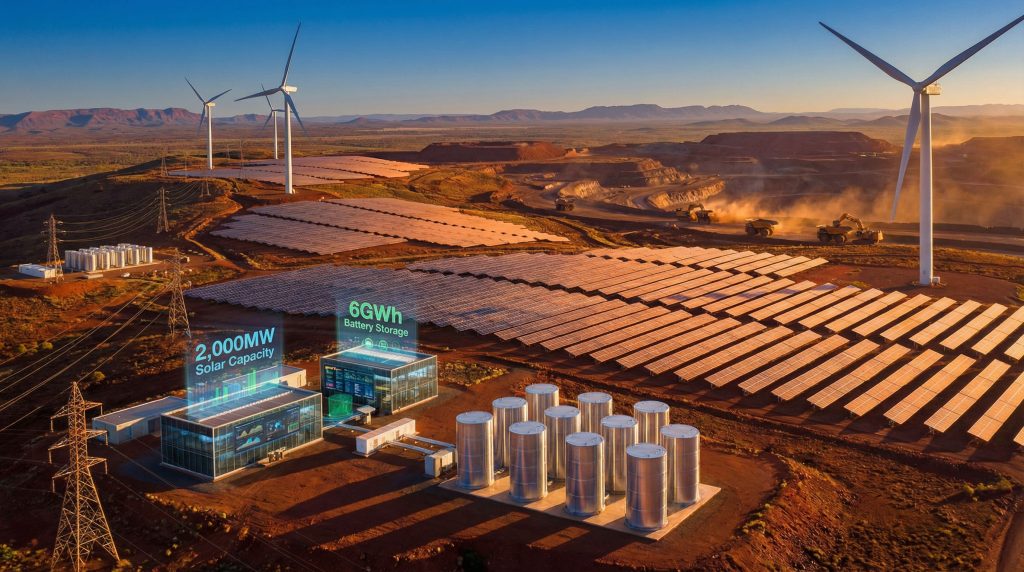
- Solar photovoltaic arrays: 500MW to 2,000MW capacity ranges
- Wind generation capacity: 200MW to 800MW with weather-independent backup
- Battery storage systems: 2GWh to 6GWh with multi-hour discharge capability
- Grid integration: 1.5GW to 3GW total capacity with cross-site load balancing
Integrated Off-Grid System Architecture
Modern industrial renewable grids combine multiple generation sources through sophisticated load balancing and energy storage platforms. These installations typically integrate solar photovoltaic arrays sized for peak industrial demand with wind generation capacity matched to regional meteorological patterns. Advanced battery storage systems enable continuous operation during periods of reduced renewable generation, while AI optimization platforms manage real-time load distribution across multiple sites.
The technical architecture differs substantially from utility-scale renewable projects connected to national grids. Industrial systems must incorporate redundant generation sources, distributed storage capacity, and automated switching mechanisms that ensure operational continuity without relying on external power sources during maintenance periods or extreme weather events. In addition, the integration of renewable energy solutions has become essential for competitive operations.
What Drives Economic Viability for Off-Grid Industrial Energy Systems?
Power Distribution Across Geographic Footprints
Large-scale industrial operations require distributed energy generation spanning hundreds of kilometres, with processing facilities, transportation systems, and extraction equipment operating continuously across multiple sites. Unlike residential or commercial installations, industrial renewable grids must deliver consistent power density levels matched to heavy equipment specifications and continuous processing requirements.
The geographic distribution creates both challenges and opportunities for system optimisation. Multiple generation sites can leverage diverse weather patterns and resource availability, improving overall system reliability compared to centralised installations. However, this distribution requires sophisticated grid management systems capable of real-time load balancing and inter-site power transfers.
Technical Specifications for Industrial Renewable Infrastructure:
| Component | Capacity Range | Operational Requirements |
|---|---|---|
| Solar Generation | 1,200MW | 24/7 availability through storage integration |
| Wind Capacity | 600MW+ | Weather-independent backup systems |
| Battery Storage | 4-5GWh | Multi-hour discharge for continuous operations |
| Total Grid Integration | 2GW | Real-time load balancing across sites |
Cost Economics Beyond Environmental Considerations
The financial case for industrial renewable grids extends significantly beyond carbon reduction mandates. Large-scale operations achieve substantial operational cost reductions through elimination of diesel fuel transportation to remote sites, reduced exposure to fossil fuel price volatility, and lower maintenance requirements for renewable generation equipment compared to conventional power systems.
Transportation costs for diesel fuel delivery to remote mining sites represent a substantial ongoing expense. Operations in Australia's Pilbara region, for example, require fuel transportation across hundreds of kilometres of challenging terrain. The elimination of these logistics costs provides immediate cost savings that improve operational margins regardless of commodity price fluctuations.
Fortescue's renewable grid implementation demonstrates quantifiable economic benefits, with the company forecasting US$100 million in annual fossil fuel cost savings and C1 unit cost reductions of US$2-4 per wet metric tonne. These cost improvements translate directly to enhanced operational competitiveness across production cycles, particularly significant given iron ore price volatility during 2024-2025. Consequently, this Fortescue green energy grid approach has set new industry standards for sustainable operations.
Technology Integration as Operational Advantage
Advanced industrial renewable systems employ machine learning algorithms to predict energy demand patterns across multiple operational sites while optimising generation forecasting and storage management. These systems analyse historical production schedules, weather forecasting data, equipment maintenance requirements, and market demand fluctuations affecting production intensity.
The development of proprietary optimisation platforms represents strategic differentiation beyond simple renewable capacity installation. These systems coordinate power distribution across geographically dispersed facilities while maintaining operational continuity through automated switching between generation sources, storage discharge cycles, and backup system integration during extreme weather events.
How Do Predictive Management Systems Optimise Industrial Energy Operations?
Real-Time Grid Coordination Across Multiple Sites
Industrial energy management platforms must coordinate power distribution across geographically dispersed facilities while maintaining operational continuity through sophisticated control systems. These platforms redistribute power between sites based on operational priorities, automatically switch between generation sources during maintenance periods, and manage battery charging and discharge cycles to optimise storage capacity utilisation.
The complexity of multi-site coordination requires advanced algorithms capable of processing real-time data from renewable generation sources, equipment telemetry, and operational scheduling systems. Unlike utility-scale installations that feed power into established grid networks, industrial systems must balance supply and demand internally while optimising efficiency across the entire operational footprint.
AI Optimisation Functions in Industrial Energy Systems:
- Predictive load forecasting based on production scheduling and maintenance windows
- Weather prediction integration for solar and wind generation optimisation
- Real-time load distribution across processing facilities and equipment
- Energy storage optimisation for charge/discharge cycle efficiency
- Demand-side management through optimised equipment scheduling
Advanced Weather Integration and Generation Forecasting
Machine learning systems trained on historical operational data can identify consumption patterns across equipment types, production schedules, and maintenance windows with accuracy levels that static scheduling cannot achieve. These systems incorporate equipment-specific power requirements, startup sequences, and efficiency curves, informing optimised scheduling decisions that minimise peak demand periods and reduce storage system stress.
Solar forecasting integrated with industrial operations can predict intra-day generation patterns with sufficient accuracy to inform battery charging schedules and equipment shutdown sequences. Wind forecasting enables advance preparation for periods of reduced generation, triggering pre-positioning of stored energy or operational adjustments that maintain production continuity.
The integration of weather modelling with renewable generation systems significantly improves dispatch efficiency. Fortescue's decarbonisation strategy demonstrates how advanced forecasting systems can predict generation availability 24-72 hours in advance, enabling longer-term operational planning and battery optimisation that maximises system reliability during extended weather events.
What Technical Obstacles Must 24/7 Industrial Renewable Operations Overcome?
Energy Storage Solutions for Continuous Industrial Processes
Unlike residential or commercial applications, industrial operations cannot easily adjust energy consumption based on renewable generation availability. Mining processes, smelting operations, and transportation systems require consistent power delivery regardless of weather conditions, necessitating substantial energy storage capacity capable of maintaining operations during multi-day weather events.
Industrial energy storage requirements extend far beyond typical utility applications. Processing circuits for ore beneficiation, material handling systems, and equipment startup sequences consume significant power during specific operational phases that cannot be delayed or rescheduled based on renewable generation availability. Moreover, the battery recycling breakthrough presents new opportunities for sustainable energy storage solutions.
Industrial Energy Storage Design Considerations:
| Challenge | Technical Solution | Implementation Requirements |
|---|---|---|
| Multi-day weather events | Extended battery capacity (4-6GWh) | Redundant storage systems |
| Peak demand management | Grid-scale battery arrays | Rapid discharge capability |
| Maintenance continuity | Distributed storage architecture | Modular replacement systems |
| Temperature extremes | Climate-controlled facilities | Environmental management systems |
System Redundancy and Backup Integration
Industrial renewable grids require multiple redundancy layers to ensure operational continuity that conventional grid-connected systems can rely on external sources to provide. These systems typically include diversified renewable generation sources across different geographic areas, hybrid renewable-conventional backup systems for extended outages, and interconnected storage systems enabling cross-site power sharing.
The absence of external grid connectivity means that industrial renewable systems must incorporate backup capacity sufficient to maintain operations through equipment failures, extended maintenance periods, and extreme weather events. This requires sophisticated automatic switching systems capable of seamless transitions between power sources without interrupting critical industrial processes.
Distributed storage architecture enables localised power supply with interconnection capabilities for load sharing across sites. Modular replacement systems ensure that maintenance activities do not compromise overall system reliability, while climate-controlled battery facilities protect storage equipment from temperature extremes common in remote industrial locations.
How Are Industrial Renewable Grids Expanding Beyond Pilot Implementations?
Technology Transfer and Global Implementation Models
Early industrial renewable grid implementations provide valuable operational data for scaling similar systems across different industries and geographic regions. Key learnings include optimal ratios between solar, wind, and storage capacity for different climates, cost reduction strategies through standardised equipment procurement, and operational best practices for managing distributed renewable systems.
The success of large-scale industrial renewable grids demonstrates potential applications across other energy-intensive industries including steel production facilities requiring consistent high-temperature processes, aluminium smelting operations with continuous power demands, and chemical manufacturing plants with complex energy requirements. Furthermore, these implementations address significant energy export challenges facing resource-dependent economies.
Integration methodologies for existing industrial infrastructure represent critical knowledge for broader adoption. Companies developing expertise in remote site construction, high-voltage transmission installation, and renewable system integration with conventional industrial equipment create valuable intellectual property for licensing or export to other regions.
Economic Scaling Across Industrial Sectors
The capital cost structure for industrial renewable grids shows significant economies of scale potential. Fortescue's expansion plans target additional 2GW capacity with advanced battery systems at capital costs below US$2.5 billion, demonstrating cost reduction opportunities through standardised equipment configurations and optimised installation processes.
Equipment Manufacturing and Technology Provider Opportunities:
- Large-scale solar panel manufacturing for harsh environment applications
- Industrial-grade wind turbine systems designed for remote locations
- Grid-scale battery storage with extended operational lifespans
- AI-driven energy management software platforms for complex systems
Technology export and licensing opportunities emerge from successful industrial renewable grid implementations. Proprietary AI optimisation algorithms, standardised equipment configurations, operational protocols for large-scale renewable systems, and technical training programmes create revenue streams beyond direct system installation and operation.
The next major ASX story will hit our subscribers first
What Investment Opportunities Exist in Industrial Energy Grid Technology?
Infrastructure Development and Engineering Services
Industrial renewable grid projects require specialised expertise in remote site construction and logistics management, high-voltage transmission line installation across challenging terrain, and integration of renewable systems with existing industrial infrastructure. Ongoing maintenance and optimisation services for complex energy systems represent substantial long-term revenue opportunities.
The expansion of industrial renewable grids creates significant opportunities for companies specialising in grid-scale equipment manufacturing, installation services, and system integration. Engineering firms with expertise in off-grid industrial applications, battery storage system design, and AI-driven optimisation platforms are positioned to benefit from broader industry adoption. For instance, Fortescue's North Star Junction project demonstrates the complexity and scale of modern industrial renewable infrastructure.
Service providers capable of managing complex logistics for remote site construction, specialised equipment transportation, and ongoing system maintenance across vast geographic areas represent critical components of industrial renewable grid development. These capabilities become increasingly valuable as more companies pursue similar decarbonisation strategies.
Technology Licensing and Global Replication
Successful industrial renewable grid implementations create intellectual property and operational expertise suitable for licensing or export to other regions. This includes proprietary algorithms for industrial energy management, standardised equipment configurations for different applications, operational protocols for managing large-scale systems, and training programmes for technical personnel in emerging markets.
Companies developing expertise in industrial renewable grid technology can leverage their knowledge across multiple projects and geographic regions. The scalability of proven system designs, optimisation algorithms, and operational protocols creates opportunities for technology licensing arrangements with industrial operators pursuing similar decarbonisation objectives.
How Will Industrial Renewable Grids Transform Global Energy Markets?
Reduced Industrial Fossil Fuel Demand
Large-scale adoption of industrial renewable grids could significantly impact global energy markets by reducing industrial demand for diesel fuel used in remote operations and backup generation, natural gas for industrial heating and power generation, coal for steel production and other heavy industrial processes, and grid electricity during peak demand periods.
The cumulative impact of industrial decarbonisation across multiple sectors and geographic regions represents substantial changes to traditional energy commodity markets. Mining operations, steel production, aluminium smelting, and chemical manufacturing collectively represent significant portions of global fossil fuel consumption, particularly in regions with limited grid infrastructure.
Industrial renewable grid adoption also affects energy market dynamics through reduced participation in peak demand periods and potential excess capacity sales during high generation periods. These changes contribute to grid stability improvements and reduced energy price volatility in regions with significant industrial renewable capacity. Consequently, the Fortescue green energy grid model is being studied by other industrial operators worldwide.
International Technology Transfer and Development
Global adoption of industrial renewable grids depends on supportive international frameworks including technology sharing agreements between developed and developing nations, trade policies facilitating renewable energy equipment exports, international financing mechanisms for large-scale industrial projects, and technical standards harmonisation for cross-border technology deployment.
The development of industrial renewable grid technology creates opportunities for knowledge transfer to emerging markets with significant industrial development potential. Countries with large mining sectors, heavy industry concentrations, or limited grid infrastructure can benefit from proven system designs and operational expertise developed in advanced markets.
What Regulatory Frameworks Support Industrial Renewable Grid Development?
Government Incentives and Carbon Pricing Mechanisms
Policy frameworks increasingly support industrial decarbonisation through carbon pricing systems that enhance renewable energy cost-competitiveness, tax incentives for large-scale renewable energy investments, and streamlined permitting processes for industrial renewable projects. Research and development grants for innovative energy storage technologies further accelerate technology development and deployment.
The regulatory environment for industrial renewable grids continues evolving as governments recognise the strategic importance of industrial decarbonisation for climate objectives and energy security. Supportive policies reduce financial risks associated with large-scale renewable investments while encouraging technological innovation and job creation in emerging energy sectors.
International coordination on carbon pricing, technology standards, and trade policies affects the global competitiveness of industrial renewable grid technology. Harmonised approaches to carbon accounting, renewable energy certificates, and technology transfer facilitate broader adoption across different regulatory jurisdictions.
Trade and Technology Transfer Policies
International trade policies significantly influence industrial renewable grid adoption through equipment export-import regulations, technology licensing frameworks, and international financing mechanisms. Supportive trade policies facilitate technology transfer while ensuring adequate intellectual property protection for companies investing in research and development.
Technical standards harmonisation across different countries enables equipment interoperability and reduces engineering costs for multi-national industrial operations. Common standards for grid integration, safety protocols, and performance metrics facilitate technology transfer while maintaining operational reliability and safety.
Future Evolution of Industrial Renewable Grid Technology
Next-Generation Energy Storage and Grid Management
Emerging technologies will enhance industrial renewable grid capabilities through advanced battery chemistries offering improved energy density and operational lifespan, hydrogen production and storage systems for long-term energy storage, enhanced AI algorithms incorporating real-time market pricing data, and integration with smart grid technologies for broader system optimisation.
Technology development focuses on reducing storage costs while improving performance characteristics for industrial applications. Flow battery systems, compressed air energy storage, and hybrid storage configurations offer potential advantages for specific industrial applications requiring extended discharge duration or extreme environmental resilience.
Advanced control systems incorporating machine learning algorithms, real-time market data, and predictive maintenance capabilities will improve system efficiency and reduce operational costs. Integration with emerging smart grid technologies enables broader optimisation opportunities while maintaining the independence required for remote industrial operations.
Global Scaling and Cost Reduction Trajectories
As industrial renewable grid technology matures, cost reductions will accelerate adoption across multiple sectors through standardisation of equipment and installation processes, economies of scale in manufacturing driving down component prices, improved financing mechanisms making large-scale projects more accessible, and technology learning curves reducing operational complexity.
The learning curve effects from early implementations contribute to cost reductions for subsequent projects through optimised system designs, streamlined installation processes, and improved operational practices. These cost improvements make industrial renewable grids increasingly attractive compared to conventional power systems across a broader range of applications and geographic regions. However, the success of projects like the Fortescue green energy grid depends on continued technological advancement and supportive regulatory frameworks.
Manufacturing scale economies for specialised industrial renewable equipment will reduce capital costs as market demand increases. Standardised equipment configurations, modular system designs, and optimised supply chains contribute to cost reductions while maintaining system reliability and performance characteristics required for industrial applications.
Investment Considerations:
The industrial renewable grid sector presents significant opportunities for investors interested in the intersection of clean energy technology and heavy industry transformation. However, these investments typically require substantial capital commitments and longer payback periods compared to conventional renewable projects. Potential investors should carefully evaluate technology risks, regulatory frameworks, and market adoption timelines when considering exposure to this emerging sector.
Ready to Capitalise on the Next Wave of Industrial Energy Transformation?
As energy-intensive industries rapidly transition to renewable power infrastructure, savvy investors are positioning themselves to benefit from the companies driving these transformations. Discovery Alert's proprietary Discovery IQ model delivers instant notifications when ASX-listed companies announce significant breakthroughs in renewable energy technology, battery storage solutions, and industrial decarbonisation projects—ensuring you never miss actionable opportunities in this rapidly evolving sector. Begin your 14-day free trial today to stay ahead of the market and identify tomorrow's energy leaders before the broader investment community catches on.