
July 1, 2026
Global energy markets operate within a complex web of vulnerabilities that extend far beyond simple supply and demand dynamics. Critical chokepoints like the Strait of Hormuz create systemic risks that can amplify through interconnected financial systems, transforming localised geopolitical tensions into worldwide economic disruptions. When communication failures intersect with market psychology during crisis periods, the resulting volatility reveals fundamental structural weaknesses in how energy security intersects with modern trading infrastructure. The recent Hormuz escort claim incident exemplifies how rapidly misinformation can cascade through global markets.
The Architecture of Energy Market Vulnerability
Energy chokepoints represent more than geographic bottlenecks; they function as critical nodes where physical infrastructure meets financial speculation. The recent Hormuz escort claim incident demonstrates how quickly misinformation can cascade through trading systems, creating price volatility that extends well beyond the immediate conflict zone.
Market participants operate within an information environment where the distinction between political rhetoric and operational reality becomes blurred during crisis periods. This information asymmetry creates opportunities for both intentional and accidental market manipulation, as demonstrated when a single social media post triggered a 14% decline in WTI crude futures within hours.
Furthermore, these incidents highlight the interconnected nature of modern energy markets, where oil price movements can be dramatically influenced by single communication failures.
Physical Flow Dependencies and Strategic Calculations
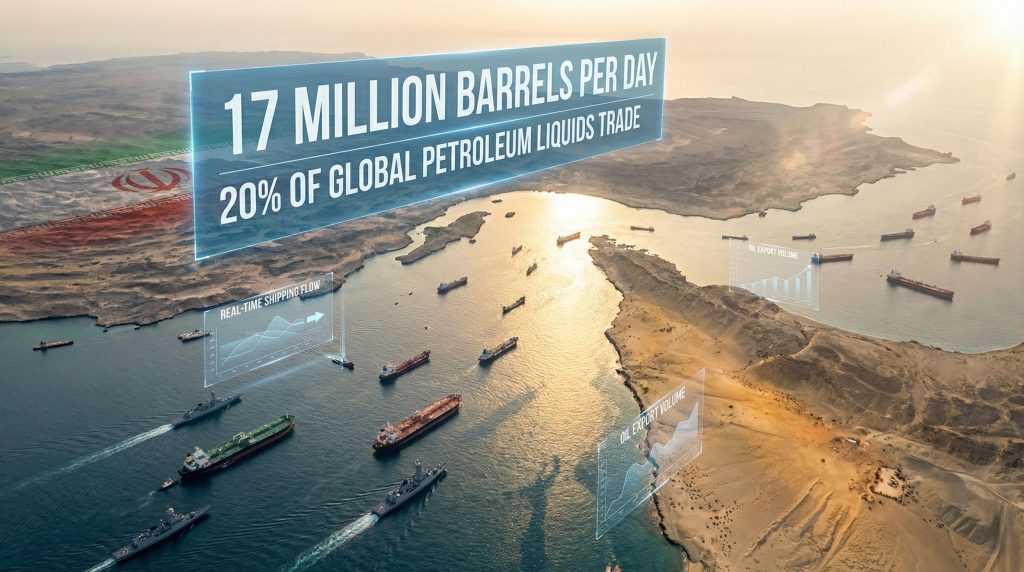
The Strait of Hormuz normally facilitates the transit of approximately 17 million barrels per day of petroleum products, representing roughly 20% of global liquid fuel trade. This volume breaks down into 14 million barrels per day of crude oil and condensate alongside 3 million barrels per day of refined products, creating multiple layers of supply chain dependency.
Current conflict conditions have reduced traffic through the strait to minimal levels, with industry sources confirming that only a handful of vessels have attempted transit since hostilities began. This dramatic reduction in throughput has created a natural experiment in energy market resilience, revealing how quickly physical disruptions translate into financial market stress.
The economic multiplier effects extend beyond crude oil markets into refined product pricing, LNG flows, and petrochemical feedstock availability. War-risk insurance premiums have reportedly increased by $5-15 per barrel for vessels attempting to transit the region, while an estimated 300-3,200 tankers remain idle in Gulf waters awaiting safer passage conditions.
Moreover, the Saudi exploration impact on regional dynamics adds another layer of complexity to these supply chain calculations.
Information Asymmetry and Market Response Mechanisms
The Wright social media incident provides a clear case study in how communication failures amplify market reactions during periods of heightened geopolitical tension. U.S. Energy Secretary Chris Wright's erroneous claim about naval escort operations triggered immediate market responses despite the lack of operational verification.
The sequence of events unfolded rapidly: Wright posted the escort claim, deleted it shortly thereafter, and the White House subsequently clarified that no naval escorts had actually been provided. Despite this quick correction, WTI futures settled around $81 per barrel, representing a substantial decline from previous trading sessions.
This incident highlights several critical vulnerabilities in modern energy trading:
- Hair-trigger algorithmic responses to geopolitical keywords and official statements
- Limited real-time verification capabilities for claims made by government officials
- Persistence of risk premiums even after information corrections
- Gap between political expectations and military operational timelines
General Dan Caine, Chairman of the U.S. Joint Chiefs of Staff, clarified that military commanders were only beginning to assess escort operation feasibility, examining resource requirements, command and control needs, and risk mitigation strategies. This assessment phase contrasts sharply with market expectations of immediate operational capability.
Consequently, these patterns also reflect broader trends in natural gas trends, where similar information asymmetries create market volatility.
When big ASX news breaks, our subscribers know first
Operational Complexity of Naval Escort Systems
Naval escort operations involve significantly more complexity than simple military presence. Historical precedents suggest that effective escort systems require comprehensive logistical coordination, substantial resource allocation, and sophisticated risk management protocols.
However, the recent analysis from Politico reveals additional layers of complexity in implementing such operations during active conflict scenarios.
Resource Allocation and Strategic Constraints
Convoy formation requirements inherently reduce transit speeds compared to independent vessel operations. Military escort vessels must coordinate with commercial tankers that operate at different speeds and with varying manoeuvrability characteristics. This coordination challenge becomes particularly acute when managing multiple vessels simultaneously through confined waterways.
Command and control infrastructure requirements extend beyond vessel-to-vessel communication. Effective escort operations require:
- Real-time intelligence coordination between naval assets and shore-based command centres
- Integration with air defence systems to counter drone and missile threats
- Mine detection and clearance capabilities along transit routes
- Medical and damage control resources for potential casualties
- Fuel and ammunition resupply logistics for extended operations
U.S. naval assets face competing demands across multiple theatres, with resources stretched between Indo-Pacific operations, European security commitments, and now Middle Eastern escort requirements. This multi-theatre demand creates strategic trade-offs that influence operational sustainability.
Historical Precedent Analysis and Effectiveness Metrics
Previous escort operations provide mixed evidence regarding effectiveness and cost-benefit ratios. Red Sea escort initiatives have achieved limited success in restoring full commercial traffic, with many shipowners remaining reluctant to transit despite military protection availability.
The Tanker War of the 1980s offers relevant historical context, demonstrating both the potential and limitations of naval escort systems. During that conflict, escort operations provided psychological reassurance to commercial operators whilst facing persistent asymmetric threats from mines, small boat attacks, and missile strikes.
Insurance market responses to military protection announcements have historically lagged behind actual operational deployment. War-risk premiums tend to remain elevated until escort operations demonstrate sustained effectiveness over extended periods, suggesting that market confidence requires proof of concept rather than mere operational announcements.
Strategic Economic Warfare and Market Psychology
Iranian strategy appears designed to exploit Western risk-aversion whilst maintaining plausible deniability regarding direct confrontation with U.S. naval forces. This approach maximises economic disruption whilst minimising the risk of full-scale military escalation.
The Hormuz escort claim incident demonstrates how effectively misinformation can be weaponised to create market uncertainty without direct military confrontation.
Asymmetric Economic Impact Strategies
Iran's approach to Strait of Hormuz disruption demonstrates sophisticated understanding of global energy market psychology. Rather than completely closing the waterway, which might provoke immediate military retaliation, Iranian forces have created sufficient uncertainty to deter most commercial transit whilst allowing selective passage of vessels aligned with Iranian interests.
Shadow fleet operations continue largely unimpeded at facilities like Kharg Island, allowing Iran to maintain some export capability whilst disrupting competitors' market access. This selective approach creates maximum psychological impact whilst preserving Iranian revenue streams.
The timing of escalation events appears coordinated with peak trading hours in major financial centres, suggesting deliberate market timing designed to maximise volatility. Calculated ambiguity about attack patterns prevents market participants from developing reliable risk assessment models.
Exploitation of Western Commercial Risk Models
Commercial shipping operators have unanimously indicated reluctance to transit Hormuz waters regardless of available military protection. This risk-averse positioning reflects insurance liability concerns, crew safety considerations, and cargo owner preferences for alternative routing.
Iranian Revolutionary Guard Corps statements characterising potential escort operations as military traps for U.S. forces add another layer of psychological pressure. These communications create additional uncertainty regarding the nature and scope of potential threats to naval escort vessels.
The persistence of elevated risk premiums beyond immediate conflict zones demonstrates how localised threats can create system-wide cost increases. Market participants appear to be pricing in prolonged disruption scenarios rather than expecting quick resolution of the underlying conflict.
In addition, these patterns align with broader global trade impacts that create cascading effects across multiple sectors.
Global Supply Chain Restructuring Implications
Energy supply chain diversification pressures have accelerated dramatically as a result of Hormuz transit uncertainties. European and Asian importers are actively exploring alternative supply sources and transit routes to reduce dependency on Persian Gulf exports.
Regional Adaptation Strategies
China's strategic petroleum reserve utilisation patterns suggest preparation for extended supply disruptions. Alternative supply route development through Central Asian pipelines and increased Russian crude purchases indicate strategic hedging against continued Middle Eastern instability.
India's approach involves balancing strategic petroleum reserve drawdowns with opportunistic purchasing from discounted sources. The Indian government has indicated willingness to continue purchasing Iranian crude through alternative payment mechanisms, complicating Western sanctions enforcement.
European energy security consultation frameworks have been activated, with G7 coordination mechanisms examining potential strategic petroleum reserve releases. However, no immediate release decisions have been announced, suggesting confidence that alternative supplies can meet short-term demand.
Long-term Contract Evolution and Force Majeure Considerations
Energy contract renegotiations increasingly incorporate enhanced force majeure clauses that account for geopolitical disruption scenarios. These contractual modifications reflect growing recognition that traditional supply chain assumptions may no longer be reliable.
Long-term infrastructure investments are being reassessed to account for chokepoint vulnerabilities. Pipeline development projects connecting alternative supply sources to major consumption centres have received increased attention from both government and private investors.
The development of alternative transit routes faces significant lead times and capital requirements. Rail transport capacity, pipeline construction, and port facility development require years of planning and investment, limiting short-term supply chain flexibility.
For instance, commodity trading insights reveal how major trading houses are adapting their strategies to these evolving dynamics.
Investment Strategy Implications and Market Timing
Energy sector valuations have become increasingly sensitive to escort policy developments and geopolitical risk assessments. Traditional valuation models struggle to account for the elevated volatility and correlation breakdowns observed during crisis periods.
Sector-Specific Valuation Adjustments
Tanker company valuations have shown extreme sensitivity to escort policy announcements and operational updates. Day rates for very large crude carriers (VLCCs) have increased substantially, whilst vessel utilisation patterns have shifted dramatically away from Persian Gulf routes.
Energy infrastructure resilience has emerged as a key valuation metric for pipeline operators, storage facilities, and processing plants. Assets with diversified supply sources or strategic geographic positioning command premium valuations compared to those dependent on single chokepoints.
Defence contractor positioning for potential escort contracts has influenced stock performance across the maritime security and naval systems sectors. Companies with relevant capabilities in convoy protection, mine warfare, and unmanned systems have seen increased investor interest.
Market Structure Vulnerability Assessment
Options market pricing reflects elevated volatility expectations across energy commodities, with implied volatility indices reaching multi-year highs. This pricing structure suggests that market participants expect continued turbulence regardless of immediate policy responses.
Basis spread volatility between regional crude benchmarks has increased substantially, reflecting transportation cost uncertainties and supply source flexibility constraints. These spreads provide insight into market expectations regarding the duration and scope of supply disruptions.
Correlation breakdowns between crude oil grades and refined product prices indicate that traditional hedging relationships may not function reliably during crisis periods. This breakdown creates additional complexity for risk management strategies across the energy supply chain.
Technological Solutions and Information Infrastructure
Modern energy markets depend heavily on real-time information flow and price discovery mechanisms that have proven vulnerable to both intentional and accidental misinformation. The Hormuz escort claim incident revealed significant gaps in verification capabilities and algorithmic trading safeguards.
Social Media Impact on Commodity Price Formation
The Wright incident demonstrates how social media posts by government officials can move commodity markets within hours, creating new categories of operational risk for energy traders. Traditional news verification systems appear inadequate for the speed and scale of modern market reactions to social media content.
Algorithm trading responses to geopolitical keywords and official statements lack sophisticated context analysis, leading to market movements based on incomplete or inaccurate information. This technological limitation creates opportunities for both intentional manipulation and accidental disruption.
Market maker risk management protocols during information gaps have proven insufficient to prevent dramatic price swings. The speed of algorithmic trading systems appears to outpace human oversight capabilities during rapidly developing situations.
Furthermore, detailed reporting from The Hill provides additional context on how these technological vulnerabilities manifest in real-world scenarios.
Systemic Vulnerability and Financial Stability
Single chokepoint dependency creates cascading economic risks that extend well beyond energy markets. Financial market interconnectedness means that energy price volatility can influence currency markets, inflation expectations, and central bank policy responses.
Central banks are monitoring energy-driven inflation risks carefully, with potential policy implications if elevated energy prices persist. The Federal Reserve and European Central Bank have indicated readiness to adjust monetary policy if energy costs create sustained inflationary pressure.
Economic growth implications from sustained high energy prices could influence fiscal policy responses and government spending priorities. Energy cost increases affect both consumer spending power and industrial production costs, creating multiple transmission channels for economic impact.
The next major ASX story will hit our subscribers first
Strategic Outlook and Market Adaptation
Energy market structure appears to be undergoing permanent changes as a result of repeated chokepoint disruption events. Risk premium incorporation in energy pricing models may persist even after immediate conflicts resolve, reflecting updated assessments of geopolitical vulnerability.
Investment Acceleration in Alternative Infrastructure
Strategic stockpiling policies are evolving across major economies as governments reassess energy security requirements. The adequacy of existing strategic petroleum reserves is being questioned given the scale and duration of potential supply disruptions.
Technology deployment for enhanced supply chain visibility has become a priority for both government and private sector stakeholders. Real-time tracking systems, predictive analytics, and alternative routing optimisation are receiving increased investment attention.
International maritime security cooperation mechanisms require development to address the multilateral nature of energy supply chain protection. Cost-sharing arrangements for naval escort operations face significant diplomatic and operational challenges.
Policy Framework Evolution and Diplomatic Coordination
Energy diplomacy integration with military strategy reflects growing recognition that energy security and national security have become inseparable. Traditional diplomatic approaches may prove inadequate for managing the intersection of economic and military threats.
Commercial-military coordination protocols for crisis response require development to ensure effective cooperation between government escort capabilities and private sector shipping operations. These protocols must balance security requirements with commercial operational flexibility.
The development of multilateral escort cost-sharing arrangements faces significant political and operational obstacles. Different nations have varying interests in specific trade routes and energy suppliers, complicating burden-sharing negotiations.
Disclaimer: This analysis contains forward-looking statements and speculative assessments based on current market conditions and available information. Energy market volatility, geopolitical developments, and policy changes may significantly impact actual outcomes. Readers should conduct independent research and consult qualified professionals before making investment or operational decisions.
Looking for Investment Opportunities in Energy Market Volatility?
Discovery Alert's proprietary Discovery IQ model delivers real-time alerts on significant ASX mineral discoveries, providing subscribers with actionable insights during volatile market conditions like current energy disruptions. Begin your 14-day free trial today to gain a market-leading advantage whilst energy sector valuations remain highly sensitive to geopolitical developments.