
July 1, 2026
Why the Loudest Gold Headlines Are Often the Least Useful
The precious metals market generates more noise than almost any other asset class. The Adrian Day gold outlook and central bank buying thesis cuts through this noise by separating structural demand forces from the minute-by-minute commentary on Federal Reserve language, currency moves, and geopolitical flashpoints that creates a constant stream of short-term signals. In aggregate, these signals frequently obscure the forces that actually determine where gold prices go over multi-year periods. Investors conditioned by quarterly reporting cycles and algorithmic news feeds are structurally disadvantaged when analysing markets that move on decade-long dynamics.
Understanding the current gold environment requires separating two distinct analytical layers: the cyclical, sentiment-driven fluctuations visible in daily price charts, and the structural demand architecture being quietly assembled beneath the surface by buyers who are entirely indifferent to short-term technical levels. The distinction between these two layers is not academic. It has direct implications for how investors should interpret recent price weakness, ETF outflow data, and currency strength narratives that currently dominate financial media coverage.
When big ASX news breaks, our subscribers know first
The Structural Architecture Beneath the Gold Price
Central Banks as the Foundation of Modern Gold Demand
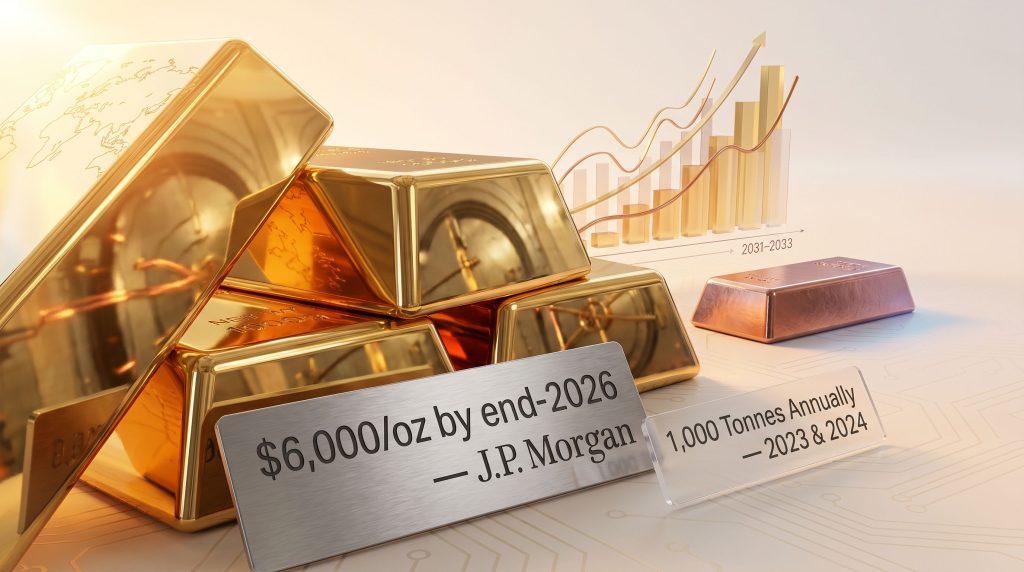
Central bank gold demand accumulation has become one of the most significant demand-side developments in the precious metals market in a generation. Annual sovereign purchases exceeded 1,000 tonnes in both 2023 and 2024, representing a demand regime that has no direct parallel in modern market history. Net purchases resumed in April 2026 following a brief, liquidity-driven interruption earlier in the year, and survey data indicates that 89% of central banks expect global gold reserves to increase further over the coming year.
What makes this demand profile particularly significant from a structural standpoint is that sovereign buyers do not behave like conventional investors. A central bank is not cross-referencing gold's position relative to its 200-day moving average before committing to a purchase. Buying decisions are driven by reserve diversification mandates that operate on political and fiscal timescales measured in decades, not quarters.
The core driver behind this shift is a 25-year trend of reducing exposure to U.S. dollar-denominated reserve assets. This is not a phenomenon that originated with any particular political administration and is unlikely to conclude with one either. The freezing of Russian sovereign assets in response to the Ukraine conflict gave this structural shift considerable momentum, demonstrating to central banks globally that dollar-denominated reserves carry geopolitical conditionality that gold does not.
When sovereign institutions rotate out of dollar assets, the proceeds flow predominantly into gold rather than alternative reserve currencies. The euro, the yen, and other major currencies have absorbed only marginal increases in reserve allocation despite large-scale dollar reductions. The gold market outlook for multi-year periods is consequently underpinned by a demand floor that is structurally independent of short-term sentiment.
| Sovereign Demand Factor | Current Status | Structural Implication |
|---|---|---|
| Annual purchase volume | Resumed net buying April 2026 | Persistent price floor support |
| Reserve diversification mandate | Active across 89% of central banks | Long-duration demand commitment |
| Dollar reserve reduction trend | 25-year ongoing structural shift | Independent of political cycles |
| Geopolitical conflict impact | Brief liquidity pressure in early 2026 | Not a structural reversal signal |
Tether and the New Category of Price-Insensitive Gold Buyers
Beyond sovereign institutions, a structurally important and widely underappreciated demand source has emerged from the digital asset sector. Tether's U.S. dollar stablecoin carries approximately 5% gold backing, which creates systematic and ongoing purchase requirements as stablecoin issuance grows. More significantly, the launch of a dedicated gold-backed stablecoin approximately one year ago established an entirely new and mechanically driven demand channel.
During three consecutive quarters of its gold-backed stablecoin program, Tether's gold acquisitions exceeded purchases made by any single central bank over the same period. This is a development that has received minimal attention in mainstream financial analysis despite its meaningful scale. The purchasing mechanism is inherently price-insensitive: as additional gold-backed stablecoins are issued, the corresponding gold reserves must be acquired at prevailing market prices regardless of technical levels or short-term sentiment.
Structural observation: The combination of central bank mandate-driven buying and stablecoin reserve mechanics means a meaningful portion of current gold demand operates entirely outside the price-sensitive retail and ETF investor base. This creates a demand floor that functions independently of conventional investment sentiment cycles.
Reading ETF Outflows Correctly: Sentiment Signal, Not Structural Reversal
Approximately $3 billion in outflows from the world's largest physical gold ETF occurred over a recent one-month period. On the surface, this appears to represent significant selling pressure. Analysed in context, however, it illustrates something more nuanced: during that same period, central bank purchases in April 2026 were sufficient to broadly offset the ETF redemptions. Retail and small institutional sellers are, in effect, providing liquidity that price-insensitive sovereign and quasi-sovereign buyers are absorbing.
This substitution dynamic reframes what might appear to be a bearish signal. When the largest category of price-sensitive sellers in the market are being offset by buyers who are structurally indifferent to current price levels, the resulting price weakness represents opportunity absorption rather than demand erosion.
What the Absence of Retail Participation Actually Tells Us
Three Anomalies That Define This Unusual Bull Market
The current gold bull market, which has been building since at least the end of 2015 and has demonstrated clear strength over the past three years, carries three characteristics that collectively have no precedent in prior precious metals cycles:
- No meaningful retail participation: A multi-year, high-magnitude gold bull market has never previously occurred without broad individual investor engagement driving the later phases of the cycle.
- No significant leverage in gold equities: Prior gold bull markets have historically seen mining stocks deliver three to five times the price appreciation of physical gold. That leverage has been largely absent throughout this cycle.
- No generalist institutional inflows: Mutual funds, hedge funds, and non-specialist investment institutions have remained broadly underweight gold across the duration of this bull market.
These three characteristics are interconnected. Generalist investors and retail participants have historically accessed gold exposure through equities rather than physical metal. Their absence from the market simultaneously explains why ETF outflows are possible at current gold price levels and why gold mining equity leverage has underperformed the metal itself on a multi-year basis.
The Analytical Implication of a Retail-Absent Bull Market
The conventional approach to bull market cycle analysis involves overlaying current price behaviour against previous cycle patterns to identify analogous phases and project forward trajectories. The unusual composition of this bull market makes that framework significantly less reliable. Price appreciation driven almost entirely by sovereign and quasi-sovereign buyers creates a fundamentally different market structure than one fuelled by retail momentum and generalist capital rotation.
The asymmetric implication is that when generalist investors do eventually enter this market, the leverage effect in gold equities that has been suppressed throughout this cycle could activate with unusual force. The mining sector discount to physical gold that currently exists represents a structural anomaly that would likely correct sharply in such a scenario.
The Investment Cycle Mechanics Behind Copper's Long-Term Setup
Why Commodity Supply Responds to Yesterday's Decisions, Not Today's Prices
One of the most practically important, yet frequently misunderstood, dynamics in resource investing is the fundamental distinction between economic cycles and investment cycles. Economic activity fluctuates on timescales of months to a few years. Resource supply responds to investment decisions made five to seven years earlier, operating on an entirely different clock.
The former CEO of Freeport-McMoRan, one of the world's largest copper producers, has noted publicly that even projects classified as shovel-ready, with all permitting and feasibility work complete, require a minimum of five years from board approval to first copper production. That constraint is not a function of regulatory delays or bureaucratic friction. It reflects the fundamental physical reality of large-scale mine construction.
This five-to-seven year supply lag creates a systematic mismatch between investment decisions made at price peaks and the economic environment those projects eventually produce into. Capital floods in when prices are high, supply surges arrive years later into changed conditions, prices fall, investment collapses, and the next deficit begins accumulating.
The Copper Demand Picture Beyond the AI Narrative
Copper demand grows at a remarkably consistent 2 to 4% annually across economic cycles, with projections from major research institutions indicating that trajectory is expected to continue for at least 15 years. This consistency reflects the metal's role across industrial activity, construction, electrification, and urbanisation in emerging markets, none of which are discretionary consumption categories subject to rapid cyclical fluctuation.
The AI infrastructure narrative has attracted considerable investor attention as a copper demand driver. However, whilst data centres and AI hardware do consume copper, S&P Global estimates that AI-related demand represents approximately 3% of projected global consumption. Furthermore, the copper supply crunch represents a more consequential structural development than any single demand narrative.
| Copper Demand Driver | Share of Global Demand | Time Horizon |
|---|---|---|
| Industrial and construction | Dominant | Ongoing |
| Electrification and EVs | Growing significantly | 10 to 20 years |
| AI data infrastructure | ~3% (S&P Global estimate) | 5 to 10 years |
| Emerging market urbanisation | Substantial | 15+ years |
Research projections consistently identify a meaningful supply shortfall developing in 2031 to 2033, as insufficient new mine development was committed during the current cycle. Given the five-to-seven year lead time from approval to production, the window within which new investment could bridge that gap is narrowing considerably.
Near-Term Technical Risk and the Long-Term Thesis
Scenario Analysis: Conditions for Gold's Next Major Move
Assessing gold's trajectory over a twelve-month horizon requires mapping the specific conditions that would allow the structural bull thesis to reassert against the cyclical headwinds currently dominating price action. Three convergent conditions would likely be required:
- Resolution of active geopolitical conflict removes the safe-haven premium currently embedded in the U.S. dollar, allowing the underlying structural dollar depreciation trend to reassert itself.
- Central banks signal a shift away from the hawkish rate narrative as elevated energy prices weigh on economic growth rather than functioning purely as an inflation driver.
- Generalist and retail investors begin entering the market, activating the leverage mechanism in gold equities that has been absent throughout this cycle.
Dollar strength during active military conflict is a well-documented, historically temporary phenomenon. The safe-haven premium that accrues to the dollar during geopolitical crises has consistently dissipated once conflict resolution occurs. The structural case for dollar depreciation rests on fiscal arithmetic and reserve diversification dynamics that no single geopolitical episode resolves or creates.
Institutional Price Projections and Their Underlying Logic
J.P. Morgan has projected gold reaching $6,000 per ounce by end-2026 and $6,300 per ounce in 2027, contingent on continued central bank accumulation and the eventual re-engagement of broader investor participation. For a detailed breakdown of these projections, Adrian Day's gold market forecast provides further context on the conditions driving these estimates.
Near-term technical conditions, however, present a more cautious picture. Gold trading below its 20-day, 50-day, and 200-day moving averages, combined with silver trading below the $60 level, creates technical conditions that support the probability of a further retest of recent lows before any sustained upward momentum develops. Such a consolidation would be consistent with structural bull market behaviour rather than cycle termination.
The next major ASX story will hit our subscribers first
Evaluating Management Quality as a Core Investment Variable
The Human Capital Dimension of Resource Investing
Technical geological analysis represents a specialised capability that most generalist investors cannot replicate at the level required to independently assess project viability. Mineral grades, metallurgical recovery rates, structural geology, and feasibility study assumptions involve technical depth that creates an inherent analytical gap for non-specialist investors.
Management quality, capital allocation discipline, and strategic decision-making are, by contrast, assessable through pattern recognition, track record analysis, and network intelligence. These competencies are often more directly accessible to experienced investors than the geological variables underlying them.
Investment principle: In resource companies, identifying who leads the organisation and how they have historically allocated capital is as analytically important as evaluating the underlying asset base. This applies at every scale of the sector, from junior explorers to major producers.
The relevance of executive quality is not limited to small-cap resource companies. Recognising management red flags early is, in many cases, more valuable than any geological assessment. Within the gold mining sector, where companies that appear large relative to junior peers are still relatively modest in global corporate terms, the influence of individual management decisions on asset development and capital efficiency is proportionally significant.
A Due Diligence Framework for Resource Company Leadership
- Track record assessment: Review prior capital allocation decisions, project delivery history against original feasibility parameters, and long-term shareholder return generation across different commodity price environments.
- Network validation: Peer assessment and industry expert perspectives on management credibility, operational competence, and relationship capital within the sector.
- Incentive alignment: Evaluate whether management compensation structures reward long-term asset development and responsible capital stewardship rather than short-term capital raising activity.
- Strategic consistency: Assess whether the company's stated strategy has remained coherent across commodity price cycles or has been revised opportunistically in response to market sentiment.
The Long-Term Convergence Case Across Metals and Macro Forces
Structural Signals Across Gold, Copper, and Currency Markets
| Asset | Primary Structural Driver | Key Risk | Long-Term Signal |
|---|---|---|---|
| Gold | Central bank de-dollarisation plus retail re-engagement potential | Near-term technical breakdown | Bullish: structural demand floor intact |
| Gold Equities | Leverage to gold price when generalists enter | Continued absence of retail participation | Asymmetric upside when cycle matures |
| Copper | Industrial demand growth plus 2031 to 2033 supply gap | Severe global recession or China demand collapse | Structurally bullish beyond four-year supply match |
| U.S. Dollar | Safe-haven premium from geopolitical conflict | Conflict resolution removes premium | Structural depreciation trend likely to reassert |
The macro forces supporting precious and industrial metals over multi-year horizons share a common foundation: fiscal expansion across major economies sustaining long-term dollar depreciation pressure, reserve diversification as a durable and politically independent structural trend, energy transition and industrial modernisation driving secular copper demand growth, and chronic underinvestment across the resource sector creating supply constraints that will take years to resolve regardless of near-term price signals.
Consequently, investors focused on quarterly earnings cycles and monthly price charts are, by the nature of those frameworks, systematically underweighting the forces that will determine commodity market outcomes over the next decade. The Adrian Day gold outlook and central bank buying framework reflects a long-term, cycle-aware approach that prioritises structural demand architecture over short-term sentiment. For a fuller discussion of this perspective, this in-depth interview explores how selectivity and structural thinking apply across the mining sector today.
Frequently Asked Questions: Gold Outlook and Central Bank Buying
Why are central banks choosing gold over other reserve diversification options?
Gold carries no counterparty risk and is not subject to foreign policy leverage or asset freezing. When central banks reduce dollar exposure, alternative reserve currencies including the euro and yen have absorbed only marginal increases in allocation. The structural characteristics of gold as a reserve asset make it the primary destination for proceeds from dollar reserve reduction.
Does a strengthening U.S. dollar indicate the gold bull market is reversing?
Dollar strength during active military conflicts reflects a temporary safe-haven premium with extensive historical precedent. Once geopolitical risk premiums normalise, the underlying structural dollar depreciation trend driven by fiscal deficits and reserve diversification has historically reasserted. The current dollar strength is most accurately read as a cyclical interruption rather than a structural reversal.
What specific conditions would trigger the next major leg higher in gold?
The convergence of three factors: geopolitical conflict resolution removing the dollar safe-haven premium; central bank communications shifting away from the hawkish rate narrative as high energy prices weigh on economic growth; and the entry of retail and generalist institutional investors who have been absent throughout this bull cycle.
Why have gold mining stocks underperformed physical gold across this bull cycle?
The absence of retail and generalist institutional participation means the leverage mechanism that has characterised previous gold bull markets has not activated. Generalist investors typically access gold exposure through equities rather than physical metal, so their absence suppresses the amplification effect that has historically produced three to five times leverage in mining stocks relative to gold.
How significant is stablecoin-driven gold demand relative to traditional buyers?
During three consecutive quarters of Tether's gold-backed stablecoin program, its gold purchases exceeded those of any single central bank. As digital asset adoption expands, gold-backed stablecoin reserves must grow proportionally, creating a mechanically driven and price-insensitive demand source that is structurally growing.
When is the copper supply gap expected to become acute?
Research projections from major institutions identify a meaningful supply shortfall developing in 2031 to 2033 as a result of insufficient new mine development committed during the current cycle. Given minimum five-to-seven year lead times from project approval to first production, the opportunity window for new investment to close this gap is narrowing significantly.
Want to Position Yourself Ahead of the Next Major Mineral Discovery?
Discovery Alert's proprietary Discovery IQ model scans ASX announcements in real time, delivering instant alerts on significant mineral discoveries — from gold to copper — so subscribers can act on high-potential opportunities before the broader market catches on. Explore historic discoveries and their exceptional returns, then begin a 14-day free trial at Discovery Alert to gain a structural edge in resource investing.