
June 2, 2026
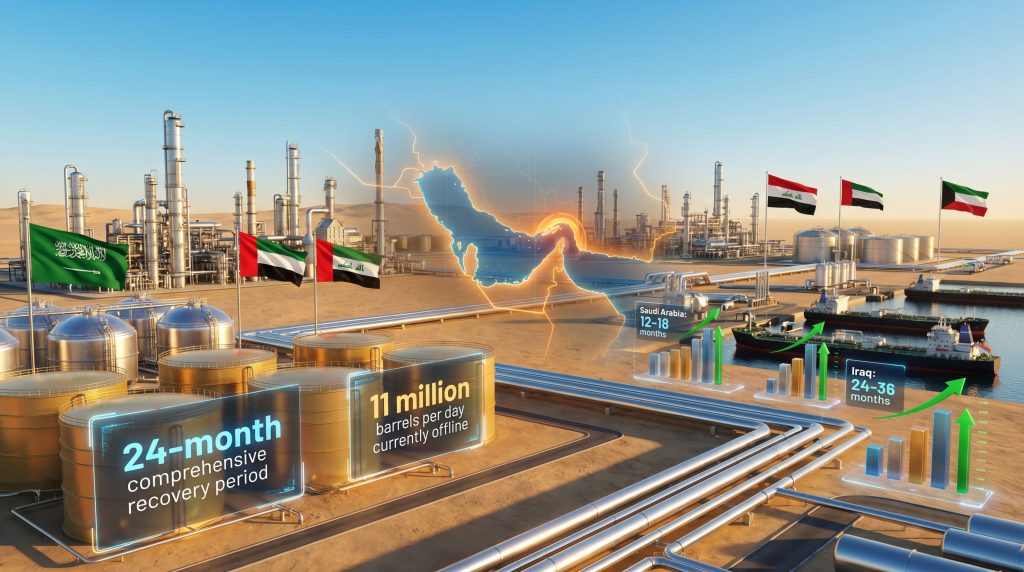
Energy output recovery in Middle East production systems faces a comprehensive 24-month restoration timeline according to International Energy Agency assessments. This projection encompasses multiple operational phases spanning immediate logistical restoration through complete upstream capacity rehabilitation. Furthermore, the complex interdependencies between infrastructure damage, storage constraints, and export logistics create cascading effects that significantly influence recovery sequencing across the region.
Understanding the Two-Year Recovery Framework for Regional Energy Infrastructure
Fatih Birol, Executive Director of the IEA, emphasized that comprehensive recovery extends beyond simple production restart protocols. The assessment indicates that regional variations create distinct restoration pathways, with Iraq requiring substantially longer recovery periods compared to Saudi Arabia's more resilient infrastructure base. Moreover, the energy security challenges across the region compound these recovery complexities.
Critical Recovery Components:
- Infrastructure Assessment Phase: 3-6 months for comprehensive damage evaluation
- Logistical Restoration: 6-12 months for export route reestablishment
- Production Restart: 12-18 months for systematic capacity restoration
- Quality Optimization: 18-24 months for full operational standards
The recovery framework operates through sequential phases rather than parallel restoration efforts. Each phase requires completion before subsequent operations can commence safely, preventing equipment damage from rushed restart procedures. Consequently, producers must balance speed requirements with operational integrity preservation.
Infrastructure Damage Assessment and Recovery Sequencing
Current operational disruptions affect multiple energy subsectors simultaneously, requiring coordinated restoration approaches. The recovery sequence prioritises export logistics capabilities, storage capacity optimisation, and systematic upstream production restart protocols. In addition, the OPEC production impact considerations influence regional coordination strategies.
Technical assessments indicate that recovery sequencing depends on infrastructure redundancy levels and pre-conflict operational status. Countries with robust backup systems demonstrate faster restoration capabilities compared to those with limited infrastructure diversity. However, even resilient systems face substantial challenges during comprehensive restoration phases.
When big ASX news breaks, our subscribers know first
What Factors Determine Country-Specific Recovery Timelines?
Regional energy producers face varying restoration challenges based on infrastructure resilience, geographic positioning, and operational complexity. These differentials create distinct recovery structures across major producing nations. Furthermore, the oil price stagnation effects influence recovery investment priorities.
Birol's analysis reveals that Iraq's recovery timeline extends significantly beyond regional averages due to complex upstream damage patterns. Conversely, Saudi Arabia's infrastructure redundancy and strategic storage capabilities position the Kingdom for accelerated operational restoration. For instance, Saudi exploration licenses demonstrate the country's continued investment in capacity expansion.
Recovery Timeline Analysis:
| Country | Estimated Recovery | Primary Constraints |
|---|---|---|
| Saudi Arabia | 12-18 months | Storage optimisation protocols |
| UAE | 15-20 months | Domestic gas infrastructure repairs |
| Iraq | 24-36 months | Extensive upstream field damage |
| Kuwait | 18-24 months | Export logistics restoration |
Note: Timeline estimates require verification from official national oil company sources and may vary based on conflict cessation conditions.
Saudi Arabia's Accelerated Recovery Pathway
The Kingdom's strategic petroleum infrastructure demonstrates superior resilience compared to regional counterparts. Multiple pipeline networks, redundant processing facilities, and substantial storage capacity create recovery advantages that minimise restoration complexity. Additionally, Saudi Aramco's operational philosophy emphasises system redundancy.
Saudi Aramco's operational philosophy emphasises system redundancy, enabling continued partial operations even during infrastructure disruptions. This design principle facilitates faster restoration once security conditions permit operational restart. However, even resilient systems require careful restart protocols to prevent equipment damage.
Iraq's Extended Rehabilitation Requirements
Iraq's energy infrastructure suffers from limited redundancy and complex field-by-field restoration requirements. The country's production systems require comprehensive rehabilitation rather than simple restart procedures, extending recovery timelines substantially. Moreover, security considerations across multiple provinces create additional operational challenges.
Historical precedents suggest that Iraq's recovery patterns follow extended trajectories due to technical complexity and security considerations affecting field operations. Consequently, the country faces the longest projected recovery timeline among major regional producers.
How Will Strait of Hormuz Reopening Impact Recovery Speed?
The strategic waterway's operational status serves as the primary determinant for regional energy export restoration. Current closure effects compound existing production disruptions through comprehensive logistics bottlenecks affecting global supply chains. Furthermore, according to the IEA Middle East energy assessment, the waterway's closure creates cascading effects throughout global energy markets.
Birol warned that energy markets substantially underestimate the consequences of prolonged Strait closure. His analysis indicates that existing shipments previously en route provided temporary market buffer, but the complete cessation of new tanker loadings in March creates forward-looking supply deficits.
Shipping Impact Assessment:
- Historical Daily Transit: Approximately 21% of global petroleum liquids
- Current Status: Zero new loadings since March 2026
- Export Route Alternatives: Limited capacity through Red Sea and overland pipelines
- Market Impact: Sustained price elevation during closure period
Immediate Post-Reopening Recovery Phase
Initial recovery focuses on clearing accumulated cargo backlogs and restoring primary shipping routes before addressing upstream production increases. The waterway's reopening enables producers to begin utilising existing storage capacity while gradually increasing production rates. However, technical considerations require systematic approaches to prevent port congestion.
Technical considerations require systematic approach to shipping route restoration, preventing port congestion and ensuring safe navigation through potentially damaged channel infrastructure. Additionally, coordination between storage optimisation and export scheduling becomes critical during restart phases.
What Are the Storage Capacity Constraints Affecting Recovery?
Regional storage infrastructure limitations create cascading effects on production restart capabilities, with varying national capacities determining restart sequencing across different producer nations. These constraints operate as production restart bottlenecks because producers cannot increase output beyond storage limits without export capability.
Storage capacity constraints operate as production restart bottlenecks because producers cannot increase output beyond storage limits without export capability. This creates interdependency between storage optimisation, export route availability, and production restart timing. Consequently, the LNG supply implications extend beyond immediate production considerations.
Storage Duration Assessment:
| Region | Estimated Capacity | Recovery Constraint Level |
|---|---|---|
| Saudi Arabia/UAE | 25-35 day capacity | Moderate limitation |
| Iraq/Kuwait | 10-20 day capacity | Severe constraint |
| Qatar LNG | Specialised terminals | Technical complexity |
Storage capacity figures require verification from national petroleum company disclosures and may vary based on facility damage assessments.
Strategic Storage Optimisation During Recovery
Producers must balance storage utilisation with gradual production increases to prevent infrastructure overload during restart phases. This requires careful coordination between production rates, storage turnover, and export scheduling. Furthermore, optimal storage management involves maintaining strategic reserves while maximising export throughput.
Optimal storage management during recovery involves maintaining strategic reserves while maximising export throughput, requiring sophisticated logistics coordination across multiple operational phases. Additionally, temperature-controlled storage requirements for different product grades add complexity to recovery planning.
How Will LNG Infrastructure Recovery Differ from Oil Operations?
Liquefied natural gas facilities require specialised restart procedures due to complex cryogenic systems and multi-train operational requirements. Qatar's energy infrastructure represents the region's largest LNG restoration challenge. Moreover, technical complexity differs fundamentally from crude oil operations.
LNG recovery differs fundamentally from crude oil operations due to specialised cooling and compression systems requiring systematic restart sequencing. Equipment sensitivity to temperature variations necessitates gradual restart procedures to prevent costly equipment damage. For instance, the Economic Times recovery analysis highlights these technical complexities.
LNG Recovery Specifications:
- Technical Complexity: Cryogenic system restart protocols
- Timeline Requirements: Extended preparation phases
- Equipment Sensitivity: Temperature-controlled restart sequences
- Production Scaling: Train-by-train restoration approach
Qatar's Ras Laffan Complex Restoration Strategy
The facility represents global LNG production concentration, requiring careful restart sequencing to maximise restoration speed while ensuring operational safety. Multi-train complexes demand coordinated restart approaches preventing system-wide disruptions. However, energy output recovery in Middle East LNG facilities faces unique technical challenges.
Technical considerations include cooling system restart, compression equipment inspection, and systematic quality testing before full operational capacity restoration. Additionally, the complex requires specialised workforce expertise for safe restart procedures.
What Economic Implications Will Extended Recovery Create?
Prolonged restoration timelines generate compound economic effects through sustained supply disruptions, pricing volatility, and global market share redistribution across alternative energy suppliers. These impacts operate through immediate price elevation and forward-looking uncertainty about recovery timelines.
Birol's assessment indicates energy market participants underestimate disruption severity. Economic impacts operate through immediate price elevation from supply shortage and forward-looking uncertainty about recovery timelines creating sustained market volatility. Consequently, these factors influence long-term investment strategies across the energy sector.
Economic Impact Categories:
- Price Volatility: Sustained elevation during 24-month recovery period
- Supply Chain Disruption: Global energy market rebalancing toward alternative suppliers
- Investment Requirements: Substantial capital allocation for infrastructure restoration
- Market Share Shifts: Potential permanent changes in global supply relationships
Global Energy Market Rebalancing During Recovery
Alternative suppliers gain market positioning during Middle Eastern recovery, potentially creating lasting modifications in global energy supply relationships. These shifts may persist beyond recovery completion due to supply chain diversification strategies. Furthermore, market psychology during extended disruptions creates preference changes favoring supply security.
Market psychology during extended disruptions often creates preference changes favouring supply security over cost optimisation, influencing long-term contract structures and supplier relationships. Additionally, insurance and risk management considerations become increasingly important for energy investments.
The next major ASX story will hit our subscribers first
Which Recovery Strategies Minimise Long-Term Infrastructure Damage?
Careful restart protocols prevent equipment damage from rushed restoration attempts, balancing speed requirements with operational integrity preservation across complex energy infrastructure systems. These strategies emphasise systematic approaches over rapid restart attempts to ensure sustainable recovery.
Optimal recovery strategies emphasise systematic approaches over rapid restart attempts. Technical best practices focus on gradual pressure restoration, comprehensive equipment inspection, and phased capacity increases preventing infrastructure overload. Moreover, energy output recovery in Middle East operations requires specialised technical expertise.
Recovery Protocol Framework:
- Gradual Pressure Restoration: Systematic pressure increases preventing equipment stress
- Comprehensive Quality Testing: Ensuring operational safety standards before full restart
- Phased Capacity Increases: Sequential production increases avoiding system overload
- Equipment Inspection: Detailed assessment preventing premature equipment failure
Upstream Asset Protection During Restart Operations
Oil and gas fields require careful pressure management and equipment inspection to prevent permanent damage from accelerated restart procedures. Reservoir engineering considerations demand systematic approaches to production restart. Additionally, wellhead equipment inspection ensures operational safety standards.
Technical protocols emphasise reservoir pressure management, wellhead equipment inspection, and pipeline integrity testing before resuming normal production operations. Furthermore, environmental monitoring systems require calibration and testing during restart phases.
How Do Regional Conflicts Historically Impact Energy Recovery Timelines?
Historical precedents provide context for current recovery projections, though modern infrastructure complexity creates unique restoration challenges compared to previous conflict recovery operations. These patterns demonstrate consistent themes across different historical conflicts despite varying specific circumstances.
Energy infrastructure recovery patterns demonstrate consistent themes across different historical conflicts, though specific timelines vary based on infrastructure complexity, conflict duration, and post-conflict security conditions. However, current scenarios face unprecedented technical and logistical challenges.
Historical Recovery Patterns:
- Gulf War (1991): Kuwait achieved 18-month production restoration
- Iraq War (2003): Comprehensive recovery required 36-month timeline
- Libya Crisis (2011): Production normalisation achieved within 24 months
- Current Scenario: Projected 24-month comprehensive recovery timeline
Historical timeline figures require verification from energy ministry records and international organisation assessments.
Modern Infrastructure Complexity vs. Historical Precedents
Current energy infrastructure demonstrates higher technological sophistication compared to historical conflict scenarios, requiring more careful restoration approaches and extended preparation phases. Modern systems integrate digital control systems, environmental monitoring, and safety protocols demanding systematic restart procedures.
Modern systems integrate digital control systems, environmental monitoring, and safety protocols that demand systematic restart procedures, contrasting with simpler historical infrastructure designs. Consequently, recovery timelines may extend beyond historical precedents despite technological advances.
What Role Do Emergency Reserve Releases Play in Recovery?
Strategic petroleum reserve deployments provide market stability during recovery periods, though sustained releases face capacity limitations and political considerations affecting deployment duration. These mechanisms serve as temporary market stabilisation tools rather than long-term supply solutions.
The IEA coordinated strategic reserve releases in March 2026, with Birol confirming readiness for additional deployments if market conditions deteriorate. Reserve releases serve as temporary market stabilisation mechanisms rather than long-term supply solutions. Furthermore, international cooperation enables larger-scale market intervention.
Reserve Release Framework:
- IEA Coordination: Multi-national strategic reserve deployment
- Release Sustainability: Limited duration for emergency measures
- Market Stabilisation: Temporary price volatility reduction
- Political Considerations: International cooperation requirements
Coordinated International Response Mechanisms
Global energy agencies coordinate reserve releases and alternative supply arrangements to minimise recovery period disruptions. International cooperation enables larger-scale market intervention compared to individual country responses. Additionally, strategic coordination involves timing optimisation and volume allocation strategies.
Strategic coordination involves timing optimisation, volume allocation, and market communication strategies designed to maximise stabilisation effects while preserving reserve capacity for extended emergencies. However, sustained deployments face political and capacity constraints.
How Will Recovery Progress Monitoring and Assessment Work?
Systematic recovery tracking requires comprehensive metrics covering production restoration, infrastructure repair, and market normalisation indicators across multiple operational dimensions. These frameworks integrate production data with infrastructure status assessments for comprehensive progress evaluation.
Recovery monitoring frameworks integrate production data, infrastructure status assessments, and market indicators to provide stakeholders with comprehensive progress evaluation capabilities throughout the restoration period. Moreover, security conditions assessments enable sustainable production restart planning.
Monitoring Framework Components:
- Production Metrics: Monthly capacity restoration tracking across different facility types
- Infrastructure Status: Critical facility operational assessments and damage repair progress
- Market Indicators: Price stability measurement and supply chain normalisation tracking
- Security Conditions: Operational safety assessments enabling sustainable production restart
Key Performance Indicators for Recovery Success
Measurable benchmarks enable stakeholders to assess recovery progress and adjust restoration strategies based on operational realities and changing security conditions. Performance indicators integrate technical metrics with market response data for comprehensive assessment frameworks.
Performance indicators integrate technical metrics with market response data, creating comprehensive assessment frameworks for evaluating recovery effectiveness across different operational phases. Additionally, real-time monitoring enables adaptive management strategies during recovery implementation.
Investment Disclaimer: This analysis contains forward-looking assessments and recovery projections that involve substantial uncertainty. Energy market conditions, geopolitical developments, and technical challenges may significantly impact actual recovery timelines. Investors should conduct independent research and consider professional advice before making investment decisions based on energy output recovery projections for the Middle East.
Looking for Investment Opportunities in Energy Recovery?
Discovery Alert's proprietary Discovery IQ model provides real-time alerts on significant ASX mineral and energy discoveries, delivering instant insights that position subscribers ahead of market developments during volatile periods. Explore how major discoveries can generate substantial returns by visiting Discovery Alert's discoveries page and begin your 14-day free trial to secure your competitive advantage in today's dynamic markets.