August 22, 2026
The Regulatory Machinery Behind Deep-Sea Mining's Defining Moment
For most of the past decade, the race to extract critical minerals from the deep ocean floor existed primarily as a theoretical exercise. Environmental assessments remained incomplete, governance frameworks were unresolved, and commercial infrastructure was largely conceptual. That calculus is shifting rapidly. NOAA clears TMC Pacific seabed license near Mexico in a move that signals the period between 2025 and 2027 may well represent the moment when deep-sea nodule recovery transitions from scientific ambition to industrial reality, and the regulatory decisions being made right now will shape the architecture of that industry for generations.
At the centre of this transition sits a procedural determination by the US National Oceanic and Atmospheric Administration (NOAA), and understanding precisely what that determination does and does not mean is essential context for anyone tracking the critical minerals demand sector.
When big ASX news breaks, our subscribers know first
What NOAA's Certification Actually Means for TMC USA
NOAA's certification of TMC USA's USA B exploration license application covering approximately 122,000 km² of Pacific seafloor is not a mining permit. It is not an endorsement of commercial viability. It is not environmental approval. What it represents is a formal finding that TMC USA's consolidated filing meets the baseline procedural requirements for substantive review under the Deep Seabed Hard Mineral Resources Act (DSHMRA).
A useful analogy is a planning authority accepting a development application as formally complete. The paperwork qualifies the project for review. However, the review itself has not begun, and approval remains far from guaranteed.
Key Distinction: Substantial compliance under DSHMRA is a threshold procedural finding. It confirms the application meets the minimum requirements for formal consideration, not that the proposed activities are approved, environmentally sound, or commercially authorised.
The certification triggers a structured sequence of regulatory steps that must be completed before any exploration license is granted:
- NOAA publishes a Notice of Intent to Prepare an Environmental Impact Statement
- The Draft EIS is developed and released for public comment
- Draft Terms, Conditions and Restrictions are circulated
- The public comment period closes
- NOAA issues a final agency determination
- Interagency consultation is completed
- A separate commercial recovery permit must be obtained before any extraction can begin
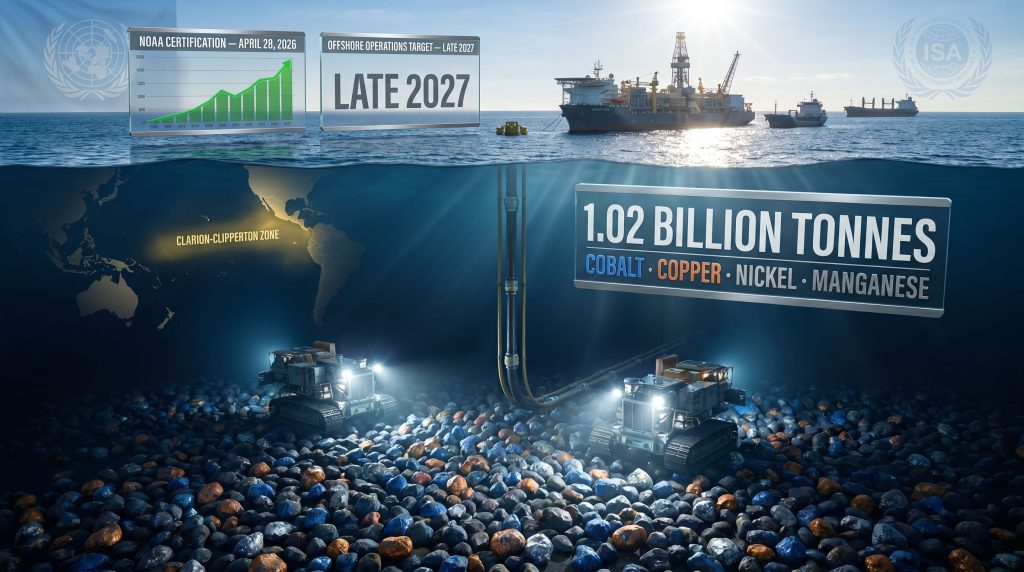
TMC USA is simultaneously advancing a second application, designated USA A, which consolidates an exploration license and commercial recovery permit into a single filing. That application was determined to be fully compliant on April 28, 2026, and is advancing through its own parallel regulatory track. According to NOAA's official findings, this dual-track approach represents an unprecedented step in US deep-sea mining regulatory history.
The Two-Track Application Structure
| Application Area | Structure | Coverage | Key Compliance Milestone |
|---|---|---|---|
| USA A | Consolidated exploration + commercial recovery permit | Undisclosed km² | Fully compliant April 28, 2026 |
| USA B | Exploration license application | ~122,000 km² | Certified compliant June 2026; EIS pending |
| USA B Resource Estimate | Pre-commercial | ~1.02 billion tonnes polymetallic nodules | NOAA EIS process now underway |
The Clarion-Clipperton Zone: Geography, Jurisdiction, and Geopolitical Weight
The Clarion-Clipperton Zone spans international waters in the central Pacific Ocean, situated broadly between the Hawaiian archipelago and the Mexican coastline. A critical jurisdictional point that is frequently misunderstood in mainstream coverage is that the CCZ does not fall within Mexico's exclusive economic zone or territorial waters. It lies beyond the 200 nautical mile boundary that defines national maritime jurisdiction, placing it under the governance framework of the International Seabed Authority (ISA), the United Nations body responsible for regulating seabed resources in areas beyond national jurisdiction.
Despite this international status, the zone's proximity to Mexico's Pacific marine jurisdiction creates genuine geopolitical adjacency concerns. These include the potential for transboundary sediment plume impacts, fisheries disruption in adjacent waters, and the establishment of operational precedents that could affect how international maritime law evolves in the coming decades.
The resource scale within the CCZ is extraordinary by any measure. TMC USA's USA B area alone contains an estimated 1.02 billion tonnes of polymetallic nodules across its 122,000 km² of seafloor. Furthermore, independent geological assessments have consistently found that the CCZ as a whole contains greater concentrations of manganese, nickel, cobalt, and copper than all known land-based reserves combined, making it the most mineral-dense seafloor zone identified on the planet by surface area.
Competitor American Ocean Minerals Corporation (AOMC) has separately estimated more than 500 million wet tonnes of polymetallic nodules within its own license area, mapped across 23,500 km² in just 16 days using its refurbished 196-foot research vessel, the Anuanua Moana. The speed of that survey reflects significant advances in autonomous underwater vehicle technology and multibeam sonar mapping capabilities that have dramatically compressed exploration timelines compared to earlier generations of deep-sea surveying.
Why Washington Is Accelerating Permitting Now
The timing of NOAA's regulatory acceleration is not coincidental. A critical minerals executive order directed federal agencies in July 2025 to fast-track offshore mining permitting, framing deep-sea nodule extraction explicitly as a national security and supply chain resilience priority. Both TMC USA and AOMC are advancing applications within the framework that executive order established.
The strategic rationale centres on reducing US dependence on Chinese-controlled critical mineral supply chains. The four minerals concentrated in CCZ polymetallic nodules are precisely those where Chinese processing dominance creates the most acute supply chain vulnerability for US defence manufacturing and electric vehicle battery production.
The China Dependency Calculation
| Mineral | Primary Strategic Use | China's Approximate Processing Share | CCZ Nodule Concentration |
|---|---|---|---|
| Cobalt | EV batteries, aerospace alloys | ~70-75% | High |
| Nickel | Battery cathodes, stainless steel | ~35-40% (refining) | High |
| Manganese | Steel production, battery anodes | ~90%+ (processing) | Very high |
| Copper | EV motors, electrical wiring | ~40% (smelting) | Moderate-high |
What makes CCZ nodule recovery particularly attractive from a supply chain diversification perspective is the simultaneous co-extraction of all four minerals in a single operation. Conventional terrestrial mining typically targets one or two primary commodities. A nodule recovery operation yields cobalt, copper, nickel, and manganese from a single extraction process, fundamentally altering the unit economics when production reaches commercial scale.
This multi-mineral co-production model means the economic viability of deep-sea nodule operations is not determined by the price of any single metal. It is governed by the combined commodity price basket of all four target minerals, which introduces a different risk and return profile compared to single-commodity mining investments. Consequently, when manganese prices are depressed, elevated nickel or cobalt prices can sustain project economics, creating a natural commodity diversification hedge embedded in the operational model itself.
AOMC's Corporate Restructuring Signals Institutional Confidence
AOMC's acquisition of Odyssey Marine Exploration through a reverse takeover created a combined entity valued at approximately US$1 billion, trading on Nasdaq under the ticker AOMC. The emergence of two well-capitalised competing US operators targeting CCZ resources signals that Washington views commercial deep-sea mining as a serious industrial policy objective rather than a speculative research programme. The capital markets appear to share that assessment, at least at the current stage of development.
TMC's Commercial Infrastructure: Engineering at 4 Kilometres Depth
Regulatory progress means little without the physical capability to execute operations. TMC has assembled what it describes as the contractual cornerstone of its commercial strategy through a signed agreement with Swiss-based offshore engineering firm Allseas to design, commission, and operate the nodule recovery system in the CCZ.
The planned system carries a nameplate production capacity of 3 million wet tonnes per year, deploying two collector vehicles operating at depths exceeding 4 kilometres below the ocean surface. Allseas conducted a 3,000-tonne pilot nodule recovery test in 2022, providing the proof-of-concept foundation on which the commercial-scale system design is based.
How the Recovery System Works
The operational architecture involves five integrated components working in sequence:
- Collector vehicles (x2): Operate on the seabed at depths exceeding 4km, harvesting nodules from the ocean floor surface
- Riser pipe system: Transports collected nodules hydraulically from the seabed to the surface vessel
- Surface vessel (Hidden Gem): Primary offshore platform for receiving, processing, and managing nodule throughput
- Transfer vessel: Moves collected nodules from the Hidden Gem to bulk carriers at sea, eliminating the need for port calls during operations
- Bulk carriers: Transport nodules to onshore processing facilities where the four target minerals are extracted
Subcontract awards for the full system are targeted by the end of Q3 2026, with offshore recovery operations aimed to commence by late 2027, subject to all regulatory approvals being obtained.
The Risk-Sharing Finance Model
A noteworthy structural feature of the Allseas agreement is its financing architecture. Allseas will fund a significant portion of system procurement, integration, and operational costs, with cost recovery structured through future production revenue. This contractor-financed model substantially reduces TMC's upfront capital exposure while aligning Allseas's financial incentives with the success of commercial production.
For investors assessing project risk, this arrangement shifts a meaningful portion of execution risk to an experienced engineering contractor with direct operational skin in the game. It also signals that Allseas, a firm with substantial offshore engineering credibility, has conducted sufficient due diligence to commit capital to the venture.
The International Governance Fault Line
The most significant unresolved tension surrounding CCZ deep-sea mining is not technical, financial, or even environmental in isolation. It is fundamentally jurisdictional. The ISA has been negotiating a commercial seabed mining code for years without reaching a finalised framework. Approximately 40 countries have backed a moratorium on deep-seabed mining, citing inadequate environmental impact assessment protocols, unresolved biodiversity protection mechanisms, and contested benefit-sharing obligations.
Legal analysts have raised concerns that companies simultaneously holding ISA exploration contracts while pursuing US national licenses under DSHMRA may face conflicting obligations under the UN Convention on the Law of the Sea (UNCLOS). Greenpeace International has argued publicly that this dual-track approach could circumvent the multilateral environmental protection and benefit-sharing mechanisms that UNCLOS was designed to enforce in areas beyond national jurisdiction.
Policy Warning: Unilateral national licensing frameworks pursued outside the ISA's multilateral process risk creating operational facts on the ground before international governance frameworks are finalised, effectively determining the regulatory landscape through commercial precedent rather than negotiated international agreement.
The moratorium coalition includes Pacific Island nations whose marine ecosystems and traditional fishing rights are most directly exposed to potential transboundary impacts, alongside marine science bodies and environmental advocacy states. Their core concerns include:
- Destruction of chemosynthetic communities that have evolved over millions of years in abyssal environments
- Sediment plume dispersal that can extend hundreds of kilometres from collector vehicle operations
- Noise and light pollution at depth affecting species adapted to near-total darkness and silence
- Disruption of deep-ocean carbon cycling processes that play a role in climate regulation
- Recovery timelines for disturbed abyssal ecosystems that some scientific studies suggest may extend to centuries or may never fully restore pre-disturbance biodiversity levels
TMC has responded to these concerns through a transparency initiative, publicly releasing findings from its Environmental Impact Assessment across two dedicated video series. However, whether this approach is sufficient to satisfy regulatory, reputational, and diplomatic concerns remains genuinely contested. In addition, the broader deep-sea mining controversy continues to draw significant attention from environmental groups and policymakers alike.
Comparing Deep-Sea Recovery to Conventional Mining
| Factor | Conventional Land Mining | Deep-Sea Nodule Recovery |
|---|---|---|
| Operating depth | Surface to ~2km underground | 4km+ below ocean surface |
| Land disturbance | Significant terrestrial footprint | No land use impact |
| Ecosystem impact type | Deforestation, acid drainage, habitat clearing | Abyssal biodiversity disruption, sediment plumes |
| Minerals per operation | Typically one or two primary commodities | Four critical minerals simultaneously |
| Regulatory framework | National mining codes | International (ISA) and national (DSHMRA) |
| Targeted production start | Varies | Late 2027 (subject to approvals) |
The next major ASX story will hit our subscribers first
Mexico's Evolving Diplomatic Position
Mexico's response to the commercial acceleration in Washington reflects a genuine strategic dilemma for a nation that ranks 12th globally by marine area. The CCZ's proximity to Mexico's Pacific coast means that while the zone falls outside Mexican jurisdiction, its operational outcomes are not geopolitically neutral for Mexico.
Mexico's position has shifted materially over a 16-month window:
| Period | Mexico's Stance |
|---|---|
| July 2023 | Supported acceleration of ISA regulatory processes |
| November 2023 | Joined 25 nations calling for suspension of seabed mining pending adequate environmental studies |
| Current position | Will not endorse international licenses until environmental conditions are met; open to future collaboration within an established international legal framework |
The strategic dilemma Washington's permitting acceleration creates for Mexico is acute. By the time international governance frameworks are finalised at the ISA level, US operators may have already established operational precedents in the CCZ. Furthermore, Mexico must balance its stated precautionary environmental stance against the risk of being excluded entirely from governance conversations and benefit-sharing arrangements if commercial operations proceed without its engagement.
Three Scenarios for What Happens Next
The trajectory of CCZ deep-sea mining through 2027 and beyond is genuinely uncertain. Three broad scenarios are worth considering, particularly in light of evolving deep-sea mining regulations at both national and international levels.
Scenario 1: Full US Unilateral Commercialisation. NOAA grants licenses, operations commence under domestic US law, and the ISA framework is effectively bypassed for US-regulated operators. This sets a global precedent for national-path deep-sea mining that other major maritime powers may replicate.
Scenario 2: International Framework Convergence. The ISA finalises a commercial mining code that aligns sufficiently with US regulatory standards to enable dual compliance, granting broader international legitimacy to CCZ operations while preserving the multilateral governance architecture.
Scenario 3: Legal Challenge and Prolonged Delay. Environmental organisations or moratorium-supporting nations pursue formal international legal challenges under UNCLOS, creating extended regulatory uncertainty that pushes commercial operations well beyond the 2027 target date.
Key Milestones to Monitor Through 2027
- End of Q3 2026: Allseas subcontract awards targeted, signalling commercial system procurement is underway
- 2026 (ongoing): NOAA publishes Notice of Intent to Prepare EIS for USA B area
- 2026-2027: Draft EIS and Terms, Conditions and Restrictions released for public comment
- 2027 (targeted): Final NOAA determination on USA B exploration license
- Late 2027 (targeted): Offshore nodule recovery operations commence, subject to all approvals
- Ongoing: ISA mining code negotiations continue; moratorium coalition maintains international pressure
As this pivotal moment unfolds, NOAA clears TMC Pacific seabed license near Mexico in a way that has drawn significant industry attention, with analysts and stakeholders watching closely to see whether commercial deep-sea mining will emerge as a transformative new sector or face insurmountable regulatory and diplomatic headwinds before the decade is out.
This article is intended for informational purposes only and does not constitute financial or investment advice. Forward-looking statements, production targets, and regulatory timelines are subject to material uncertainty and should not be relied upon as guarantees of future outcomes. Investors and interested parties should conduct independent due diligence and consult qualified advisers before making any decisions related to companies or projects discussed.
Want to Track the Next Major Resource Discovery Before the Market Does?
Discovery Alert's proprietary Discovery IQ model delivers real-time alerts on significant ASX mineral discoveries — including critical minerals like cobalt, nickel, copper, and manganese — turning complex geological and market data into clear, actionable investment insights. Explore how historic mineral discoveries have generated extraordinary returns on Discovery Alert's dedicated discoveries page, and begin your 14-day free trial today to position yourself ahead of the broader market.