July 10, 2026
Why South Africa's Mining Industry Is Rethinking Its Energy Strategy From the Ground Up
Across the global mining landscape, few structural vulnerabilities carry as much operational weight as electricity dependency. For mines extracting energy-intensive commodities like platinum group metals (PGMs), power is not simply a utility — it is the central nervous system of the entire operation. When that power source is unreliable, expensive, and carbon-heavy, the consequences ripple across cost structures, ESG ratings, and long-term mine viability alike. The NOA power deal with Siyanda Bakgatla mine represents exactly the kind of structural response this environment demands.
South Africa's PGM sector has lived this reality for over a decade. Eskom, the state-owned utility, has delivered consecutive above-inflation tariff increases while simultaneously subjecting industrial users to load-shedding events that have caused measurable, documented production losses. For mines operating in Limpopo Province — the geographic heartland of South Africa's platinum belt — this combination of cost pressure and supply unreliability has steadily eroded the case for pure grid dependency.
The NOA power deal with Siyanda Bakgatla mine, announced on July 10, 2026, is the latest and most instructive example of how the sector is responding — not with patience, but with structural adaptation.
When big ASX news breaks, our subscribers know first
The Electricity Problem That PGM Mines Can No Longer Ignore
Understanding why agreements like the NOA power deal with Siyanda Bakgatla mine matter requires grasping just how electricity-intensive platinum mining actually is. Underground PGM operations rely on continuous, high-volume electricity for shaft hoisting, ventilation systems that prevent dangerous gas accumulation, water pumping at depth, ore milling, and downstream smelting. None of these processes can be throttled without production consequences.
The structural risks of Eskom dependency for Limpopo-based mines have compounded over time:
- Eskom's industrial tariffs have risen above consumer price inflation for more than a decade, eroding cost certainty for long-life mining assets
- Load-shedding, which reached Stage 6 severity during South Africa's worst outage periods, has caused direct production shortfalls across PGM operations in Limpopo and the North West Province
- Grid reliability in remote mining regions is structurally weaker than in urban industrial zones, given the age and maintenance backlog of transmission infrastructure
- Scope 2 greenhouse gas emissions from coal-generated grid electricity increasingly conflict with the ESG disclosure obligations that institutional investors and international offtake partners require
Furthermore, renewable energy in mining has emerged as the most credible solution to these compounding pressures, particularly as independent power producers scale their portfolios to serve multiple large offtakers simultaneously.
Electricity is consistently ranked by South African mining finance executives as one of the most volatile and difficult-to-plan-around operating cost lines — a distinction that separates it from labour, reagents, and other inputs that behave more predictably over a mine's life.
How South Africa's Regulatory Shift Made Private Power Viable at Scale
The structural transformation of South Africa's electricity procurement market did not happen overnight. It was driven by a sequence of regulatory reforms that fundamentally changed what mining companies could legally and practically do.
The single most important change was the removal of the 100 megawatt licensing threshold for embedded generation in 2022. Before this reform, any power generation project above 100 MW required a generation licence from the National Energy Regulator of South Africa (NERSA), a process that was slow, uncertain, and effectively prohibitive for most private developers. Removing this cap opened the door to utility-scale independent power producers contracting directly with industrial consumers.
Equally important was the maturation of South Africa's wheeling framework, which allows electricity generated at a remote location to be transmitted to an industrial customer elsewhere on the national grid. Eskom's infrastructure serves as the transmission conduit, and the commercial relationship between generator and consumer is settled independently of Eskom's retail tariff structure. The broader mining electrification and decarbonisation agenda has, consequently, accelerated considerably as this framework matured.
The regulatory timeline that enabled private mining power procurement:
| Year | Milestone | Impact |
|---|---|---|
| 2021 | NERSA begins enabling third-party wheeling reforms | Creates legal pathway for remote generation supply |
| 2022 | 100 MW self-generation licensing cap removed | Unlocks utility-scale private generation |
| 2023–2024 | First large-scale industrial wheeling agreements executed | Proves commercial viability at mining scale |
| 2025–2026 | IPP portfolios scale to serve multiple mining offtakers simultaneously | Market reaches structural maturity |
What the NOA Power Deal With Siyanda Bakgatla Mine Actually Involves
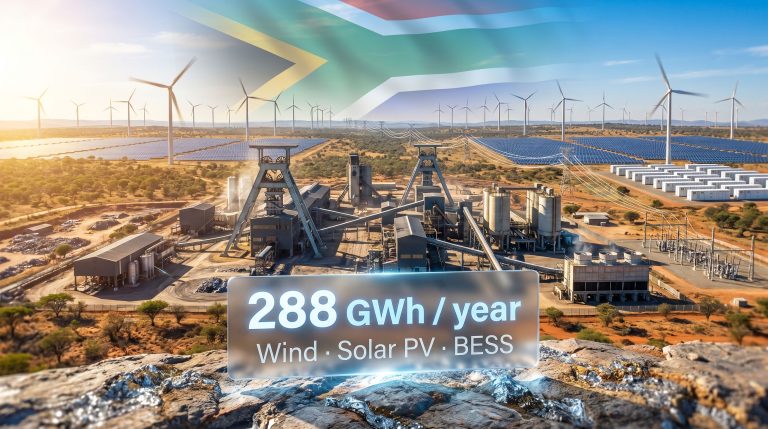
The agreement, announced on July 10, 2026, establishes NOA Group as the renewable electricity supplier to Siyanda Bakgatla Platinum Mine, located in the Swartklip area of Limpopo Province. The deal covers 288 gigawatt-hours of renewable electricity per year, sourced from NOA's combined portfolio of solar photovoltaic, wind, and battery energy storage systems (BESS).
Delivery occurs through a wheeling arrangement across South Africa's national grid, meaning no dedicated physical infrastructure between NOA's generation assets and the mine is required. The contract is structured as a medium-term agreement with an option for extension. Financial terms, including tariff rates, contract duration, and delivery commencement dates, were not publicly disclosed by either party.
Key parameters of the agreement at a glance:
| Parameter | Detail |
|---|---|
| Announcement Date | July 10, 2026 |
| Mine Location | Swartklip, Limpopo Province |
| Mine Type | Platinum Group Metals (PGM) |
| Parent Company | Siyanda Resources |
| Notable Shareholder | Public Investment Corporation (PIC) |
| Annual Supply Volume | 288 GWh |
| Energy Technologies | Solar PV, wind, BESS |
| Delivery Mechanism | Wheeling via national grid |
| Contract Structure | Medium-term with extension option |
| Financial Value | Not disclosed |
Why the PIC's Involvement Matters
Siyanda Resources, the parent company of Siyanda Bakgatla Platinum Mine, counts the Public Investment Corporation among its shareholders. The PIC manages South Africa's largest pool of institutional capital, primarily comprising government employee pension funds. Its involvement as a shareholder adds a layer of institutional credibility to the mine's sustainability commitments, given the PIC's stated mandate to support transformation-aligned and responsible investment practices.
This ownership context also signals that the transition to renewable energy at Siyanda Bakgatla is not merely a cost management decision — it carries stakeholder expectations from one of Africa's most influential asset managers.
How Wheeling Actually Works: A Technical Explanation for Non-Specialists
The wheeling mechanism underpinning the NOA power deal with Siyanda Bakgatla mine is frequently misunderstood, yet it is central to why private renewable power has become commercially scalable in South Africa.
A wheeling arrangement does not involve physically routing electricity from a specific power plant to a specific mine through a dedicated cable. Instead, the generator injects electrons into the national grid at one node, and the consumer draws an equivalent quantum of electricity from the grid at a different node. The commercial and financial settlement between generator and consumer reflects this energy balance, with wheeling charges paid to Eskom for use of its transmission infrastructure.
The practical implications for Siyanda Bakgatla specifically include:
- No capital expenditure required on-site for generation infrastructure
- Access to NOA's geographically diversified solar and wind portfolio, reducing single-source weather-related generation risk
- Battery energy storage system backing provides supply smoothing during periods of low solar irradiance or wind output
- The mine retains grid connectivity as a backup, maintaining operational resilience
The Operating Economics: Modelling the Potential Cost Impact
While the financial terms of the NOA power deal with Siyanda Bakgatla mine were not disclosed, the scale of 288 GWh annually provides a basis for directional analysis.
At South Africa's industrial electricity tariff benchmarks of approximately R1.50 to R2.00 per kilowatt-hour, the mine's annual electricity spend at grid rates would fall in the range of R432 million to R576 million per year. Private renewable wheeling agreements in South Africa have historically been structured to offer discounts of roughly 10 to 25 percent relative to prevailing Eskom industrial tariffs, suggesting potential annual savings of R43 million to R144 million — a material improvement for a mid-tier PGM operation.
Note: These figures are directional estimates based on publicly available Eskom industrial tariff benchmarks and are not derived from the undisclosed terms of the NOA-Siyanda Bakgatla agreement. They should not be treated as financial guidance or forecasts.
Siyanda Bakgatla's Chief Financial Officer, Imraan Osman, confirmed that electricity represents one of the mine's most significant and most difficult costs to control, and that the NOA agreement is expected to deliver three specific operational improvements:
- Cost reduction through tariff rates anticipated to track below Eskom's escalation trajectory over the contract period
- Supply flexibility by diversifying the mine's energy sourcing away from single-source grid dependence
- Carbon footprint reduction by replacing coal-generated grid electricity with certified renewable supply across a large portion of the mine's consumption
The decarbonisation benefits associated with this kind of transition extend well beyond compliance — they increasingly translate into financing advantages and improved relationships with international offtake partners.
The next major ASX story will hit our subscribers first
NOA's Growing Mining-Sector Portfolio: A Pattern Worth Examining
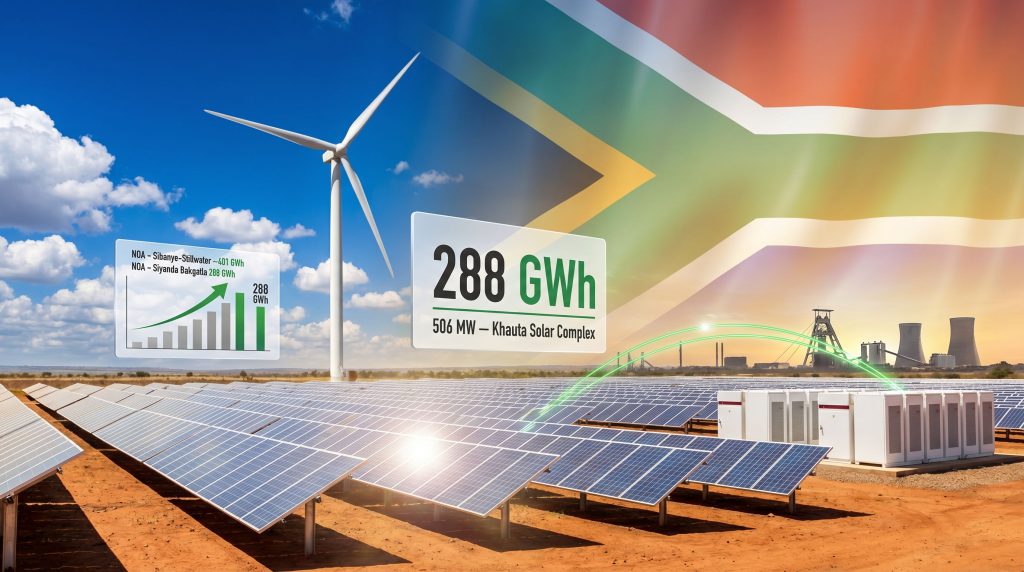
The Siyanda Bakgatla agreement does not stand alone in NOA's commercial history. The company has been systematically building a concentrated mining-sector offtake portfolio that now spans multiple major South African producers. NOA's 401 GWh agreement with Sibanye-Stillwater, for instance, demonstrates the scale at which the company is now operating.
NOA's confirmed mining sector supply agreements as of July 2026:
| Counterparty | Annual Volume | Additional Allocation | Status |
|---|---|---|---|
| Sibanye-Stillwater | ~401 GWh | Up to 100 GWh flexible | Announced February 2026 |
| Pan African Resources | Not disclosed | Not applicable | Active |
| Siyanda Bakgatla Platinum Mine | 288 GWh | Not disclosed | Announced July 2026 |
The Siyanda Bakgatla deal at 288 GWh annually represents approximately 72 percent of the base volume secured with Sibanye-Stillwater, confirming it as a substantial rather than token offtake commitment. Collectively, the confirmed volumes already declared by NOA across Sibanye-Stillwater and Siyanda Bakgatla alone exceed 689 GWh per year, before accounting for the Pan African Resources agreement and the flexible top-up allocation with Sibanye-Stillwater.
The 506 MW Khauta Solar Complex as the Generation Backbone
Underpinning NOA's ability to scale these supply commitments is the company's development of the 506 MW Khauta Solar Complex — its single largest generation asset. At that installed capacity, Khauta would rank among South Africa's largest individual solar developments. Combined with wind generation assets and BESS integration, the total NOA portfolio in development is positioned to simultaneously service multiple large-scale mining offtake agreements.
This generation-to-offtake alignment is strategically important: NOA is not simply brokering third-party power but building owned generation infrastructure designed to deliver on medium-term contractual obligations to some of South Africa's most significant mining companies.
The Broader Structural Shift: South Africa's Mining Industry as a Renewable Energy Market Force
The NOA power deal with Siyanda Bakgatla mine is best understood not as an isolated transaction but as a data point within a structural reorientation of South Africa's industrial electricity market. Mining companies — historically passive recipients of whatever Eskom could supply at whatever price it chose to charge — are rapidly evolving into sophisticated, active energy buyers.
The six forces accelerating this transformation:
| Driver | Mechanism | Effect on Mining Companies |
|---|---|---|
| Eskom tariff escalation | Above-inflation annual increases | Raises long-run cost of grid dependency |
| Load-shedding exposure | Unpredictable supply interruptions | Forces energy source diversification |
| Regulatory liberalisation | Removal of 100 MW licensing cap | Enables direct IPP contracting at scale |
| ESG investor pressure | Scope 2 emissions disclosure requirements | Incentivises renewable procurement |
| Carbon border adjustment risk | Evolving global trade policy | Creates potential long-term cost exposure |
| Wheeling framework maturity | Established grid access agreements | Reduces implementation barriers |
The ESG Dimension: More Than a Reporting Exercise
The shift to renewable electricity at Siyanda Bakgatla directly reduces the mine's Scope 2 greenhouse gas emissions, which represent the indirect emissions generated by purchased electricity. Under the Greenhouse Gas Protocol, Scope 2 emissions are a mandatory disclosure category for companies reporting to frameworks such as the Carbon Disclosure Project and the Global Reporting Initiative.
For a PGM producer with international customers in the automotive catalytic converter supply chain — where sustainability credentials are increasingly scrutinised — demonstrable Scope 2 reductions carry commercial as well as reputational value. In addition, the energy transition demand for PGMs in applications such as hydrogen fuel cells means that mines demonstrating credible decarbonisation progress are better positioned for long-term market relevance.
Mines that can verify lower carbon intensity in their electricity sourcing are better positioned for ESG-linked financing instruments and may face lower exposure to future carbon pricing mechanisms as South Africa's climate policy framework evolves. Furthermore, the broader energy security transition underway globally reinforces the strategic logic of diversifying away from single-source, fossil-fuel-dependent electricity supply.
Frequently Asked Questions About the NOA Power Deal With Siyanda Bakgatla Mine
What is the NOA power deal with Siyanda Bakgatla mine?
It is a renewable electricity supply agreement under which NOA Group will deliver 288 GWh of clean energy annually to the Siyanda Bakgatla Platinum Mine in Limpopo Province, South Africa. The electricity is sourced from NOA's portfolio of solar, wind, and battery storage assets and delivered via a wheeling arrangement using South Africa's national grid.
Why is 288 GWh significant for a single mine?
For context, 288 GWh annually is equivalent to the electricity consumption of approximately 72,000 average South African households per year. For a single PGM mine, it represents a substantial share of total operational electricity demand, particularly for processes such as shaft ventilation, ore milling, and associated processing activities.
What is wheeling and why does it matter for this deal?
Wheeling allows electricity generated at one geographic location to be commercially delivered to a consumer at a different location using the existing national grid as a transmission conduit. It eliminates the need for dedicated physical infrastructure between the generator and the mine, significantly reducing the capital cost and lead time for implementing private renewable energy supply.
What other deals has NOA completed in the mining sector?
Prior to the Siyanda Bakgatla agreement, NOA announced a supply deal with Sibanye-Stillwater covering approximately 401 GWh per year with an additional flexible allocation of up to 100 GWh, announced in February 2026. NOA has also concluded an agreement with Pan African Resources, the terms of which have not been publicly disclosed.
Key Takeaways: What This Agreement Signals for South Africa's Energy Transition
Four strategic conclusions emerge from examining the NOA power deal with Siyanda Bakgatla mine in its full context:
- South Africa's wheeling market has reached operational maturity. The ability to structure and execute a 288 GWh-per-year renewable supply agreement for a remote Limpopo mine confirms that the technical and regulatory infrastructure for private power delivery is now genuinely functional at scale.
- PGM producers are becoming energy market participants, not just consumers. The sophistication of medium-term renewable procurement contracts — combining solar, wind, and battery storage with wheeling delivery — reflects a strategic capability that was not present in the sector five years ago.
- NOA's mining-sector concentration creates durable revenue visibility. By anchoring its generation pipeline to long-dated offtake commitments from established producers including Sibanye-Stillwater, Pan African Resources, and now Siyanda Bakgatla, NOA has constructed a business model with substantially lower revenue uncertainty than merchant power trading.
- Limpopo Province is emerging as a proving ground for renewable mining supply chains. The geographic concentration of PGM operations in Limpopo, combined with improving wheeling infrastructure and a growing pipeline of IPP developers, creates the conditions for a self-reinforcing cluster of private renewable power procurement activity in the region.
The NOA-Siyanda Bakgatla agreement illustrates something more significant than a bilateral commercial transaction. It demonstrates that South Africa's mining industry has crossed a threshold where private renewable energy procurement is no longer an experimental alternative to grid power — it is becoming the default strategic choice for energy-intensive producers seeking cost certainty, supply security, and credible decarbonisation progress simultaneously.
This article contains directional financial estimates based on publicly available benchmark data. These estimates are illustrative and do not represent financial guidance, investment advice, or disclosed contract terms. Readers should conduct independent analysis before making any investment or commercial decisions.
Want to Capitalise on the Mining Sector's Biggest Shifts Before the Market Does?
Discovery Alert's proprietary Discovery IQ model scans ASX announcements in real time, delivering instant alerts on significant mineral discoveries — including opportunities emerging from the structural transformation reshaping energy-intensive sectors like PGMs — so subscribers can act on actionable insights ahead of the broader market. Explore historic discoveries and their returns on Discovery Alert's dedicated discoveries page, and begin your 14-day free trial today to position yourself at the forefront of the next major find.