July 10, 2026
Why South Africa's Platinum Mines Are Rethinking Their Energy Strategy
Across the global mining industry, the cost of energy has quietly become one of the most consequential variables separating profitable operations from struggling ones. For platinum group metals producers in South Africa, this dynamic is particularly acute. The Bushveld Igneous Complex, which hosts the world's largest known reserves of platinum, palladium, rhodium, and iridium, also hosts some of the most energy-intensive underground mining operations on earth. Deep-level mechanised extraction, ventilation systems, hoisting infrastructure, and processing facilities all consume electricity at a scale that makes energy pricing a direct determinant of mine viability.
Against this backdrop, the Siyanda Bakgatla Platinum Mine renewable energy wheeling deal represents more than a single procurement decision. It reflects a structural shift in how South African PGM producers are managing their exposure to electricity costs, supply interruptions, and growing decarbonisation pressure from international customers and investors.
When big ASX news breaks, our subscribers know first
Understanding the Siyanda Bakgatla Platinum Mine Renewable Energy Wheeling Deal
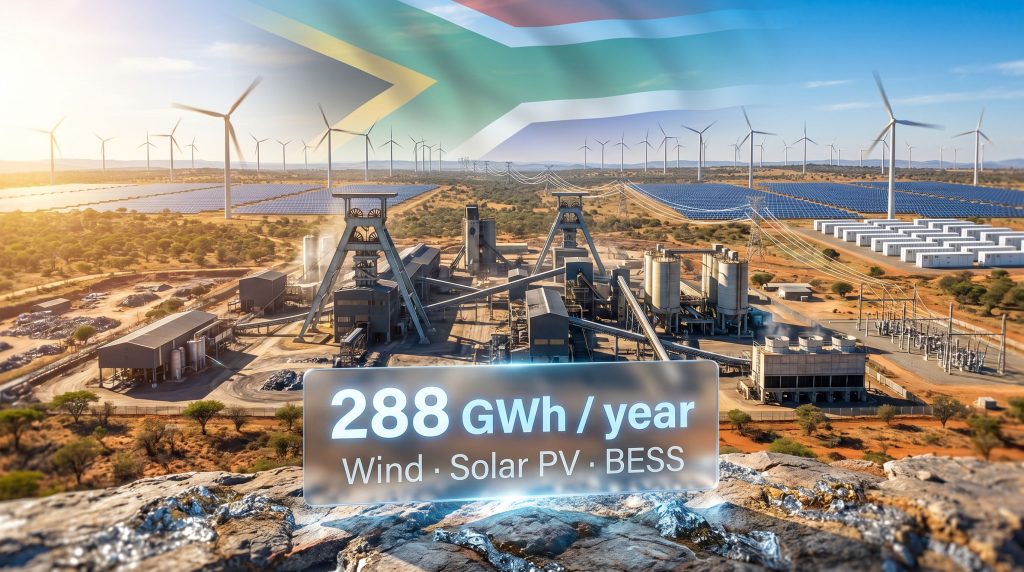
At its core, the agreement is straightforward in intent, though sophisticated in structure. NOA Group, a South African renewable energy in mining solutions provider focused on large industrial customers, will supply 288 gigawatt-hours of renewable electricity per year to Siyanda Bakgatla Platinum Mine, located in Swartklip in Limpopo province. That volume is transmitted not through dedicated private infrastructure, but across South Africa's national transmission grid, using a mechanism known as energy wheeling.
The agreement commences as a medium-term arrangement with an option to extend into a longer-term procurement relationship. Solink Energy served in an advisory and facilitation capacity as the wheeling broker, a role that reflects the growing complexity of navigating South Africa's evolving grid access rules and independent power producer frameworks.
Siyanda Bakgatla Platinum Mine is a subsidiary of Siyanda Resources, in which the Public Investment Corporation, South Africa's state-owned institutional investment manager, holds a significant shareholding. That ownership structure adds a layer of institutional accountability and developmental mandate to the mine's operational and environmental decisions.
The mine's workforce of approximately 5,300 permanent employees and 2,800 contractors means that operational sustainability decisions, including energy procurement, carry direct social consequences for thousands of families in the Limpopo region.
How Energy Wheeling Works: The Mechanics Behind the Deal
Grid Transmission vs. On-Site Generation
Energy wheeling is a procurement model that allows an industrial customer to purchase electricity generated at a remote site and have it delivered via the existing national grid. In South Africa, this means the electricity produced by NOA Group's generation assets travels through Eskom's transmission infrastructure before being consumed at the mine in Swartklip.
This is fundamentally different from on-site generation, such as a rooftop solar array or a captive wind turbine installed directly at the mine. While on-site generation has its place for smaller supplemental loads, it is rarely sufficient to meet the baseload demands of a large underground PGM operation running continuous production shifts around the clock. Wheeling solves this by decoupling the physical location of generation from the physical location of consumption.
A key cost consideration in any wheeling transaction is the wheeling charge: a tariff paid to the grid operator for the use of transmission infrastructure. This charge is baked into the total landed energy cost and must be weighed against the savings achieved through competitive renewable tariffs versus standard Eskom grid pricing. Furthermore, mining energy transition strategies increasingly treat wheeling as a core tool rather than an alternative option.
The Generation Portfolio Powering Siyanda Bakgatla
The electricity being wheeled to the mine is not sourced from a single technology. NOA Group's LinkedIn announcement confirms that their generation fleet behind this deal combines:
- Wind power for consistent overnight and shoulder-period generation
- Photovoltaic solar for daytime peak generation capacity
- Battery energy storage systems (BESS) for load-shifting, grid stability, and bridging intermittency gaps between wind and solar output
This blended approach is increasingly considered best practice for mining wheeling agreements. A single-technology supply, such as solar-only, creates predictable daily output gaps that are problematic for operations requiring 24-hour electricity continuity. By combining wind, solar, and storage, NOA Group's portfolio can deliver a far more consistent and reliable supply profile suited to underground mining's uninterrupted operational demands.
Blended renewable generation portfolios reduce what industry practitioners call single-technology output variability*, a risk that becomes operationally unacceptable when even brief power disruptions can halt underground equipment, compromise ventilation systems, or create safety hazards.*
The Energy Economics of Underground Platinum Mining
Why Electricity Costs Are So Difficult to Control
Underground PGM mining is among the most electricity-intensive industrial processes in the world. Ventilation alone, required to maintain safe atmospheric conditions in deep workings, can account for a substantial share of total site electricity consumption. Add hoisting, ore processing, compressed air systems, pumping, and surface infrastructure, and the energy bill becomes one of the largest and most structurally rigid cost lines on a mine's income statement.
What makes this particularly challenging in South Africa is that Eskom's tariffs have increased at rates substantially above inflation for many consecutive years. Between 2010 and the mid-2020s, industrial electricity tariffs in South Africa increased by several hundred percent in nominal terms, according to data tracked by the South African minerals industry. For energy-intensive operations like PGM mines, this trajectory has materially compressed margins, particularly during periods of softer platinum and palladium market prices.
Compounding the tariff issue is the reliability problem. South Africa experienced severe load-shedding cycles in recent years, with scheduled power cuts reaching up to Stage 6 in intensity during the worst periods. For a mine running continuous underground operations, unplanned power interruptions create safety risks, damage equipment, reduce throughput, and erode workforce productivity.
What the 288 GWh Deal Delivers Operationally
The operational benefits delivered by the Siyanda Bakgatla Platinum Mine renewable energy wheeling deal can be mapped across four dimensions:
| Operational Benefit | Mechanism | Strategic Relevance |
|---|---|---|
| Cost Predictability | Structured renewable tariff below Eskom escalation trajectory | Protects margins across the commodity price cycle |
| Supply Reliability | Diversified wind, solar, and BESS fleet reduces outage risk | Critical for continuous underground operations |
| Workforce Sustainability | Energy savings protect the economic base for 8,100+ workers | Social licence and community investment capacity |
| Decarbonisation | Renewable sourcing reduces Scope 2 carbon emissions intensity | Meets pressure from OEM customers and ESG investors |
The mine's Chief Financial Officer noted publicly that energy represents one of the most difficult cost lines to manage at scale, and that improvements in both pricing and reliability directly strengthen the operation's capacity to sustain employment, invest in people, and continue community development programs. The deal was described as delivering meaningful cost relief, supply flexibility, and a credible pathway to reducing the mine's carbon footprint.
The Parties: Who Is Behind This Agreement?
NOA Group's Industrial Energy Philosophy
NOA Group has positioned itself as a provider that structures energy solutions around each customer's specific production profile, operational requirements, and commercial objectives rather than offering standardised off-the-shelf contracts. For a mine like Siyanda Bakgatla, which operates at a scale requiring continuous baseload supply, that tailored approach is essential.
NOA Group's CEO Karel Cornelissen has publicly described high-quality South African mining operations as precisely the type of customer for which flexible, large-scale renewable energy solutions deliver the greatest value, combining price certainty, cost savings relative to grid alternatives, and measurable progress toward decarbonisation goals.
Siyanda Resources and the Bakgatla-Ba-Kgafela Community
The mine's ownership history is worth understanding in detail. Siyanda Bakgatla Platinum Mine was acquired in 2018 from what was then Anglo American Platinum, the asset now operating under the Valterra Platinum brand following that company's rebranding. The acquisition was structured as a three-way partnership involving Siyanda Resources, the Bakgatla-Ba-Kgafela community, and employee shareholders.
This tripartite model is relatively uncommon in its depth of community and employee equity participation. Rather than a nominal community stake, the Bakgatla-Ba-Kgafela community holds a meaningful ownership interest, meaning energy cost reductions and operational improvements translate directly into value for a community that depends on the mine's sustained operation.
Benchmarking the Deal Within the PGM Sector
The 288 GWh per year volume secured by Siyanda Bakgatla positions this agreement among the more substantial off-site renewable procurement deals completed by a South African platinum mine. For context, the broader PGM sector has become one of the most active adopters of renewable wheeling structures. The South African platinum outlook more broadly reflects this accelerating transition toward energy independence.
| Mining Operation | Renewable Deal Structure | Approximate Annual Volume | Status |
|---|---|---|---|
| Siyanda Bakgatla Platinum Mine | NOA Group wheeling (wind, solar PV, BESS) | 288 GWh/year | Active (2026) |
| Anglo American Platinum (Valterra) | 20-year PPA with Envusa Energy | Multi-TWh over contract term | Scheduled for 2026 operation |
| Sibanye-Stillwater | PPA for 140 MW Umsinde Emoyeni Wind Farm | ~350-400 GWh/year (estimated) | Expected Q4 2026 |
| Impala Platinum (Implats) | Discovery Green wheeling deal | 130,000+ MWh/year | From 2026 |
Note: Volume figures for peer operations are estimates based on publicly available reporting and capacity announcements. Readers should verify current data independently before making any investment or commercial decisions based on information contained herein.
The next major ASX story will hit our subscribers first
The Decarbonisation Imperative Driving These Decisions
Scope 2 Emissions and the Automotive Supply Chain
One aspect of these renewable energy deals that receives less attention than energy cost savings is their role in addressing Scope 2 carbon emissions, which are emissions generated by purchased electricity. For PGM producers, this has become an increasingly significant commercial issue rather than merely a reputational one. In addition, the broader mining decarbonisation benefits extend well beyond individual mine economics.
Platinum and palladium are primarily purchased by automotive manufacturers for catalytic converters, while platinum also plays a growing role in hydrogen fuel cell technology. Both catalytic converter and hydrogen fuel cell applications are central to global decarbonisation strategies, yet the automakers deploying these technologies face intense scrutiny over the carbon intensity of their supply chains. European OEMs in particular have implemented supply chain due diligence requirements that include upstream Scope 2 emissions performance.
A PGM mine that can demonstrate verified renewable electricity consumption has a tangible commercial advantage in securing long-term offtake relationships with manufacturers that have committed to carbon neutrality across their value chains.
South Africa's Regulatory Liberalisation as an Enabling Context
The wave of renewable energy wheeling deals now flowing through the South African mining sector has been enabled by progressive regulatory reform in the country's energy market. Amendments to the Electricity Regulation Act and the removal of licensing thresholds for embedded generation projects opened pathways for large industrial consumers to contract directly with independent power producers at a scale previously unavailable.
This regulatory liberalisation did not happen quickly. It followed years of advocacy by the Minerals Council South Africa, load-shedding crises that made energy security a national economic emergency, and gradual acknowledgment that Eskom alone could not reliably serve South Africa's industrial base. Consequently, Chariot-backed Etana's 220MW deal with Sibanye-Stillwater exemplifies how the current environment, where deals like the Siyanda Bakgatla wheeling agreement are commercially viable and regulatorily navigable, is the product of a decade of structural change.
What the Extension Optionality Signals to the Market
One detail in the deal structure that deserves closer analysis is the extension mechanism built into the medium-term agreement. The optionality to extend into a longer-term arrangement is not merely a contractual formality. It signals that both Siyanda Bakgatla Platinum Mine and NOA Group have confidence in the durability of South Africa's wheeling infrastructure, tariff framework, and regulatory environment over an extended horizon.
For a mine planning workforce commitments, capital allocation, and community investment programs across multi-year cycles, this kind of energy certainty is foundational. The Siyanda Bakgatla Platinum Mine renewable energy wheeling deal is, in this sense, as much a statement about the mine's long-term operational confidence as it is a procurement transaction.
Disclaimer: This article contains references to industry estimates, market comparisons, and forward-looking operational observations. These should not be construed as financial advice. Investors and industry participants should conduct independent due diligence before making any commercial or investment decisions based on information contained herein.
Frequently Asked Questions
What is the Siyanda Bakgatla Platinum Mine wheeling deal?
It is a renewable energy supply agreement under which NOA Group will deliver 288 GWh of electricity per year to Siyanda Bakgatla Platinum Mine in Swartklip, Limpopo, transmitted across South Africa's national grid using a diversified portfolio of wind, solar PV, and battery energy storage facilities.
Where is Siyanda Bakgatla Platinum Mine located?
The mine is located in Swartklip, Limpopo province, within the Bushveld Igneous Complex, the world's largest known repository of platinum group metals.
Who owns Siyanda Bakgatla Platinum Mine?
Ownership is divided among Siyanda Resources, the Bakgatla-Ba-Kgafela community, and employee shareholders. The Public Investment Corporation holds a significant stake in Siyanda Resources. The mine was acquired from the entity now known as Valterra Platinum in 2018.
How large is the workforce at the mine?
The mine employs approximately 5,300 permanent staff and 2,800 contractors, making workforce sustainability a central consideration in the mine's energy strategy.
What role does Solink Energy play?
Solink Energy served as the wheeling broker and advisor, facilitating the transaction and helping navigate the regulatory and grid access requirements associated with large-scale renewable energy wheeling in South Africa.
Want to Track the Next Major Mineral Discovery Before the Market Does?
Discovery Alert's proprietary Discovery IQ model delivers real-time alerts on significant ASX mineral discoveries, turning complex mineral data into actionable insights for both short-term traders and long-term investors. Explore Discovery Alert's dedicated discoveries page to see how historic finds have generated substantial returns, and begin your 14-day free trial today to position yourself ahead of the market.