July 10, 2026
The Hidden Cost of Corrosion: Why Steel Protection Is a Global Engineering Priority
Steel is not permanent. Left unprotected in the environments where it is most commonly deployed, it begins to degrade almost immediately. Moisture, oxygen, chloride ions, and industrial chemicals work together in an electrochemical process that consumes ferrous metal from the outside in, silently eroding structural integrity across bridges, mining headframes, port cranes, and transmission towers. Zinc metal coating for steel corrosion protection has consequently become one of the most critical disciplines in modern infrastructure engineering.
The financial consequences of this degradation are staggering. Corrosion costs industrialised economies an estimated 3 to 4 percent of GDP annually, with heavy industry and infrastructure sectors absorbing the largest share of those losses. In practical terms, this translates to billions of dollars in unplanned maintenance, emergency repairs, premature asset replacement, and production downtime across mining, construction, marine, and energy sectors every year.
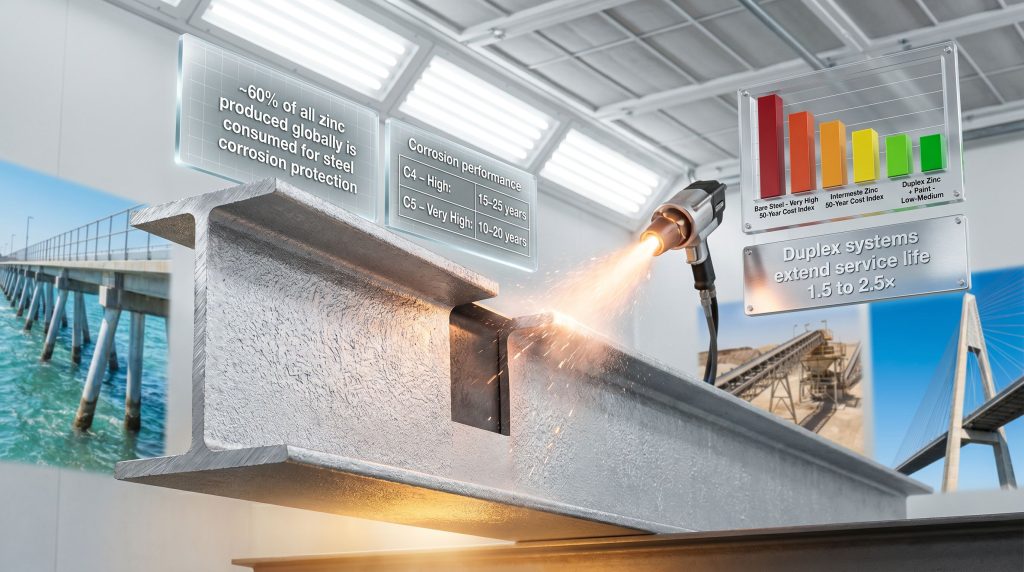
What makes this particularly significant is that the majority of these costs are avoidable. Lifecycle cost modelling consistently demonstrates that investing in high-performance corrosion protection systems at the point of construction delivers a return on investment that far outweighs the upfront application cost. Approximately 60% of all zinc produced globally is consumed specifically for steel corrosion protection, a figure that reflects the degree to which industry has already accepted zinc as its primary defensive mechanism against structural degradation.
"Corrosion management is not an operational expense, it is a capital preservation strategy. Organisations that approach coating selection through a lifecycle cost lens rather than a minimum-compliance mindset consistently achieve lower total ownership costs over multi-decade asset lifespans."
Furthermore, the broader industrial landscape is shifting. Steel and aluminium tariffs are reshaping global supply chains, placing additional pressure on asset owners to extend the usable lifespan of existing steel structures rather than face costly replacements. Mining operations, port infrastructure, power transmission networks, and large-scale industrial facilities all share a common characteristic: they represent multi-decade capital commitments where structural degradation directly erodes financial returns.
When big ASX news breaks, our subscribers know first
What Makes Zinc the Preferred Element for Steel Corrosion Protection
The reason zinc metal coating for steel corrosion protection has become the globally dominant methodology lies not in convention, but in fundamental electrochemistry. Zinc sits above iron in the galvanic series, which means it is anodic to steel. When both metals are present within an electrolytic environment — any environment containing moisture — zinc will oxidise preferentially, sacrificing itself to preserve the structural integrity of the underlying steel.
This property creates a two-layer defence mechanism that no purely barrier-based system can replicate:
| Protection Mechanism | How It Functions | Practical Benefit |
|---|---|---|
| Barrier Protection | Zinc physically isolates steel from oxygen and moisture | Prevents electrochemical corrosion at the substrate level |
| Cathodic (Sacrificial) Protection | Zinc oxidises preferentially at any breach in the coating | Steel remains protected even when the coating sustains mechanical damage |
The second mechanism, cathodic protection, is what fundamentally differentiates zinc-based systems from conventional paint or epoxy coatings. A standard paint film fails catastrophically at damage points. Once a scratch or impact exposes bare steel beneath a non-zinc coating, corrosion begins immediately at the exposed site. According to corrosion protection research from the American Galvanizers Association, zinc-coated steel behaves differently: the zinc surrounding any breach continues to electrochemically protect the exposed steel, preventing rust formation across a zone extending well beyond the damaged area itself.
What Is the Zinc Carbonate Patina?
There is a third protective mechanism that is less widely understood: the zinc carbonate patina. As zinc reacts with atmospheric carbon dioxide and moisture, it forms a stable, tightly adherent mineral compound on the coating surface. This natural patina dramatically reduces the rate of ongoing zinc consumption, with research indicating it can slow further corrosion by a factor of 10 to 100 times compared to unprotected steel, depending on environmental conditions. The practical implication is that zinc coatings become progressively more stable over time rather than deteriorating at a constant rate.
Zinc Thermal Spraying vs. Other Application Methods
Understanding which zinc application method is most appropriate for a given asset requires familiarity with the full range of available technologies. Each method delivers zinc-based protection through a fundamentally different process, with distinct performance characteristics and application constraints.
| Application Method | Process | Typical Thickness | Best Application |
|---|---|---|---|
| Hot-Dip Galvanising | Steel immersed in 450°C molten zinc bath | 45–200 µm | Fabricated structural components |
| Zinc Thermal Spraying | Molten zinc projected via flame or electric arc | 100–300+ µm | Large structures, in-situ field applications |
| Electro-Galvanising | Electrochemical zinc deposition | 5–25 µm | Fasteners, automotive precision parts |
| Zinc-Rich Paint | Primer with >77% zinc in dry film | 50–75 µm | Maintenance coatings, repair applications |
| Sherardising | Zinc powder diffusion at elevated temperature | 15–30 µm | Small parts, threaded fasteners |
Why Zinc Thermal Spraying Dominates Large-Scale and In-Situ Applications
Hot-dip galvanising remains the most cost-effective method for factory-fabricated steel components that can be transported to a galvanising facility. However, its application is fundamentally constrained by the physical dimensions of available zinc kettles. Large structures, installed infrastructure, and complex assemblies cannot be immersed.
Zinc thermal spraying, also referred to as zinc metallising, addresses this limitation directly. The process projects molten zinc particles onto the prepared steel surface using one of two methods:
- Combustion (flame) spraying: Zinc wire or powder is melted using an oxygen-fuel gas flame, with molten droplets propelled toward the substrate by compressed gas
- Electric arc spraying: An electrical arc is struck between two zinc wire electrodes within the spray gun, atomising the molten zinc into fine particles that bond mechanically upon impact with the steel surface
Electric arc spraying delivers higher deposition rates and greater coating density than flame spraying, making it the preferred method for large-scale industrial and infrastructure applications. Flame spraying equipment, however, offers greater portability and lower capital cost, which suits smaller field operations or remote site access scenarios.
Critically, thermal spraying can be performed entirely on-site without dismantling or transporting the structure. This characteristic makes it particularly practical for operational mine sites, installed bridge structures, port cranes, and transmission towers, where production continuity and structural constraints make removal impossible.
Service Life by Corrosion Environment: What to Expect
One of the most important and least understood aspects of zinc coating specification is that service life is not fixed. It varies significantly based on coating thickness and the aggressiveness of the environment. Industry classification frameworks provide a structured basis for estimation.
| Corrosion Category | Typical Environment | Estimated Service Life |
|---|---|---|
| C1 – Very Low | Dry, heated indoor spaces | 100+ years |
| C2 – Low | Unheated indoor, rural outdoor | 50–100 years |
| C3 – Medium | Urban and light industrial | 25–50 years |
| C4 – High | Industrial zones, coastal areas | 15–25 years |
| C5 – Very High | Aggressive industrial, marine splash zones | 10–20 years |
| CX – Extreme | Offshore, chemical processing | 5–15 years |
"These estimates assume correct surface preparation to at least Sa 2.5 blast cleaning standard per ISO 8501-1, appropriate coating thickness, and no significant mechanical damage during service. Actual performance will vary based on localised environmental conditions and maintenance history."
Coating thickness is the primary lever available to specifiers seeking to extend service life within a given corrosion category. Because zinc protection is consumed progressively through sacrificial corrosion, a thicker coating simply contains a larger zinc reservoir. A 200 µm thermal spray coating in a C4 industrial environment will, under otherwise identical conditions, deliver approximately twice the service life of a 100 µm coating.
Advanced Systems: Duplex Coatings and Zinc Alloys
For assets operating in the most aggressive corrosion categories, zinc coatings alone may not achieve the desired maintenance interval. Two technology pathways extend performance further.
Duplex Coating Systems
A duplex system combines a metallic zinc coating with an organic topcoat, typically a paint or powder coating system. The protective benefit is multiplicative rather than simply additive: the paint layer shields the zinc from direct environmental exposure, dramatically reducing the rate at which the zinc reservoir is consumed. If the paint layer is eventually breached, the zinc beneath continues to provide electrochemical protection.
Research indicates duplex systems can extend service life by a factor of 1.5 to 2.5 times compared to either the zinc coating or the paint system deployed in isolation. For assets in C5 or CX environments, duplex specifications are frequently the only approach capable of achieving a 20 to 30 year maintenance-free interval.
Zinc Alloy Coatings
Alloying zinc with other metals can substantially enhance specific performance characteristics:
| Alloy System | Composition | Key Advantage |
|---|---|---|
| Galfan | Zn + 5% Al | Superior corrosion resistance with improved formability |
| Galvalume | Zn + 55% Al + 1.6% Si | Exceptional combined heat and corrosion resistance |
| Zinc-Nickel | Zn + 12–15% Ni | Exceeds 720 hours salt spray resistance; automotive-grade |
| Zinc-Magnesium | Zn + Mg alloy | Enhanced cut-edge protection for thin-gauge steel products |
Critical Sectors: Where Zinc Metal Coating Delivers the Greatest Value
Mining Infrastructure
Mining environments present one of the most demanding combinations of corrosion drivers encountered anywhere in industry. Mechanical abrasion, acid mine drainage, process chemical exposure, high humidity, and temperature cycling occur simultaneously on the same structural steel. Furthermore, the broader steel market challenges facing global producers are intensifying the need for asset owners to maximise the operational lifespan of existing structures rather than replace them prematurely.
Processing plant steelwork, conveyor systems, headframes, and tailings infrastructure all face accelerated degradation without adequate protection. The ability to apply zinc thermal spraying in the field, directly onto installed structures without production shutdown, makes it uniquely suited to operating mine sites.
Marine and Coastal Infrastructure
Chloride ions present in seawater and coastal atmospheres are among the most potent accelerants of steel corrosion. The electrochemical reaction rate in marine splash zones can be orders of magnitude higher than in dry inland environments. Jetties, offshore platforms, port cranes, and vessel infrastructure require corrosion protection systems capable of performing reliably across decades of continuous saltwater exposure.
Nordic Galvanizers' research on zinc coating corrosion rates confirms that zinc thermal spraying is recognised under international standards, including ISO 2063 and AS/NZS 4506, as an approved methodology specifically for corrosion protection of marine steel structures. The combination of coating thickness flexibility and in-situ application capability makes it one of very few practical options for large installed marine assets.
Civil Infrastructure: Bridges and Transmission Towers
Large civil infrastructure assets, including road and rail bridges, electrical transmission towers, and major industrial buildings, are typically too large for hot-dip galvanising and must be protected in place. These structures commonly carry design lifespans of 50 to 100 years, making long service intervals and minimal maintenance requirements a functional necessity rather than merely a cost preference.
The next major ASX story will hit our subscribers first
Step-by-Step Application: From Surface Preparation to Quality Assurance
The performance of any zinc thermal spray coating depends as much on the quality of surface preparation and application control as on the coating material itself. The following sequence represents established best practice:
- Surface preparation: Abrasive blast cleaning to Sa 2.5 (near-white metal) per ISO 8501-1, with a surface profile of 50–100 µm. Contamination from oil, mill scale, or moisture will cause premature delamination regardless of application quality.
- Equipment selection and calibration: Arc spray for high-volume industrial applications; flame spray for portable or lower-volume scenarios. Wire feed rate, spray distance, and angle must be controlled within specified tolerances.
- Coating application: Multiple passes are required to build specified thickness without overheating or porosity. Overlap between passes must be maintained, particularly at edges, welds, and complex geometry transitions.
- Inspection and testing: Thickness verification using magnetic dry film thickness gauges per ISO 2808; adhesion testing via pull-off test per ISO 4624; visual defect assessment. All measurements and environmental conditions are documented as part of the quality assurance record.
- Sealer and topcoat application (duplex systems only): A sealer coat fills surface porosity before intermediate and topcoat layers are applied. Paint system compatibility with the zinc substrate must be verified prior to specification.
Lifecycle Cost Analysis: The Investment Case for Zinc Metal Coating
The most persistent barrier to adoption of premium zinc coating systems is the upfront cost differential relative to standard paint systems. This framing, however, misrepresents the actual financial comparison.
| Protection Strategy | Initial Cost | Recoating Frequency | 50-Year Total Cost Index |
|---|---|---|---|
| Bare steel (no coating) | Low | Frequent emergency repairs | Very High |
| Standard paint system | Low to Medium | Every 5–10 years | High |
| Zinc thermal spray | Medium to High | Every 15–30+ years | Medium |
| Duplex (zinc + paint) | High | Every 25–50 years | Low to Medium |
| Hot-dip galvanising | Medium | Minimal | Low |
The true cost of a paint-only system on a large industrial structure includes not just material and labour for periodic recoating, but also the scaffold erection, production shutdown, surface preparation costs at each recoating cycle, and the compounding risk of undetected corrosion between inspection intervals. In addition, innovations in green iron production and hydrogen iron reduction are beginning to influence the broader steel sector, with sustainability considerations increasingly factoring into long-term asset protection strategies.
When these factors are incorporated into a genuine 30 to 50 year total cost model, zinc-based systems, particularly thermally sprayed coatings on large structures where hot-dip galvanising is not feasible, consistently demonstrate a lower total ownership cost. Consequently, green steel pricing dynamics are also beginning to shape how asset owners weigh the long-term value of premium protective coatings against evolving material costs.
"The question for asset owners in mining, marine, and infrastructure sectors is not whether zinc metal coating for steel corrosion protection is worth the investment. The more precise question is which zinc system, at which specified thickness, in which environmental category, delivers the optimal balance of upfront cost and long-term maintenance deferral for a given asset's expected service life."
Disclaimer: Service life estimates, cost comparisons, and performance data presented in this article are based on published industry standards and general engineering references. Actual performance outcomes will vary based on site-specific conditions, application quality, and environmental factors. This article is intended for informational purposes only and does not constitute engineering advice. Readers should consult qualified corrosion engineers for project-specific specifications.
Want to Know Which ASX Mineral Discoveries Could Deliver Exceptional Returns?
Discovery Alert's proprietary Discovery IQ model scans ASX announcements in real time, instantly identifying high-potential mineral discoveries across more than 30 commodities — the same kind of transformative finds that have historically generated substantial returns for early-positioned investors, as showcased on Discovery Alert's dedicated discoveries page. Begin your 14-day free trial today and gain a market-leading edge before the broader market catches on.