August 5, 2026
When Labour Meets Leverage: Understanding the Economics Behind Australia's Biggest Mining Port Dispute
Few industries expose the raw tension between capital returns and workforce compensation as viscerally as bulk commodity mining. When a single port facility generates revenues measured in the hundreds of millions per day, and the workers powering that throughput are earning wages that lag similarly-classified roles by tens of thousands of dollars annually, the conditions for industrial conflict become almost structurally inevitable. The BHP Port Hedland strike action now unfolding in Western Australia is not simply a wages dispute. It is a stress test of how Australia's resources sector balances record profitability against the expectations of the workforce that makes it possible.
When big ASX news breaks, our subscribers know first
Seven Months of Deadlock: How the Bargaining Process Broke Down
Enterprise agreement negotiations between BHP and the Combined Ports Unions coalition began with the routine optimism that typically characterises Pilbara bargaining rounds. Seven months later, that optimism has given way to a formal five-day strike notice, with between 150 and 200 unionised port and maintenance workers from a total workforce of approximately 450 preparing to walk off the job on July 16, 2026.
The core disagreement is stark in its specificity. Workers are seeking a AU$25,000 pay rise and the elimination of wage disparities of up to AU$40,000 that currently exist between employees performing functionally identical roles under different contract arrangements. That second point is particularly significant and often underreported in general coverage of the dispute. The existence of parallel wage structures for equivalent work, sometimes within the same operational area, creates a form of internal inequity that is difficult for union representatives to accept as anything other than a deliberate cost-reduction mechanism.
Beyond the headline wage figures, unions have flagged working conditions and safety standards as non-negotiable components of any settlement. In Pilbara port operations, where the scale and physical intensity of work is among the highest of any Australian industrial environment, these concerns carry genuine operational weight.
The Unions Behind the Action
The Combined Ports Unions coalition represents a notably broad front of organised labour:
- The Electrical Trades Union (ETU) achieved a 100% member vote in favour of strike action, a result that signals near-total workforce alignment on the key demands.
- The Australian Manufacturing Workers' Union (AMWU) recorded an 89.4% approval rate in its own strike ballot, reinforcing that the ETU result was not an outlier.
- The Australian Workers' Union (AWU) had a formal ballot pending at the time of reporting.
- The Western Mine Workers Alliance rounds out the coalition, lending additional structural weight to the collective bargaining position.
High ballot approval figures matter in industrial disputes. They signal to employers that union representatives have genuine backing for escalation, rather than a fragmented or reluctant membership. In this case, the vote numbers remove any ambiguity about workforce intent. Reuters reporting on the strike ballot confirms the breadth of support across the unions involved.
The Financial Stakes of an Eight-Hour Window
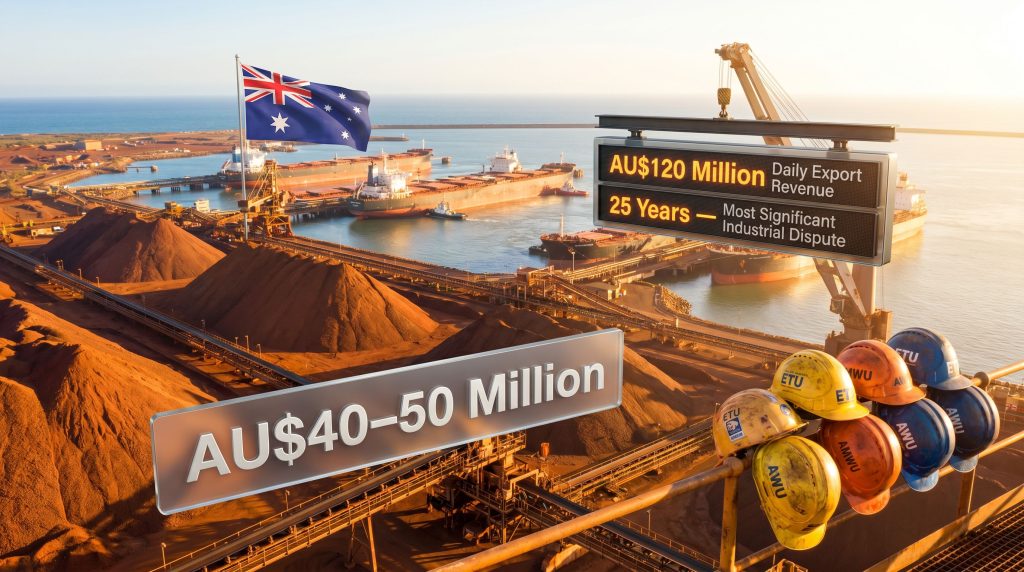
Port Hedland is not merely Australia's largest bulk export hub. It is the world's largest iron ore export terminal by volume. On any given operating day, BHP's Pilbara iron ore shipments moving through the facility generate up to AU$120 million in export revenue. The Western Australian government collects approximately AU$6.85 million in royalties for each day of full operational capacity. The WA resources sector contribution to state finances makes these royalty figures a matter of genuine public interest, not merely a corporate accounting concern.
The planned eight-hour stoppage, scheduled between 2 PM and 10 PM on July 16, is estimated to cost BHP between AU$40 million and AU$50 million in lost revenue. The union coalition's deliberate selection of a so-called "double-up day" amplifies this figure considerably. On these days, elevated staff numbers are rostered specifically for critical maintenance tasks and operational handovers. The compounding effect of disrupting both loading operations and the maintenance cycles that underpin them means the downstream impact extends well beyond the eight hours of the formal action itself.
| Factor | Detail |
|---|---|
| Strike Duration | 8 hours |
| Strike Date | July 16, 2026 |
| Strike Window | 2 PM to 10 PM |
| Shift Type Targeted | Double-up maintenance and handover day |
| Estimated BHP Revenue Loss | AU$40 million to AU$50 million |
| Daily Export Revenue Potential | Up to AU$120 million |
| WA Government Royalties at Risk | AU$6.85 million per day |
This is a sophisticated operational calculation, not a blunt instrument. Port logistics at the scale of Port Hedland are governed by carefully sequenced vessel scheduling, tidal windows, and berth allocation systems. When a high-staffing shift is disrupted, the cascading effects on vessel queuing, loading completion times, and scheduled maintenance windows can extend disruption across subsequent shifts even after workers return. Furthermore, understanding WA iron ore logistics helps contextualise just how sensitive the entire supply chain is to even brief operational interruptions.
Profitability as a Bargaining Argument: The AU$100 Billion Question
One of the most rhetorically powerful elements of the union case is the framing of BHP's financial performance as a direct counterpoint to wage demands. Union representatives have consistently highlighted that BHP generated more than AU$100 billion in cumulative profit over the past five years. Against that backdrop, a AU$25,000 pay rise request does not occupy the same moral or financial territory as a demand placed on a company operating on thin margins.
This argument is not unique to the Port Hedland dispute. Across Australia's Pilbara operations more broadly, the gap between corporate earnings and workforce wage growth has become a recurring fault line in enterprise bargaining. What makes the current situation distinctive is the documented structural inequity, specifically the wage gap of up to AU$40,000 for equivalent roles, which gives unions a concrete and auditable grievance rather than a generalised claim about fairness.
The contrast between resource sector profit cycles and workforce wage outcomes is a structural feature of the Australian mining industry, not an anomaly. When commodity prices and production volumes align favourably, corporate earnings can grow exponentially while enterprise agreement wages move incrementally, creating compounding gaps that take years of bargaining to close.
What BHP Has Said and What It Has Already Done
BHP's public response to the strike notice has been measured. The company confirmed it has contingency strategies in place to protect supply chain continuity and maintain safe operations during any industrial action. Its stated preference remains a negotiated outcome described as fair, competitive, and reasonable.
The company has also pointed to a recently concluded non-union-backed enterprise agreement covering approximately 1,800 workers at its South Flank and Mining Area C mine sites as evidence of its capacity to reach acceptable outcomes. That deal, finalised the week before the strike notice was issued, covers a significantly larger employee cohort but in a different operational context, namely mine site operations rather than port and maintenance functions.
Union representatives have questioned whether the terms of the mine site agreement are directly applicable to port workers, whose role profiles, operational conditions, and contribution to throughput revenue differ in material ways. This distinction matters because BHP's use of the South Flank agreement as a reference point implicitly argues that its offer to port workers is comparably structured, a position the unions contest. Reporting from The Australian suggests some ground has already been conceded by BHP as negotiations have progressed.
Government Positioning: Support Without Intervention
Both state and federal political figures have navigated the dispute carefully. WA Premier Roger Cook acknowledged the workers' legal entitlement to engage in protected industrial action under Australia's Fair Work framework while urging both parties toward a negotiated resolution. Federal Resources Minister Madeleine King expressed confidence that a settlement remained achievable without taking a position on the specific terms under negotiation.
Under Australian industrial law, protected action within enterprise bargaining is a recognised mechanism, not an exceptional circumstance. Direct political intervention to halt the action would require extraordinary justification. The posture adopted by both Cook and King reflects an awareness that being seen to suppress legitimate bargaining rights in a high-profile resources dispute carries its own political risk, particularly in a state economy heavily dependent on mining workforce relations remaining functional over the long term.
The next major ASX story will hit our subscribers first
The July 15 Meeting: A Last-Chance Threshold
A high-stakes negotiation session between BHP and union representatives is scheduled for July 15, 2026, one day before the planned walkout. ETU WA Secretary Adam Woodage has characterised this meeting as the final realistic window for BHP to demonstrate sufficient movement on the core issues to justify suspending the action.
The range of outcomes from that meeting maps to a relatively clean set of scenarios:
| Scenario | Driving Condition | Likely Outcome |
|---|---|---|
| Agreement Reached on July 15 | BHP makes substantive wage concession | Strike suspended or withdrawn |
| Partial Progress Only | Incremental offer tabled | Strike proceeds, further talks continue |
| No Agreement Reached | Positions remain entrenched | Strike proceeds July 16 as planned |
| Post-Strike Escalation | July 16 action completes without resolution | Additional protected action ballots likely |
The multi-union structure of the coalition complicates any partial offer strategy. An offer that satisfies ETU members but not AMWU or AWU members would not resolve the dispute and could actually entrench divisions that complicate future rounds.
Twenty-Five Years of Context: What Historical Pilbara Disputes Tell Us
The last significant industrial action at Port Hedland occurred in 2008, making the current dispute an approximately 18-year gap in major port-level disruption. Industry analysts are describing the current situation as the most consequential in Western Australia's resources sector in a generation.
Several features distinguish this dispute from earlier Pilbara industrial actions:
- Multi-union coordination across three separate organisations with overlapping but not identical membership profiles creates a broader and more resilient bargaining coalition than single-union actions.
- High ballot approval rates across all unions that have completed their votes signal genuine workforce conviction rather than passive compliance with union leadership direction.
- The structural wage disparity argument, with documented gaps of up to AU$40,000 for equivalent roles, introduces a complexity that previous disputes did not feature at the same level of specificity.
- The scale of financial exposure is measurably larger than in 2008, reflecting the expansion of Port Hedland's throughput capacity and the current iron ore price environment.
Historical precedent in Australian Pilbara disputes suggests that prolonged stoppages are rare, and that negotiated settlements typically emerge before or shortly after initial protected action. However, the structural inequity at the core of this dispute introduces a variable that does not resolve easily through incremental wage offers alone.
Global Supply Chain Exposure: Why This Is Not Just a Local Story
Port Hedland's status as the world's largest iron ore export terminal by volume transforms what might otherwise be a domestic industrial relations story into a globally relevant supply event. BHP's Pilbara shipments supply steel mills across Asia, with Chinese buyers representing the largest downstream customer base. Consequently, the China steel and iron ore market will be watching developments at Port Hedland with particular attention, given the potential for even brief disruptions to affect spot pricing and procurement decisions.
Even a single eight-hour disruption at a facility of this scale produces effects that ripple outward. Vessel scheduling at major bulk terminals operates on tightly optimised berth rotation systems. When a shift is disrupted, ships already queued or in transit may face delays that push them into subsequent tide windows, creating a backlog that takes multiple operational cycles to clear.
Short-Term Supply Chain Implications (0 to 7 Days)
- Vessel queuing and loading delays at Port Hedland berths
- Spot market iron ore price sensitivity if the disruption is sustained or signalled to escalate
- Activation of BHP's contingency protocols to maintain minimum throughput
Longer-Term Implications if the Dispute Escalates
- Repeated industrial action could trigger force majeure considerations for contracted shipments
- Extended uncertainty may prompt downstream steel mill operators to pursue alternative supply arrangements
- Reputational consequences for Australia as a reliable bulk commodity exporter, a dimension that carries long-term commercial significance beyond the immediate dispute
It is worth noting that the iron ore demand outlook adds further complexity to this picture. Australia's Pilbara producers, including BHP, Rio Tinto, and Fortescue, collectively dominate a substantial share of global supply. A sustained disruption at Port Hedland would have limited immediate replacement options for buyers, though Brazil's Vale remains the primary alternative seaborne supplier over longer time horizons.
What This Dispute Signals for Future Pilbara Bargaining
Regardless of how the July 15 and July 16 events resolve, the BHP Port Hedland strike action has surfaced dynamics that will shape enterprise bargaining across the broader Pilbara workforce for years ahead. The structural wage disparity argument is unlikely to disappear even if the immediate dispute reaches settlement. Workers at other Pilbara operations will observe the outcome closely, and union organisers will carry the precedent into future bargaining rounds.
In addition, any Pilbara haul road disruption running concurrently with port-level industrial action would compound the logistical pressures already facing BHP and other Pilbara operators, underscoring the interconnected vulnerabilities within the region's export infrastructure.
The resources sector more broadly is also watching. The combination of high corporate profitability, multi-union coordination, and strong ballot outcomes represents a template that labour coalitions at other large mining operations may seek to replicate if it yields results. Conversely, if BHP successfully limits the concessions made in this round, it will reinforce existing management negotiating frameworks across the industry.
The BHP Port Hedland strike action is not an isolated industrial event. It is a signal of where the fault lines within Australia's resources workforce are deepening, and how they are likely to continue expressing themselves as the next commodity cycle unfolds.
This article is intended for informational purposes only and does not constitute financial, investment, or legal advice. Figures relating to potential revenue losses and financial impacts represent estimates and projections reported by union representatives and industry observers, and should not be treated as confirmed or definitive financial outcomes. Readers are encouraged to consult qualified advisers before making decisions based on information contained herein.
Want to Stay Ahead of Major ASX Mineral Discoveries Before the Broader Market Reacts?
While industrial disputes like the BHP Port Hedland strike action highlight the immense financial stakes within Australia's resources sector, Discovery Alert's proprietary Discovery IQ model delivers real-time alerts on significant ASX mineral discoveries the moment they are announced — turning complex data across more than 30 commodities into clear, actionable insights for both short-term traders and long-term investors. Explore how historic discoveries have generated substantial returns on Discovery Alert's dedicated discoveries page, and begin your 14-day free trial today to position yourself ahead of the market.