


July 10, 2026
The Invisible Ecosystem at Risk Before We've Even Learned Its Secrets
Evolution is a patient architect. Over millions of years, life adapts to conditions that would be lethal to most organisms, developing biochemical tools, structural innovations, and survival mechanisms that no laboratory could replicate from scratch. Nowhere is this more apparent than in the lightless depths of the ocean floor, where hydrothermal vent communities have quietly refined their biology across geological timescales, entirely independent of the surface world.
The growing commercial interest in deep-sea mineral extraction is now placing this living library under direct threat. Deep-sea mining threatens molluscs and the broader vent ecosystems they inhabit in ways that the IUCN's 2026 Red List assessment makes plain, noting that the window for intervention is narrowing faster than most people appreciate.
When big ASX news breaks, our subscribers know first
What Makes Hydrothermal Vent Ecosystems Ecologically Irreplaceable
Most of Earth's ecosystems are ultimately powered by sunlight. Deep-sea hydrothermal vents operate on an entirely different energy currency. Located kilometres below the ocean surface along tectonic boundaries, these systems emit superheated, mineral-saturated fluids through chimney-like geological formations. Specialised microorganisms convert the chemical energy in these fluids into biological matter through a process called chemosynthesis, forming the base of food webs that have no equivalent anywhere else on the planet.
Molluscs occupy a structurally critical position within these food webs. They function simultaneously as consumers and as physical habitat providers for surrounding species, creating the ecological scaffolding that supports broader vent communities. Their removal from a given vent field does not merely reduce biodiversity by one taxon. It initiates a cascading collapse across all non-mollusc species that depend on the same habitat architecture.
Why Vent Molluscs Cannot Simply Move On
What makes the deep-sea mining controversy such a uniquely serious concern is the complete absence of any refuge option for these organisms. Unlike terrestrial animals facing habitat loss, vent molluscs cannot migrate to alternative environments. Their biology is calibrated to superheated sulfide chemistry with extraordinary precision. Remove that chemistry, and the organism has nowhere to go and no biological toolkit with which to adapt.
This biological immobility, combined with the geographically constrained nature of vent fields, means that impact at a single site translates directly into species-level extinction risk rather than local population displacement. Furthermore, deep-sea mining threatens molluscs not just at the extraction point but across the wider surrounding ecosystem through secondary disturbance mechanisms.
Breaking Down the 2026 IUCN Red List Assessment
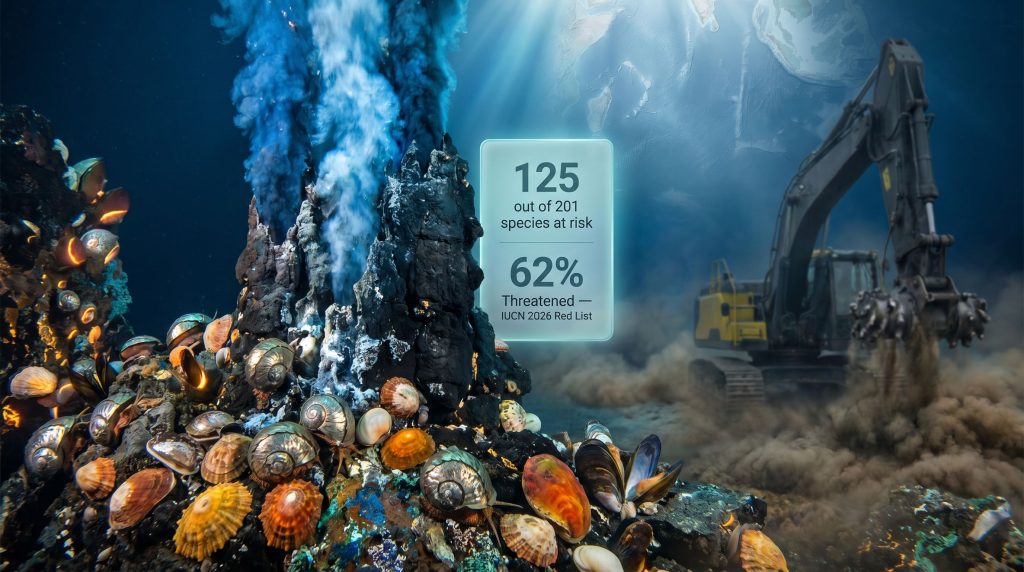
The figures published in the IUCN's 2026 Red List assessment represent the most detailed extinction-risk analysis of deep-sea vent molluscs conducted to date. The results are striking in their severity. According to reporting from the IUCN, the scale of risk identified has alarmed scientists and conservationists alike.
| Metric | Figure |
|---|---|
| Total vent-dwelling mollusc species assessed | 201 |
| Species classified as at risk of extinction | 125 (62%) |
| Species classified as Critically Endangered | 39 |
| Share of global mollusc biodiversity represented | Less than 1% |
| Indian Ocean vent molluscs facing some extinction risk | 100% |
| Indian Ocean species classified as Critically Endangered | 62% |
A 62% threatened classification rate is extraordinary by any comparative measure. Terrestrial and shallow-marine ecosystems facing significant anthropogenic pressure rarely approach this proportion. The figure reflects two converging realities: the extreme habitat specificity of vent-dwelling molluscs and the concentrated geographic overlap between proposed commercial mining zones and the highest-density vent communities.
The Indian Ocean data carries particular weight. In ocean basins where the International Seabed Authority has already granted exploration contracts, every single assessed vent mollusc species faces documented extinction risk. Sixty-two percent of those species carry the most severe classification available under IUCN methodology.
How Scientists Determine Extinction Risk for Species in the Deep Ocean
Applying Red List methodology to deep-sea organisms presents distinct challenges that differ from surface ecosystem assessments. IUCN evaluators assess population size estimates, geographic range data, observed or projected rates of decline, and the probability of recovery following disturbance events.
For vent species, one factor dominates all others in driving Critically Endangered classifications: the near-impossibility of habitat recovery following physical destruction of vent chimney structures. These geological formations take thousands of years to develop to the point where they can sustain complex biological communities. Once removed by extraction equipment, the physical and chemical substrate of the ecosystem is permanently eliminated on any timescale relevant to human policy or conservation intervention.
How Deep-Sea Mining Physically Destroys These Ecosystems
Commercial deep-sea mining targeting seafloor massive sulfide deposits requires the complete physical removal of hydrothermal vent chimneys. There is no gentler variant of this process. The vent chimney is not incidental to the deposit; it is the deposit, and extracting it means destroying the geological structure around which the entire community has organised itself.
Beyond direct extraction, the operational footprint extends considerably further through several secondary mechanisms:
- Sediment plumes generated during extraction spread across the surrounding seafloor, smothering adjacent habitats and disrupting the chemosynthetic processes that vent communities depend on for energy production
- Toxic metal dispersion from disturbed sulfide ore bodies introduces elevated concentrations of copper, cobalt, zinc, and associated heavy metals into surrounding food webs at levels acutely toxic to filter feeders and sediment-dwelling organisms
- Noise pollution from drilling and extraction equipment propagates through the water column across distances that far exceed the immediate mining footprint, disrupting sensory environments critical to deep-sea fauna navigation and reproduction
- Light pollution from remotely operated vehicles introduces artificial stimuli into ecosystems that have operated in complete darkness across their entire evolutionary history
- Physical crushing of sessile species during equipment deployment destroys populations that lack any capacity to relocate in response to mechanical disturbance
The combined effect of these impacts means that even carefully targeted extraction operations carry consequences that extend well beyond the visible mining zone. Precision drilling does not produce a precision ecological outcome in vent environments.
Dr Chong Chen of the IUCN's Mollusc Specialist Group has noted that the loss of polymetallic nodules and vent molluscs at a particular vent field would also result in the elimination of all other non-mollusc vent species dependent on the same habitat, describing the process as one that would effectively smother the entire ecosystem. (Reuters, July 2026)
The Scientific Value We Risk Destroying Before We Understand It
The argument for protecting vent molluscs extends well beyond conventional biodiversity conservation. Several species have already demonstrated applied value across commercially relevant scientific disciplines, making the stakes considerably higher than ecological loss alone.
The Scaly-Foot Snail and Its Industrial Applications
The scaly-foot snail, Chrysomallon squamiferum, has attracted significant research attention for a process no other known organism performs: the biological synthesis of iron sulfide nanoparticles as part of its shell and scale structure. Researchers are actively investigating this biomineralisation mechanism for potential applications in nanoparticle manufacturing relevant to solar cell technology. The snail has effectively evolved a room-temperature, aqueous-chemistry solution to a materials engineering problem that synthetic processes approach only with energy-intensive methods.
Separately, the structural proteins found in vent mollusc shells are under investigation as potential bio-based alternatives to synthetic plastics, addressing materials science challenges that have resisted conventional engineering approaches. In addition, a recent ScienceDirect study highlights further biomolecular properties of vent species that may have broad implications for materials science and medicine.
The Undiscovered Majority Problem
Of the 201 vent mollusc species assessed in the 2026 Red List, the overwhelming majority have received only preliminary taxonomic identification. Their biochemistry, genetics, and potential applied properties are entirely unknown. This creates a specific category of irreversible loss that goes beyond standard extinction impact calculations.
Organisms that evolved under conditions of extreme pressure, extreme temperature, and extreme chemical toxicity develop biochemical solutions that cannot be replicated through conventional synthesis. The selective pressure of vent environments has acted on these lineages for millions of years, producing compounds and structural mechanisms with properties that benign-environment chemistry simply does not generate.
Allowing extinction before scientific characterisation means permanently foreclosing on biological innovations refined under the most intense selective conditions on Earth. As Dr Chen noted, losing these species could mean also losing biological solutions to future challenges in medicine, materials, and technology before we have even had the chance to discover them. (Reuters, July 2026)
The Regulatory Architecture: ISA, UNCLOS, and the Jamaica Negotiations
The governance framework for deep-sea mineral extraction sits with the International Seabed Authority, a UN-affiliated intergovernmental body operating under the UN Convention on the Law of the Sea. The ISA holds jurisdiction over all mineral-related activities in international seabed areas beyond national jurisdiction, a designation UNCLOS terms "the Area" and classifies as the common heritage of mankind.
Despite this mandate, the ISA has already issued exploration contracts across multiple ocean basins. The Indian Ocean, where these contracts are most concentrated, corresponds directly with the vent fields showing the highest proportion of critically threatened mollusc species. Consequently, deep-sea mining regulations have become one of the most contested areas of international environmental law.
What the July 2026 Kingston Talks Are Deciding
ISA member states convened in Kingston, Jamaica from July 13 to 31, 2026 to negotiate the regulatory framework that would govern commercial-scale extraction operations. The central policy tension is not difficult to identify: accelerating global demand for copper, cobalt, and zinc in clean energy manufacturing sits in direct conflict with mounting scientific evidence of irreversible biodiversity loss at the precise locations where those minerals are most concentrated.
The IUCN entered the Jamaica talks with a renewed call for a formal moratorium on all commercial operations pending comprehensive environmental impact assessment. The organisation's position is supported by Pacific Island nations and a number of EU member states. On the other side of the fault line, resource-dependent developing nations and, most significantly, the United States have pushed for permitting acceleration.
| Position | Key Advocates | Core Rationale |
|---|---|---|
| Full moratorium | IUCN, Pacific Island nations, several EU members | Irreversible biodiversity loss, insufficient environmental data |
| Regulated extraction | ISA majority, resource-dependent developing nations | Economic development, critical mineral supply security |
| Accelerated permitting | United States (Trump administration) | Strategic mineral independence, domestic industry competitiveness |
The Trump administration's decision to accelerate permitting for US companies operating in international waters has introduced geopolitical friction into negotiations that analysts had expected to produce incremental regulatory progress. Critics argue this posture directly undermines the multilateral governance framework that UNCLOS was designed to establish, creating pressure for other major economies to similarly prioritise national extraction interests over collective environmental standards.
The next major ASX story will hit our subscribers first
The Critical Minerals Dilemma: A Genuine Tension With a Misleading Framing
Seafloor massive sulfide deposits concentrated around hydrothermal vents contain exceptionally high-grade accumulations of copper, cobalt, zinc, and associated trace elements. The mineral grades found in some vent-proximal deposits exceed those of economically productive terrestrial ore bodies, and land-based deposits of equivalent quality are progressively depleted. This is the genuine economic logic driving deep-sea mining interest, and it deserves honest engagement rather than dismissal.
However, the argument that deep-sea mining serves the clean energy transition contains a structural contradiction that proponents rarely address directly. Destroying irreplaceable, non-recoverable ecosystems to produce materials for an environmental sustainability agenda undermines the foundational logic of that agenda. Moreover, the critical minerals demand driving this push can, in many cases, be met through less destructive means.
Why the Supply Emergency Argument Does Not Hold Up
A critical and frequently overlooked distinction applies here: no commercial-scale deep-sea mining operation is currently in production. All existing activity remains at the exploration and permitting stage. A moratorium imposed at the 2026 Jamaica talks would not immediately disrupt a single active supply chain. The supply security argument for proceeding with extraction is a forward-looking risk projection, not a present-day emergency.
Alternative supply pathways that reduce pressure on vent ecosystems include:
- Battery recycling infrastructure expansion — Closed-loop lithium-ion battery recycling can recover significant proportions of the cobalt and copper demand that current projections assign to deep-sea extraction
- Development of underdeveloped terrestrial deposits — Multiple high-grade sulfide deposits in geologically favourable and politically stable jurisdictions remain unextracted due to capital and infrastructure constraints rather than mineral scarcity
- Demand reduction through materials substitution — Solid-state battery architectures and lithium-iron-phosphate chemistries are progressively reducing cobalt dependency in next-generation energy storage, directly reducing the projected demand curve that drives extraction interest
The demand for critical minerals is an engineering and investment problem with multiple solution pathways. The extinction of hydrothermal vent mollusc species has no solution pathway. The asymmetry between these two categories of problem should inform which one receives the precautionary treatment.
Applying the Precautionary Principle to Deep-Sea Governance
International environmental law has long embedded the precautionary principle as a governing standard for decisions involving potentially irreversible harm under conditions of scientific uncertainty. The combination of factors present in the deep-sea mining debate represents a textbook application of this principle.
The conditions that warrant precautionary restraint are all present:
- Irreversibility of habitat destruction following vent chimney removal
- Scientific uncertainty about the full ecological consequences of extraction-generated sediment plumes
- Demonstrated species-level extinction risk supported by the most comprehensive assessment methodology available
- Uncharacterised biological value in the majority of threatened species
- No current production that would be disrupted by a precautionary moratorium
Under this framework, the burden of proof falls on those advocating extraction to demonstrate that operations can proceed without causing irreversible biodiversity loss. Current environmental impact methodologies for deep-sea environments cannot meet that standard, a fact that the scientific community involved in IUCN Red List assessments has consistently emphasised.
Deep-sea mining threatens molluscs in ways that serve as an ecological proxy for the overall health of hydrothermal vent communities. Their population status reflects the integrity of the chemosynthetic food web that supports all vent-associated biodiversity. Conservation frameworks built around this indicator taxon provide a scientifically defensible, measurable basis for regulatory decision-making that does not require comprehensive surveys of every vent-associated species before protective standards can be established.
The question the Jamaica negotiations must ultimately answer is not whether critical minerals matter. They clearly do. The question is whether the permanent elimination of ecosystems that took millions of years to develop, and that contain biological solutions to challenges humanity has not yet encountered, constitutes an acceptable trade-off for minerals that alternative technologies and supply chains are progressively making more accessible from less irreplaceable sources.
Disclaimer: This article contains forward-looking analysis regarding regulatory outcomes, species extinction projections, and supply chain scenarios. These represent current scientific assessments and policy positions as reported and should not be interpreted as investment advice or confirmed policy outcomes. Readers are encouraged to consult primary sources including IUCN Red List documentation and ISA regulatory publications for the most current information.
Want to Stay Ahead of Significant ASX Mineral Discoveries as They Happen?
While the deep-sea mining debate highlights the complex intersection of resource extraction and environmental consequence, Discovery Alert's proprietary Discovery IQ model delivers real-time alerts on significant ASX mineral discoveries, instantly translating complex geological data into actionable investment insights for both short-term traders and long-term investors. Explore historic discoveries and their remarkable market returns, then begin your 14-day free trial at Discovery Alert to position yourself ahead of the broader market.