July 10, 2026
The Hidden Cost of Imprecision in Mineral Processing
Every tonne of ore that passes through a processing circuit carries an embedded economic decision. The separation equipment chosen, the way it is configured, and how precisely it operates determine whether valuable minerals reach the product stream or disappear into tailings. Across high-tonnage operations processing millions of tonnes annually, even marginal inefficiencies compound into substantial revenue leakage. A 1% improvement in separation efficiency at scale can translate into millions of dollars in additional recovered product value each year, making equipment selection and calibration among the most consequential decisions a processing plant can make.
Multotec spiral concentrators and cyclones separation efficiency has intensified scrutiny on two technologies that sit at the core of gravity-based beneficiation: spiral concentrators and dense medium cyclones. Both have long track records across global mineral processing, but recent engineering advances have widened the performance gap between conventional designs and next-generation configurations. Understanding what drives that gap requires looking closely at the physics, the geometry, and the operational variables that govern separation outcomes.
When big ASX news breaks, our subscribers know first
What Governs Separation Efficiency in Gravity-Based Systems?
The Physics That Determine Where Each Particle Reports
Gravity separation exploits a fundamental physical property: minerals of different densities behave differently when subjected to fluid flow, centrifugal acceleration, or both simultaneously. Spiral concentrators harness the interplay of gravitational settling, centrifugal force along the helical trough, and the thin fluid film created by water flowing across the spiral profile. Heavier mineral particles migrate toward the inner edge of the trough, while lower-density gangue material is displaced outward and eventually reports to the tailings or middlings stream.
The efficiency of this stratification process is governed by three primary variables:
- Feed solids concentration, ideally between approximately 20% and 40% solids by weight
- Density differential between the target mineral and the surrounding gangue, with an approximate 1.0 specific gravity (SG) differential considered optimal for most applications
- Particle size distribution, which for standard spiral concentrators typically falls in the range of 75 microns to 3 mm
When any of these variables drifts beyond its optimal window, separation sharpness degrades. The fluid film dynamics across the trough profile become disrupted, stratification bands blur, and misplacement of valuable particles into the tailings fraction increases. These losses are often invisible in real-time plant monitoring but become painfully apparent in mass balance reconciliations. Furthermore, understanding cut-off grade economics is essential when evaluating how these inefficiencies translate into broader financial impacts across the operation.
"Misplacement in gravity separation circuits is rarely a single catastrophic failure. It accumulates incrementally across thousands of operating hours, and its true cost only becomes visible when recovery-grade curves are interrogated systematically."
Feed Rate as a Silent Efficiency Killer
One of the least-discussed performance variables in spiral circuit design is the relationship between feed rate and separation efficiency. Empirical data from operating circuits consistently shows a linear decline in separation efficiency as feed rates increase beyond the manufacturer-specified optimal throughput. Overloading a spiral concentrator disrupts the thin fluid film that enables mineral stratification across the trough surface, effectively destroying the conditions that make gravity separation work.
Diagnosing feed rate-related efficiency losses in an operating spiral circuit involves a structured approach:
- Benchmark the current feed rate against the manufacturer's specified optimal throughput for the installed spiral geometry
- Collect representative product and tailings samples across multiple feed rate intervals during a controlled trial
- Calculate separation efficiency metrics, such as the Ep value (probable error of separation), or construct recovery-grade curves at each feed rate interval
- Identify the inflection point where efficiency decline becomes economically significant relative to throughput gains
- Adjust feed distribution across the spiral bank or install additional spiral modules to restore each unit to its optimal loading condition
This diagnostic process is straightforward in principle but frequently overlooked in practice, particularly in operations that have progressively increased throughput without reassessing spiral loading.
Multotec Spiral Concentrators and Cyclones: Engineering Advances Across the Product Range
SC25 vs. SC21: Quantifying the Performance Gap
Among the most significant advances in Multotec spiral concentrator technology is the architectural evolution represented by the SC25 model relative to the earlier SC21. The performance differential between these two models has been quantified across multiple ore types and processing stages. Spirals in mineral processing provide detailed technical context on how these design improvements translate into measurable plant outcomes.
In chromite ore processing, the SC25 demonstrates measurably superior Cr₂O₃ separation efficiency alongside higher SiO₂ rejection at equivalent saleable grades. The improvement is most pronounced in the coarser size fractions, particularly particles above 820 µm, where the SC25 geometry creates more effective stratification conditions than the SC21 trough profile allows.
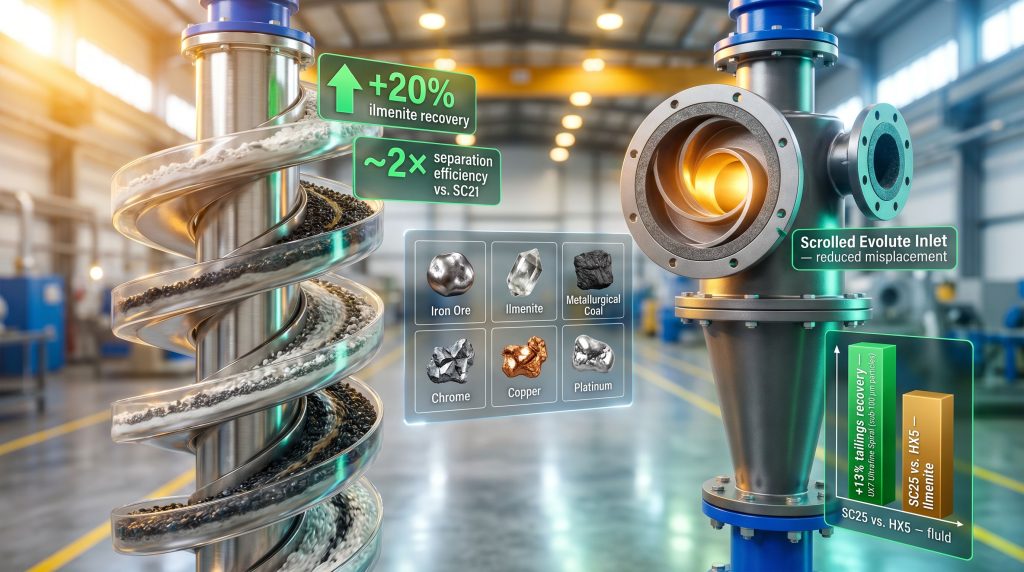
In ferrochrome slag processing, the performance differential becomes even more pronounced. At the rougher stage, the SC25 achieves nearly double the separation efficiency of the SC21, a result that fundamentally changes the economics of slag retreatment circuits. For ilmenite ore processing, the SC25 delivers 20% more ilmenite recovery than the HX5 spiral at comparable product grades, representing a substantial improvement for mineral sands operations where ilmenite recovery directly determines plant revenue.
| Model | Primary Application | Key Performance Metric |
|---|---|---|
| SC25 | Chrome, ilmenite, mineral sands | ~2x separation efficiency vs. SC21 at rougher stage |
| SC21 | General mineral sands | Baseline reference configuration |
| HX5 | Ilmenite ore | 20% lower ilmenite recovery than SC25 |
| SX7 / MX7 | Coal (two-stage) | Dual-stage in single assembly; reduced plant footprint |
| SX10 | Low-cut-density coal | Lower ash product; higher-grade metallurgical coal |
| UX7 | Ultrafine heavy minerals | Designed for particles at or below 100 microns |
The SX7 and MX7: Compact Dual-Stage Coal Spiral Architecture
The SX7 and MX7 coal spiral concentrator models address a practical engineering challenge in coal processing plant design: how to achieve two-stage spiral separation without the capital cost and footprint associated with separate rougher and cleaner spiral circuits. Both models integrate two stages of spiraling into a single compact modular assembly, reducing both installation height and floor space requirements substantially.
Multotec has installed multiple units of these models across coal processing operations in Canada and the United States, with documented success in terms of recovery performance. The modular assembly approach also reduces commissioning complexity and lowers capital expenditure relative to equivalent two-stage installations using separate spiral modules. For operations constrained by building height or floor space, this architecture provides a practical engineering solution without sacrificing separation performance.
The SX10 Low Cut Density Spiral: Targeting Premium Metallurgical Coal Specifications
Cut density is the specific gravity at which a spiral concentrator separates float product from sink material. In coal processing, a lower cut density means the spiral separates clean coal from reject at a finer density threshold, producing a lower-ash product that commands premium pricing in export markets. Standard spirals operate at higher cut densities that sacrifice some grade for throughput, which is acceptable for thermal coal but problematic for metallurgical coal pricing dynamics in export markets.
The SX10 is engineered specifically to operate at a lower density cut point, making it particularly relevant for Canadian metallurgical coal producers supplying high-specification export markets. The ash content reduction achievable with the SX10 geometry translates directly into higher product value per tonne, and in export metallurgical coal markets where specifications are tightly enforced, the difference between meeting and missing a coking coal specification can determine whether a cargo is accepted or rejected entirely.
The UX7 Ultrafine Spiral: Recovering Value That Conventional Circuits Lose
Fine particle recovery represents one of the most persistent value-leakage problems in mineral processing. Particles below 100 microns behave differently from coarser fractions in conventional spiral circuits because the gravitational and fluid forces that create effective stratification at standard particle sizes become insufficient to overcome the surface chemistry and Brownian motion effects that dominate at ultrafine scales. The result is that sub-100-micron heavy minerals frequently report to tailings in conventional circuits, representing unrecovered value that accumulates continuously during plant operation.
"Ultrafine mineral recovery is one of the most significant value-leakage points across the mineral processing industry. Particles below 100 microns frequently bypass conventional separation mechanisms entirely, and the economic cost of this loss compounds across the operating life of a plant."
The UX7 spiral concentrator is purpose-engineered to address this challenge. Its trough geometry is specifically designed to handle ultrafine feed characteristics, creating the fluid film conditions necessary to stratify particles at 100 microns and finer. Applications span a broad commodity range including iron ore types, chrome, manganese, copper, platinum group metals, and mineral sands. Measured performance data indicates that ultrafine spirals can recover up to 13% more valuable minerals from tailings streams compared to standard spiral configurations, a figure that carries significant economic weight in operations processing large volumes of fine-grained mineralisation.
How Dense Medium Cyclones Achieve Density-Based Separation
Classification Cyclones vs. Dense Medium Cyclones: A Critical Distinction
A common source of confusion in mineral processing is the functional difference between classification hydrocyclones and dense medium cyclones. The distinction is fundamental and determines which technology is appropriate for a given separation task.
Classification cyclones separate particles primarily by size, using centrifugal force to drive coarser particles to the underflow while finer particles overflow with the water fraction. Dense medium cyclones, by contrast, separate particles primarily by density, using a dense medium suspension (typically fine magnetite suspended in water) to establish a precise separation density. Particles denser than the medium sink to the underflow; particles less dense than the medium report to the overflow.
Critically, this density-based separation operates largely independently of particle size, making DM cyclones effective for coarse, heterogeneous feeds where size-based separation would produce unacceptable misplacement. This distinction matters enormously in applications such as coal washing, iron ore beneficiation, and diamond recovery, where the target mineral and gangue share overlapping size distributions but differ significantly in density.
The Scrolled Evolute Inlet: Engineering Turbulence Out of the Separation Zone
The most significant design innovation in Multotec's dense medium cyclone technology is the Scrolled Evolute inlet configuration. In conventional cyclone designs, feed material enters through a tangential inlet that creates an abrupt directional change as particles transition from the feed pipe into the cylindrical body of the cyclone. This abrupt transition generates turbulence at the entry zone, and turbulence is the primary physical mechanism responsible for particle misplacement in dense medium separation.
The Scrolled Evolute inlet addresses this problem through a gradual, scrolled entry geometry that allows feed particles to align directionally before centrifugal forces take full effect. This smoother entry path substantially reduces turbulence at the critical inlet zone, enabling high-density particles to begin reporting downward toward the spigot immediately upon entry. The practical result is sharper separation, reduced misplacement of dense particles to the overflow, and higher throughput capacity compared to standard tangential inlet configurations. For a comprehensive overview of how these advances are reshaping the industry, Multotec's spirals and cyclones represent a compelling case study in engineering-led performance improvement.
"Turbulence at the cyclone inlet is the dominant mechanism driving particle misplacement in dense medium separation circuits. Eliminating this turbulence zone is not a marginal refinement; it is a structural improvement that directly determines the sharpness of the density cut."
Operational Parameters That Govern DM Cyclone Performance
Achieving and maintaining maximum separation efficiency in a dense medium cyclone circuit requires precise control of several interacting operational parameters:
| Parameter | Recommended Condition | Consequence of Deviation |
|---|---|---|
| Feed solids concentration | ~20% solids by volume (80% water) | Above 30% solids reduces separation efficiency markedly |
| Operating feed pressure | Lower pressure preferred where possible | Higher pressures increase energy consumption without proportional efficiency gain |
| Underflow density | Maintain high and consistent underflow density | Low underflow density allows short-circuiting and water reporting to spigot |
| Vortex finder dimensions | Specified per application and cut point requirement | Incorrect sizing shifts the overflow cut point and reduces classification precision |
| Cone angle | Application-specific selection | Influences particle residence time and ultimately separation sharpness |
Multotec's approach to cyclone specification involves optimising this entire parameter matrix simultaneously, with product specialists defining the correct combination of pressure, cone angle, vortex finder geometry, and spigot dimensions for each application. This engineering rigour is particularly important in operations where the consequences of misplacement extend beyond recovery losses into downstream processing complications.
Silicon Carbide Liners: Extending Wear Life in Abrasive Service
Cyclone wear is concentrated at the spigot, cone, and vortex finder, where particle velocities are highest and abrasion is most intense. Conventional rubber and ceramic liners provide reasonable wear resistance but require frequent replacement in highly abrasive applications, generating maintenance downtime and consumable costs that accumulate over the operating life of a cyclone installation.
Multotec has incorporated silicon carbide as a liner material in its cyclone designs, replacing conventional alternatives in high-wear zones. Silicon carbide offers substantially higher abrasion resistance than rubber or standard ceramics, extending service intervals, reducing unplanned downtime, and lowering the total cost of ownership across the cyclone's operational lifespan. In operations processing highly abrasive ores such as iron ore or chromite, the economic case for silicon carbide liners becomes compelling within a relatively short payback period.
Commodity-by-Commodity Applications of Spiral and Cyclone Technology
The breadth of commodity applications addressable by Multotec spiral concentrators and cyclones separation efficiency reflects the versatility of gravity-based separation across different mineralogical contexts:
- Metallurgical coal: The SX7 and MX7 dual-stage modular spirals serve established North American coal processing circuits, while the SX10 targets premium-grade export specifications through lower cut density operation. DM cyclones handle the dense medium washing of coarser coal fractions.
- Iron ore: Both SC25 spirals and DM cyclones are applied to magnetite and hematite beneficiation, where high-volume processing of coarse heterogeneous feeds demands precise density-based separation.
- Mineral sands (ilmenite, rutile, zircon): The SC25's documented 20% ilmenite recovery advantage over the HX5 makes it the preferred configuration for high-value mineral sands circuits where product recovery directly determines plant economics.
- Chrome and ferrochrome slag: The SC25's near-doubling of separation efficiency versus the SC21 at the rougher stage makes it particularly compelling for chrome circuits and slag retreatment operations where upgrading efficiency determines whether marginal feed grades are economically viable.
- Battery and critical minerals (copper, manganese, nickel, zinc): The UX7 ultrafine spiral targets fine-grained disseminated mineralisation across the battery metals spectrum. In addition, understanding copper processing methods provides further context on how gravity-based recovery complements broader hydrometallurgical approaches where conventional circuits fail to adequately recover fine particles.
- Platinum group metals: The UX7 is applied in fine PGM-bearing chromite circuits where sub-100-micron PGM carrier particles represent significant recoverable value that standard spiral configurations consistently lose.
Research Collaboration as a Driver of Separation Technology Advancement
University Partnerships and the Innovation Feedback Loop
One dimension of Multotec's technological development that is not widely visible in standard equipment specifications is its collaboration with universities and metallurgical research laboratories across North America. These partnerships serve a function that internal commercial R&D alone cannot efficiently replicate: access to fundamental separation science research conducted without the time pressures of product development cycles.
Academic collaboration in mineral processing engineering typically focuses on areas including separation science fundamentals, advanced process control methodologies, and flowsheet optimisation modelling. The value of these partnerships lies in the feedback loop they create: operating plant performance data informs research programme priorities, while laboratory-scale findings translate into practical improvements in spiral geometry, cyclone inlet design, and operational parameter specifications.
The translation of fundamental research into field-deployable equipment improvements is where industrial engineering expertise becomes decisive. Understanding the fluid dynamics of ultrafine particle behaviour on a spiral trough at the laboratory scale is a necessary precondition for designing the UX7 geometry, but converting that understanding into a manufacturable product that performs reliably in operating plant conditions requires a different set of competencies. The combination of academic research depth and industrial engineering capability accelerates the pace of practical innovation beyond what either partner could achieve independently.
The next major ASX story will hit our subscribers first
Sustainability Dimensions of High-Efficiency Separation
Advanced separation technology contributes to environmental performance metrics in ways that extend well beyond simple recovery percentages. Indeed, the mining sustainability transformation agenda is increasingly shaped by the operational efficiencies that technologies like spiral concentrators and cyclones can demonstrably deliver:
- Water consumption: Higher separation efficiency per unit of feed processed reduces the volume of process water required per tonne of product, which is increasingly important in water-stressed operating jurisdictions.
- Energy intensity: Gravity-driven spiral concentrators require no energy input beyond the feed pump, while the lower operating pressures achievable with efficient DM cyclone designs reduce energy consumption relative to competing separation technologies such as flotation or high-intensity magnetic separation.
- Tailings volume reduction: Improved recovery from ultrafine spirals means proportionally less valuable mineral reporting to tailings storage facilities, reducing both the environmental footprint of tailings management and the long-term liability associated with mineral-bearing waste storage.
- Consumable replacement frequency: Extended wear life through silicon carbide and advanced liner materials reduces the volume of consumables passing through a plant over its operating life, lowering both material consumption and the waste streams associated with liner disposal.
These operational characteristics align naturally with the ESG performance targets that mining companies increasingly report against, and where separation efficiency metrics can be directly translated into resource stewardship outcomes, the business case for investing in advanced separation technology extends well beyond its immediate recovery economics.
Key Performance Summary: Multotec Spiral Concentrators and Cyclones
| Technology | Benchmark Comparison | Documented Outcome |
|---|---|---|
| SC25 Spiral (ilmenite applications) | Recovery vs. HX5 spiral | +20% ilmenite recovery at comparable product grades |
| SC25 Spiral (ferrochrome slag) | Separation efficiency vs. SC21 | Approximately 2x efficiency at rougher stage |
| UX7 Ultrafine Spiral | Tailings recovery vs. standard spirals | Up to +13% recovery for sub-100 micron particles |
| DM Cyclone with Scrolled Evolute Inlet | Misplacement vs. tangential inlet designs | Reduced turbulence; measurably improved separation sharpness |
| SX10 Coal Spiral | Product specification vs. standard-cut spirals | Lower ash content; higher-grade metallurgical coal output |
| SX7 / MX7 Coal Spiral | Plant footprint vs. separate two-stage circuits | Dual-stage performance in single assembly; reduced height and floor space |
This article contains references to equipment performance data and operational benchmarks. Actual performance outcomes in any given application will vary according to feed characteristics, ore mineralogy, operating conditions, and plant configuration. Independent metallurgical testing is recommended prior to equipment selection and circuit design.
Want to Know Which ASX Mining Companies Are Advancing Separation Efficiency?
Discovery Alert's proprietary Discovery IQ model scans ASX announcements in real time, instantly identifying significant mineral discoveries across commodities like iron ore, copper, chromite, and mineral sands — the very sectors where separation efficiency gains translate directly into recoverable value. Explore how historic ASX mineral discoveries have generated substantial returns and begin your 14-day free trial to position yourself ahead of the broader market.