July 9, 2026
The Race to the Ocean Floor Is Outpacing the Science Needed to Understand It
Every major technological transition in history has created a scramble for raw materials, and the current shift toward renewable energy infrastructure is no exception. What makes this particular resource rush historically unique is not its scale or speed, but its geography. For the first time, industrial extraction is being seriously contemplated in one of the least understood environments on Earth: the deep ocean floor, thousands of metres below the surface, where entirely separate branches of life have evolved in isolation from the sunlit world above.
The consequences of getting this wrong are not reversible on any timescale meaningful to human civilisation. Furthermore, new data from the world's most authoritative biodiversity monitoring body suggests the window for making the right decisions is already narrowing faster than many policymakers appreciate.
When big ASX news breaks, our subscribers know first
What Hydrothermal Vents Actually Are, and Why They Matter Beyond the Deep Sea
Hydrothermal vents form where tectonic plates diverge or converge, allowing seawater to percolate deep into the ocean crust, superheat against magma chambers, and erupt back through the seafloor laden with dissolved minerals. The superheated fluids, sometimes exceeding 400 degrees Celsius, create towering chimney structures composed of precipitated sulphide minerals, primarily copper, zinc, cobalt, and nickel compounds.
What makes these structures scientifically extraordinary is not the mineralogy, but the biology that colonises them. In the complete absence of sunlight, vent communities have independently evolved a parallel biological economy built on chemosynthesis rather than photosynthesis. Specialised bacteria convert hydrogen sulphide into usable energy, forming the base of food webs that support tube worms, shrimp, crabs, and critically, a diverse assemblage of molluscs found nowhere else on Earth.
These ecosystems represent an experiment in parallel evolution conducted over millions of years under extreme conditions. The organisms that survive at vents face simultaneous challenges that would be lethal to virtually all surface life: crushing pressure, near-boiling temperatures, toxic metal concentrations, and perpetual darkness. The biological solutions these species have evolved in response to these pressures are genuinely without terrestrial equivalent.
The Scaly-Foot Snail: A Case Study in Biological Innovation
Among the most scientifically remarkable vent inhabitants is the scaly-foot snail (Chrysomallon squamiferum), which has developed a shell architecture incorporating iron sulphide mineralisation, a biological process with no known parallel in the natural world. Materials scientists are actively studying this organism's biomineralisation pathway as a template for developing nanoparticles applicable to solar energy conversion technology.
The structural logic of its shell, formed under extreme chemical and thermal stress, offers engineering principles that conventional materials synthesis cannot easily replicate. Similarly, other vent mollusc species are being investigated as biological models for developing structural alternatives to petroleum-derived plastics, using the unique polymer chemistry their tissues have evolved under deep-sea conditions.
"The biological capital embedded in vent ecosystems represents a library of evolutionary solutions accumulated over geological time. Allowing extinctions to proceed before that library is catalogued is functionally equivalent to burning books that have never been read."
What the 2026 IUCN Red List Reveals About the Scale of the Crisis
The International Union for Conservation of Nature's 2026 Red List assessment of hydrothermal vent molluscs delivers findings that reframe the urgency of the deep-sea mining controversy in concrete, quantifiable terms. Research led by scientists at Queen's University Belfast evaluated 184 species found exclusively within hydrothermal vent environments, contributing to a formal assessment of 201 vent mollusc species in total.
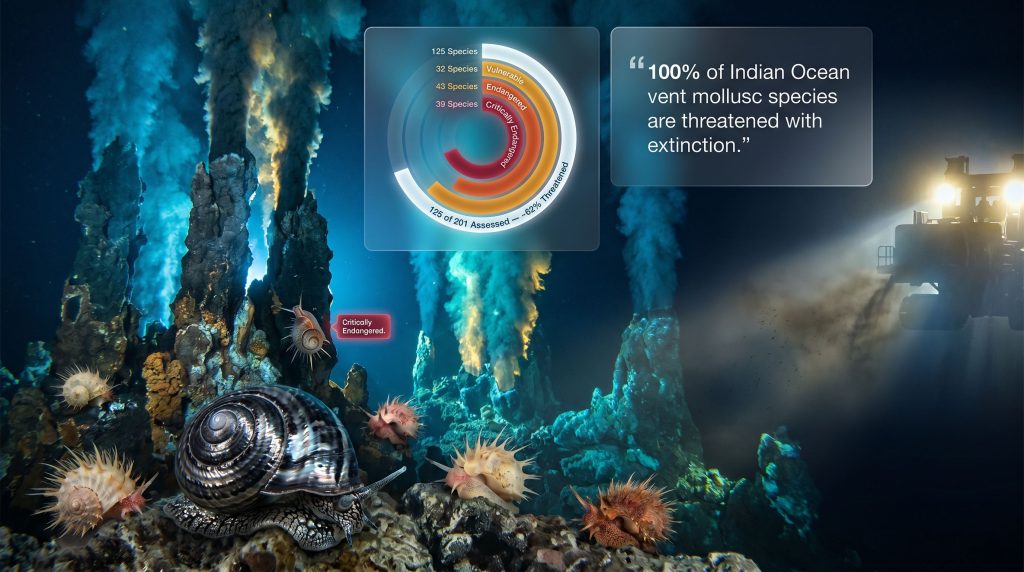
The results are stark. Of those 201 species, 125 are now classified as threatened with extinction, representing 62% of all assessed vent molluscs. This is not a gradual or ambiguous trend; it is a near-majority of an entire specialised fauna facing collapse within a single generation of industrial activity.
Species Threat Classification Breakdown
| Threat Classification | Number of Species | Share of Total Assessed |
|---|---|---|
| Critically Endangered | 39 | ~19% |
| Endangered | 32 | ~16% |
| Vulnerable | 43 | ~21% |
| Total Threatened | 125 of 201 | ~62% |
The primary driver identified across assessments is deep-sea mining activity and the habitat destruction associated with it, including both direct physical removal of vent structures and secondary impacts such as sediment plume dispersal.
The Indian Ocean: An Entire Basin at Risk
The regional breakdown of extinction risk reveals that the Indian Ocean is experiencing what can only be described as a basin-scale biodiversity emergency. Every known hydrothermal vent mollusc species in the Indian Ocean is currently classified as threatened, representing a 100% regional threat rate with no equivalent recorded in comparable assessments of other marine environments.
The dragon snail (Dracogyra subfusca), first formally described by science in 2017, exemplifies the compressed timeline between discovery and potential extinction. This species, known from a single vent field, is already classified as Critically Endangered because its entire known habitat overlaps with an active mineral exploration contract zone. The interval between its scientific description and its endangered listing is less than a decade, a speed that illustrates how fundamentally industrial timelines are outpacing scientific ones in this environment.
In the Pacific, six species of morphologically distinctive snails in the genus Alviniconcha, colloquially referred to as punk rock snails due to their spiky shell ornamentation, are now uniformly assessed as either vulnerable or endangered across their Pacific vent field distributions. As The Guardian reports, mining could push hundreds of such deep-sea species towards extinction before they are even fully understood.
The Four Mechanisms Through Which Deep-Sea Mining Destroys Vent Ecosystems
Understanding precisely how deep-sea mining threatens molluscs and the broader vent community requires examining the specific pathways of destruction, because they operate at different spatial scales and persist across different time horizons.
1. Physical Elimination of the Geological Habitat Itself
Seafloor massive sulphide (SMS) deposits, the primary extraction target at hydrothermal vent zones, are structurally identical to the vent chimney systems that sustain biological communities. Extracting these deposits requires the complete physical removal of the chimney structures themselves. Unlike surface mining scenarios where the substrate remains and vegetation can eventually recolonise, vent chimney removal eliminates the geological heat and chemical flux on which the entire ecosystem depends. There is no substrate left to recolonise because the habitat generator has been destroyed.
Evidence from historical mining trial sites demonstrates that this is not a theoretical concern. Disturbed areas studied decades after early experimental mining operations show measurably reduced microbial diversity and activity 30 years after the initial disturbance, with recovery trajectories suggesting full restoration timescales measured in centuries rather than decades.
2. Sediment Plume Dispersal Beyond the Mining Footprint
Mining vehicles operating across the seafloor resuspend fine sediment particles that travel as suspended plumes through the water column. These plumes can extend tens to hundreds of kilometres laterally from the extraction site before settling, depositing sediment blankets that suffocate filter-feeding and suspension-feeding organisms across an area vastly larger than the immediate extraction zone.
This creates a critical asymmetry in impact assessment: the ecological footprint of a mining operation is not bounded by the licence area but extends far beyond it through fluid dynamics that are difficult to model accurately with current understanding.
3. Toxic Metal Release Into Pelagic Food Webs
Sulphide deposits naturally concentrate metals including copper, cobalt, zinc, and nickel at grades far exceeding typical crustal abundance. When these deposits are physically disrupted, the metals are liberated into the surrounding water column through mid-water plumes. These toxicants enter marine food webs at multiple trophic levels simultaneously.
The bioaccumulation pathways through which these metals might reach commercially harvested species in overlying water columns are poorly characterised. Consequently, this represents a significant knowledge gap with potential implications extending well beyond the vent ecosystem itself into broader ocean food web dynamics.
4. Acoustic and Photic Pollution in Permanently Dark Environments
The deep sea is defined by near-absolute darkness and extreme acoustic quiet, conditions to which vent species have calibrated their sensory biology over evolutionary time. Industrial mining equipment generates persistent mechanical noise and artificial illumination that disrupt biological behaviours that evolved in the complete absence of these stimuli. The consequences for communication, predator detection, reproduction, and navigation are poorly understood but are structurally unlikely to be benign.
"Recovery timescales for hydrothermal vent ecosystems following industrial disturbance are measured in centuries. This is the fundamental temporal asymmetry at the heart of the policy debate: extraction generates returns within years, while ecological costs accrue across timescales that exceed recorded human institutional memory."
The Critical Minerals Pressure Driving Commercial Expansion
The commercial logic behind deep-sea mining is straightforward and rooted in real supply chain dynamics. Hydrothermal vent systems geologically concentrate copper, cobalt, zinc, and nickel through high-temperature precipitation processes, producing seafloor massive sulphide deposits with metal grades that are economically attractive compared to many marginal land-based deposits.
These are precisely the metals at the centre of critical minerals demand for energy transition infrastructure. Cobalt is essential to the cathode chemistry of lithium-ion batteries. Copper underpins virtually all electrical transmission infrastructure. Zinc and nickel feature across multiple clean energy technology supply chains.
Land-Based vs. Deep-Sea Mining: A Comparative Framework
| Factor | Land-Based Mining | Deep-Sea Mining |
|---|---|---|
| Ecosystem recovery potential | Decades (partial) | Centuries (uncertain) |
| Uniqueness of affected biodiversity | Variable | Extreme, endemic species only |
| Regulatory framework maturity | Established | Nascent and contested |
| Sediment dispersal range | Localised | Tens to hundreds of kilometres |
| Scientific understanding of impacts | Moderate to high | Very low |
| Habitat offsetting feasibility | Difficult but sometimes possible | Functionally impossible |
Land-based critical mineral supply chains face genuine geopolitical concentration risks, particularly regarding processing capacity, which has intensified interest in seabed mineral deposits as a diversification strategy. The Trump administration's acceleration of permitting for US companies seeking critical minerals in international waters reflects this strategic calculation, prioritising supply security considerations within a framework of competing national interests.
It is important to note that this represents a policy direction rather than project-specific endorsement, and the deep-sea mining regulations governing international seabed extraction remain under active negotiation.
Who Governs the Ocean Floor, and Is That Governance Adequate?
The International Seabed Authority (ISA) is the United Nations-mandated body responsible for regulating mineral extraction from areas of the international seabed beyond national jurisdiction, operating under the framework established by the UN Convention on the Law of the Sea (UNCLOS). Its mandate encompasses both facilitating resource development and ensuring marine environmental protection.
This dual mandate creates a structural tension that independent scientists and conservation groups have consistently flagged as a fundamental governance problem. An institution simultaneously charged with promoting and regulating the same activity faces inherent conflicts that may compromise the rigour of environmental safeguards.
The July 2026 Jamaica Negotiations
ISA member states convened in Kingston, Jamaica from July 13 to 31, 2026 to advance negotiations toward finalising the regulatory framework governing commercial-scale deep-sea metal extraction. The outcome of this process will determine whether binding environmental protections, including potential moratorium provisions, are embedded in the governance architecture before commercial operations commence at scale.
The IUCN's Red List publication was released directly ahead of these negotiations. More than 600 marine science and policy experts have formally endorsed the IUCN's call for a global moratorium on deep-sea mining pending comprehensive and independent environmental impact assessment. The European Parliament has also formally endorsed this position.
The moratorium debate maps onto a genuine values conflict rather than simply a scientific one:
- Conservation advocates argue that irreversibility of ecosystem destruction, combined with profound scientific uncertainty about the full scope of impacts, justifies a precautionary pause until adequate knowledge exists to make informed decisions
- Resource security advocates counter that critical mineral supply diversification is a legitimate strategic priority and that responsible regulated extraction is preferable to unregulated pressure on land-based ecosystems
- Industry proponents argue that advances in extraction technology may reduce environmental impacts over time, though no commercially viable low-impact method currently exists at scale
Neither position is without legitimate foundation, which makes the ISA negotiations consequential rather than merely procedural.
The next major ASX story will hit our subscribers first
The Unrealised Scientific and Economic Value at Risk
One of the less commonly understood dimensions of the vent extinction risk is the economic argument embedded within the conservation case. The history of pharmaceutical and materials science is populated with discoveries derived from organisms initially considered marginal or obscure, subsequently found to contain compounds or structural properties of significant commercial value.
Vent molluscs occupy a particularly strong position in this precautionary value framework for several reasons:
- Their biochemistry has been shaped by selection pressures — extreme pressure, temperature, metal toxicity, and chemical gradients — that are unlikely to have been independently replicated elsewhere in the biosphere
- The biomineralisation processes documented in species such as the scaly-foot snail have direct relevance to nanotechnology and materials fabrication, fields where novel synthesis pathways carry significant commercial value
- Compounds produced by vent species to manage toxic metal exposure are of direct interest to researchers developing industrial enzymes and stress-resistant biological systems with applications in mining, pharmaceutical manufacturing, and environmental remediation
- Several vent mollusc species produce compounds being assessed for antimicrobial relevance, a research priority given the scale of the global antimicrobial resistance challenge
The asymmetry between the cost of regulatory restraint — foregone extraction revenue in the near term — and the potential cost of extinction — permanent elimination of biological capital whose value has not yet been quantified — frames the precautionary argument as economically rational rather than simply ethical. However, as Greenpeace Australia notes, the threat to these unique deep-sea ecosystems extends well beyond the immediate mining footprint.
Frequently Asked Questions: Deep-Sea Mining and Vent Mollusc Extinction
What percentage of vent mollusc species are currently at risk?
The IUCN's 2026 Red List assessment found that 62% of assessed hydrothermal vent mollusc species — or 125 out of 201 — are classified as threatened with extinction, with deep-sea mining activity identified as the primary driver.
Why can't vent ecosystems recover after mining disturbance?
Vent communities depend on active geological heat and chemical flux. Removing sulphide chimney structures eliminates the conditions sustaining life, not merely the substrate. Evidence from historical trial mining sites shows measurably reduced microbial activity three decades after disturbance, with recovery timescales projected in centuries.
Which ocean basin is most acutely affected?
The Indian Ocean presents the most severe regional concentration of risk, with every known vent mollusc species in that basin currently classified as threatened. The newly described dragon snail (Dracogyra subfusca) moved from scientific discovery to Critically Endangered status in under a decade due to its sole known habitat overlapping with an active mining exploration zone.
What minerals are targeted in vent zones?
Deep-sea mining programmes targeting hydrothermal vent zones primarily seek copper, cobalt, zinc, and nickel from seafloor massive sulphide deposits, all classified as critical minerals essential to energy transition technologies. In addition, polymetallic nodules found across the wider seabed floor represent another significant target for extraction operations.
How far can mining-generated sediment plumes travel?
Seafloor mining operations generate sediment plumes capable of dispersing tens to hundreds of kilometres from the extraction site, smothering organisms across a vastly larger area than the licensed mining footprint.
What is the IUCN's formal position?
The IUCN, representing the world's largest conservation network, has formally called for a global moratorium on deep-sea mining pending comprehensive environmental impact assessment. This position is supported by more than 600 marine science and policy experts and has been endorsed by the European Parliament.
The Path Forward: Three Scenarios and What Each Requires
The international community effectively faces three broad pathways as ISA negotiations proceed:
Scenario One: Moratorium Pending Comprehensive Scientific Assessment. This approach, advocated by the IUCN and a substantial coalition of scientists, argues that the combination of irreversibility and scientific uncertainty justifies a precautionary pause. Its practical prerequisite is consensus among ISA member states that environmental unknowns outweigh supply security imperatives, a difficult political threshold given current geopolitical pressures around critical mineral access.
Scenario Two: Strictly Regulated Extraction With Enhanced Environmental Conditions. Some member states and industry proponents advocate for extraction under rigorous environmental management frameworks. The fundamental challenge here is that habitat offsetting is functionally impossible for endemic species with no alternative habitat, and current scientific knowledge is insufficient to design adequately effective monitoring and mitigation systems.
Scenario Three: Technology Development Priority. Emerging research into selective extraction approaches targeting mineral-rich fluids rather than physical chimney removal offers the conceptual possibility of reduced direct habitat destruction. However, sediment plume and toxic metal release impacts would persist regardless, and no commercially viable low-impact extraction technology exists at scale. Treating this as a near-term solution conflates research-stage concepts with deployment-ready technology.
What the scientific community is broadly aligned on, regardless of position on extraction, includes:
- Mandatory comprehensive baseline biodiversity surveys of all vent fields prior to any extraction licensing decisions
- Independent environmental impact assessment processes structurally separated from the ISA's dual promotional and regulatory mandate
- Legally binding international protections for vent ecosystems with confirmed high biodiversity or endemic species concentrations
- Mandatory post-extraction monitoring periods of at minimum 50 years before any extraction programme can be considered environmentally characterised
The intersection of where deep-sea mining threatens molluscs and broader ocean biodiversity with where critical mineral supply chains are heading represents one of the defining resource governance challenges of the coming decade. Furthermore, the growing body of evidence around seabed mineral deposits underscores just how much remains scientifically uncharted in these environments. The decisions made in Kingston in July 2026 will not be easily undone, and the ecosystems at stake have spent millions of years becoming what they are.
This article draws on publicly available IUCN Red List documentation, peer-reviewed marine biology literature, and reporting from Mining.com on deep-sea mining regulatory developments. Readers interested in the governance dimensions of seabed resource extraction are encouraged to review ISA documentation and independent marine science assessments. Forecasts and projections referenced in this article represent scientific estimates subject to revision as research evolves.
Want to Track the Critical Minerals at the Heart of the Deep-Sea Mining Debate?
Discovery Alert's proprietary Discovery IQ model delivers real-time alerts on significant ASX mineral discoveries — including copper, cobalt, zinc, and nickel — instantly translating complex data into actionable insights for investors at every level. Explore how major mineral discoveries have historically generated substantial returns on Discovery Alert's dedicated discoveries page, and begin your 14-day free trial today to position yourself ahead of the market.