July 9, 2026
The Energy Equation That Decides Who Wins in Global Aluminium
Across the global aluminium industry, one variable separates profitable producers from chronically squeezed ones: the cost and reliability of electricity. Unlike most industrial sectors where energy is a significant line item, aluminium smelting is defined by it. Electricity accounts for roughly 35 to 40 percent of total smelting costs globally, and in markets where grid power is volatile, expensive, or inconsistently supplied, even the most efficient smelter can be rendered uncompetitive overnight. This fundamental reality is what makes captive power not just a preference for large aluminium producers, but an operational imperative.
India's aluminium sector understands this dynamic acutely. The country holds substantial upstream capacity, from bauxite reserves to alumina refining, but translating that potential into a dominant primary aluminium position requires solving the energy problem at scale. The NALCO NLC India power plant JV in Odisha is precisely that kind of structural solution, one that doesn't merely address today's energy needs but locks in a competitive energy architecture for the next quarter century.
When big ASX news breaks, our subscribers know first
Why Captive Power Is the Defining Variable in Indian Aluminium Economics
Grid dependency in energy-intensive manufacturing creates layered vulnerabilities. Tariff revisions, transmission losses, supply curtailments during peak demand periods, and regulatory uncertainty around open access all create operational and financial risk for smelters drawing power from state electricity boards or merchant markets.
Captive power eliminates most of these variables. By owning or co-owning the generation asset, an aluminium producer internalises energy cost control and gains the operational certainty that continuous electrolytic reduction demands. Aluminium smelting is a 24-hour, 365-day process. The electrolytic pots that convert alumina into primary metal cannot simply be switched off during a grid outage without risking a pot-line freeze, which is a technically catastrophic and extremely costly event requiring lengthy recovery periods and causing significant production losses.
How the Electricity Act, 2003 Underpins Long-Term Energy Security
India's regulatory architecture for long-term power supply is anchored in the Electricity Act, 2003. Section 62 of this legislation governs tariff determination for long-term power purchase agreements, providing a legally structured framework that supports project bankability. A 25-year PPA executed under Section 62 means that power offtake obligations are legally binding, tariff escalation is governed by a defined mechanism, and lenders financing the generation asset have a clear, long-duration revenue stream to underwrite.
Furthermore, for a USD 3.5 billion smelter expansion, this kind of contractual certainty is not a financial nicety. It is the foundational condition that makes the investment viable in the first place.
Project Architecture: The 50:50 JV Between Two Navratna CPSEs
The Joint Venture-cum-Shareholders' Agreement formalised on July 8, 2026 between National Aluminium Company Limited (NALCO) and NLC India Limited (NLCIL) creates a dedicated joint venture company to develop, own, and operate the new generation asset. The equal equity split between both partners reflects a deliberate inter-ministerial alignment: NALCO operates under the Ministry of Mines, while NLCIL falls under the Ministry of Coal, making this a rare cross-ministry industrial collaboration at the CPSE level.
Technical Specifications at a Glance
| Parameter | Detail |
|---|---|
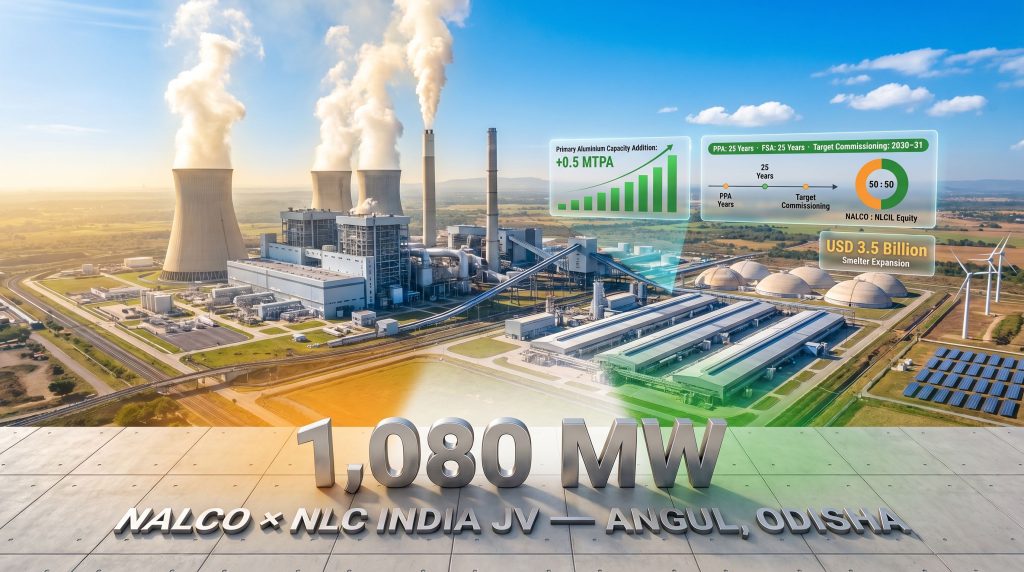
| Total Installed Capacity | 1,080 MW |
| Unit Configuration | 4 x 270 MW generating units |
| Plant Location | Angul, Odisha (within NALCO's existing facility) |
| Power Offtake | 100% captive supply to NALCO |
| PPA Duration | 25 years (under Section 62, Electricity Act 2003) |
| Fuel Supply Source | NLCIL's Machhakata coal mine, Odisha |
| FSA Duration | 25 years at Coal India-notified prices |
| Equity Split | 50:50 (NALCO : NLCIL) |
| Target Commissioning | 2030-31 |
The modular four-unit configuration is a deliberate engineering and risk management choice. Rather than constructing a single large turbine, the phased unit approach allows individual generating sets to be commissioned progressively, meaning partial capacity can come online ahead of full commissioning. This reduces the binary risk of a single large project delay cutting off all power supply during the critical early phase of smelter expansion.
NALCO's Integrated Asset Base: Where This Plant Fits
NALCO operates one of India's most vertically integrated aluminium production chains. Bauxite is extracted from the Panchpatmali mines in Koraput district, refined into alumina at the Damanjodi refinery, and then smelted into primary aluminium at the Angul facility. Co-locating the new 1,080 MW power plant within the existing Angul premises is strategically significant for two reasons: it minimises transmission losses that erode efficiency across long power lines, and it maximises the utilisation of existing site infrastructure, grid connection points, and land already cleared for industrial use.
The Government of India holds a 51.28 percent equity stake in NALCO, reinforcing the company's mandate to serve broader national industrial objectives alongside its commercial operations. In addition, leading aluminium mining companies globally are increasingly adopting similar integrated asset strategies to insulate themselves from energy market volatility.
The USD 3.5 Billion Expansion This Plant Is Built to Power
The entire rationale for the NALCO NLC India power plant JV in Odisha traces back to one of India's largest single-asset industrial investments: a planned 0.5 million tonne per annum (MTPA) addition to NALCO's primary aluminium smelting capacity, valued at approximately USD 3.5 billion.
This expansion is not incidental to India's industrial ambitions. Domestic aluminium consumption is accelerating across multiple high-growth sectors:
- Electric vehicle battery housings, structural components, and heat exchangers
- Construction applications including architectural extrusions, roofing, and facades
- Packaging, particularly in food, beverage, and pharmaceutical segments
- Defence and aerospace platforms where lightweighting is a design imperative
Despite having meaningful upstream capability, India remains a net importer of value-added aluminium products, signalling that domestic primary capacity has not kept pace with demand for downstream conversion. Expanding smelter capacity at scale is the upstream response to that structural imbalance.
Why 800 MW of Reliable Power Was the Minimum Viable Requirement
Aluminium smelting through the Hall-Heroult electrolytic process is extraordinarily power-hungry. Each tonne of primary aluminium requires approximately 13 to 15 megawatt-hours of electricity under modern smelting conditions. For a 500,000-tonne annual expansion, that translates to a baseload power requirement of roughly 800 MW on a continuous basis.
The 1,080 MW installed capacity of the JV plant provides a 280 MW buffer above that minimum operating threshold. This headroom is not surplus in the conventional sense. It accounts for planned maintenance outages across the four generating units, auxiliary power consumption within the plant itself, and the need to maintain stable voltage and frequency characteristics that electrolytic pot-lines demand. Power quality, not just power quantity, matters acutely in smelting operations.
Fuel Strategy: How the Machhakata FSA Creates a 25-Year Cost Floor
One of the structurally underappreciated aspects of this JV is the fuel supply architecture. NLCIL will supply coal from its Machhakata coal mine in Odisha under a dedicated 25-year Fuel Supply Agreement, with pricing benchmarked to Coal India-notified rates.
This arrangement matters enormously for project economics. International seaborne thermal coal markets have demonstrated extreme price volatility over the past decade, with prices swinging from below USD 50 per tonne to above USD 400 per tonne during supply disruptions. A mine-linked FSA at regulated domestic pricing insulates the JV from these global shocks entirely.
Comparing Fuel Procurement Models for Captive Power
| Fuel Strategy | Risk Profile | Cost Predictability | Term |
|---|---|---|---|
| Spot market coal procurement | High | Low | Short-term |
| Coal India linkage without dedicated FSA | Medium | Moderate | Variable |
| Dedicated mine-linked FSA (this JV model) | Low | High | 25 years |
| Grid renewable energy (non-firm) | Medium | High long-term | Varies |
The Machhakata mine's location within Odisha also reduces logistics risk compared to coal sourced from distant coalfields, supporting consistent supply and reducing per-unit delivered costs through shorter rail haul distances.
The integration of mine, power plant, and smelter within a single state creates a compact, logistics-efficient industrial chain that vertically integrated global producers spend decades trying to replicate.
Renewable Energy Integration: Meeting India's RCO Without Sacrificing Reliability
Beyond the coal-fired baseload, both JV partners have committed to pursuing 200 to 250 MW of round-the-clock renewable energy (RE-RTC) through long-term procurement arrangements. Understanding what RE-RTC means in practice is important: unlike standard solar or wind contracts where generation is weather-dependent and inherently intermittent, RE-RTC structures guarantee firm power delivery at all hours, typically achieved through hybrid configurations combining solar or wind capacity with battery storage or pumped hydro backup.
Why This Component Is Strategically Critical
India's Renewable Consumption Obligation (RCO) requires large industrial electricity consumers to source a defined and progressively increasing share of their power from renewable sources. For a smelter of NALCO's expanded scale, meeting RCO thresholds is not optional; non-compliance attracts financial penalties and reputational exposure.
However, the renewable component carries a second, forward-looking significance. Europe's Carbon Border Adjustment Mechanism (CBAM) is progressively imposing carbon costs on aluminium imports based on their embodied emissions intensity. Aluminium produced primarily from coal-fired power carries a materially higher carbon footprint than metal produced with renewable or low-carbon electricity. Consequently, as European buyers and global sustainability frameworks tighten on embodied carbon standards, Indian producers with credible renewable energy integration will hold a competitive advantage. This broader shift toward low-carbon metals production is reshaping competitiveness benchmarks across the entire metals sector, not just aluminium.
The 200 to 250 MW RE-RTC commitment is a foundational step toward building that credential, even if a full transition away from coal-fired baseload remains a longer-term objective. Furthermore, the mining decarbonisation benefits associated with integrating renewables into industrial energy strategies are becoming increasingly tangible in financial terms, not merely reputational ones.
The next major ASX story will hit our subscribers first
Navratna Autonomy: Why CPSE Status Accelerates This Project
Both NALCO and NLCIL hold Navratna status, a classification within India's Central Public Sector Enterprise framework that grants enhanced financial and operational autonomy. Navratna CPSEs can enter joint ventures, make capital investments, and form subsidiaries without requiring case-by-case government approval for each decision, provided transactions fall within defined financial thresholds.
This autonomy is practically significant for a project of this complexity. Large JV formations between standard PSUs can be delayed by extended inter-ministerial approval chains. Navratna status compresses that timeline, allowing management teams to move from negotiation to agreement execution more efficiently.
The fact that both partners bring established operational track records — NALCO in integrated aluminium production and NLCIL in coal mining and thermal power generation — means the JV entity benefits from demonstrated institutional competence on both the power generation and fuel supply sides of its business model.
Key Risks and Execution Challenges
No infrastructure project of this scale is without execution risk. The 2030-31 commissioning target is achievable under optimal conditions, but several risk categories warrant attention:
| Risk Category | Nature of Risk | Mitigation Mechanism |
|---|---|---|
| Power offtake uncertainty | Demand shortfall or smelter delay | 25-year PPA with 100% NALCO offtake |
| Fuel price volatility | International coal price spikes | Coal India-notified FSA pricing |
| Construction delay | Equipment supply, civil works | Phased 4-unit modular commissioning |
| Environmental clearance | EIA requirements above 500 MW | Co-location on existing NALCO premises |
| Renewable compliance | RCO threshold breaches | Dedicated 200-250 MW RE-RTC procurement |
| Machhakata mine ramp-up | Early-phase coal availability | FSA provides contractual supply obligation |
Thermal power projects exceeding 500 MW require Environmental Impact Assessment under India's Environment Protection Act. While co-location at NALCO's existing Angul facility provides some procedural advantages by building on an established industrial footprint, it does not eliminate the requirement for fresh clearances for new installed capacity. This regulatory pathway is a realistic source of schedule variability.
Frequently Asked Questions
What is the total capacity of the power plant?
The JV will develop a 1,080 MW coal-based thermal captive power plant structured as four generating units of 270 MW each, located at Angul in Odisha.
Why a 50:50 JV rather than sole NALCO ownership?
The equal partnership allows NALCO to share capital expenditure obligations while accessing NLCIL's coal mining capability and the Machhakata fuel supply infrastructure, creating a structurally integrated energy solution that neither party could replicate as efficiently alone.
Who receives the power output?
One hundred percent of generation will be supplied exclusively to NALCO under a 25-year Power Purchase Agreement executed under Section 62 of India's Electricity Act, 2003.
What smelter project does this plant support?
The captive power plant underpins NALCO's USD 3.5 billion aluminium smelter expansion, targeting an additional 500,000 tonnes per annum of primary aluminium production capacity with a target commissioning date of 2030-31.
Does the JV include renewable energy?
Yes. Beyond the thermal plant, the partners plan to secure 200 to 250 MW of round-the-clock renewable energy through long-term arrangements to address India's Renewable Consumption Obligation requirements. The broader adoption of renewable energy in mining and heavy industry demonstrates that this hybrid approach is increasingly standard practice among leading industrial operators.
What makes Coal India-notified pricing significant?
It provides a regulated, predictable cost basis for fuel procurement across the full 25-year FSA term, protecting the project from international thermal coal price volatility and supporting lender confidence in long-term project bankability.
Strategic Outlook: What This JV Signals for India's Aluminium Trajectory
The NALCO NLC India power plant JV in Odisha is best understood not as a standalone infrastructure agreement but as the energy foundation of a broader industrial ambition. India's aluminium sector stands at a genuine inflection point. Rising domestic consumption, government emphasis on supply chain localisation, and growing export market interest in primary and semi-fabricated aluminium are converging simultaneously.
Globally, the producers that will define aluminium competitiveness through the 2030s are those securing long-duration, low-cost, and increasingly low-carbon energy well in advance of capacity additions. The countries and companies that control their energy inputs structurally outcompete those dependent on volatile grid or spot market supply. NALCO's approach through this JV reflects precisely that strategic logic. For context, the China metals market outlook illustrates how energy cost advantages have historically shaped which producing nations dominate global metals trade flows.
The hybrid energy architecture — coal-fired baseload combined with firm renewable supply — represents a pragmatic transition model. It preserves the operational reliability that aluminium smelting demands today while progressively building the renewable energy credentials that export markets, particularly under Europe's CBAM framework, will increasingly require tomorrow.
The agreement between NALCO and NLCIL positions India's primary aluminium sector to compete on both cost and sustainability dimensions simultaneously — a combination that few emerging market producers have yet managed to credibly demonstrate at scale.
Whether the 2030-31 commissioning target holds will depend on regulatory clearance timelines, equipment procurement, and the pace of Machhakata mine development. However, the structural logic of the arrangement is sound, and the contractual frameworks binding both parties provide the kind of long-term certainty that capital-intensive industrial expansion genuinely requires.
Readers seeking broader context on India's aluminium industry and global aluminium market dynamics can explore ongoing coverage at AL Circle, a dedicated information platform covering the global aluminium ecosystem from mining through to end-use applications. Additionally, NLC India's official joint venture project page provides further detail on NLCIL's broader partnership portfolio and strategic project pipeline.
Want to Identify the Next Major ASX Mineral Discovery Before the Market Does?
Discovery Alert's proprietary Discovery IQ model delivers real-time alerts on significant ASX mineral discoveries — cutting across more than 30 commodities, including those driving Australia's critical minerals and energy transition ambitions — so subscribers can act on actionable opportunities the moment they emerge. Explore historic discoveries and their exceptional market returns to understand the scale of opportunity, then begin your 14-day free trial to secure a market-leading edge.