July 9, 2026
The Industrial Inertia Behind Steel Decarbonisation — and Why It Is Finally Breaking
The physics of steelmaking have not changed. Iron ore still needs to be reduced, carbon still wants to bond, and heat still needs to come from somewhere. What has changed, after more than three decades of technological stagnation in Australia's steel sector, is that the economic and environmental calculus now points decisively toward electricity rather than combustion. The emergence of Australia's first all-electric steel mill is not simply a corporate announcement — it is a signal that the structural barriers holding back electric steelmaking have weakened enough for private capital to move at scale.
Steel manufacturing is responsible for approximately 7 to 9 percent of global CO₂ emissions, placing it among the most carbon-intensive and difficult-to-abate industrial sectors on the planet. Unlike power generation, where renewables can be substituted directly for fossil fuel combustion, steelmaking has historically required coal not just for energy but as a chemical reductant — a role that electricity alone cannot replicate unless the process is fundamentally redesigned from the ground up.
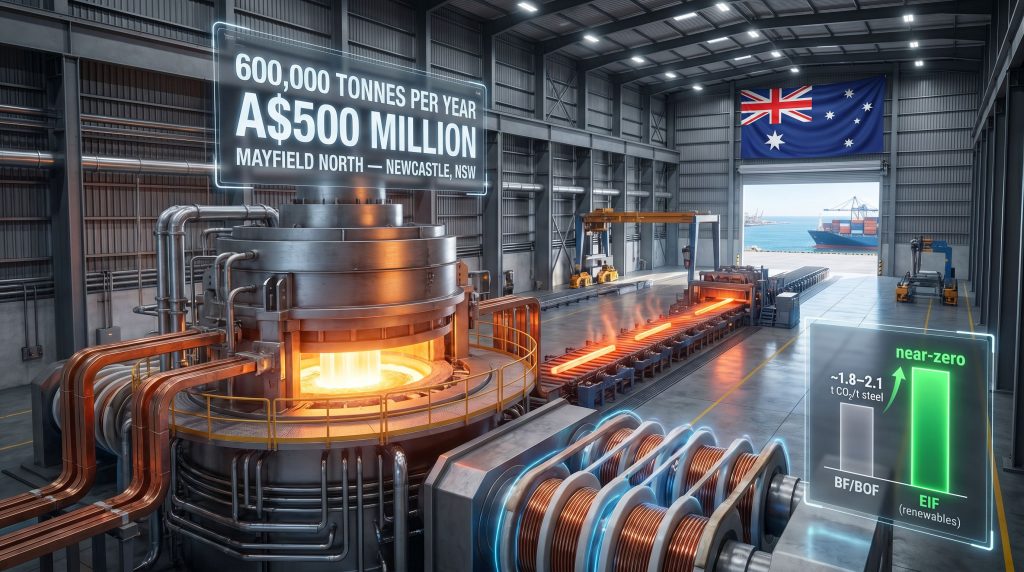
Australia's domestic steel sector has operated without a new greenfield facility for over 30 years, a period of structural stagnation driven by high capital costs, energy pricing uncertainty, and the entrenched economics of coal-based blast furnace production. That stagnation is now being challenged by a A$500 million (approximately US$347 million) private capital commitment from GreenSteel Australia (GSA), which is building the country's first fully gas-free, all-electric steel mill at Mayfield North in Newcastle, New South Wales.
| Process Type | Primary Energy Input | CO₂ Intensity | Key Feedstock |
|---|---|---|---|
| Blast Furnace / BOF | Metallurgical coal | ~1.8–2.1 t CO₂/t steel | Iron ore |
| Electric Arc Furnace (EAF) | Electricity | ~0.4–0.6 t CO₂/t steel | Scrap steel / DRI |
| Electric Induction Furnace (EIF) | Electricity | Near-zero (with renewables) | Steel billets |
| DRI-EAF (Green Iron Route) | Hydrogen / natural gas | Variable | Iron ore pellets |
The table above illustrates why the technology choice at Mayfield North matters: the EIF pathway, when powered by renewable electricity, offers a path to near-zero operational emissions — a step-change improvement over every coal-based alternative.
When big ASX news breaks, our subscribers know first
What an Electric Induction Furnace Actually Does — and Why It Matters
The Technical Distinction That Separates EIF from EAF
To understand why Australia's first all-electric steel mill represents a genuine technological departure, it helps to understand precisely how an electric induction furnace differs from the more commonly discussed electric arc furnace.
An electric arc furnace (EAF) generates heat by striking a powerful electrical arc between graphite electrodes and the metallic charge in the furnace vessel. The arc temperature can exceed 3,000°C, and this intense localised heat melts the surrounding scrap steel or direct reduced iron. EAF technology dominates recycled steel production in the United States and Europe, where scrap availability is high.
An electric induction furnace (EIF), by contrast, generates heat through an entirely different mechanism. A high-frequency alternating electrical current is passed through a copper coil surrounding the furnace vessel, inducing eddy currents within the metal charge itself. The metal becomes its own heat source through electromagnetic induction — no arc, no electrodes, no combustion of any kind.
Key Technical Insight: Because the EIF heats the feedstock from within rather than from an external arc, it achieves superior temperature uniformity and is particularly well-suited to processing pre-refined feedstocks like steel billets. This is a fundamentally different operational profile from scrap-based EAF steelmaking.
| Attribute | Electric Induction Furnace (EIF) | Electric Arc Furnace (EAF) |
|---|---|---|
| Heat Generation Mechanism | Electromagnetic induction within metal | Electrical arc between electrodes and charge |
| Preferred Feedstock | Pre-refined billets / clean scrap | Scrap steel, DRI, pig iron |
| Gas or Combustion Required | None | None |
| Temperature Uniformity | High — ideal for quality-sensitive grades | High but more variable across charge |
| Scale Architecture | Modular and scalable | Typically larger-scale installations |
| Global Adoption | Growing in Asia and specialty markets | Dominant in US and EU recycled steel |
The selection of EIF technology at Mayfield North reflects a deliberate engineering and commercial decision: to build a production system optimised for pre-refined billet feedstock sourced from Southeast Asia, rather than a scrap-processing operation dependent on domestic collection infrastructure. This architectural choice has meaningful implications for both feedstock procurement strategy and the facility's emissions profile. Furthermore, advances in green steelmaking technology globally are accelerating the commercial case for these electric-first approaches.
How the Mayfield North Project Will Be Built and Operated
Stage One: Site Preparation on Historic Industrial Ground
The Mayfield North facility will occupy a 70,000 m² site at 51 Industrial Drive, Mayfield North, Newcastle, NSW — the former BHP steelworks location in Newcastle, which ceased operations in 1999. The site's existing approval for steel fabrication under current zoning classifications removes a layer of regulatory complexity that would otherwise confront a greenfield development.
GreenSteel Australia has confirmed that it is finalising detailed design plans and will lodge a development application for the project. Site refurbishment works are scheduled to begin before the end of 2026, covering civil infrastructure, electrical system upgrades, and preparation of the facility for equipment installation.
Stage Two: Equipment Procurement from a Global Leader in Electric Steelmaking
The core steelmaking equipment for Mayfield North has been contracted from Danieli, an Italian steel plant engineering firm with an extensive global portfolio of electric steelmaking installations. Danieli is one of the few companies in the world capable of supplying large-scale EIF systems designed for continuous long-steel production.
Key equipment, including the EIF system itself, is scheduled to arrive from October 2027, with a commissioning timeline targeting full operational readiness by January 2028. The phased delivery schedule allows for parallel installation and pre-commissioning testing activities rather than sequential execution.
Stage Three: Production Ramp-Up Across Steel Product Categories
Initial production at Mayfield North will focus on reinforcing bar (rebar), one of the highest-volume steel products used in residential, commercial, and infrastructure construction across Australia. Subsequent production stages will introduce:
- Wire rod — used extensively in construction, engineering, and fastener manufacturing
- Coil products — serving a broader range of fabrication and manufacturing applications
- Nameplate capacity is targeted at up to 600,000 tonnes per year of finished steel
- Staffing is planned at approximately 200 full-time employees
What Markets Will Mayfield North Target?
Domestic Demand Drivers Across Three Core Sectors
The product mix at Mayfield North is specifically calibrated to serve three structurally robust demand categories within the Australian economy:
- Residential and commercial construction — Rebar demand tracks directly with building approvals, which remain elevated across Australia's major metropolitan markets amid an entrenched housing supply shortfall.
- Transport infrastructure — Federal and state government infrastructure pipelines, spanning road, rail, bridge, and port development, represent long-cycle demand for structural steel products with multi-year forward visibility.
- Renewable energy construction — The buildout of wind farms, utility-scale solar installations, and high-voltage transmission networks is creating a new and growing demand category for steel products that did not exist at meaningful scale a decade ago.
Newcastle's Strategic Logistics Advantage
The choice of Newcastle as the facility location provides several structural advantages that a purpose-built greenfield site elsewhere in Australia would struggle to replicate:
- Port access for inbound Southeast Asian billet shipments and outbound finished product distribution along the eastern seaboard
- Proximity to Sydney, Australia's largest construction market, reducing freight costs relative to interstate supply alternatives
- Existing utility connections and industrial-grade logistical infrastructure inherited from the site's BHP heritage, reducing establishment costs
- Industrial zoning already in place, avoiding the time and cost of rezoning or environmental reclassification
The Capital Structure and Investment Scale
A$500 Million in Private Capital: What It Buys
The A$500 million investment envelope at Mayfield North is one of the largest private capital commitments to new steel manufacturing infrastructure in Australia in modern history. The funding covers:
- Site refurbishment and civil works
- Electrical infrastructure upgrades to support EIF power requirements
- Procurement and installation of the Danieli EIF steelmaking system
- Operational ramp-up costs through to initial commercial production
Critically, GreenSteel Australia has confirmed that the Mayfield North project has not received direct government funding, distinguishing it from competing green steel initiatives in Australia that are contingent on public capital allocation.
Investor Note: The fully private capital structure of this project eliminates exposure to sovereign policy risk from funding approval processes. However, it also places the entire commercial risk — including feedstock price volatility, electricity cost trajectory, and rebar market pricing — on the project's private financiers.
How Mayfield North Fits Within Australia's Green Steel Policy Landscape
The federal government's Future Made in Australia (FMIA) policy framework is designed to signal long-term industrial policy support and create market certainty that attracts private capital. GreenSteel Australia has identified the FMIA agenda as a contributing factor in the investment decision, illustrating how industrial policy can catalyse private capital deployment without direct grant expenditure.
Separately, the federal government's Green Iron Investment Fund (GIIF), announced in February 2025, allocates A$1 billion to support early-mover green iron production projects. Half of this, A$500 million, has been directed to the Whyalla Steelworks in South Australia as part of a broader A$3.2 billion government support package. The remaining A$500 million is available to other national applicants, with applications having closed in February 2025 and successful recipients yet to be announced as of mid-2026.
| Initiative | Funding Type | Scale | Technology Pathway |
|---|---|---|---|
| Mayfield North (GreenSteel Australia) | Private (A$500mn) | 600,000 t/yr | EIF — fully electric, gas-free |
| Whyalla Steelworks (SA) | Government (A$3.2bn total, A$500mn GIIF) | 1.2mn t/yr | DRI-EAF transition |
| Green Iron Investment Fund (GIIF) | Federal government | A$1bn total | Hydrogen-based DRI |
| Generation Steel (Collie, WA) | Private | TBA | Electric arc furnace |
It is worth noting that the GIIF framework defines green iron specifically as lower-carbon production through methods such as hydrogen-based direct reduced iron (DRI) — a process explored in depth through hydrogen iron ore reduction research. This definitional distinction means the Mayfield project may not qualify for GIIF support even if it were to apply, underscoring the significance of its fully private financing model.
Is Mayfield North Truly "Green"? An Honest Emissions Assessment
Understanding the Difference Between Gas-Free and Zero-Emissions
One of the most important distinctions in the green steel discussion is the difference between eliminating direct emissions and achieving net-zero carbon intensity. These are related but not identical concepts.
The EIF process at Mayfield North eliminates all Scope 1 emissions from the steelmaking operation — there is no combustion, no gas, and no on-site CO₂ generation from the heating process. This is a genuine and significant achievement. However, the facility's actual carbon footprint depends on two additional factors:
- The emissions intensity of the electricity grid supplying the plant, which improves progressively as Australia's renewable energy penetration increases
- The embodied carbon in Southeast Asian steel billets (Scope 3 upstream emissions), which reflects the production methods used by billet suppliers rather than by Mayfield North itself
| Grid Scenario | Estimated CO₂ Intensity | Reduction vs. Conventional BF/BOF |
|---|---|---|
| Current Australian grid (~50% renewables) | ~0.3–0.5 t CO₂/t steel (indirect) | ~75–85% reduction |
| 2030 projected grid (~70–80% renewables) | ~0.15–0.25 t CO₂/t steel (indirect) | ~88–93% reduction |
| 100% renewable electricity supply | Near-zero operational emissions | ~95–98% reduction |
Important Distinction: The Mayfield North facility eliminates fossil fuel combustion at the point of steel production — a meaningful decarbonisation milestone. Full lifecycle near-zero status depends on the continued greening of the national electricity grid and, eventually, the upstream emissions intensity of billet feedstock supply chains.
The next major ASX story will hit our subscribers first
The Feedstock Risk That Deserves Closer Attention
Southeast Asian Billet Dependency: A Structural Vulnerability
The Mayfield North facility's reliance on steel billets sourced from Southeast Asia introduces a feedstock dependency that partially offsets the domestic supply chain resilience benefits the project is intended to deliver. Several dynamics compound this risk:
- Chinese steel export policy has an outsized influence on billet pricing across Southeast Asian markets. When Chinese mills increase export volumes, regional billet prices can fall sharply, compressing margins for billet producers and distorting supply flows.
- Scrap availability in billet-producing countries affects production costs and, consequently, the price of billets offered to export markets.
- Energy cost volatility in producing countries — particularly those reliant on coal-fired power for their own electric furnace operations — can translate into price instability for Australian buyers.
A potential stage two development at the Mayfield North site, details of which GreenSteel Australia has indicated will be announced in the near term, may address this structural dependency through upstream integration, scrap processing capability, or feedstock diversification strategies. The evolution of that announcement will be closely watched by supply chain analysts and construction sector buyers alike.
What This Project Signals for Australia's Industrial Future
The Hunter Valley's Industrial Transformation in Structural Context
The Hunter Valley region is navigating a well-documented long-term transition away from thermal coal dependency. The reactivation of the former BHP Newcastle Steelworks site for advanced electric steelmaking carries significance that extends beyond the project's production economics.
The Newcastle site sat idle for more than 25 years before GreenSteel Australia identified its potential for however, its resurrection as a clean industrial facility is emblematic of a broader pattern emerging across former heavy-industrial regions in developed economies. H2 Green Steel and similar ventures globally are demonstrating that repurposing brownfield industrial heritage for low-emissions manufacturing — leveraging existing utility connections, port access, and skilled workforce geography — is increasingly viable rather than aspirational.
The project's 200 direct jobs may seem modest against the employment footprint of the original BHP steelworks, but the nature of those roles — in advanced electric steelmaking rather than coal-based heavy industry — reflects the structural shift underway in the regional labour market.
Private Capital Leading Where Public Funding Has Not Yet Followed
Perhaps the most consequential aspect of the Mayfield North project is not the technology it deploys or the products it will make, but the financing model it demonstrates. Large-scale green industrial infrastructure in Australia has, to date, been heavily associated with public capital support.
The South Australia green iron transformation at the Whyalla steelworks, for instance, required A$3.2 billion in government funding to remain viable during its transformation process. The GIIF itself exists because private capital had not moved at scale toward green iron without explicit fiscal incentives.
Mayfield North changes that narrative. A A$500 million fully private commitment to a new electric steelmaking facility, without direct government subsidy, represents a meaningful shift in investment appetite. This shift is driven by the convergence of falling renewable electricity costs, rising domestic rebar demand, and the structural import dependency that the Australian construction sector has accepted as a default condition for decades.
Whether this model can be replicated across other sectors of Australia's industrial economy remains to be seen. However, as a proof of concept for private-led green industrial investment, the Mayfield North project provides a data point that policymakers, investors, and competing producers across the region will study carefully. Broader steel sector decarbonisation efforts internationally reinforce just how significant this private-led model could be.
Frequently Asked Questions: Australia's First All-Electric Steel Mill
What makes the Mayfield North facility different from existing Australian steel mills?
Mayfield North is designed to operate on electricity alone, with no natural gas used at any stage of the steelmaking process. It uses electric induction furnace technology supplied by Danieli of Italy, making it the first new steel mill built in Australia in over 30 years and the first ever to be fully gas-free from inception.
Who is developing the project?
The project is being developed by GreenSteel Australia (GSA), a private metals developer. The company is chaired by prominent Australian economist Ross Garnaut, a longstanding advocate for Australia's transition to low-emissions industrial production.
Where exactly is the facility located?
The mill will be constructed at 51 Industrial Drive, Mayfield North, Newcastle, New South Wales, on a 70,000 m² brownfield site that previously housed BHP's Newcastle Steelworks before its closure in 1999. Notably, electric steelmaking returns to a site with deep industrial heritage, which lends the project an additional layer of regional significance.
When will production begin?
Site refurbishment is scheduled to commence before the end of 2026. Key steelmaking equipment from Danieli is due to arrive from October 2027, with full operations targeted to begin in January 2028.
What will the mill produce and at what volume?
The facility is designed for up to 600,000 tonnes per year of finished steel, beginning with reinforcing bar and later expanding into wire rod and coil product categories.
Has this project received government funding?
The Mayfield North project has not received direct government funding. While the federal government's Future Made in Australia policy environment influenced the investment decision, GreenSteel Australia is proceeding on a fully private capital basis.
What feedstock will the facility use?
The facility will process steel billets as its primary feedstock, expected to be sourced from Southeast Asian producers. This distinguishes it from scrap-based EAF operations and from iron ore-based blast furnace steelmaking.
This article is intended for informational purposes only and does not constitute financial advice. Forecasts, timelines, and capacity figures are based on information provided by GreenSteel Australia and reported by Argus Media. Actual outcomes may differ materially from projections due to changes in market conditions, regulatory approvals, construction timelines, and other factors beyond the company's control. Readers should conduct their own due diligence before drawing investment conclusions.
Want to Track the ASX Stocks Positioned to Benefit From Australia's Green Industrial Shift?
Discovery Alert's proprietary Discovery IQ model delivers real-time alerts on significant ASX mineral discoveries — instantly identifying actionable opportunities in the commodities underpinning green steel, renewable energy, and infrastructure buildout. Explore historic examples of major mineral discoveries and their market returns, then begin your 14-day free trial at Discovery Alert to position yourself ahead of the market.