August 21, 2026
The Quiet Crisis Behind America's Tungsten Gap
For most of the twentieth century, industrial nations assumed that commodity markets would self-correct, that price signals alone would guarantee supply of the raw materials underpinning modern manufacturing and defence. Tungsten was no exception. As Chinese production scaled aggressively from the 1980s onward, U.S. domestic mines shuttered one by one, unable to compete on cost. The result, decades later, is a structural vulnerability that no amount of spot-market purchasing can easily resolve: the United States currently produces zero primary tungsten domestically, leaving its defence industrial base entirely dependent on foreign sources for one of the most strategically critical metals on earth.
That dependency is now being directly addressed through the Guardian Metal US tungsten mining pilot, a multi-institutional processing trial that brings together mining, academia, and defence research to test whether America can rebuild a domestic tungsten supply chain from the ground up, starting with ore that has been sitting stockpiled in the Nevada desert for decades.
When big ASX news breaks, our subscribers know first
Why Tungsten Is Unlike Any Other Critical Mineral
Tungsten carries a unique combination of physical properties that make substitution extraordinarily difficult. With the highest melting point of any metal at 3,422°C, it is irreplaceable in applications where extreme heat resistance is non-negotiable. Its density, exceeding that of lead by a significant margin, makes it the material of choice for kinetic energy penetrators used in armour-piercing ammunition. Understanding tungsten's strategic importance helps explain why rebuilding domestic supply has become a national security priority.
Beyond defence, tungsten carbide tools account for the majority of global tungsten consumption, underpinning precision machining across aerospace, automotive, and electronics manufacturing. Furthermore, the critical minerals demand surge underway globally is intensifying competition for reliable tungsten sources outside Chinese control.
The U.S. Geological Survey and the Department of the Interior formally designate tungsten as both a critical and strategic mineral, a dual classification reflecting its economic importance and its national security sensitivity. Yet despite this designation, no domestic primary production exists. The United States imports virtually all of its tungsten requirements, with China controlling an estimated 80% or more of global tungsten mine production according to USGS data.
China's Export Policy Shifts and Their Downstream Effects
China's approach to tungsten exports has evolved considerably over recent years. Progressive tightening of export quotas, combined with consolidation of domestic Chinese tungsten producers under state-aligned entities, has reduced the predictability of supply for Western buyers. These policy shifts are not incidental. Tungsten is among the minerals where China has demonstrated a clear willingness to use export controls as a geopolitical instrument, a reality that has accelerated Western demand for alternative supply sources.
For U.S. defence procurement specifically, the exposure is acute. Its role as a critical military metal across multiple application categories means tungsten metal powder must currently be sourced almost entirely from non-domestic suppliers. The absence of a domestic processing capability represents a gap that policymakers have increasingly identified as unacceptable.
The Tempiute Tungsten Project: History Becoming Strategy
The site at the centre of the Guardian Metal US tungsten mining pilot is the Tempiute Tungsten Project, also historically known as the Emerson Tungsten Mine, located near Rachel, Nevada. This is not a speculative exploration target. The site has a verified production history extending back to 1916, with its most recent operational phase concluding in the 1980s before low-cost Chinese imports made continued operation commercially unviable.
What makes the Tempiute site particularly valuable for a near-term pilot is the nature of the available feedstock. Rather than requiring fresh ore extraction, the programme will utilise approximately 250 to 400 tonnes of legacy ore that has been stockpiled from prior mining operations. This distinction carries significant practical weight.
Legacy ore reprocessing bypasses the two most time-consuming elements of new mine development: exploration risk and permitting timelines. When the mineralisation is already characterised and the material is already surface-accessible, the pathway to first production compresses dramatically.
This approach also aligns with contemporary ESG frameworks. Reprocessing historical stockpiles reduces environmental disturbance, avoids the creation of new surface footprints, and can address legacy liabilities from prior operations simultaneously.
| Asset Feature | Detail |
|---|---|
| Site Name | Tempiute Tungsten Project (Emerson Tungsten Mine) |
| Location | Near Rachel, Nevada |
| Historical Production Start | 1916 |
| Last Operational Period | 1980s |
| Legacy Ore Volume (Pilot) | 250-400 tonnes |
| Processing Destination | Philipsburg, Montana |
| First Shipment Target | Late Summer 2026 |
A Four-Partner Architecture Built for Credibility
One of the structurally distinctive elements of the Guardian Metal US tungsten mining pilot is its multi-institutional partnership design. Rather than a bilateral commercial arrangement, the programme integrates four organisations with complementary and non-overlapping roles.
- Guardian Metal Resources (LON: GMET) provides the ore feedstock from Tempiute and acts as project lead and strategic coordinator across the initiative.
- Montana Mining Association (MMA) contributes regional processing expertise and facilitates operational access to the Philipsburg, Montana processing facility, which was selected partly for its proximity to established mineral processing infrastructure in the northern Rocky Mountain region.
- Montana Technological University (MTU) provides metallurgical research capability and academic validation of processing methods, ensuring that the pilot's technical findings carry scientific credibility.
- Army Research Laboratory (ARL) provides defence application oversight, aligning the programme's outputs directly with the technical requirements of U.S. military procurement.
The ARL's participation is particularly significant from an investor and policy perspective. Its involvement signals that the pilot is not simply a commercial processing experiment but a programme with direct relevance to the tungsten in defence aerospace supply chain and broader U.S. military readiness requirements. This type of defence-aligned research partnership is increasingly common in critical mineral development, reflecting a broader policy recognition that supply chain security and military readiness are inseparable.
How the Processing Trial Works: From Stockpile to Metal Powder
Understanding the technical progression of the pilot requires familiarity with the tungsten processing value chain, which is considerably more complex than many other metals.
Raw tungsten ore does not yield usable metal directly. The standard processing sequence moves through several distinct stages:
- Ore beneficiation to produce a tungsten concentrate, typically through gravity separation or flotation depending on ore mineralogy.
- Hydrometallurgical processing to convert concentrate into ammonium paratungstate (APT), the primary intermediate product in global tungsten trade.
- Calcination of APT to produce tungsten oxide (WO₃).
- Hydrogen reduction of tungsten oxide to produce tungsten metal powder, the end product targeted by this pilot.
Each stage has specific technical requirements, and the optimal processing parameters vary with ore characteristics. This is precisely why the metallurgical test-work phase, currently underway at laboratories in both the United States and the United Kingdom, is foundational. Without accurate characterisation of the Tempiute ore's response to processing, pilot-scale design cannot be optimised.
Stage Progression and Decision Gates
The programme follows a structured four-stage progression with decision gates at each transition point.
Stage 1 involves ongoing laboratory-scale metallurgical analysis. Results from this phase will define the processing flowsheet for pilot-scale testing.
Stage 2 moves to on-site pilot-scale testing at the Philipsburg facility in Montana. This is where laboratory findings are stress-tested at a larger physical scale before any significant ore transport is committed.
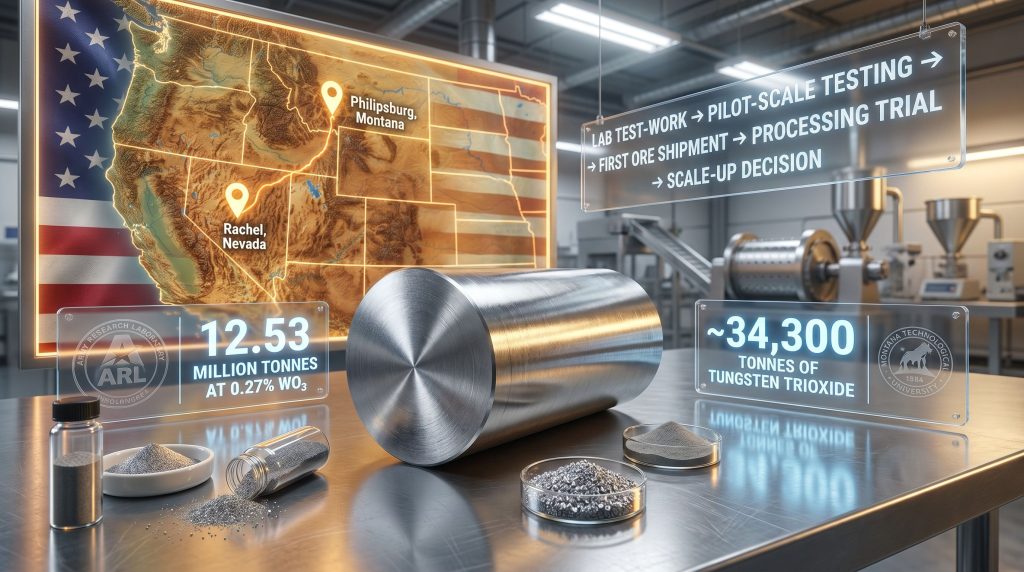
Stage 3 involves the first physical ore shipments, targeting late summer 2026, when 250 to 400 tonnes of Tempiute legacy ore will be transported from Nevada to Montana for processing trials aimed at producing defence-grade tungsten metal powder.
Stage 4 is conditional on the outcomes of Stage 3. Successful processing results could trigger additional ore shipments from Tempiute and would inform the commercial production parameters for any future scaled operation.
The Pilot Mountain Project: The Strategic Asset Behind the Pilot
While the Tempiute processing trial is the near-term operational focus, it exists within a broader development context anchored by the Pilot Mountain Tungsten Project, Guardian Metal's primary long-term asset and one of the largest undeveloped tungsten deposits in the United States.
| Resource Parameter | Estimate |
|---|---|
| Total Resource | 12.53 million tonnes |
| Tungsten Grade | 0.27% WO₃ |
| Contained Tungsten (WO₃) | ~34,300 tonnes |
| Co-product Minerals | Silver, Copper, Zinc |
| Development Stage | Pre-Feasibility Study (PFS) |
| Deposit Type | Skarn mineralisation |
The polymetallic nature of the Pilot Mountain deposit is economically meaningful. Silver, copper, and zinc credits within the ore body have the potential to materially improve project economics by offsetting processing costs, a factor that becomes increasingly important when modelling project viability at different tungsten price scenarios.
The Tremor Zone: An Expanding Resource Envelope
A noteworthy geological development at Pilot Mountain has been the identification of a new tungsten skarn zone during condemnation drilling conducted as part of the ongoing Pre-Feasibility Study. Designated the Tremor Zone, this discovery extends approximately 400 metres and is located 300 to 400 metres from the main Desert Scheelite deposit. Its identification during what was essentially infrastructure-clearance drilling, rather than targeted exploration, suggests the broader mineralised system at Pilot Mountain may be larger than current resource estimates reflect.
Skarn-hosted tungsten deposits, like those at Pilot Mountain, typically form through the metasomatic replacement of carbonate rocks adjacent to intrusive bodies. The geometry of such deposits can be complex and discontinuous, meaning that condemnation drilling in areas assumed to be mineralisation-free can occasionally intersect unexpected grade. The Tremor Zone discovery is a reminder that resource estimation in skarn systems carries meaningful upside optionality.
Pilot North: Consolidating a Nevada Tungsten Portfolio
In July 2025, Guardian Metal Resources acquired the Pilot North Tungsten Project, situated approximately 15 kilometres northwest of the main Pilot Mountain deposit. Pilot North hosts historical tungsten prospects from the World War II era with comparable skarn-style mineralisation, and its acquisition reflects a deliberate portfolio consolidation strategy. By assembling contiguous or near-contiguous tungsten assets within a single Nevada jurisdiction, the company is building the foundations of what could eventually function as an integrated tungsten mining district.
The next major ASX story will hit our subscribers first
Defence Funding, Off-Take Signals, and Commercial De-Risking
The commercial and policy scaffolding around the programme includes two particularly significant signals for investors and analysts tracking the domestic tungsten re-shoring story.
First, Guardian Metal Resources has received a $6.2 million award linked to U.S. Department of Defense mechanisms. Defense Production Act funding has been increasingly deployed as an instrument for domestic critical mineral development, reflecting a policy judgement that mineral supply chain security is a defence preparedness issue, not merely a commercial one. This particular award is directed toward completing the Pre-Feasibility Study at Pilot Mountain.
Second, the company has signed a non-binding off-take letter of intent with Global Tungsten and Powders, one of the world's leading manufacturers of tungsten-based products. While non-binding arrangements carry no legal certainty, the involvement of an established downstream buyer at this stage of development materially reduces the market access risk that typically weighs on junior mining companies in the pre-production phase.
Disclaimer: Non-binding letters of intent are expressions of commercial interest and do not constitute binding sales agreements. Investors should not treat such arrangements as guaranteed revenue or confirmed supply contracts.
Comparing Domestic Tungsten Development Pathways
The Tempiute pilot occupies a specific and strategically important position within the broader landscape of U.S. tungsten development options.
| Development Pathway | Timeframe | Risk Profile | Strategic Value |
|---|---|---|---|
| Legacy ore reprocessing (Tempiute pilot) | Near-term (2026) | Low, proven mineralisation | Immediate supply chain proof-of-concept |
| Pre-feasibility development (Pilot Mountain) | Medium-term | Moderate, PFS stage | Large-scale domestic primary production |
| Tailings reprocessing | Near-to-medium term | Low-moderate | Environmental remediation plus resource recovery |
| Greenfield tungsten exploration | Long-term | High | Future supply optionality |
Legacy ore and tailings reprocessing are chronically undervalued pathways in public market narratives, which tend to focus on greenfield discoveries and headline resource estimates. Yet from a supply chain security perspective, the ability to produce tungsten metal powder from existing stockpiles within a 12 to 18 month timeframe is extraordinarily more valuable than a large resource estimate that is still a decade from production.
Milestones That Will Define the Programme's Trajectory
Near-Term Catalysts
- Completion of metallurgical test-work at U.S. and UK laboratory facilities
- Commencement of pilot-scale testing at the Philipsburg, Montana facility
- First ore shipments from Tempiute, targeted for late summer 2026
- Initial tungsten metal powder production data from processing trials
Medium-Term Developments
- Pre-Feasibility Study completion for Pilot Mountain, informed by pilot programme outputs
- Potential formalisation of the off-take relationship with Global Tungsten and Powders
- Assessment of expanded ore shipments from Tempiute based on pilot success
- Continued resource delineation at the Tremor Zone
Long-Term Strategic Outlook
- Potential transition from pilot-scale to commercial-scale tungsten metal powder production
- Integration of the Pilot North acquisition into a consolidated Nevada development strategy
- Positioning of Nevada as a viable domestic tungsten production hub aligned with U.S. defence industrial base requirements
Frequently Asked Questions: Guardian Metal US Tungsten Mining Pilot
What exactly is the Guardian Metal US tungsten mining pilot?
The programme is a structured processing trial in which legacy ore from the Tempiute Tungsten site in Nevada will be transported to Philipsburg, Montana for metallurgical testing and tungsten metal powder production trials. It is not an operational mine, but a methodically staged experiment designed to validate commercial processing methods using historically stockpiled ore.
Who are the key partners involved?
The programme involves Guardian Metal Resources as project lead and ore supplier, the Montana Mining Association as processing facilitator, Montana Technological University as the metallurgical research partner, and the Army Research Laboratory providing defence application oversight. Further details on the company's broader project portfolio are available via the Guardian Metal Resources website.
How much ore will be processed in the initial phase?
Approximately 250 to 400 tonnes of legacy ore stockpiled at the Tempiute site near Rachel, Nevada will be used in the first phase of the pilot.
When are first ore shipments expected?
First shipments to the Philipsburg processing facility are targeted for late summer 2026, following completion of current laboratory test-work and on-site pilot-scale testing in Montana.
Why does the U.S. have no domestic tungsten production?
U.S. tungsten mining declined through the latter half of the twentieth century as lower-cost Chinese production captured global market share. No primary domestic tungsten production has operated for over a decade, creating a structural supply chain vulnerability that programmes like the Guardian Metal pilot are designed to address.
Is tungsten classified as a critical mineral by the U.S. government?
Yes. Tungsten holds formal critical and strategic mineral designation from both the USGS and the Department of the Interior, reflecting its defence, manufacturing, and advanced technology applications.
This article contains forward-looking statements and projections related to mining development timelines, resource estimates, and commercial arrangements. These involve inherent uncertainty and should not be relied upon as guarantees of future outcomes. Readers should conduct their own due diligence before making any investment decisions.
Want to Stay Ahead of the Next Major ASX Mineral Discovery?
Discovery Alert's proprietary Discovery IQ model delivers real-time alerts on significant ASX mineral discoveries across critical minerals and beyond, turning complex data into actionable investment insights for traders and long-term investors alike. Explore Discovery Alert's dedicated discoveries page to see how historic finds have generated substantial returns, and begin your 14-day free trial today to position yourself ahead of the broader market.