July 9, 2026
The Chemistry Problem Hiding Inside the Global Battery Supply Chain
Every lithium-ion battery produced today contains a component that most consumers never think about: the anode. Constructed almost entirely from purified spherical graphite (PSG), the anode is a deceptively simple-looking material that requires extraordinarily precise chemistry to manufacture. Achieving the carbon purity levels demanded by battery producers is not merely a technical exercise. It is, in practice, a chemical safety challenge that has quietly constrained the development of battery material supply chains outside of China for years.
The dominant purification method used globally relies on hydrofluoric acid (HF), a reagent with properties that make it effective at stripping silicate and mineral impurities from graphite concentrates. HF is also acutely toxic, corrosive at trace concentrations, and requires containment infrastructure that most Western industrial jurisdictions struggle to approve, insure, and operate at scale. The result is a structural bottleneck: the world needs more ex-China PSG, but the established chemistry for making it is poorly suited to the regulatory environments where new supply is most urgently required.
Understanding this tension is the starting point for evaluating why the Renascor hydrofluoric acid-free graphite purification process has attracted meaningful attention from battery supply chain participants.
When big ASX news breaks, our subscribers know first
What Graphite Purification Actually Involves
Why 99.95% Carbon Is the Floor, Not the Target
Battery-grade PSG is not simply mined graphite that has been cleaned up. It is a precision material. Lithium-ion battery anode manufacturers require graphite with carbon purity exceeding 99.95% C as a baseline specification. Below this threshold, residual mineral impurities interfere with lithium-ion intercalation, degrade cycle performance, and can accelerate capacity fade in battery cells.
Reaching this purity level from run-of-mine graphite concentrate, which may carry carbon content of 90% to 97% depending on deposit quality, requires aggressive chemical purification. Impurities including silicates, iron compounds, alumina, and other gangue minerals must be dissolved and removed without damaging the graphite crystal structure that gives PSG its electrochemical value.
Historically, hydrofluoric acid accomplished this efficiently. HF dissolves silicates rapidly at relatively low temperatures, making it a cost-effective choice in processing environments where its hazards can be managed. China's dominant PSG industry was built around this chemistry, and the infrastructure to handle HF safely within Chinese industrial zones evolved over decades. Replicating that infrastructure elsewhere has proven far more difficult.
The Hidden Costs of Hydrofluoric Acid-Based Processing
Beyond the well-documented acute toxicity of HF, which causes severe chemical burns and systemic fluoride poisoning even at low dermal exposure, the operational cost structure of HF-based purification carries significant embedded expenses that are rarely foregrounded in project economics:
- Specialised containment infrastructure: HF requires dedicated storage, transfer pipework, and emergency neutralisation systems constructed from HF-resistant materials.
- Elevated health and safety management: Worker training, personal protective equipment, medical monitoring protocols, and emergency response readiness all add recurring overhead.
- Regulatory approval complexity: In Australia, the European Union, North America, and other Western jurisdictions, HF storage and use triggers multi-agency regulatory review processes that can significantly extend project timelines.
- Waste treatment obligations: HF-laden process liquors require specialised neutralisation before discharge, generating fluoride-bearing waste streams with their own disposal requirements.
- Insurance and community risk premiums: Facilities handling HF at industrial scale face elevated insurance costs and, increasingly, community opposition that can introduce project risk not captured in standard financial models.
"The commercial case for HF-free purification in Western jurisdictions is not primarily environmental. It is financial. Eliminating HF removes a category of cost, risk, and regulatory friction that materially affects project economics before a single tonne of PSG is produced."
The Renascor Hydrofluoric Acid-Free Graphite Purification Process: A Technical Breakdown
How the Flow Sheet Works
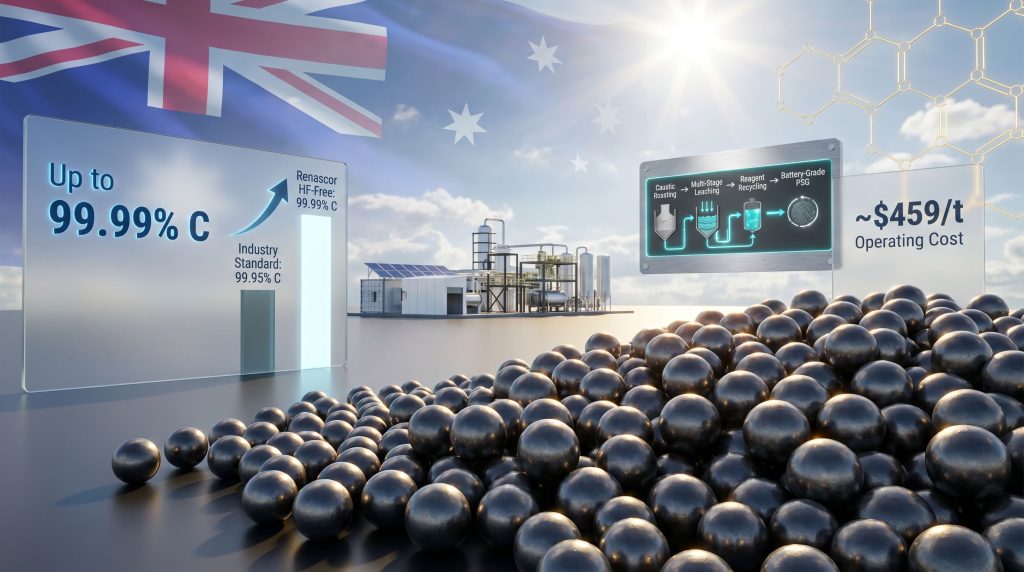
The Renascor hydrofluoric acid-free graphite purification process achieves battery-grade purity through a sequence of lower-hazard chemical steps that collectively replace the role HF plays in conventional flow sheets. The process can be understood as four integrated stages:
- Low-temperature caustic roasting: Graphite concentrate is treated with a caustic (alkaline) solution at reduced thermal energy input compared to high-temperature alternatives. The caustic environment attacks silicate mineral structures, beginning the impurity dissolution process without requiring extreme heat.
- Multi-stage acid leaching: Following caustic roasting, the material undergoes sequential leaching. A caustic solution stage addresses alkaline-soluble impurities, followed by a sulfuric acid stage that dissolves residual mineral phases. Critically, bench-scale process refinements replaced hydrochloric acid with sulfuric acid at this stage, further reducing chemical costs, energy consumption, and water usage.
- Integrated water treatment and reagent recycling: A closed-loop water treatment system recovers and recycles reagents across the process, reducing ongoing chemical consumption. This is not simply an environmental feature. It is a direct operating cost reduction mechanism that compresses variable costs per tonne of output over the life of the operation.
- Final product recovery: The purified graphite is recovered, processed into spherical form, and subjected to final quality verification to confirm purity thresholds are met or exceeded.
Purity Performance and Independent Validation
The process has been validated through independent locked-cycle trial testing conducted by Dorfner Anzaplan, a German battery mineral consultancy with established credibility in the critical minerals sector. Locked-cycle trials differ from single-pass batch tests in that they simulate continuous production conditions, cycling process streams through multiple iterations to confirm that performance metrics are reproducible and stable rather than the product of optimised one-off conditions.
| Performance Metric | Specification |
|---|---|
| Carbon purity achieved | Up to 99.99% C |
| Industry minimum anode standard | 99.95% C |
| Purity premium above standard | +0.04% C |
| Independent validation body | Dorfner Anzaplan (Germany) |
| Validation methodology | Locked-cycle trial testing |
Achieving 99.99% carbon purity positions the output not merely at the threshold of commercial acceptability but in premium anode material territory. For battery manufacturers with tighter internal specifications or applications requiring extended cycle life, this headroom above the minimum standard has practical commercial value.
"Independent locked-cycle confirmation from a recognised European testing organisation carries weight in offtake and investment discussions that internal testwork alone cannot provide. It signals that the purity claims are reproducible under production-analogous conditions, not simply achievable under ideal laboratory settings."
Furthermore, the battery raw materials market has increasingly recognised that third-party validation of this nature is a prerequisite for serious offtake negotiations with major anode manufacturers.
Examining the $459 Per Tonne Operating Cost Estimate
What the Cost Study Covers
A detailed purification cost study, based on engineering assessments and testwork conducted at Renascor's PSG demonstration plant in South Australia, produced an estimated operating cost of approximately $459 per tonne of purified spherical graphite. This figure encompasses reagent costs, energy inputs, water treatment operations, and general operational overhead associated with running the purification process.
| Cost Benchmark | Figure |
|---|---|
| Estimated HF-free purification operating cost | ~$459/t |
| Comparison basis | Competitive with HF-based Western purification methods |
| Study methodology | Detailed engineering and testwork at PSG demonstration plant |
Why the Relevant Benchmark Is Western HF-Based Costs, Not Chinese Production Costs
A common analytical error when evaluating ex-China PSG projects is benchmarking operating costs against Chinese production, which benefits from decades of infrastructure amortisation, lower labour costs, highly optimised HF supply chains, and regulatory environments that do not impose the same overhead structure as Western jurisdictions. This comparison is commercially irrelevant for a project targeting Western battery manufacturers seeking supply chain diversification.
The commercially meaningful benchmark is what it costs to produce PSG using HF-based methods in Western jurisdictions currently under development. Against that reference point, the $459/t estimate is competitive, and the structural cost advantages of the HF-free approach become clearer:
- Lower reagent procurement costs: Sulfuric acid and caustic solution carry substantially lower per-unit costs than hydrofluoric acid, which requires specialised supply chains and handling premiums.
- Reagent recycling reducing variable costs over time: The closed-loop system means reagent consumption per tonne decreases as the recycling circuit matures, improving unit economics at scale.
- Elimination of HF compliance overhead: Removing HF from the process eliminates dedicated containment capital, ongoing health and safety management costs, and elevated insurance premiums.
- Reduced energy intensity: The low-temperature roasting step requires less thermal energy than high-temperature purification alternatives, reducing energy cost per tonne.
Comparison Framework: HF-Free vs. HF-Based Purification
| Attribute | HF-Based (Conventional) | Renascor HF-Free Process |
|---|---|---|
| Primary purification reagent | Hydrofluoric acid | Caustic solution + sulfuric acid |
| Reagent recycling capability | Limited | Integrated closed-loop system |
| Health and safety overhead | High (HF containment required) | Significantly reduced |
| Regulatory exposure | Elevated | Lower |
| Carbon purity achievable | Up to 99.95%+ | Up to 99.99% C |
| Western jurisdiction suitability | Constrained | Optimised |
| Environmental waste profile | Higher fluoride waste burden | Reduced via water treatment system |
The South Australia Demonstration Plant: From Testwork to Production Validation
Why Demonstration Scale Matters
The transition from laboratory-scale metallurgical testwork to demonstration plant operations is one of the most consequential and least appreciated steps in the commercialisation of any mineral processing technology. Laboratory results, even those confirmed through locked-cycle trials, cannot fully replicate the engineering realities of continuous production: reagent feed variability, equipment wear patterns, water circuit chemistry evolution, and the compounding effects of running connected unit operations simultaneously.
Renascor's high-purity graphite plant, located in Adelaide, South Australia, was commissioned to validate engineering, operating, and process parameters under conditions that approximate commercial production. The plant received co-funding from the Australian government, reflecting alignment with sovereign critical minerals processing objectives, though this does not constitute project-specific designation or accelerated permitting.
Three Validation Objectives
The demonstration plant is designed to confirm three distinct categories of performance:
- Engineering parameters: Confirming that plant equipment performs to design specifications under sustained operating conditions, including pumps, reactors, filtration systems, and the water treatment circuit.
- Operating parameters: Demonstrating stable and predictable reagent consumption rates, energy inputs, and water treatment performance across multiple production runs, generating the data inputs required for bankable feasibility study preparation.
- Process parameters: Confirming that 99.99% C purity is reproducible across production runs rather than an artefact of isolated optimal-condition testing, which is the critical assurance for prospective offtake partners.
Customer Qualification Progress
Concurrent with demonstration plant commissioning, Renascor has achieved first-stage qualification with two major anode company customers. These two customers collectively represent offtake potential covering up to two-thirds of planned Stage 1 production volume, a meaningful proportion of initial output that substantially de-risks the commercial pathway before full-scale capital commitment.
"Achieving customer qualification before commercial-scale infrastructure is built inverts the conventional project risk profile. Rather than constructing capacity and then seeking buyers, validation of market acceptance precedes the major capital decision, providing a structurally more defensible commercialisation pathway."
The Siviour Deposit: The Upstream Foundation
Scale and Quality as Strategic Assets
The downstream PSG processing strategy is underpinned by the Siviour Graphite Deposit in South Australia, which ranks among the largest graphite deposits outside of Africa by resource size. Deposit scale matters enormously in the economics of integrated graphite operations. A large, high-quality resource base reduces the risk of upstream supply constraints, provides flexibility in production scheduling, and supports the kind of long-term offtake commitments that major battery manufacturers require when diversifying supply chains.
The graphite quality characteristics of Siviour are also relevant to processing economics. Higher-grade concentrate with lower initial impurity loads reduces the chemical burden placed on the purification circuit, which has a direct bearing on reagent consumption and therefore operating costs. Concentrate that requires less intensive beneficiation before entering the PSG flow sheet lowers the overall cost of producing battery-grade material.
The Logic of Vertical Integration
The strategic rationale for combining mine-stage graphite production with in-country PSG processing is grounded in commercial risk management rather than simple value-adding aspiration. Selling raw graphite concentrate into a market where Chinese processors dominate conversion to battery-grade PSG exposes the producer to processing margin compression and supply chain intermediaries with their own pricing power. Integrating downstream processing captures a larger share of the value chain and creates a more defensible commercial position.
Vertical integration also reduces exposure to supply chain disruption risk. An operation that controls concentrate supply and processing capacity within a single jurisdiction is less vulnerable to third-party processing bottlenecks, geopolitical trade friction, or pricing volatility in intermediate markets. In addition, approaches to critical minerals recycling are also beginning to influence how vertically integrated producers plan their long-term material strategies.
The next major ASX story will hit our subscribers first
Why Ex-China PSG Supply Has Become a Strategic Priority
The Concentration Problem in Global Graphite
China's position in global graphite supply chains extends well beyond mining. Chinese processing capacity is estimated to account for the substantial majority of global PSG production, with some industry estimates placing the figure above 80% of total output. This concentration creates single-point-of-failure risk for battery manufacturers across North America, Europe, South Korea, and Japan, where domestic PSG production capacity is either nascent or non-existent.
The global graphite shortage has consequently become a focal point for governments and battery manufacturers alike, accelerating the search for credible ex-China processing alternatives.
| Supply Chain Stage | Current Dominant Geography | Strategic Gap for Western Producers |
|---|---|---|
| Natural graphite mining | China, Mozambique, Madagascar | Australia, Canada, Africa (emerging) |
| Graphite concentrate processing | China (~70%+ of capacity) | Near-zero ex-China capacity |
| PSG production (HF-based) | China | Constrained by HF regulation in West |
| PSG production (HF-free) | Emerging | Active development phase |
| Battery anode manufacturing | China, South Korea, Japan | North America, Europe (scaling) |
Why Purification Technology Is a Geopolitical Variable
The strategic value of a purification process that is specifically architected for Western regulatory environments extends beyond individual project economics. A technology that can be operated, licensed, or replicated in jurisdictions with strict chemical safety regulations without compromising purity performance represents a template for building PSG capacity where it is most strategically needed.
HF-based processing faces structural headwinds in Western manufacturing environments that go beyond regulatory approval timelines. Community opposition to HF storage facilities, rising insurance costs for hazardous chemical operations, and the increasing scrutiny of chemical safety in industrial permitting processes all compound the practical difficulty of deploying conventional purification chemistry at scale outside of existing industrial zones in China.
Regulatory frameworks including the US Inflation Reduction Act's critical minerals provisions and the EU Critical Raw Materials Act have intensified commercial incentives for battery manufacturers to diversify their PSG sourcing. However, these frameworks create demand signals for ex-China supply without resolving the underlying technical and regulatory barriers to building that supply. The critical minerals demand outlook, moreover, suggests these pressures will only intensify as the energy transition accelerates. A commercially competitive, HF-free purification process that functions effectively in Western jurisdictions directly addresses the supply-side constraint that policy frameworks alone cannot solve.
Furthermore, Renascor's eco-friendly purification technology has been recognised as one of the more viable approaches to resolving this structural challenge at commercial scale.
Frequently Asked Questions: Renascor's HF-Free Process
What does hydrofluoric acid-free graphite purification actually mean?
It means the entire purification flow sheet achieves battery-grade purity without introducing hydrofluoric acid at any stage. The chemistry relies instead on caustic roasting and sequential acid leaching using reagents with substantially lower hazard profiles, without sacrificing the purity outcomes that HF conventionally delivers.
What purity level does the process achieve?
Independent locked-cycle testing has confirmed carbon purity of up to 99.99% C, which exceeds the 99.95% C minimum threshold required for lithium-ion battery anode applications by a meaningful margin.
Has the process been independently verified?
Yes. Dorfner Anzaplan, an independent German battery mineral consultancy, confirmed process performance through locked-cycle trial testing, providing third-party validation of purity claims under production-analogous conditions.
What stage is the technology at?
The technology has progressed from laboratory validation through to demonstration plant commissioning in Adelaide, South Australia. First-stage customer qualification has been achieved with two major anode manufacturers, covering up to two-thirds of planned Stage 1 production volume.
How does the operating cost compare to conventional methods?
The estimated operating cost of approximately $459 per tonne is cost-competitive with HF-based purification methods under development in Western jurisdictions, based on detailed engineering and testwork at the South Australia demonstration plant.
Key Takeaways at a Glance
| Summary Metric | Detail |
|---|---|
| Process type | Caustic roast + multi-stage acid leaching (HF-free) |
| Carbon purity achieved | Up to 99.99% C |
| Industry minimum standard | 99.95% C |
| Estimated operating cost | ~$459/t |
| Validation status | Independent locked-cycle trials confirmed by Dorfner Anzaplan |
| Demonstration plant location | Adelaide, South Australia |
| Customer qualification | First-stage qualification with two major anode companies |
| Production coverage | Up to two-thirds of planned Stage 1 output |
| Upstream resource | Siviour Graphite Deposit, South Australia |
| Strategic model | Integrated mine-to-PSG, ex-China supply chain |
The convergence of cost parity confirmation, third-party technical validation, and early-stage customer qualification positions the Renascor hydrofluoric acid-free graphite purification process as one of the more technically advanced ex-China PSG development programmes currently moving through the pre-commercial pipeline. Whether the broader battery supply chain accelerates its adoption of non-Chinese PSG sources will depend on how quickly Western anode manufacturers translate policy incentives into binding commercial commitments, and how rapidly demonstration-scale programmes like this one complete the validation work required to support full-scale investment decisions.
This article contains forward-looking statements and references to project development timelines, cost estimates, and commercial outcomes that are subject to material uncertainty. Operating cost figures and purity metrics are based on demonstration plant testwork and engineering studies and should not be interpreted as guarantees of commercial performance. Readers should conduct their own due diligence and consider independent financial advice before making investment decisions related to any companies or projects referenced herein.
Want to Identify the Next Major Critical Minerals Discovery Before the Market Does?
Discovery Alert's proprietary Discovery IQ model scans ASX announcements in real time, instantly converting complex mineral data across 30+ commodities into clear, actionable insights for traders and investors alike — start your 14-day free trial today and see why significant mineral discoveries have historically delivered extraordinary returns.