July 9, 2026
The Strategic Logic Behind Queensland's Fuel Security Push
Across the developed world, governments that once treated fuel supply as a logistical afterthought are now confronting an uncomfortable reality: decades of offshoring refining capacity and over-reliance on global commodity flows have left even resource-rich nations exposed to disruption. Australia is no exception. Despite sitting atop vast reserves of oil and gas, the country imports the majority of its refined liquid fuels, a structural vulnerability that geopolitical tension, shipping route instability, and price volatility have brought sharply into focus.
It is against this backdrop that Queensland's 2026-27 budget commitment to Queensland gas and fuel security investment carries significance well beyond its dollar value. The AU$19 million package is not a standalone fix. It is a framework-setting signal designed to convert prospective geology into producible reserves, attract billions in private capital, and rebuild the sovereign capability stack that Australia allowed to erode over several decades.
Understanding why this matters requires looking at both the upstream geology driving exploration optimism and the downstream refining and storage gaps that currently leave Queensland, and by extension the nation, exposed.
When big ASX news breaks, our subscribers know first
Queensland's Dominant but Incomplete Role in National Gas Supply
Supplying the East Coast: A Position of Strength with a Critical Weakness
Queensland's existing contribution to Australia's domestic gas market is extraordinary. The state currently supplies more than 90% of east-coast domestic gas demand, a concentration that reflects both the productivity of its coal seam gas fields and the underdevelopment of alternatives elsewhere on the continent. Australia's resource and energy exports remain a cornerstone of the national economy, yet structural gaps in downstream capability continue to limit true fuel sovereignty.
This dominance, however, cuts both ways. While Queensland's upstream gas production is formidable, its liquid fuel refining infrastructure has been progressively wound back. Australia as a whole now operates with minimal domestic refining capacity, a situation that leaves liquid fuel consumers — including transport, aviation, agriculture, and defence — dependent on imports processed overseas and shipped across long, potentially fragile supply lines.
Queensland's outsized role in domestic gas production means its energy policy decisions reverberate nationally. Strengthening upstream capability without addressing downstream refining and storage creates only a partial solution to true fuel sovereignty.
Why Global Energy Market Volatility Is Forcing a Rethink
The post-pandemic energy landscape delivered a series of object lessons in supply chain fragility. Shipping bottlenecks, refinery outages in Asia, and global trade disruption all contributed to price spikes and periodic supply tightness in Australian fuel markets. For policymakers in Queensland, where regional communities can sit hundreds of kilometres from the nearest major fuel depot, the consequences of supply disruption are not theoretical.
The 2026-27 budget investment reflects a deliberate shift toward reducing that exposure through a combination of exploration acceleration, refining feasibility work, and targeted infrastructure upgrades.
Breaking Down Queensland's $19 Million Fuel Security Budget Package
A Two-Stream Architecture: Upstream Meets Downstream
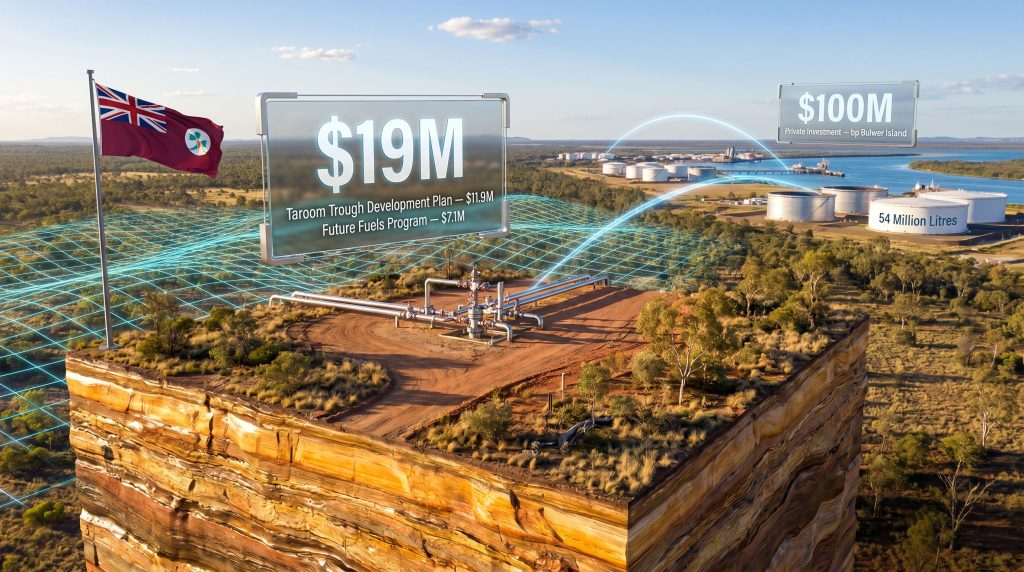
The AU$19 million package is structured across two distinct but complementary programs, each targeting a different layer of the fuel supply chain.
| Investment Stream | Allocation | Strategic Focus |
|---|---|---|
| Taroom Trough Development Plan | $11.9 million | Basin-wide regulatory coordination and infrastructure to unlock private capital |
| Future Fuels Program | $7.1 million | Refining feasibility, fuel conversion research, and regional bulk liquid storage upgrades |
| Total Committed | $19 million | Sovereign fuel production, refining, and storage capability |
What the $11.9 Million Taroom Trough Development Plan Actually Funds
The larger of the two allocations is directed at the upstream end of the value chain, specifically at creating the institutional and infrastructure conditions needed to attract major private operators into the Taroom Trough. Key elements include:
- Establishing a whole-of-basin coordination framework to align regulatory processes across multiple tenements
- Streamlined project approvals to compress the timeline between exploration success and production
- Planning road and trunk infrastructure to support orderly and scalable resource extraction
- Building investment certainty sufficient to catalyse private sector capital deployment at the scale the basin's geology warrants
The logic here is well understood in resource development circles: government seed investment in coordination and de-risking can unlock multiples of private capital that would not otherwise flow into a frontier basin. The Taroom Trough's prospectivity is not in question. What has historically constrained development is the regulatory complexity and infrastructure deficit that increases project risk for operators.
What the $7.1 Million Future Fuels Program Is Designed to Achieve
The downstream component targets the refining and storage gaps that represent the most acute vulnerability in Queensland's fuel security position. Furthermore, the program funds:
- Feasibility investigations into onshore refining viability and fuel conversion facility development
- Assessment of renewable diesel production opportunities, including options centred on Brisbane
- Targeted upgrades to bulk liquid fuel storage assets across regional Queensland, where supply disruption risk is highest
The Queensland Coordinator-General's Accelerating Fuel Infrastructure Program provides additional detail on how government land audits and market engagement processes are being used to lower barriers for private developers.
What Is the Taroom Trough and Why Does It Matter?
Geological Profile of One of Australia's Most Prospective Onshore Basins
The Taroom Trough sits within Queensland's Western Downs region, a part of the state that has historically been associated more with agricultural production than hydrocarbon extraction. Geologically, the trough forms part of a broader sedimentary system that has attracted growing scientific and commercial attention as improved seismic imaging and drilling technology have made its subsurface structures more legible to explorationists.
What makes the Taroom Trough particularly interesting from an investment and geological standpoint is its relatively undisturbed exploration history compared to more mature Australian basins. While formations like the Cooper Basin and Surat Basin have been extensively drilled, the Taroom Trough represents a frontier opportunity with meaningful upside for operators willing to absorb early-stage exploration risk.
The Taroom Trough is widely regarded among industry geologists as one of the most significant untested onshore hydrocarbon systems on the continent. State investment is aimed at lowering the threshold for entry so that serious capital can begin systematic evaluation of the basin's true resource potential.
How 3D Seismic Survey Technology Is Reshaping Frontier Basin Evaluation
One of the most technically significant developments in the Taroom Trough in recent months has been Shell's commencement of what is described as Queensland's largest-ever 3D seismic survey within the trough. This is not a minor operational detail. Three-dimensional seismic surveys represent the most comprehensive subsurface mapping tool currently available to the industry, generating a volumetric picture of rock structures, fault systems, and potential reservoir geometries that two-dimensional surveys simply cannot match.
For frontier basins, 3D seismic acquisition is often the pivotal de-risking event. By resolving structural uncertainty and identifying drillable targets with much greater confidence, a high-quality 3D survey can transform operator appetite and attract drilling capital that would otherwise wait on the sidelines. Shell's willingness to fund this work at the scale being reported signals meaningful institutional confidence in the basin's prospectivity.
Private Sector Momentum and the Exploration Surge
Activity Across the Basin Is Accelerating Simultaneously
The state budget investment has landed at a moment when private sector activity in and around the Taroom Trough is already building independently. Several dynamics are converging:
- Junior explorer Omega Oil & Gas has been advancing plans for its next major multi-well drilling campaign in the region, a programme designed to test multiple prospects in sequence and generate the kind of statistical confidence that early-stage basin evaluation demands
- Shell's 3D seismic programme across the trough represents the entry of major capital and technical resources into an area that previously attracted only smaller operators
- In the adjacent Denison Trough, Denison Gas has reported significant new gas strike confirmations, with estimated volumes sufficient to supply every Queensland household with gas for approximately five years
Why Regulatory Certainty Is the Decisive Variable for Private Capital
Resource sector investment decisions are not made purely on geological grounds. Operators weigh prospectivity against the full cost stack, which includes regulatory uncertainty, approval timelines, infrastructure availability, and tenure security. Consequently, when any of these factors is materially adverse, capital flows to more competitive jurisdictions even when the geology is compelling.
The regulatory approval frameworks adopted across different jurisdictions offer instructive comparisons. Queensland's investment in a coordinated basin framework directly addresses this dynamic by compressing approval timelines and providing infrastructure certainty, effectively lowering the risk-adjusted cost of exploration capital deployment in the Taroom Trough.
The Accelerating Fuel Infrastructure Program: A Different Model of Intervention
How AFIP Catalyses Private Investment Without Direct Expenditure
Alongside the budget programs, Queensland has also been operating the Accelerating Fuel Infrastructure Program (AFIP), which operates on a fundamentally different model. Rather than directing capital into infrastructure directly, AFIP provides streamlined regulatory approvals, government land audits, and structured market engagement processes to lower the barrier for private developers of fuel storage and refining infrastructure.
The program has generated substantial market interest, with 35 expressions of interest recorded from private operators. This level of industry engagement is a meaningful signal that commercial appetite for new fuel infrastructure in Queensland exists and that regulatory friction, rather than economic viability, has been the primary constraint.
Six Government Land Parcels Released for Private Development
As part of the land release component of AFIP, six government-owned land parcels have been identified and made available for private fuel infrastructure development. The geographic spread of these parcels — running from Townsville in the north to Brisbane in the south — reflects a deliberate effort to build a north-to-south storage and logistics corridor that reduces Queensland's exposure to concentrated infrastructure failure.
This matters because Queensland's regional communities, particularly in the north and west of the state, have the greatest exposure to fuel supply disruption. Building storage capacity at multiple nodes along a north-south corridor creates redundancy that a single southern-focused solution cannot provide.
The next major ASX story will hit our subscribers first
The bp Bulwer Island Case Study: Leveraging Government Action for Private Capital
How a Targeted Lease Extension Unlocks $100 Million in Private Investment
One of the most instructive examples of how non-expenditure government intervention can amplify private capital comes from the fast-tracked lease extension at bp's Bulwer Island facility in Brisbane. By expediting tenure security for the existing site, the government has enabled bp to proceed with approximately AU$100 million in private refurbishment investment that would otherwise have remained contingent.
The projected outcome of this investment is an additional 54 million litres of storage capacity across three critical fuel categories:
- Diesel, the dominant fuel for heavy transport, agriculture, and mining
- Gasoline, critical for passenger transport across the state
- Aviation fuel, essential for both commercial aviation and defence operations
The Bulwer Island arrangement demonstrates a principle that is underutilised in Australian infrastructure policy: targeted regulatory action, at near-zero cost to government, can unlock private capital at ratios that direct public expenditure rarely achieves.
The Queensland Government's announcement on new fuel storage and refining projects provides further context on how these initiatives collectively aim to restore fuel security across the state.
Mapping Queensland's Sovereign Fuel Capability: Current State and Targets
The Gap Between Extraction Strength and Full-Stack Sovereignty
Genuine fuel sovereignty requires capability across the entire value chain. Queensland's current position reflects significant strength in some layers and material weakness in others:
| Capability Layer | Current Status | Investment Target |
|---|---|---|
| Gas Extraction | Strong, supplying more than 90% of east-coast domestic demand | Expand via Taroom Trough development |
| Liquid Fuel Refining | Limited domestic capacity | Feasibility investigations underway |
| Bulk Fuel Storage | Regionally vulnerable, particularly in north and west Queensland | Upgrades across regional Queensland |
| Fuel Conversion and Renewable Diesel | Early-stage with no operating facilities | Brisbane-based opportunities under review |
The table illustrates why the budget investment is structured as it is. The Taroom Trough allocation builds on an existing strength, whilst the Future Fuels Program addresses the weakest links in the chain.
Queensland's Approach Versus Other States
A National Policy Gap in Domestic Fuel Security
No other Australian state is pursuing a comparable integrated model of upstream exploration acceleration combined with downstream refining and storage investment. This creates both an opportunity and a risk. Queensland can position itself as the national anchor for domestic fuel capability, but the federated nature of Australia's energy governance means that gaps in other states are not automatically filled by Queensland's success.
| State | Primary Fuel Security Mechanism | Refining Ambition | Gas Reservation Policy |
|---|---|---|---|
| Queensland | Production plus refining investment plus storage | Active feasibility | No formal reservation |
| Western Australia | Domestic gas reservation scheme | Limited | 15% domestic reservation |
| Other States | Largely reliant on imports and pipelines | Minimal | None |
Western Australia's domestic gas reservation policy, which requires producers to set aside 15% of production for the domestic market, is frequently cited as a model for supply security. Queensland has not adopted a formal reservation scheme but is instead pursuing a production-first strategy premised on the view that expanding total output serves domestic consumers more effectively than reserving a share of a constrained supply. In addition, monitoring natural gas price trends will be essential as these dynamics continue to evolve.
The Economic Multiplier Case for the Western Downs
Regional Jobs and the Long-Term Employment Dividend
Resource sector development in the Western Downs has implications that extend well beyond the fuel market. High-wage mining and gas production jobs, construction and infrastructure roles supporting basin development, and downstream manufacturing employment in any refining facilities that emerge from feasibility work all represent substantial economic multipliers for a regional Queensland economy that has historically been dependent on agriculture.
Queensland's Natural Resources and Mines Minister Dale Last has emphasised that the combination of newly released exploration permits and budget support is designed to lock in high-wage regional jobs for decades. The employment argument is not incidental to the fuel security case. It is part of the political economy that makes sustained investment in this direction durable across electoral cycles.
Realistic Timelines and the Scale of Capital Required
Why the $19 Million Is an Enabler, Not a Solution
Industry practitioners are consistent on one point: restoring meaningful domestic refining and storage capacity at scale requires not hundreds of millions but potentially billions of dollars in combined public and private capital over a multi-year horizon. The 2026-27 budget allocation for Queensland gas and fuel security investment is best understood as the first chapter of a longer investment narrative rather than a complete response to the challenge.
The realistic trajectory involves several distinct phases:
- Framework establishment (2026-2027): Regulatory coordination, infrastructure planning, land release, and seismic data acquisition
- Exploration confirmation (2027-2029): Multi-well drilling campaigns to convert prospective resources into defined reserves
- Development sanctioning (2029-2031): Final investment decisions by major operators contingent on reserve certification and market conditions
- Production and refining ramp-up (2031 and beyond): Progressive build-out of extraction, processing, and storage infrastructure at commercial scale
Industry analysis consistently indicates that the journey from frontier basin to producing province typically spans a decade or more even under favourable conditions. The Taroom Trough's timeline will depend heavily on the quality of data generated by current exploration campaigns and the speed of regulatory processing once commercial discoveries are confirmed.
Frequently Asked Questions: Queensland Gas and Fuel Security Investment
What is the total value of Queensland's fuel security investment in 2026-27?
Queensland has committed AU$19 million across two programs: AU$11.9 million for the Taroom Trough Development Plan and AU$7.1 million for the Future Fuels Program, as part of the 2026-27 state budget.
What is the Taroom Trough and where is it located?
The Taroom Trough is a prospective onshore oil and gas basin in Queensland's Western Downs region. It is considered one of Australia's most significant frontier hydrocarbon formations and is the primary upstream focus of the state's fuel security strategy.
How much of Australia's east-coast domestic gas does Queensland currently supply?
Queensland supplies more than 90% of Australia's domestic east-coast gas demand, making it the dominant contributor to national gas supply.
What does the Future Fuels Program fund?
The AU$7.1 million Future Fuels Program funds investigations into onshore refining viability, fuel conversion technologies including renewable diesel, and upgrades to bulk liquid fuel storage infrastructure across regional Queensland.
How does the bp Bulwer Island lease extension fit into the strategy?
A fast-tracked lease extension at bp's Bulwer Island facility is expected to unlock approximately AU$100 million in private refurbishment investment, adding 54 million litres of diesel, gasoline, and aviation fuel storage capacity to Queensland's fuel buffer.
How long will it take for Queensland to achieve meaningful fuel sovereignty?
A full build-out of domestic refining and storage capability is likely to unfold over multiple years and require billions in combined investment. The current budget package is best understood as a critical enabling step in a longer strategic programme targeting genuine Queensland gas and fuel security investment outcomes.
A Blueprint with Long-Term Implications
Why the Architecture of This Investment Matters as Much as the Amount
What distinguishes Queensland's approach is not the quantum of the 2026-27 commitment but the architectural logic underlying it. By combining upstream basin coordination, downstream feasibility work, non-expenditure mechanisms like AFIP, land release, and tenure security decisions like the Bulwer Island extension, the state has assembled a multi-layered intervention designed to remove different categories of friction simultaneously.
Each layer addresses a distinct barrier: regulatory uncertainty, infrastructure gaps, land access constraints, and tenure risk. Together they create a more complete enabling environment than any single spending measure could achieve in isolation.
The key milestones worth monitoring over the next three to five years include:
- The results of Shell's 3D seismic programme and how they shape operator appetite for drilling
- The outcomes of Omega Oil & Gas's upcoming multi-well campaign
- Progress on refining feasibility investigations and whether they generate investment-grade business cases
- The conversion of AFIP expressions of interest into committed private infrastructure projects
For those tracking the intersection of energy policy, frontier exploration, and sovereign industrial capability, Queensland's 2026-27 budget has set a framework that will be stress-tested by geology, markets, and regulatory execution in equal measure.
This article contains forward-looking analysis regarding exploration timelines, investment projections, and energy policy outcomes. Readers should note that resource development involves material uncertainty and that actual outcomes may differ significantly from projections. This content is informational in nature and does not constitute financial or investment advice.
Further Exploration: Readers following Queensland's energy and resources policy developments can access upstream project updates, regulatory news, and exploration activity coverage at Petroleum Australia.
Want to Capitalise on the Next Major ASX Energy or Resources Discovery?
Discovery Alert's proprietary Discovery IQ model delivers real-time alerts the moment significant mineral and resource discoveries hit the ASX, transforming complex geological and market data into actionable investment insights for both short-term traders and long-term investors — explore historic discovery returns on Discovery Alert's dedicated discoveries page to understand the scale of opportunity, then begin your 14-day free trial to position yourself ahead of the broader market.