July 9, 2026
India's Aluminium Sector and the Case for Captive Power Integration
Few industrial decisions carry as much long-term weight as where a manufacturer sources its electricity. In energy-intensive sectors, power is not simply an input cost — it is the primary determinant of whether a domestic producer can compete on the global stage. For aluminium smelters, this reality is starker than almost any other industry. Electricity accounts for roughly 35 to 40% of total aluminium smelting costs globally, meaning that access to stable, price-predictable power is less a convenience and more a structural competitive necessity.
India's aluminium producers operating on grid power have historically faced a disadvantage relative to peers in regions with integrated captive energy assets. The exposure to grid tariff variability, peak demand surcharges, and supply reliability risks creates a ceiling on how aggressively domestic producers can expand capacity. Against this backdrop, the NALCO NLC India joint venture captive power plant in Odisha reflects a deliberate and strategically coherent response to a structural problem that has constrained India's aluminium ambitions for years.
When big ASX news breaks, our subscribers know first
The Joint Venture Architecture: How Is the Deal Structured?
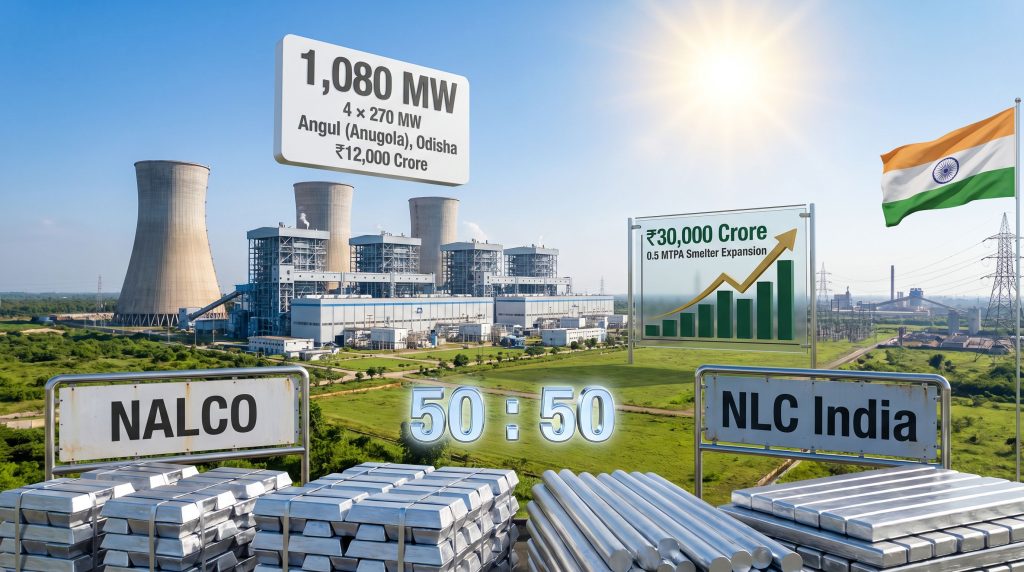
The two companies signed a Joint Venture-cum-Shareholders' Agreement on 8 July 2026, establishing equal equity ownership in a newly formed JV entity. This entity will develop, own, and operate a 4 x 270 MW coal-based thermal captive power plant at Angul (Anugola) in Odisha — one of India's most industrially significant districts for primary metal production.
The commercial framework underpinning this arrangement is notable for its multi-layered certainty:
| Parameter | Detail |
|---|---|
| Total Installed Capacity | 1,080 MW |
| Unit Configuration | 4 x 270 MW |
| Location | Angul (Anugola), Odisha |
| JV Equity Structure | 50:50 (NALCO : NLC India) |
| Primary Purpose | Captive power for NALCO's 0.5 MTPA smelter expansion |
| Power Offtake Arrangement | 25-year PPA (100% to NALCO) |
| Fuel Supply Arrangement | 25-year FSA with NLC India |
| Coal Pricing Basis | Coal India-notified rates |
| Renewable Energy Component | 200-250 MW RE-RTC (under exploration) |
| Estimated Project Cost | ~₹12,000 crore |
| JVA Signing Date | 8 July 2026 |
| Legal Framework | Section 62, Electricity Act, 2003 |
The structure is built around two interlocking long-term agreements. First, the JV entity will supply 100% of its power output to NALCO under a 25-year Power Purchase Agreement structured under Section 62 of the Electricity Act, 2003 — a regulated tariff mechanism that provides a legally defensible and transparent pricing framework. Second, NLC India will supply coal to the JV under a 25-year Fuel Supply Agreement, with prices anchored to Coal India-notified rates rather than spot market dynamics.
This combination of a regulated offtake agreement and a cost-anchored fuel supply arrangement creates a degree of commercial certainty that is rarely achievable in merchant power markets. For a project with a 25-year horizon, locking in both revenue and input costs simultaneously is the foundation of bankable project finance.
Why Section 62 of the Electricity Act Matters More Than It Appears
The choice to structure the PPA under Section 62 of the Electricity Act, 2003 is a technically significant decision that deserves attention beyond the headline numbers. Section 62 governs tariff determination by electricity regulatory commissions, providing a framework for cost-plus pricing that protects both the generator and the consumer from unilateral price movements.
For industrial captive power arrangements of this scale, this legal structure delivers several practical advantages:
- Regulatory legitimacy: Tariffs are set through a transparent commission-based process, reducing the risk of contractual disputes or renegotiation pressure.
- Financing visibility: Lenders and infrastructure investors can model project returns with greater confidence when the revenue mechanism is governed by statute rather than bilateral negotiation.
- Long-term enforceability: A statutory framework provides stronger legal protections than a purely commercial contract across a 25-year project life.
- Precedent stability: Section 62 has governed regulated power supply arrangements in India since 2003, providing a substantial body of regulatory jurisprudence.
This is not simply administrative tidiness. For a ₹12,000 crore infrastructure project intended to operate across multiple political cycles, the legal architecture of the offtake agreement is as commercially important as the physical specifications of the plant itself.
NLC India's Strategic Role: Beyond Equity Participation
A detail that receives insufficient attention in surface-level analysis of this deal is the depth of NLC India's contribution beyond its 50% equity stake. NLCIL's involvement in this joint venture is not merely financial — it is operationally integral.
NLC India has historically been associated with lignite-based power generation in Tamil Nadu, but the company has progressively diversified into coal-based thermal generation and renewable energy assets across multiple Indian states. Its presence in Odisha through the Machhakata coal mine positions it as a natural fuel supply partner for a project sited at Angul — geographic proximity that reduces logistics costs and supply chain complexity for the JV's 25-year FSA.
The complementary contributions of each partner can be understood across several dimensions:
| Dimension | NALCO's Contribution | NLC India's Contribution |
|---|---|---|
| Power Demand | 100% offtake via 25-year PPA | — |
| Site Infrastructure | Existing Angul industrial complex | — |
| Fuel Supply | — | Coal via 25-year FSA at regulated rates |
| Generation Expertise | Existing captive plant experience | Extensive thermal generation portfolio |
| Equity Capital | 50% of JV equity | 50% of JV equity |
| Regional Presence | Angul operations anchor | Machhakata coal mine, Odisha |
This distribution of roles means the JV is structurally designed to leverage what each party does best, rather than requiring either to develop entirely new capabilities.
NALCO's Integrated Value Chain: Where Does This Project Fit?
To understand why the 1,080 MW plant is a strategic necessity rather than a supplementary asset, it is essential to map NALCO's existing operational infrastructure. NALCO operates one of India's most comprehensively vertically integrated aluminium complexes:
- Panchpatmali bauxite mines in Odisha — captive ore supply at the top of the value chain.
- Damanjodi alumina refinery in Koraput district — pit-head alumina processing that eliminates long-distance ore transport costs.
- Angul aluminium smelter — primary metal production drawing on the refinery's output.
- Existing captive power plant and coal mines at Anugola, Angul — the precedent model for integrated energy supply.
The proposed 1,080 MW JV plant extends this integration by adding dedicated long-term power capacity precisely calibrated to the output requirements of NALCO's 0.5 MTPA smelter expansion. Furthermore, without this power supply, the smelter expansion carries the risk of becoming a stranded asset — physical capacity that cannot operate reliably at design throughput due to energy supply constraints.
NALCO's broader ₹30,000 crore capacity expansion programme in Odisha encompasses the smelter expansion, refinery upgrades, and related infrastructure. The captive power plant, at approximately ₹12,000 crore, represents around 40% of that total investment envelope — a proportion that reflects just how foundational energy supply is to the entire programme's viability.
The Renewable Energy Mandate: A Signal, Not Yet a Solution
The JV framework includes a mandate to explore 200 to 250 MW of firm renewable energy with round-the-clock (RE-RTC) supply. This component warrants careful interpretation.
RE-RTC arrangements in India typically involve a combination of solar or wind generation paired with battery storage or hydropower backup, structured to guarantee a consistent power delivery profile regardless of weather variability. The inclusion of this exploration mandate in the JVA signals awareness of India's broader energy transition trajectory — but it stops short of a firm commitment.
The 25-year PPA horizon for the thermal component extends to approximately 2051, a timeframe that will intersect directly with India's stated net-zero ambitions. The RE-RTC component may represent the first step in a longer decarbonisation roadmap for the Angul complex, but the scale — 200 to 250 MW against 1,080 MW of thermal capacity — means the project remains overwhelmingly fossil fuel-dependent for the foreseeable future.
This creates a genuine long-term risk that investors and analysts should factor into assessments of the project. Consequently, carbon pricing mechanisms, whether domestic or through trade measures like the European Union's Carbon Border Adjustment Mechanism, could materially alter the economics of coal-based aluminium production over the project's life. Indeed, wider trends in low-carbon metals production suggest increasing pressure on fossil fuel-dependent industrial processes over the coming decades.
The next major ASX story will hit our subscribers first
Odisha's Position as India's Aluminium Industrial Corridor
The geographic concentration of this investment in Odisha is not coincidental. The state hosts a disproportionate share of India's primary aluminium production capacity for structural geological and logistical reasons:
- Bauxite reserves: Odisha contains some of India's largest bauxite deposits, particularly in the Eastern Ghats region, providing the foundational ore supply for the aluminium value chain.
- Coal availability: The state's coal-bearing geology supports both captive mine development and proximity to existing Coal India operations.
- Water resources: Large-scale aluminium smelting and refining require significant water inputs; Odisha's river systems provide accessible industrial water supply.
- Existing infrastructure: Decades of public sector industrial investment have created port access, rail connectivity, and industrial power infrastructure that reduces greenfield development costs.
The Angul-Sambalpur belt has evolved into a de facto aluminium industrial corridor, hosting multiple smelters and associated energy infrastructure. NALCO's deepening investment in this corridor reinforces a pattern of industrial concentration that generates its own agglomeration benefits — shared infrastructure, skilled labour pools, and supplier ecosystems.
Import Substitution and the Strategic Case for Domestic Capacity
India currently imports meaningful volumes of primary aluminium to satisfy domestic demand, despite possessing the bauxite reserves and industrial infrastructure to be a net exporter. The gap between domestic production capacity and consumption demand reflects historical underinvestment in smelting capacity — a gap that reliable, cost-competitive power supply has consistently failed to close.
Aluminium demand in India is growing across multiple end-use sectors, and shifting metals demand trends are reshaping global supply chains in ways that benefit well-positioned domestic producers. In addition, expanded domestic smelter output underpinned by captive power directly addresses India's import exposure across the following high-growth areas:
- Electric vehicles: Lightweighting requirements are driving substitution of steel with aluminium in vehicle bodies and battery enclosures.
- Aerospace and defence: Indigenous manufacturing programmes are creating new demand for domestically produced aerospace-grade aluminium.
- Packaging: Food safety regulations and export requirements are expanding aluminium packaging consumption.
- Power transmission: India's grid expansion programme requires significant quantities of aluminium conductor cable.
- Construction: High-rise and commercial construction is increasing aluminium demand for facades, windows, and structural elements.
However, realising this potential hinges on securing the energy infrastructure that makes competitive production possible. This is precisely why the NALCO NLC India joint venture captive power plant in Odisha carries significance well beyond the balance sheets of its two founding partners. Leading aluminium mining companies are increasingly pursuing integrated energy strategies of exactly this kind.
NALCO's Navratna Status and the Public Sector Partnership Model
NALCO holds Navratna status under India's Ministry of Mines — a classification reserved for public sector enterprises demonstrating consistent financial performance, operational scale, and strategic national importance. The Government of India retains a 51.28% equity stake in NALCO, reflecting the company's position as a strategic national asset in the minerals and metals sector.
The 50:50 partnership with NLC India — itself a Navratna enterprise — creates an institutional alignment that carries practical advantages beyond shared capital. Both organisations operate within similar governance frameworks, procurement regulations, and accountability structures, reducing the transaction costs and cultural friction that frequently complicate joint ventures between entities with divergent institutional cultures.
For a project requiring coordinated decision-making across fuel supply, power generation, and industrial offtake over a 25-year horizon, this institutional compatibility is an underappreciated but genuinely valuable feature of the partnership's design. Furthermore, the partnership's structure aligns with broader national priorities around green transition minerals and energy security, adding another layer of policy relevance to the venture.
Key Takeaways for Industry Observers
The NALCO NLC India joint venture captive power plant in Odisha represents a convergence of several strategic imperatives that have been building in India's aluminium sector for over a decade. Considered together, the project's defining characteristics are:
- Scale: At 1,080 MW, this ranks among the largest captive industrial power projects in India's aluminium sector in recent years.
- Duration: The 25-year PPA and FSA create exceptional long-term commercial certainty for both parties and for project financing purposes.
- Integration: The plant deepens NALCO's vertically integrated value chain, adding dedicated power infrastructure to an existing complex of mines, refinery, and smelter.
- Partnership logic: The 50:50 structure with NLC India distributes capital risk while leveraging complementary competencies in thermal generation expertise and coal supply.
- Transition exposure: The 25-year thermal power horizon introduces long-term carbon risk that the RE-RTC exploration mandate only partially addresses.
- Import substitution potential: Successful execution would meaningfully expand India's primary aluminium production capacity, reducing dependence on imported metal across multiple high-growth demand segments.
Moreover, the scale of India's bauxite resource base further underscores the country's long-term potential — global bauxite production trends consistently highlight India as a nation with substantial untapped upstream capacity that integrated energy solutions like this joint venture could finally help unlock.
Disclaimer: This article contains forward-looking statements and projections based on publicly available information. Actual outcomes may differ materially from those described. Readers should not construe any information herein as financial or investment advice. Independent verification of all financial, technical, and regulatory details is recommended before drawing conclusions for investment purposes.
Want to Track the Next Major ASX Mineral Discovery Before the Market Moves?
Discovery Alert's proprietary Discovery IQ model scans ASX announcements in real time, transforming complex mineral data across more than 30 commodities into clear, actionable insights — the same approach that identified transformative discoveries like those made by De Grey Mining and WA1 Resources. Explore Discovery Alert's discoveries page to understand how historic finds have generated substantial returns, and begin a 14-day free trial to position yourself ahead of the broader market.