July 9, 2026
The Molecular Shortcut: Why Building Graphene Oxide From Gas Changes Everything
Battery materials science has long operated within a frustrating paradox. The world increasingly demands cleaner, more capable energy storage, yet the production of many critical battery components relies on processes that are chemically aggressive, carbon-intensive, and geographically concentrated in ways that create strategic vulnerability. Graphene oxide sits at the centre of this tension, and a laboratory development at Texas A&M University may have just redrawn the map entirely.
The research, published in Nature Communications in July 2026, describes a plasma-based synthesis pathway that converts methane directly into high-purity, single-layer graphene oxide under ambient atmospheric conditions. No mined graphite. No concentrated acid baths. No high-pressure thermal environments. The implications extend well beyond laboratory curiosity, touching battery manufacturing economics, US energy security, and the emerging logic of what it means to produce advanced materials cleanly.
When big ASX news breaks, our subscribers know first
What Graphene Oxide Actually Is and Why Purity Is Everything
Graphene oxide is a single-atom-thick carbon derivative distinguished by oxygen-functional groups attached across its surface. These groups make the material chemically versatile, water-compatible, and highly tuneable, properties that collectively underpin its commercial appeal across a wide range of industries.
Its most strategically significant application sits inside lithium-ion battery anodes, where graphene oxide functions as a conductive scaffold that improves structural integrity and enhances electrochemical performance. But the material's utility extends further:
- Energy storage systems at grid and residential scale
- Advanced electronics including sensors and flexible circuits
- High-performance structural coatings and surface membranes
- Concrete composites demonstrating measurably improved compressive strength
- Water filtration membranes leveraging graphene oxide's selective permeability
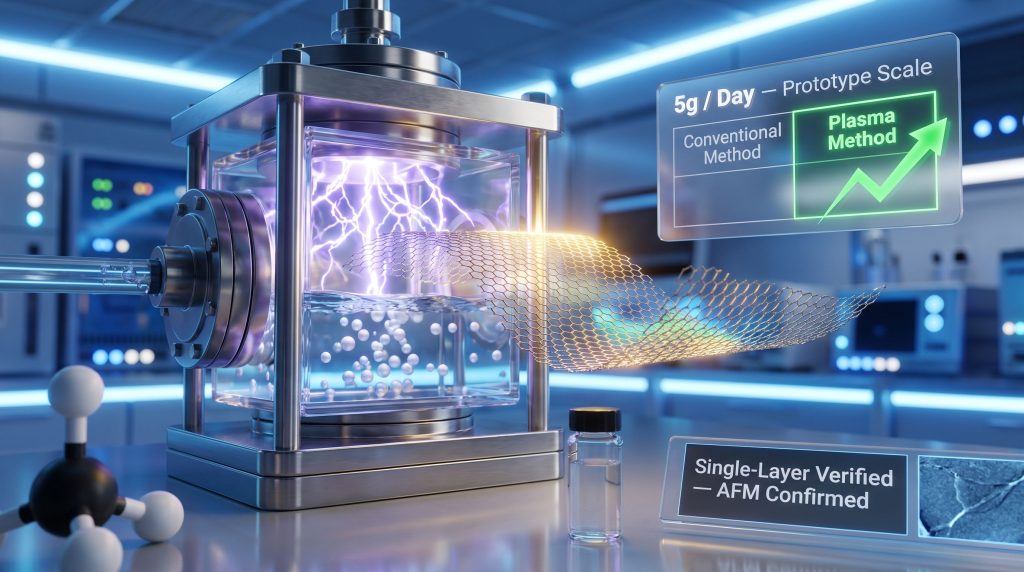
What separates high-value graphene oxide from inferior material is morphology. Single-layer architecture, where the carbon sheet exists as a truly atomic monolayer, produces superior electrochemical performance compared to multilayer material that can form during conventional processing. Atomic Force Microscopy (AFM) serves as the benchmark verification tool, providing nanoscale confirmation that the synthesised material meets single-layer specifications. The Texas A&M graphene oxide from natural gas process produces material that passes this standard, with properties comparable to commercially available products.
The Problem With How Graphene Oxide Is Currently Made
A Chemistry Relic at Industrial Scale
The dominant production method for graphene oxide has changed little in its fundamental logic since the Hummers' method was first developed in the 1950s. The process involves chemically oxidising bulk mined graphite using concentrated sulfuric acid, potassium permanganate, and controlled thermal conditions. While refinements have improved consistency over the decades, the core vulnerabilities remain structurally embedded.
| Production Factor | Conventional Method | Texas A&M Plasma Method |
|---|---|---|
| Primary Feedstock | Mined graphite | Methane (natural gas) |
| Chemical Inputs | Harsh acids and oxidants | Minimal, plasma-water interface only |
| Operating Conditions | High heat, controlled pressure | Ambient atmospheric conditions |
| Emissions Profile | Significant CO₂ and chemical waste | Near net-zero emissions |
| Output Purity | Variable, multilayer risk | High-purity, verified single-layer |
| Hydrogen Byproduct | None | Clean hydrogen co-produced |
The conventional approach is inherently top-down: large graphite structures are chemically dismantled into progressively thinner sheets. The problem is that this demolition process is difficult to control at the molecular level, creating batch-to-batch variation in layer count and oxygen content. Hazardous waste streams from acid processing add regulatory complexity and cost.
Furthermore, energy consumption across the multi-stage process is substantial, and the entire pipeline begins with graphite mining, an activity concentrated predominantly in China and subject to its own geopolitical and environmental pressures. Growing concerns around graphite supply shortages make this dependency increasingly difficult to ignore.
Key Insight: The US currently holds negligible domestic graphite mining capacity relevant to graphene oxide production, meaning the conventional supply chain routes through Chinese-controlled material sources before battery-grade graphene oxide reaches American manufacturers. This single dependency is a structural risk that the Texas A&M plasma method directly bypasses.
How the Texas A&M Plasma Process Works: Step by Step
From Methane Molecule to Battery Material
The nonthermal plasma-water interface process is fundamentally a bottom-up synthesis approach, building graphene oxide from individual molecular precursors rather than breaking down bulk feedstock. The sequence operates as follows:
- Methane introduction: Natural gas, primarily composed of methane (CH₄), is fed into the reactor as the sole carbon source. No graphite sourcing, processing, or handling is required at any stage.
- Plasma discharge activation: An electrical plasma discharge is generated at the interface between the methane gas phase and a water surface, under ambient atmospheric pressure. The nonthermal designation is significant: the plasma achieves high energy density without requiring bulk heating of the reactor environment.
- Molecular dissociation: Plasma energy breaks apart methane molecules at the reaction boundary, separating carbon atoms from hydrogen atoms with precision that thermal methods cannot replicate at this scale.
- Carbon self-assembly: Liberated carbon atoms nucleate and organise into graphene oxide structures. Because this assembly begins from individual atoms rather than from fragments of bulk graphite, the resulting architecture is inherently more uniform.
- Hydrogen co-production: Hydrogen atoms released during dissociation recombine into molecular hydrogen gas (H₂), which is captured as a commercially valuable co-product rather than vented or flared.
- Collection and characterisation: The resulting graphene oxide is collected, with oxygen content tuneable through process parameter adjustment, and verified via AFM for single-layer morphology.
The prototype system uses a four-gap plasma reactor configuration and has demonstrated a production rate of approximately 5 grams of graphene oxide per day. At that rate, a single reactor unit produces roughly 1.8 kilograms annually, a figure that underlines both how far the technology has progressed and how much engineering work remains before industrial volumes become achievable.
The Bottom-Up Advantage Most Analysts Overlook
The distinction between top-down and bottom-up synthesis is more commercially significant than it might initially appear. Top-down methods inherit impurities and structural irregularities present in the original graphite feedstock. Bottom-up synthesis starts from a chemically pure precursor, methane, and builds structure from scratch. This means contamination risks are minimised at the source rather than managed through downstream purification, which adds cost and complexity in conventional workflows.
The bottom-up approach also allows for greater tunability. Because graphene oxide's oxygen functional groups are introduced during synthesis rather than imposed through acid treatment, the Texas A&M process offers finer control over the material's surface chemistry, a capability that matters greatly for specific battery and electronics applications where oxygen content must meet tight specifications.
The Accidental Reversal: When the Byproduct Becomes the Product
The research programme that produced this breakthrough was originally designed around clean hydrogen generation. The plasma-water interface was being studied as a hydrogen production mechanism, with carbon material emerging as an incidental output that was initially classified as a process byproduct.
It was through sustained experimental observation that the research team recognised the carbon material's true commercial hierarchy. The graphene oxide being generated, originally treated as secondary waste, was in fact the higher-value output. Associate Professor David Staack and colleagues subsequently reoriented the programme around graphene oxide as the primary product, with hydrogen repositioned as the commercially valuable co-product.
This kind of research pivot, where careful observation during an experiment targeting one outcome reveals a more commercially significant secondary output, illustrates why exploratory, multi-hypothesis research frameworks generate disproportionate innovation value. Rigid, output-specific research programmes would likely have discarded the carbon material rather than investigated it.
This inversion has meaningful implications for the commercialisation economics. Green hydrogen commands growing market interest across fuel cell, industrial decarbonisation, and energy storage sectors. Having hydrogen as a co-product rather than the primary target means the process can generate a second revenue stream without any additional feedstock cost, fundamentally improving the unit economics of graphene oxide production.
Dual Revenue Streams and the Commercial Value Proposition
Rethinking the Financial Architecture of Advanced Materials Production
Few manufacturing processes for advanced materials generate two simultaneously marketable high-value outputs. The Texas A&M plasma method does precisely that:
- Stream one, graphene oxide: Single-layer, AFM-verified material targeting battery manufacturers, electronics producers, coatings specialists, and construction materials innovators across growing global markets.
- Stream two, clean hydrogen: Green hydrogen generated as a co-product aligns with accelerating demand from hydrogen fuel cell applications, industrial decarbonisation programmes, and grid-scale energy storage.
- Emissions credit eligibility: The near net-zero emissions profile of the process positions any commercial operation for potential alignment with clean manufacturing incentives and carbon credit frameworks under existing and emerging regulatory structures.
- Methane rerouting benefit: By converting methane into solid carbon material rather than combusting it for energy, the process prevents CO₂ formation at the molecular source, not merely at a carbon offset accounting level.
The United States holds some of the world's most abundant natural gas reserves, and existing pipeline and processing infrastructure represents a ready-made feedstock supply chain for a scaled plasma-based graphene oxide operation. This resource alignment is a structural advantage that no graphite-dependent competitor can replicate domestically. In addition, the process complements broader strategies around critical minerals recycling by reducing the upstream mining burden on vulnerable global supply chains.
The next major ASX story will hit our subscribers first
Battery Storage Demand and the Strategic Timing of This Discovery
Why the Market Window Is Particularly Acute Right Now
Global battery energy storage system deployment is accelerating across every scale of application, from residential solar integration to grid-stabilisation projects capable of absorbing gigawatt-hours of intermittent renewable generation. Energy research organisation Ember has characterised battery storage systems as the foremost clean flexibility tool available for making renewable electricity reliably dispatchable, noting their critical role in maintaining grid stability as variable generation sources grow.
The urgency is amplified by the AI infrastructure buildout. Hyperscale data centres powering large language models and AI computing clusters are driving electricity demand projections significantly higher across the United States and globally. This load growth creates sustained demand for storage capacity that can smooth grid stress during peak periods, a requirement that battery systems are uniquely positioned to meet at speed.
Against this backdrop, the competitive dynamics of battery manufacturing carry strategic weight. Surging critical minerals demand is reshaping supply chain priorities for every nation investing seriously in energy transition infrastructure.
| Dimension | China's Position | United States' Position |
|---|---|---|
| Lithium-ion battery manufacturing share | Dominant global leader | Significantly trailing |
| Key industrial players | CATL and vertically integrated ecosystem | General Motors, emerging domestic producers |
| Next-generation battery R&D | Aggressively funded across chemistries | Growing investment, strategic gaps remain |
| Graphene oxide supply chain | Established domestic production | Largely import-dependent |
| Strategic response | Vertical integration across battery value chain | Seeking domestic material breakthroughs |
Kurt Kelty, General Motors' Vice President of Batteries, Propulsion, and Sustainability, articulated the domestic production imperative in a 2025 press release, stating that electricity demand is climbing and that the United States needs energy storage solutions capable of rapid, economical deployment manufactured on home soil. The Texas A&M graphene oxide from natural gas method offers a technically credible pathway toward exactly that kind of domestic production capability.
Challenges on the Road From Prototype to Industrial Scale
What the 5g/Day Benchmark Conceals
Prototype performance is an achievement, not an arrival. Translating a four-gap reactor producing 5 grams per day into an industrial-scale operation requires solving several engineering problems that do not yet have validated solutions:
- Plasma uniformity at scale: Maintaining consistent discharge characteristics across larger or multiplied reactor configurations without creating hot spots or dead zones that degrade output quality.
- Oxygen content control: Reliably tuning the graphene oxide surface chemistry at production volumes without sacrificing layer uniformity, a balance that is straightforward in a prototype environment but increasingly difficult to maintain as throughput rises.
- Quality consistency: Ensuring AFM-verified single-layer morphology is preserved across commercial batch volumes, not just in carefully controlled laboratory runs.
- Reactor multiplication engineering: The most likely scaling pathway involves adding modular four-gap units rather than building larger single reactors. This approach requires precise inter-unit consistency that adds its own engineering complexity.
Texas A&M has entered a commercialisation partnership with LTEOIL to advance the technology beyond laboratory conditions. The proposed development site is the university's RELLIS campus, a purpose-built research and applied technology environment designed for exactly this kind of pre-industrial scale-up work. Key milestones for observers to track include facility construction approval, pilot-scale reactor commissioning, and the first certified batch of commercial-grade graphene oxide produced through the plasma method.
Beyond Batteries: The Wider Application Landscape
Repositioning Natural Gas as a Molecular Carbon Source
One of the less-discussed implications of the Texas A&M process is conceptual rather than technical. Natural gas has historically been framed almost exclusively as a combustion fuel, valued for the energy released when its carbon and hydrogen bonds are broken by burning. The plasma synthesis pathway proposes something categorically different: treating natural gas as a feedstock from which valuable solid carbon structures can be assembled, with hydrogen as the clean energy co-product rather than CO₂ as the combustion waste.
This reframing has implications for how existing gas infrastructure might be valued and repurposed. Pipeline networks and gas processing facilities that currently serve combustion markets could, in principle, supply feedstock to graphene oxide production operations, creating an entirely new industrial category within the existing energy infrastructure landscape. Consequently, this connects naturally with the logic underpinning renewable mining solutions that seek to reduce the environmental footprint of extractive and advanced materials industries alike.
The breadth of graphene oxide's applications means that scaled production would serve markets extending well beyond battery manufacturing:
- Electronics: Flexible circuits, high-sensitivity sensors, and semiconductor-adjacent applications where graphene oxide's thinness and conductivity offer performance advantages over conventional materials.
- Construction: Graphene oxide-enhanced concrete composites have demonstrated measurable improvements in compressive and tensile strength, with potential to reduce the volume of cement required per structural unit and thereby lower embodied carbon in construction.
- Filtration: Selective permeability membranes for water treatment and industrial separation processes represent a significant addressable market with sustainability tailwinds.
Frequently Asked Questions: Texas A&M Graphene Oxide From Natural Gas
What did Texas A&M researchers discover about graphene oxide production?
Researchers at Texas A&M University developed a plasma-based synthesis pathway that converts methane directly into high-purity, single-layer graphene oxide under ambient atmospheric conditions, requiring no mined graphite and no aggressive chemical processing.
How does the nonthermal plasma-water interface process work?
An electrical plasma discharge is applied at the boundary between methane gas and a water surface. This energy breaks methane molecules apart, allowing carbon atoms to self-assemble into graphene oxide structures while hydrogen atoms recombine into clean hydrogen gas captured as a co-product. This approach shares conceptual ground with direct lithium extraction methods that similarly bypass conventional extractive processing in favour of more targeted molecular-level techniques.
What is the current production rate of the prototype reactor?
The four-gap prototype reactor has demonstrated production of approximately 5 grams of graphene oxide per day, equivalent to roughly 1.8 kilograms annually per unit. Scaling will require modular reactor multiplication and extensive process engineering validation.
Why is graphene oxide strategically important for battery manufacturing?
As a high-performance additive in lithium-ion battery anodes, graphene oxide improves electrical conductivity, structural integrity, and energy storage capacity. Its properties also make it relevant across electronics, coatings, construction composites, and filtration membranes.
How does this process compare to conventional graphene oxide production?
Conventional methods chemically oxidise mined graphite using concentrated acids under elevated thermal conditions, generating substantial chemical waste and CO₂. The Texas A&M graphene oxide from natural gas plasma method assembles graphene oxide from methane molecules under ambient conditions, producing near net-zero emissions with clean hydrogen as a co-product.
Who is commercialising the technology?
Texas A&M has partnered with LTEOIL to advance the technology toward commercial production, with a dedicated research and development facility planned for the university's RELLIS campus to validate industrial-scale production parameters.
Where was the research published?
The peer-reviewed findings were published in Nature Communications in July 2026, representing the first scientifically validated report of scalable graphene oxide synthesis using natural gas as the sole carbon precursor.
Disclaimer: This article is for informational and educational purposes only and does not constitute financial, investment, or technical advice. References to commercialisation timelines, scaling projections, and market dynamics involve inherent uncertainty and should not be treated as confirmed outcomes. Readers should conduct independent due diligence before making any investment or business decisions related to graphene oxide technology or associated companies.
Want To Stay Ahead of the Next Major Materials or Minerals Discovery?
Discovery Alert's proprietary Discovery IQ model scans ASX announcements in real time, instantly alerting subscribers to significant mineral discoveries across more than 30 commodities — turning complex data into clear, actionable opportunities before the broader market reacts. Explore historic discoveries and their market returns, then begin your 14-day free trial at Discovery Alert to position yourself at the forefront of the next major find.