
July 9, 2026
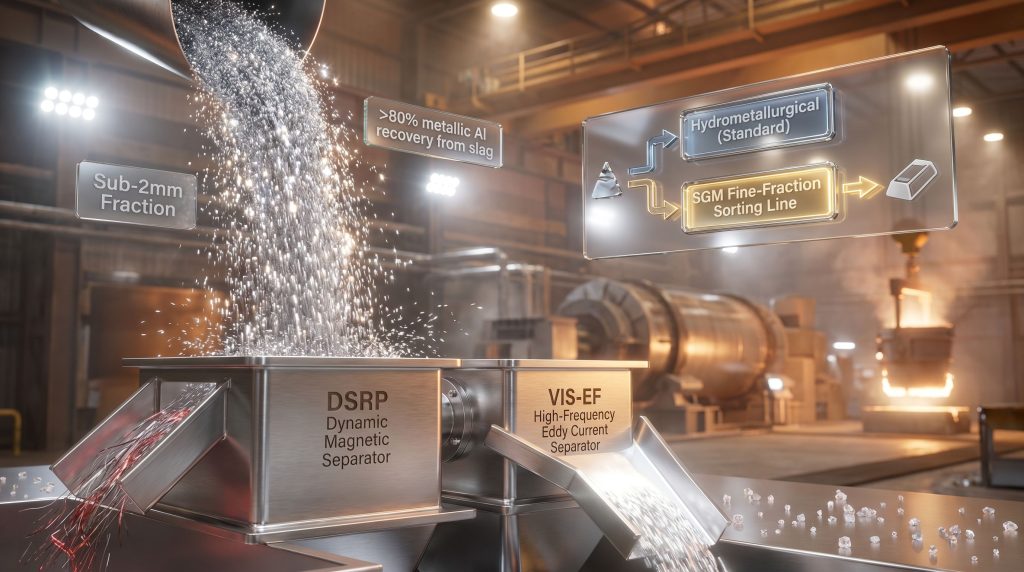
The Recycling Industry's Most Stubborn Waste Problem
Secondary aluminium production has long carried an uncomfortable contradiction at its core. The process of melting scrap aluminium is celebrated for its dramatic energy savings compared to primary smelting, consuming roughly 5% of the energy required to produce aluminium from bauxite. Understanding the bauxite production basics helps illustrate just how significant this energy reduction is. Yet the rotary furnaces at the heart of secondary smelting generate a troublesome byproduct that has frustrated processors for decades: salt slag.
Salt slag forms because rotary furnaces use chloride-based salt mixtures, typically combinations of sodium chloride and potassium chloride, as a flux to protect molten aluminium from oxidation and facilitate the separation of non-metallic impurities. When the metal is tapped, the remaining material — a dense mixture of metallic aluminium droplets, aluminium oxide, and spent salt flux — solidifies into what the industry calls salt slag or black dross.
The scale of generation is considerable. Secondary aluminium smelters typically produce between 200 and 500 kilograms of salt slag per tonne of aluminium melted, though this varies significantly with scrap quality and furnace operation. Globally, secondary aluminium production exceeds 30 million tonnes per year and continues to grow as circular economy policies accelerate scrap collection rates across Europe, North America, and Asia.
The arithmetic of even modest salt slag generation rates across that production base translates to tens of millions of tonnes of problematic waste material annually. Furthermore, the deeper problem is that salt slag is not inert waste. Its reactivity with moisture, which produces flammable hydrogen gas and corrosive ammonia, earns it hazardous waste classification in many European jurisdictions. Landfill disposal carries significant regulatory cost. Yet the material simultaneously contains recoverable metallic aluminium and other non-ferrous metals representing genuine commercial value that many processors fail to fully capture.
When big ASX news breaks, our subscribers know first
Why Fine Fractions Represent a Disproportionate Recovery Challenge
The Sub-2mm Particle Problem
Most salt slag processing facilities apply a broadly similar initial approach: mechanical crushing followed by size classification, which allows larger metallic aluminium particles to be separated relatively efficiently. This bulk separation step can recover a substantial proportion of the metallic aluminium content in the original slag.
The difficulty intensifies dramatically once material drops below approximately 2 millimetres in particle size. In this fine fraction, the physics of metal recovery work against conventional separation technologies in several compounding ways:
- Metallic aluminium particles in the sub-2mm range are frequently irregular in shape rather than spherical, which reduces the predictability and efficiency of electromagnetic separation
- The residual salt content in fine fractions creates strongly corrosive processing conditions that degrade standard equipment more rapidly than in coarser fraction processing
- Abrasive fine dust generated during processing accelerates mechanical wear across sorting system components, driving up maintenance frequency and cost
- The micro-particle size reduces the effectiveness of standard eddy current separation, which relies on inducing sufficient electrical currents within each particle to generate a deflecting magnetic force
- Residual ferrous contamination embedded within fine salt slag interferes with non-ferrous separation downstream, reducing the purity and therefore the remelting value of recovered aluminium concentrate
| Challenge Factor | Mechanism | Impact on Recovery |
|---|---|---|
| Particle size below 2mm | Irregular metal morphology | Reduces separation accuracy and consistency |
| Elevated salt content | Corrosive processing environment | Accelerates equipment degradation and reduces throughput |
| Abrasive fine dust | Mechanical wear on system components | Higher maintenance costs and unplanned downtime |
| Residual ferrous fines | Contamination of non-ferrous stream | Lowers output purity and remelting value |
| Micro-fraction non-ferrous metals | Insufficient eddy current induction | Metal losses to reject stream |
The Hidden Revenue Leak in Secondary Smelting
What makes fine-fraction salt slag losses particularly significant from an operational economics perspective is that they are largely invisible in standard processing metrics. Most smelters track overall metal yield from incoming scrap, but the granular question of how much value is leaving in the fine salt slag reject stream often goes unmeasured.
Every tonne of fine-fraction aluminium that exits a processing facility in the reject stream rather than as recovered metal concentrate represents a direct reduction in processing margin. When this loss is aggregated across multiple processing cycles per day, across an entire facility's annual throughput, the cumulative financial impact becomes material. As secondary aluminium production scales globally, the aggregate value of these fine-fraction losses across the industry grows proportionally.
How the SGM Aluminium Salt Slag Sorting Line Works
System Architecture and Design Philosophy
SGM Magnetics S.p.A., an Italian specialist in metals sorting technology, has developed a dedicated sorting line specifically engineered to address the fine-fraction recovery challenge that conventional processing consistently fails to solve. The SGM aluminium salt slag sorting line combines two complementary electromagnetic separation technologies into a single configurable processing system.
The modular design reflects an understanding that salt slag fine fractions vary considerably between facilities. For instance, key variables include:
- The particle size distribution of the input material after upstream crushing and classification
- The ratio of ferrous to non-ferrous metal content in the fine fraction
- Target processing capacity requirements for the specific facility
- The minimum metal recovery rates required to justify the processing economics
This configurability is practically significant. A one-size-fits-all approach to fine-fraction separation has historically been one of the reasons specialist recovery in this size range has underperformed. The ability to calibrate the system based on actual material characteristics allows operators to optimise recovery rather than accepting the compromises of a fixed-configuration system.
Stage One: DSRP Dynamic Magnetic Separator
The first separation stage uses SGM's DSRP dynamic magnetic separator. Its primary function is the targeted removal of residual ferrous fines from the material stream before the fine fraction encounters the eddy current stage.
This sequencing is deliberate and technically important. Ferrous particles, even when present in relatively small concentrations, can significantly interfere with the efficiency of eddy current separation by creating signal interference that reduces the separator's ability to distinguish and deflect non-ferrous metals. By removing ferrous contamination first, the DSRP unit protects the downstream stage from a compounding problem that would otherwise reduce overall system performance.
Stage Two: VIS-EF High-Frequency Eddy Current Separator
The second stage deploys SGM's VIS-EF high-frequency eddy current separator, which is specifically designed to recover fine aluminium particles and other non-ferrous metals from the small material fractions that fall through the recovery capability of standard eddy current systems.
Standard eddy current separators operate effectively on particles above a certain size threshold, typically around 5mm or larger, because they require sufficient particle mass to generate strong enough induced currents for effective deflection. The VIS-EF operates at higher frequencies specifically to extend effective separation capability down into the fine particle range where conventional systems lose effectiveness. According to SGM Magnetics' own process documentation, this high-frequency approach is critical to unlocking recovery in the sub-2mm range.
"The two-stage architecture of the SGM salt slag sorting line addresses the fine-fraction problem from both ends simultaneously: ferrous contamination is eliminated before it can compromise the non-ferrous recovery stage, while the high-frequency eddy current technology extends recovery capability into particle sizes that standard systems cannot reach efficiently."
Comparing SGM Sorting Technology with Conventional Salt Slag Processing
How Standard Hydrometallurgical Processing Works
To understand where the SGM system fits, it is important to first understand the conventional processing approach that most salt slag treatment facilities currently operate. The dominant methodology is hydrometallurgical, combining mechanical preparation with aqueous leaching:
- Mechanical preparation: Salt slag is milled or crushed to below approximately 1.25mm to maximise surface area exposure for subsequent leaching
- Screening and classification: Larger metallic aluminium particles are mechanically separated at this stage, with well-operated facilities recovering over 80% of metallic aluminium content through this step alone
- Aqueous leaching: Remaining material is subjected to water-based leaching to dissolve the soluble chloride salt components
- Filtration and crystallisation: Recovered salt solution is filtered and subjected to cooling crystallisation to recover sodium chloride and potassium chloride for reuse as rotary furnace flux, reducing raw material procurement costs
- Secondary valorisation: Residual aluminium oxide solids can, in some processes, be converted through hydrothermal synthesis into zeolites, which have commercial applications in catalysis, water treatment, and construction materials
Where Fine-Fraction Sorting Fits in the Processing Chain
The SGM aluminium salt slag sorting line is not a competitor to hydrometallurgical processing, nor a replacement for it. It is better understood as a complementary downstream recovery stage that addresses what conventional processing leaves behind.
| Processing Method | Primary Goal | Core Technology | Typical Outcome |
|---|---|---|---|
| Hydrometallurgical (standard) | Recover bulk metallic Al and reusable flux salts | Mechanical screening and aqueous leaching | Over 80% metallic Al recovery, NaCl/KCl salt recovery |
| SGM Fine-Fraction Sorting | Recover residual Al and non-ferrous from fine fraction | DSRP magnetic + VIS-EF eddy current | Non-ferrous metal concentrate from sub-2mm fractions |
| SGM Alloy Sorting (XRT/LIBS) | Upgrade scrap purity by alloy composition | X-ray transmission, XRF, LIBS spectroscopy | High-purity alloy-segregated scrap streams |
Operators who currently process salt slag through hydrometallurgical methods and discard the fine reject fraction are, in effect, accepting a known metal loss as unavoidable. The SGM system provides a technically validated pathway to recover a portion of that previously written-off value. However, as sorting technology for aluminium continues to evolve, the gap between conventional and advanced recovery rates is narrowing at a notable pace.
The Commercial and Operational Case for Adoption
Material Durability Under Corrosive Conditions
SGM offers the option of manufacturing key system components in AISI 316 stainless steel, a grade that offers substantially superior corrosion resistance compared to standard carbon steel construction. This is not an aesthetic choice. The high chloride content of salt slag fine fractions creates processing environments that aggressively attack standard metal components, accelerating corrosion and shortening equipment service life.
Specifying AISI 316 construction in components that have direct contact with the fine salt slag stream extends operational lifespan, reduces maintenance frequency, and lowers total cost of ownership over the system's operational life. For a facility running continuous processing shifts, the cumulative maintenance cost difference between standard and corrosion-resistant construction can be significant across a multi-year operational horizon.
The Economics of Fine-Fraction Recovery
The commercial logic of investing in fine-fraction sorting capability rests on a straightforward calculation: what is the value of the metal currently leaving in the reject stream, and does it exceed the annualised cost of operating the sorting line?
For most secondary aluminium processing facilities of meaningful scale, this calculation increasingly favours investment in dedicated fine-fraction recovery. This is particularly true given the broader aluminium market pressures currently reshaping processing economics industry-wide. Several converging reasons reinforce this trend:
- Aluminium scrap prices have remained elevated relative to historical norms, increasing the per-kilogram value of recovered fine-fraction metal
- Salt slag disposal costs are rising as hazardous waste regulation tightens across European jurisdictions, making the reject stream increasingly expensive to manage
- Processing margin compression in secondary aluminium has pushed operators to examine every source of recoverable value more critically
- Salt recovery economics from hydrometallurgical processing can partially offset treatment costs, making combined process chains more viable than either approach alone
European Regulatory Drivers
Several European Union member states classify salt slag as a hazardous industrial waste, imposing regulatory obligations on storage, transport, and disposal that carry direct financial costs. The European Commission's circular economy agenda continues to drive policy in the direction of maximum resource recovery from industrial waste streams, with landfill restrictions on hazardous materials tightening progressively.
For secondary aluminium producers operating within this regulatory environment, the combination of rising disposal costs and tightening waste classification creates a structural incentive to invest in processing solutions that transform salt slag from a liability into a source of recoverable value. In addition, advanced recycling technology developments across adjacent sectors are setting new benchmarks for what recovery rates regulators and investors consider acceptable.
Beyond Salt Slag: Auto Shredder Residue as a Secondary Application
The same core technology platform that addresses salt slag fine fractions has direct applicability to another growing fine-fraction waste stream: auto shredder residue (ASR). ASR is generated when end-of-life vehicles pass through industrial shredders, producing a mixed fine-fraction residue containing recoverable non-ferrous metals alongside plastics, rubber, and other materials.
The DSRP and VIS-EF separator combination that targets salt slag fine fractions can be configured to process ASR material, recovering non-ferrous metal value from a stream that many facilities currently discard or send to landfill. With end-of-life vehicle volumes growing as the European automotive fleet continues to turn over, ASR represents an expanding market opportunity for fine-fraction metal recovery technology.
This dual applicability positions the SGM aluminium salt slag sorting line as a technology platform rather than a single-application product, broadening both the addressable market and the potential return on investment for operators processing multiple fine-fraction waste streams.
The next major ASX story will hit our subscribers first
Frequently Asked Questions: SGM Aluminium Salt Slag Sorting Line
What is salt slag and why is it classified as hazardous?
Salt slag is a byproduct of secondary aluminium smelting generated when rotary furnaces use chloride salt mixtures as flux. The material contains metallic aluminium, aluminium oxide, and residual chloride salts. Its hazardous classification in many jurisdictions stems from its reactivity with water, which produces flammable hydrogen gas and corrosive ammonia compounds, creating safety and environmental risks during storage and disposal.
Why is the sub-2mm fraction so difficult to process?
Metallic aluminium in this size range is often irregularly shaped rather than spherical, reducing separation efficiency. The combination of high residual salt content, abrasive fine dust, and the reduced mass of micro-particles makes standard electromagnetic separation unreliable in this fraction.
Is the SGM sorting line a replacement for hydrometallurgical processing?
No. Conventional hydrometallurgical processing handles the bulk of metallic aluminium recovery and salt reclamation effectively. The SGM system targets the residual fine-fraction metal losses that remain in the reject stream after conventional processing, functioning as a complementary downstream stage rather than a standalone replacement.
Why does the system use two separation stages?
Residual ferrous particles in fine salt slag interfere with eddy current separation efficiency. The DSRP magnetic separator removes ferrous contamination first, protecting the VIS-EF eddy current stage and allowing it to focus exclusively on non-ferrous metal recovery without performance degradation from ferrous interference.
What other materials can the system process?
Beyond aluminium salt slag, the same DSRP and VIS-EF system configuration is applicable to auto shredder residue and other fine-fraction industrial waste streams containing recoverable non-ferrous metals.
Why is AISI 316 stainless steel specified for key components?
The high chloride content of salt slag fine fractions creates strongly corrosive processing conditions. AISI 316 stainless steel offers superior resistance to chloride-induced corrosion compared to standard grades, extending component service life under these demanding conditions and reducing total maintenance costs.
Fine-Fraction Recovery as a Structural Competitive Advantage
The broader significance of the SGM aluminium salt slag sorting line extends beyond the recovery of incremental metal volumes from a difficult waste stream. It represents a shift in how secondary aluminium processors can conceptualise the economics of salt slag management.
Under the conventional processing model, fine-fraction salt slag losses are largely accepted as an unavoidable cost of doing business. Metal that exits in the reject stream is written off. Disposal costs for residual hazardous waste are treated as fixed operational expenses. The processing margin is calculated around these accepted losses.
Introducing dedicated fine-fraction sorting capability restructures that economic model. Metal previously written off becomes recoverable revenue. Disposal volumes decrease as additional material is captured for reprocessing rather than rejection. The per-tonne processing margin improves from both directions simultaneously.
As European secondary aluminium production continues to scale in response to decarbonisation targets and growing recycled content mandates from downstream manufacturers, the aggregate value of fine-fraction losses across the industry will grow proportionally. Leading aluminium mining companies and secondary processors alike are increasingly scrutinising these recovery gaps. Furthermore, aluminium sector investment trends suggest that capital is flowing towards operations that can demonstrate superior resource efficiency and lower environmental liability profiles.
"Fine-fraction metal recovery from salt slag transforms what was previously an environmental liability and a disposal cost into a source of recoverable revenue. That fundamental reframing of how secondary smelters account for their most difficult waste stream may ultimately prove to be as significant as the technology itself."
Readers seeking broader context on the secondary aluminium recycling market and salt slag processing economics can find additional industry coverage at AL Circle, which provides regular reporting on developments across the global recycled aluminium sector.
Want to Catch the Next Major ASX Mineral Discovery Before the Market Does?
Discovery Alert's proprietary Discovery IQ model scans ASX announcements in real time, delivering instant alerts on significant mineral discoveries across more than 30 commodities — from aluminium to gold — so subscribers can act on actionable opportunities ahead of the broader market. Explore historic discoveries and their exceptional returns, then begin a 14-day free trial at Discovery Alert to position yourself at the forefront of the next major find.