July 8, 2026
The Global Alumina Supply Squeeze Reshaping Caribbean Industrial Strategy
Structural shifts in global alumina supply rarely happen in isolation. When major producing regions experience simultaneous disruptions, whether from mine closures, regulatory constraints, or geopolitical friction, the ripple effects reach facilities that have sat dormant for years. Refineries once considered marginal suddenly find themselves at the centre of serious capital conversations. That is precisely the context in which the Jamaica Alpart alumina refinery modernisation under JISCO is gaining momentum, and why a phased redevelopment plan worth up to US$3 billion deserves close examination.
When big ASX news breaks, our subscribers know first
Jamaica's Alumina Heritage and Why Alpart Still Matters
Jamaica was once among the world's most significant bauxite and alumina exporters, supplying raw and refined materials to smelters across North America and Europe throughout the latter half of the twentieth century. The island's geology is particularly well-suited to bauxite extraction, with extensive laterite deposits concentrated in the interior parishes that overlay ancient limestone formations. At its peak, Jamaica's alumina sector represented a cornerstone of national export earnings and regional industrial identity.
The Alpart facility, formally known as Alumina Partners of Jamaica, sits within St. Elizabeth parish and was originally commissioned in the 1960s as part of a consortium-driven expansion of Caribbean alumina capacity. Its designed throughput of 2 million tonnes of alumina per year places it firmly in the tier of globally significant refineries, comparable in output scale to mid-sized operations in Australia and Brazil. In today's supply-constrained environment, restoring that capacity is not a local story — it is a global one. Furthermore, understanding global bauxite production trends helps explain why this facility carries such strategic weight.
From RUSAL Divestment to Chinese State Ownership
The ownership trajectory of Alpart reflects broader shifts in global resource investment patterns. UC RUSAL, the Russian aluminium giant, divested the facility in 2016 when Jiuquan Iron and Steel Group, known as JISCO, acquired it for US$299 million. JISCO is a state-owned enterprise beneficially controlled by Gansu Province in northwestern China, a detail that carries significant implications for how investment decisions at Alpart are ultimately made.
Following the acquisition, JISCO committed approximately US$360 million to restart the refinery, creating employment for roughly 1,000 Jamaicans across direct and contractor roles. That restart, while meaningful, proved short-lived. Operations were suspended in September 2019, and the subsequent years brought a combination of pandemic-related economic disruption, alumina price volatility, and the inherent complexity of managing a large Caribbean industrial asset from a Chinese provincial government structure.
What followed was an extended period of feasibility analysis. Over five years, JISCO conducted detailed technical assessments covering refinery infrastructure condition, available processing technologies, capital requirements, and evolving global alumina production practices. That extended review period, while frustrating for Jamaican stakeholders, has ultimately produced a more credible and comprehensively scoped modernisation plan than an accelerated restart might have yielded.
The Phased Investment Architecture: Breaking Down US$3 Billion
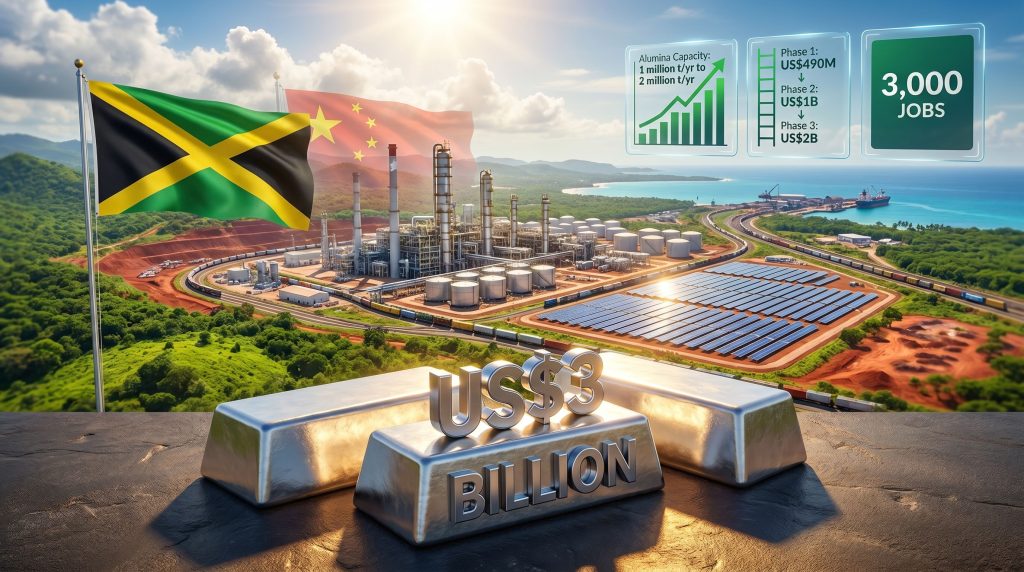
The modernisation programme JISCO has outlined is structured across three phases, each building on the last in terms of both capital commitment and industrial ambition.
| Phase | Investment | Capacity Target | Key Deliverables |
|---|---|---|---|
| Phase 1 | US$490 million | 1 million tonnes/year | Processing upgrades, power systems, dry-stacking, rail and port rehabilitation, 5 MW solar hybrid |
| Phase 2 | US$1 billion | +1 million tonnes/year (total: 2 million tonnes/year) | Full refinery expansion to design capacity |
| Phase 3 | US$2 billion | Bauxite mining park + integrated steel plant | Downstream industrial diversification |
| Total | Up to US$3 billion | 2 million tonnes alumina/year | Comprehensive industrial redevelopment |
What Phase 1 Capital Will Actually Fund
The US$490 million Phase 1 commitment is not a simple maintenance restart. It represents a substantive infrastructure overhaul targeting multiple interconnected systems:
-
Core processing unit upgrades: Bringing the Bayer process infrastructure up to contemporary operational and efficiency standards
-
Power generation modernisation: Replacing ageing generation equipment with more reliable and energy-efficient systems capable of supporting continuous industrial-scale operation
-
Dry-stacking technology implementation: Transitioning from legacy wet bauxite residue disposal to engineered dry-stacking, which compacts processed waste material into a semi-solid form, significantly reducing land footprint and the risk of catastrophic residue impoundment failures
-
Rail and port corridor rehabilitation: Restoring the logistics infrastructure essential for moving bauxite from inland mining areas to the refinery and alumina from the facility to export terminals
-
5 MW photovoltaic and battery storage hybrid system: Integrating renewable energy capacity into the facility's power mix as a demonstration of low-carbon operational intent
Dry-stacking technology for bauxite residue management is increasingly considered the global benchmark for responsible alumina refinery operation. Conventional wet slurry ponds carry documented risks of structural failure, as evidenced by the Ajka disaster in Hungary in 2010, which released approximately one million cubic metres of toxic red mud. Modern environmental permitting frameworks in many jurisdictions now favour or require dry-stacking as a condition of project approval.
The Diplomatic Mechanism Behind Project Momentum
One of the more instructive aspects of this project is how diplomatic engagement at the subnational level helped unlock progress that purely commercial channels had not. Jamaica's Minister of Agriculture, Floyd Green, travelled to China specifically to advance the Alpart reopening, meeting directly with JISCO's Board of Directors and holding discussions with the Governor of Gansu Province.
The Gansu provincial government's involvement matters because JISCO is not a privately held commercial entity making decisions purely on return-on-equity metrics. As a state-owned enterprise, its major capital allocation decisions are subject to provincial government influence and, in some cases, direction. The Governor's expressed support for the refinery's reopening effectively signals alignment between provincial industrial policy objectives and the investment programme at Alpart.
This distinction is important for anyone analysing project execution risk. A commitment backed by provincial government endorsement carries different weight than one made solely by a commercial management team facing quarterly earnings pressure. In addition, broader aluminium sector investment trends globally suggest that state-backed capital is increasingly decisive in large-scale alumina projects.
Near-Term Milestones to Watch
JISCO has articulated two specific timeline commitments:
-
Construction commencement before the end of 2026
-
Official project launch before June 2027
These represent meaningful near-term credibility tests. If regulatory approvals, environmental impact assessments, and procurement processes can be advanced within that window, it would substantially validate the seriousness of the recommitment. If delays emerge, they are most likely to originate from permitting complexity around the dry-stacking infrastructure changes and updated power generation systems, both of which will require revised environmental approvals in Jamaica.
Economic Impact: What 3,000 Jobs and a Bauxite Levy Mean for Jamaica
The socioeconomic stakes for Jamaica are substantial. St. Elizabeth and Manchester, the parishes most proximate to the Alpart facility, have historically been among the most economically dependent on the mining and refining sector. When operations suspended in 2019, the loss extended well beyond the roughly 1,000 direct jobs into the broader ecosystem of service providers, transport operators, and community businesses that depend on industrial anchor activity.
| Employment Category | Projected Jobs |
|---|---|
| Direct employment | 1,000 jobs |
| Indirect employment | 2,000 jobs |
| Primary impact region | St. Elizabeth and Manchester |
Beyond employment, the fiscal dimensions are significant. Jamaica's bauxite levy structure means government revenue is directly tied to production volumes. A return to 1 million tonnes per year in Phase 1, scaling to 2 million tonnes in Phase 2, would materially improve Jamaica's foreign exchange earnings and government revenue from the sector.
The project has also been described by Jamaican authorities as potentially one of the largest investments in the country's history, and the associated Special Economic Zone framework around the site could catalyse additional industrial activity beyond the refinery itself, particularly if Phase 3's integrated steel plant component progresses.
Alpart in the Context of Global Alumina Market Dynamics
The timing of this modernisation effort intersects with a period of notable structural tension in global alumina supply. Disruptions at producing regions in Guinea, operational constraints in parts of Brazil, and the ongoing reassessment of Australian refinery economics have collectively tightened available supply outside of China. Consequently, the role of leading bauxite mines in underpinning refinery output has never been more closely scrutinised.
Simultaneously, demand for aluminium is accelerating, driven by:
-
Electric vehicle lightweighting requirements and battery enclosure applications
-
Solar panel mounting structures and wind turbine components in the renewable energy sector
-
Aerospace and defence applications where aluminium-to-steel substitution continues
-
Packaging and construction markets in high-growth emerging economies
A 2-million-tonne-per-year Caribbean refinery with strong ESG credentials fits directly into the supply chain diversification strategies that top aluminium producers outside China are actively pursuing. Moreover, evolving aluminium tariff impacts are further incentivising producers to secure diverse, non-Chinese alumina supply.
Sustainability Credentials as a Competitive Differentiator
The inclusion of dry-stacking and renewable energy integration in Phase 1 is not purely an environmental compliance exercise. As major aluminium producers face increasing pressure from customers and investors to demonstrate responsible sourcing, offtake agreements are increasingly incorporating sustainability criteria. Refineries that can credibly align with frameworks such as the Aluminium Stewardship Initiative (ASI) gain access to premium markets and financing terms that older, less sustainably configured facilities cannot reach.
Alpart's modernisation, if executed with genuine ESG integration, could position Jamaica's alumina as a preferred input for aluminium producers serving European and North American markets where supply chain transparency is becoming a commercial requirement rather than a voluntary commitment.
The next major ASX story will hit our subscribers first
Key Risks and Execution Considerations
Disclaimer: The following section contains forward-looking assessments based on publicly available information. These should not be interpreted as investment advice. All capital projects of this scale carry execution risks that can materially affect outcomes.
Several risk dimensions warrant careful monitoring:
-
Timeline compression: Achieving all necessary regulatory approvals and commencing physical construction before end-2026 is an ambitious schedule given the scope of infrastructure modifications planned
-
Capital coordination complexity: Deploying US$490 million through a state-owned enterprise operating across two distinct regulatory and cultural jurisdictions introduces coordination risks not present in purely domestic projects
-
Commodity price sensitivity: Alumina prices between now and first production will influence whether the project economics remain compelling enough to sustain full capital commitment through Phase 1 and into Phase 2
-
Geopolitical exposure: Chinese state-owned enterprise investment in Caribbean resource assets operates within a broader geopolitical context that includes Jamaica's relationships with Western trading partners and the evolving global trade policy environment
-
Environmental permitting: Updated impact assessments for dry-stacking infrastructure and revised power generation configurations will need to navigate Jamaica's regulatory approval processes without significant delay
Frequently Asked Questions: Jamaica Alpart Alumina Refinery Modernisation Under JISCO
What is the Alpart alumina refinery and where is it located?
Alpart is a large-scale alumina refining facility in St. Elizabeth, Jamaica. It processes locally mined bauxite using the Bayer process to produce alumina, which is exported as a primary input for aluminium smelting globally.
Who currently owns Alpart?
The facility is wholly owned by Jiuquan Iron and Steel Group (JISCO), a Chinese state-owned enterprise under the beneficial ownership of Gansu Province. JISCO acquired it from UC RUSAL in 2016 for US$299 million.
Why did operations suspend in 2019?
The combination of shifting global alumina market conditions and the economic disruptions associated with the COVID-19 pandemic contributed to JISCO's decision to suspend operations after its initial restart phase.
What is the total investment planned?
The phased modernisation programme totals up to US$3 billion across three phases: US$490 million in Phase 1, US$1 billion in Phase 2, and US$2 billion in Phase 3, which includes a bauxite mining park and integrated steel plant.
When is production expected to resume?
Construction is targeted to begin before the end of 2026, with an official launch planned before June 2027. Phase 1 aims to restore capacity to 1 million tonnes of alumina per year, with Phase 2 ultimately doubling that to 2 million tonnes annually.
What makes dry-stacking technology significant for this project?
Dry-stacking stores processed bauxite residue in a compacted semi-solid form rather than in liquid slurry ponds, dramatically reducing environmental risk and land requirements. It represents the contemporary global standard for bauxite residue management and is increasingly required under modern environmental permitting frameworks.
Want to Stay Ahead of Major Mineral Discoveries on the ASX?
Discovery Alert's proprietary Discovery IQ model delivers real-time alerts on significant ASX mineral discoveries — instantly transforming complex geological data into actionable investment insights for traders and long-term investors alike. Explore historic examples of exceptional discovery returns and begin your 14-day free trial at Discovery Alert to position yourself ahead of the broader market.