
July 8, 2026
The Structural Trap Holding Back One of the World's Most Endowed CBM Nations
Unconventional gas development has reshaped energy landscapes across three continents over the past four decades. The United States built an industry producing tens of billions of cubic metres annually from coal seams that were once considered uneconomic. Australia turned dispersed, low-pressure deposits into world-scale liquefied natural gas export infrastructure. China patiently absorbed pre-commercial risk across two decades until its coal basin output rivalled entire national gas supplies. Each of these transformations shared a common precondition: the simultaneous alignment of data access, pipeline infrastructure, and financial incentive structures capable of bridging the economics of early-stage development.
India possesses all the geological ingredients for a comparable transformation. What it has lacked, persistently and at significant economic cost, is that simultaneous alignment. Understanding why requires looking not at the resource itself, but at the institutional architecture surrounding it.
When big ASX news breaks, our subscribers know first
The Arithmetic of Underperformance: Mapping India's CBM Resource-to-Production Collapse
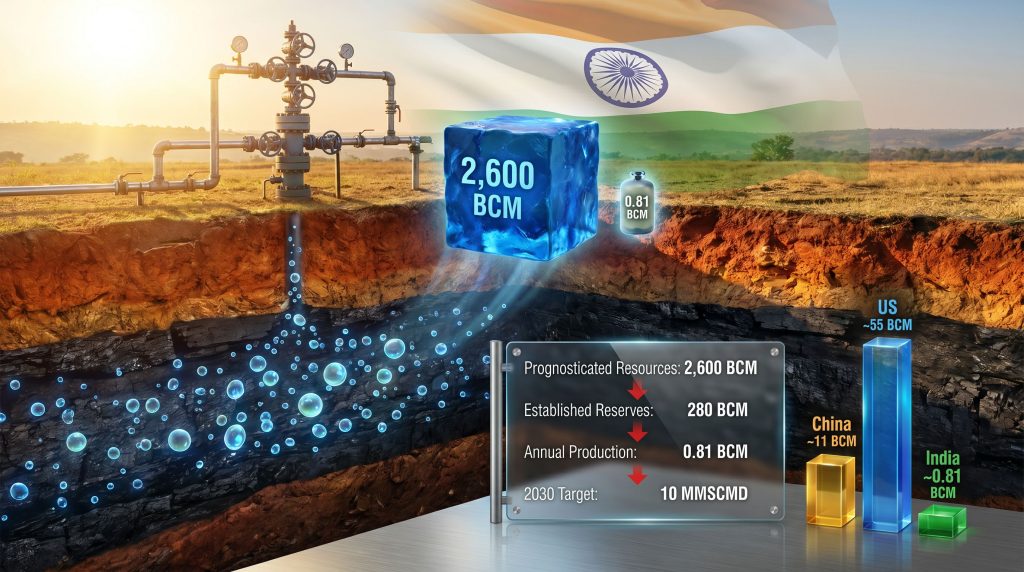
The numbers that define the India coal bed methane production gap are striking in their disproportion. The country holds an estimated 2,600 billion cubic metres (BCM) of prognosticated CBM resources distributed across 12 states, a reserve base that reflects its standing as the world's fourth-largest coal reserve holder. Yet the chain of conversion from prognosticated resource to actual output reveals a cascading failure at every stage of the development process.
| Stage | Volume | Conversion Rate |
|---|---|---|
| Prognosticated CBM Resources | 2,600 BCM | Baseline |
| Established / Confirmed Reserves | 280 BCM | ~10.8% of total resources |
| Annual Production Output | 0.81 BCM | ~0.03% of total resources |
| Share of India's Total Gas Output | ~2% of 36 BCM domestic supply | Marginal contributor |
Two distinct gaps explain this outcome. The first is an exploration gap: roughly 89% of India's prognosticated CBM resource base has never been adequately delineated, leaving the sector without the reserve foundation required to support large-scale field development. The second is a development gap: even within the confirmed 280 BCM of established reserves, annual extraction of just 0.81 BCM represents a utilisation rate below 0.3%. Established reserves are sitting dormant, constrained by infrastructure deficits, financing reluctance, and regulatory friction.
The India coal bed methane production gap is not fundamentally a geological problem. It is a policy and institutional outcome, and that distinction determines where solutions must be directed.
Current Production Benchmarks and the 2030 Target Gap
As of early 2025, India's CBM sector produces approximately 2.2 to 2.27 million metric standard cubic metres per day (MMSCMD). The government has set a near-term production target of 5.0 MMSCMD by 2027-28, implying a gap of roughly 2.73 to 2.8 MMSCMD that must be closed within a compressed timeframe. The longer-horizon ambition of 10 MMSCMD by 2030 requires more than quadrupling current daily output, a challenge that is as much institutional as it is geological.
| Metric | Current Status | Near-Term Target | 2030 Target |
|---|---|---|---|
| Daily Production | ~2.27 MMSCMD | 5.0 MMSCMD (2027-28) | 10 MMSCMD |
| Production Gap | Baseline | ~2.73-2.8 MMSCMD | ~7.73 MMSCMD |
| Active CBM Blocks | 15 blocks | – | – |
| Wells Drilled | ~1,210 | – | – |
| Cumulative Investment | ~$2.6 billion | – | – |
Why Has India's CBM Sector Stalled? A Structural Diagnosis
India awarded 33 CBM blocks across four competitive bid rounds beginning in 2001. The results were sobering: by 2016, only four blocks had reached commercial production, while fourteen had been relinquished entirely, representing nearly half the total awarded portfolio. This relinquishment rate is not a signal of geological inadequacy. It is a signal of systemic institutional friction that operators could not overcome within commercially viable timeframes.
Several structural barriers operated simultaneously and reinforced one another:
- Overlapping jurisdictions between CBM acreage and Coal India Limited's mining leases created legal paralysis for operators attempting development within the same geographic footprint
- Petroleum Exploration Licences (PELs) routinely required six to seven years to materialise, a timeline that destroys project economics before a single well is drilled
- Multi-agency clearance processes covering environmental permits, water management approvals, and land access operated without binding timelines, compounding delays unpredictably
- Administered pricing set below the cost of production rendered the dewatering phase, which can extend two to three years before commercial gas flows, commercially unviable for private operators
- Pipeline gathering infrastructure at the field level remained inadequate, leaving produced gas stranded at the wellhead even where development was technically successful
The dewatering phase deserves particular attention because it is one of the least understood barriers in CBM development. Unlike conventional gas wells, CBM reservoirs are saturated with groundwater that must be pumped out before methane can desorb from coal surfaces and flow to the surface. This process requires sustained capital expenditure, often over multiple years, with zero revenue generation during that period. When administered prices were pegged below production costs, this phase was economically impossible to justify for any private operator, regardless of geological confidence.
How Global CBM Leaders Solved the Same Problem: Three Divergent Blueprints
China's State-Led Risk Absorption Model
China's approach centred on deliberately front-loading state capital before commercial viability was established. Rather than waiting for private investors to absorb early geological and financial risk, the state underwrote infrastructure and exploration in the Qinshui and Ordos basins through two decades of patient investment. By 2023, these basins were collectively producing approximately 11 BCM annually, a scale that private capital alone would never have funded at the exploration stage.
For India, where exploration has converted only 10.8% of prognosticated resources into confirmed reserves, this early-stage commitment model is directly instructive. The pre-commercial risk that China chose to absorb through state capital is precisely the risk that has caused private operators to relinquish Indian CBM blocks for three decades.
Australia's Market Linkage and Regulatory Clarity Model
Australia's transformation of dispersed, low-pressure Queensland coal seam deposits into three world-scale LNG export terminals attracted approximately $70 billion in private capital. The enabling conditions were not geological superiority. They were regulatory clarity and market connectivity, with broader LNG market implications that continue to shape global gas trade today:
- A single authority to prospect eliminated jurisdictional fragmentation and gave operators certainty over their operating rights
- Clear produced-water management regulations resolved environmental compliance uncertainty before capital was committed
- Horizontal multi-lateral drilling technology unlocked low-pressure seams at commercially viable flow rates
- Direct LNG export market linkage provided the revenue certainty required to justify decade-long capital commitments
Queensland's coal seams are not inherently superior to India's Damodar Valley deposits. The transformation was driven by regulatory certainty and market access, not geology. That distinction carries direct implications for Indian policymakers.
The United States: Data Openness, Pipeline Access, and Fiscal Incentives
The US CBM industry was catalysed by three simultaneous enablers rather than any single policy intervention:
- Open geological data from the Bureau of Mines coal archive gave explorers subsurface confidence at minimal cost, reducing early-stage exploration risk substantially
- Open-access pipeline infrastructure assured offtake connectivity and removed the market access barrier that had previously rendered remote CBM deposits uneconomic
- Section 29 tax credit provided a targeted fiscal incentive that bridged the economics of the dewatering phase, during which costs accumulate but no revenue is generated
By 2008, US CBM production had reached approximately 55 BCM per year, built on the simultaneous alignment of these three elements rather than any one of them in isolation.
The critical lesson from all three national case studies is that CBM scale-up required a fiscal incentive, a technology breakthrough, and a pipeline solution to align at the same time. India currently has partial versions of all three. Completing that alignment is the defining challenge of the sector's next phase.
What Has Changed Since 2017: Policy Reforms and Their Limits
Pricing Reform and the Raniganj Proof of Concept
The 2017 shift to market-linked pricing for CBM was the most consequential single reform in the sector's history. Its impact was immediately visible at the Raniganj East block, where Essar Oil and Gas (EOGEPL) secured prices more than double the previous administered ceiling. The commercial response was unambiguous: Essar now contributes approximately 65% of India's total CBM output and has committed an additional $357 million over five years to expand Raniganj field production. This single block's trajectory demonstrates what pricing certainty can unlock.
The 2021 Special CBM Bid Rounds and the 2025 Follow-On
The Special CBM Bid Rounds of 2021 brought nine blocks into active exploration or development. In April 2025, a further Special CBM Bid Round (SCBM-2025) was launched, offering three additional blocks and expanding the active portfolio beyond the current 15 operational blocks. These successive rounds signal continued intent to widen the sector's development footprint.
What Reform Has Not Yet Resolved
Despite meaningful progress, critical structural gaps persist that limit the impact of pricing and block award reforms:
- Produced-water regulations remain unresolved, creating environmental compliance uncertainty that deters long-term capital commitment
- Field-level pipeline gathering infrastructure, particularly across the Damodar Valley, remains insufficient to support large-scale simultaneous development across multiple blocks
- Commercial bank financing for the pre-commercial dewatering phase remains reluctant, as lenders are unwilling to absorb multi-year expenditure cycles with no near-term revenue visibility
- Advanced completion technologies, including horizontal multi-lateral drilling and hydraulic fracturing techniques that transformed Australian and US productivity, remain underdeployed relative to their potential in Indian coal seams
The connection of CBM production zones to the Urja Ganga Pipeline as part of the National Gas Grid has materially resolved some offtake bottlenecks. However, this infrastructure linkage is a necessary rather than sufficient condition for closing the India coal bed methane production gap.
The Strategic Roadmap: Five Interventions Across Three Dimensions
Closing both the exploration gap and the development gap requires three coordinated actions pursued simultaneously rather than sequentially. Sequential implementation will not generate the compounding effect that the 2030 target demands.
Dimension 1: Unlocking the Exploration Gap
Intervention 1: Democratising Subsurface Data
India's geological institutions, including the Geological Survey of India (GSI), the Central Mine Planning and Design Institute (CMPDI), and Coal India Limited, collectively hold decades of subsurface coal exploration data that remains largely inaccessible to private CBM operators. Digitising and releasing this archive replicates the US Bureau of Mines model, providing explorers with geological confidence at minimal public cost and directly reducing the risk premium that currently suppresses exploration investment across the 89% of prognosticated resources that remain undelineated.
Intervention 2: Single-Window Clearance with Binding Timelines
Replacing the current multi-agency approval architecture with a single-window clearance mechanism carrying legally enforceable timelines is a prerequisite for attracting serious exploration capital. The six-to-seven-year PEL cycle is not a geological constraint. It is an administrative one, and it is within the government's power to eliminate it structurally rather than manage it incrementally.
Dimension 2: Accelerating Development of Confirmed Reserves
Intervention 3: Formalising a CBM-Coal Co-Development Protocol
The jurisdictional conflict between CBM operators and Coal India's mining leases is the single most structurally damaging barrier to field development across confirmed reserve areas. A formalised simultaneous production protocol would convert competitive jurisdictional claims into a structured co-development framework, allowing both resources to be extracted from the same geographic area under commercially workable terms for all parties.
Intervention 4: Anchoring the Damodar Valley Gathering Grid
A dedicated CBM gas gathering infrastructure network connecting the Raniganj, Jharia, and Bokaro production areas to downstream demand centres, including fertiliser plants, power stations, and city gas distribution networks, is the foundational investment that makes field-level project financing bankable. Furthermore, this infrastructure cannot be commercially justified by any single operator and requires state-backed project sponsorship to catalyse private participation at the field development stage.
Dimension 3: Engineering a Risk Capital Architecture
Intervention 5: A Dedicated CBM Risk Capital Facility
A dedicated risk capital facility structured under the Ministry of Petroleum and Natural Gas (MoPNG) or the Oil Industry Development Board (OIDB) would address the financing gap that has consistently stalled Indian CBM development at its most vulnerable phase. The facility would:
- Absorb pre-commercial exploration and dewatering risk that private lenders will not carry within conventional credit frameworks
- Create the financial conditions needed to attract private and foreign capital at the development stage by reducing first-loss exposure
- Draw funding from a combination of cess revenue, sovereign green bond proceeds, and operator contributions
- Leverage India's existing 100% FDI permission in CBM through active outreach to Australian, American, and Chinese operators who bring technology, capital, and demonstrated risk appetite in unconventional gas development
The next major ASX story will hit our subscribers first
Is India's 10 MMSCMD Target for 2030 Achievable? A Scenario Assessment
| Scenario | Projected 2030 Output | Key Enabler | Key Risk |
|---|---|---|---|
| Business as Usual | 4-5 MMSCMD | Raniganj expansion, incremental block development | Exploration gap widens further |
| Coordinated Three-Dimensional Reform | ~10 MMSCMD | Simultaneous five-intervention implementation | Sequencing failure across agencies |
| International Capital and Technology Acceleration | 10+ MMSCMD | Foreign technology inflow and horizontal multi-lateral deployment | Regulatory absorption capacity |
Under business-as-usual conditions, India is likely to reach roughly half its stated 2030 target. The Raniganj field expansion will drive output growth, but without structural interventions on data, approvals, coal-CBM co-development, gathering infrastructure, and risk capital, the deeper gaps will widen rather than close.
Under coordinated reform, the 10 MMSCMD target is operationally achievable, but only if the five interventions described above are implemented in parallel. The critical variable is simultaneity. These interventions are interdependent: data without approvals reform produces exploration without development; development without gathering infrastructure produces gas without markets; all of the above without risk capital produces plans without execution.
The Macro Stakes: CBM's Role in India's Energy Security Calculus
The LNG Import Cost of Inaction
Every MMSCMD of domestic CBM production that India fails to develop translates directly into additional LNG import dependency. As global LNG markets remain structurally tight, the economic cost of this extends to the broader picture of resource and energy exports and how competing supplier nations position themselves. Closing the production gap to even the 2027-28 interim target of 5.0 MMSCMD would represent a material reduction in import requirements at a time when domestic gas demand continues to grow with industrial expansion. Consequently, the India LNG import structure will remain under considerable strain without meaningful domestic production growth.
CBM as a Transition Fuel in India's Decarbonisation Pathway
Coal bed methane occupies a strategically important position within India's energy transition and security calculus. It is a lower-carbon gas source capable of displacing coal in industrial and power applications while renewable energy infrastructure scales to meet long-term demand. Developing domestic CBM also reduces the carbon intensity of India's gas supply mix compared to imported LNG, which carries additional processing, liquefaction, shipping, and regasification emissions before reaching the end consumer.
The Fertiliser Industry Connection
A less frequently discussed dimension of the production gap is its direct impact on India's fertiliser manufacturing sector. Domestic gas is the primary feedstock for urea production, and India's fertiliser plants have operated at chronic feedstock shortages that drive up import dependency for both gas and finished fertiliser products. CBM production connected to fertiliser demand centres via dedicated gathering infrastructure, as proposed for the Damodar Valley grid, would serve both energy security and agricultural input security objectives simultaneously. In addition, India's resource security strategy across multiple commodity classes reflects a broader recognition that domestic production gaps carry compounding strategic costs.
Frequently Asked Questions: India Coal Bed Methane Production Gap
What is India's current CBM production level?
India produces approximately 2.2 to 2.27 MMSCMD of coal bed methane as of early 2025, representing roughly 2% of the country's total domestic gas output of 36 BCM annually.
How large is India's CBM resource base?
India holds an estimated 2,600 BCM of prognosticated CBM resources across 12 states. However, only 280 BCM of this total has been converted into established reserves, leaving approximately 89% of the resource base unexplored or inadequately delineated. Research into coal seam gas characteristics confirms that this resource profile is technically competitive with other major CBM-producing nations.
What is the production gap India needs to close by 2030?
Against the government's 2030 target of 10 MMSCMD, India faces a production gap exceeding 7.7 MMSCMD from current output levels. The nearer-term 2027-28 target of 5.0 MMSCMD requires closing a gap of approximately 2.73 to 2.8 MMSCMD.
Why has India's CBM sector underperformed for three decades?
The primary structural causes include overlapping jurisdictions between CBM blocks and Coal India mining leases, PEL approval cycles of six to seven years, administered pricing set below production costs, inadequate gathering infrastructure, unresolved produced-water regulations, and a lack of risk capital willing to absorb the pre-commercial dewatering phase.
Which company dominates India's CBM production?
Essar Oil and Gas (EOGEPL) at the Raniganj East block contributes approximately 65% of India's total CBM output and has committed $357 million in additional investment over five years to expand production at the site.
How does India's CBM output compare internationally?
China's Qinshui and Ordos basins produce approximately 11 BCM annually. The United States reached approximately 55 BCM per year by 2008. India's current output of approximately 0.81 BCM annually represents a fraction of either benchmark, despite holding a comparable or superior resource base in volume terms.
Want to Know Which ASX Discoveries Could Transform Your Portfolio?
Discovery Alert's proprietary Discovery IQ model delivers real-time alerts the moment significant mineral discoveries hit the ASX, turning complex resource data into clear, actionable investment insights for both new and experienced investors. Explore historic discoveries that generated extraordinary returns and begin your 14-day free trial at Discovery Alert to position yourself ahead of the market.