
July 8, 2026
The Geological Gamble Beneath India's Seas: Why Deepwater Exploration Is Now a Sovereign Priority
Frontier offshore exploration has always been a long-cycle game. Decades pass between the first seismic surveys and sustained commercial production. Nations that commit early to building the foundational infrastructure of knowledge, data, and regulatory clarity tend to reap disproportionate rewards, while those that hesitate often find themselves paying a steep geopolitical price through import dependency during the very periods when global supply is most constrained.
India's current energy architecture reflects exactly this tension. Despite possessing some of the world's most geologically promising offshore sedimentary basins, the country imports approximately 85% of its crude oil requirements, exposing its balance of payments to the chronic oil price volatility of international energy markets. Every significant disruption originating from West Asia reverberates through India's macroeconomic framework in ways that no amount of diplomatic positioning can fully neutralise.
This is the structural context within which Samudra Manthan, India's National Deep Water Exploration Mission, was formally launched in August 2025. It is not simply another upstream policy initiative. It is a generational recalibration of how India intends to approach the relationship between geological endowment and energy sovereignty.
When big ASX news breaks, our subscribers know first
India's Hydrocarbon Dependency: The Numbers Behind the Strategy
To understand why Samudra Manthan India offshore oil and gas exploration carries such strategic urgency, it helps to examine the underlying production and consumption arithmetic with clarity.
India currently produces approximately 29 million metric tonnes (MMT) of crude oil per year, against a consumption profile that requires importing the vast majority of its needs. The government's stated production ambitions include reaching 35 MMT annually by 2030 and an aspirational 100 MMT by 2047, the centenary of Indian independence under the Atmanirbhar Bharat self-reliance framework.
| Metric | Current Position | 2030 Target | 2047 Vision |
|---|---|---|---|
| Crude Oil Production | ~29 MMT/year | 35 MMT/year | 100 MMT/year |
| Natural Gas Output | Baseline BCM | 45 BCM/year | 100 BCM/year |
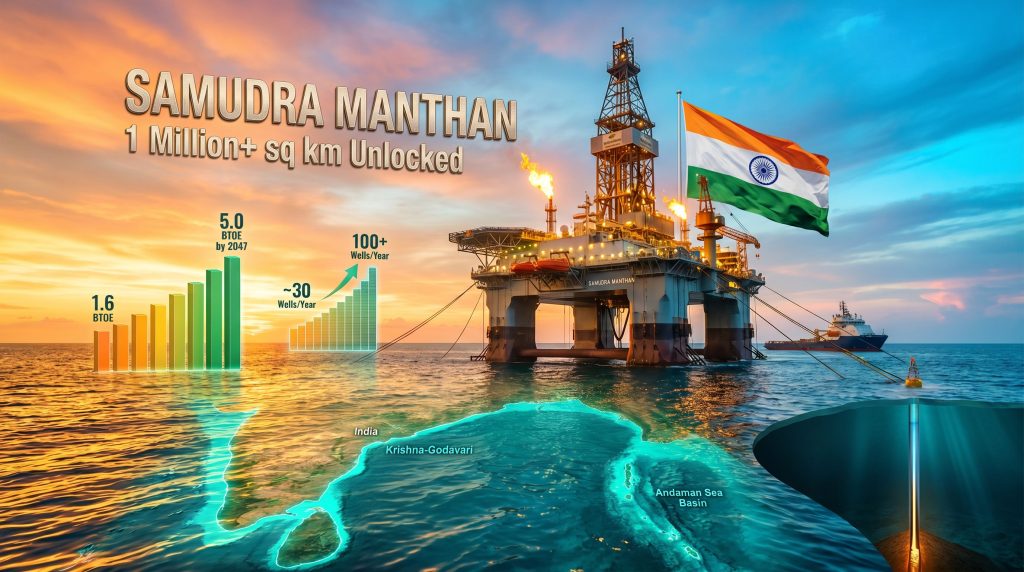
| Hydrocarbon Reserves | 1.6 BTOE | Incremental growth | 5.0 BTOE |
| Import Dependency | ~85% of crude oil | Reduction target | Atmanirbhar Bharat |
| Strategic Oil Buffer | ~74 days | 90-day reserve target | Sustained buffer |
Bridging the gap between the current production baseline and the 2047 targets is mathematically impossible without unlocking deepwater and ultra-deepwater basins. India's mature onshore and shallow-water fields are largely in decline or approaching plateau production. The next meaningful reserve increment has to come from frontier offshore geology.
What Samudra Manthan Actually Means: Mission Architecture Explained
The Sanskrit term Samudra Manthan translates as the churning of the ocean. In Hindu cosmological tradition, this event involved the systematic extraction of hidden treasures from the depths of a primordial sea. The choice of name is deliberate and precise: the mission's central premise is that India's offshore basins contain substantial hydrocarbon wealth that has simply not yet been reached through sustained, methodical exploration effort.
Operating under the Ministry of Petroleum and Natural Gas, coordinated through the Directorate General of Hydrocarbons (DGH), ONGC, and Oil India, the mission was designed to tackle four structural exploration deficits simultaneously:
- Chronically low annual drilling rates relative to the geological scale of India's offshore acreage
- Persistent data scarcity that suppresses investor confidence in frontier basin quality
- Restricted access to strategically sensitive offshore zones that had never been offered for competitive licensing
- Fiscal and regulatory frameworks calibrated for conventional onshore risk rather than deepwater capital requirements
A critical and often underappreciated insight here is that India's underexploration problem is not primarily geological in origin. The basins are there. The geological signals are encouraging. The deficit has been systemic and structural, rooted in data gaps, access restrictions, and fiscal misalignment rather than an absence of hydrocarbons.
The Drilling Intensity Gap: Why 30 Wells Per Year Is Not Enough
One of the most revealing statistics in the entire Samudra Manthan framework is the baseline drilling rate. India has historically drilled approximately 30 exploratory wells per year across its entire upstream sector. For a nation with the geographic scale of India's offshore acreage, this figure represents a profound underinvestment in geological knowledge creation.
The mission's operational targets restructure this entirely:
- Annual exploratory well target: 100+ wells (more than a threefold increase)
- Dedicated deepwater wells: 25 per year
- Stratigraphic wells: 40 per year focused on subsurface knowledge acquisition
- Total committed investment: approximately $20 billion directed toward ultra-deepwater rig procurement and large-scale seismic acquisition
The distinction between stratigraphic wells and conventional exploratory wells is worth understanding. Stratigraphic wells are not drilled primarily to find commercial accumulations. They are drilled to understand the subsurface architecture of a basin, the rock types present, the thermal history, and the distribution of potential reservoir and source rock intervals. They are, in essence, the geological intelligence that makes subsequent commercial drilling more efficient and less risky. Prioritising 40 such wells annually signals a data-first philosophy rather than a production-first mentality.
The Key Basins: Geological Promise Versus Exploration Reality
Krishna-Godavari Basin
The KG Basin along India's east coast is the most extensively studied of India's deepwater frontier zones, having hosted significant gas discoveries in earlier exploration cycles. However, its ultra-deepwater zones remain substantially underdrilled. The basin's complex structural geometry, including significant channel-levee systems and deepwater fan deposits, requires sophisticated seismic imaging technologies that have become commercially available only in the past decade. Earlier exploration campaigns were working with significantly inferior subsurface resolution.
Andaman Sea Basin
Perhaps the most consequential acreage unlocked under Samudra Manthan is the Andaman Basin. Previously classified as a restricted zone due to a combination of strategic sensitivity and environmental designations, over 1 million sq km of previously inaccessible offshore territory has now been opened for competitive licensing under the Open Acreage Licensing Policy (OALP).
Early results from this basin have validated the geological optimism underpinning the mission's design. According to reporting on Oil India's Andaman discoveries, Oil India recorded natural gas discoveries in two of the first three wells drilled in the Andaman Sea under the Samudra Manthan programme. A back-to-back discovery rate of this magnitude in a completely frontier basin is a statistically significant outcome that meaningfully derisks the broader geological thesis.
The Andaman Sea's success rate in early Samudra Manthan drilling is particularly notable because frontier basins globally typically experience high dry-hole rates during initial exploration. Hitting hydrocarbons in two of three wells suggests the basin's geological system is more developed and continuous than previously modelled.
Mahanadi and Kutch Basins
These frontier basins carry limited historical drilling data, which simultaneously elevates geological uncertainty and creates the greatest potential upside for early movers willing to accept frontier risk. Both require the data-first approach that is central to Samudra Manthan's design philosophy.
Global Benchmarking: How India Compares
| Country | Annual Exploratory Wells | Deepwater Maturity | Key Basins |
|---|---|---|---|
| India (current) | ~30 | Nascent | KG, Andaman, Mahanadi |
| India (Samudra Manthan target) | 100+ | Mission-mode | KG, Andaman, Mahanadi, Kutch |
| Brazil | 50-80+ | Mature (pre-salt) | Santos, Campos |
| United States (Gulf of Mexico) | 40-60 | Mature | Gulf of Mexico |
| Norway | 30-50 | Mature | North Sea, Barents Sea |
The Four Pillars of Mission Execution
Pillar 1: The Multi-Client Data Ecosystem
Rather than perpetuating a model where individual companies acquire proprietary seismic datasets that never circulate beyond internal use, Samudra Manthan adopts a multi-client data architecture. Independent third-party operators acquire high-quality seismic and geological data, which is then made available across the industry through the National Data Repository established by the DGH.
This model is already proven in mature exploration provinces globally. Norway's success in the North Sea was partly built on open data philosophies that reduced geological uncertainty for all participants and accelerated the pace of commercial discoveries. India is now deploying this approach at scale across frontier basins that have never been comprehensively imaged.
Pillar 2: Legislative and Regulatory Reform
| Reform Area | Specific Change |
|---|---|
| Primary Legislation | Amended Oilfields (Regulation and Development) Act, 2025 |
| Operational Rules | Overhauled PNG Rules framework |
| Contractual Structures | Streamlined production-sharing and revenue-sharing contracts |
| Acreage Access | Open Acreage Licensing Policy (OALP) enabling self-nomination |
| Approvals Process | Simplified multi-agency clearance procedures |
The OALP mechanism deserves particular attention. Unlike traditional licensing rounds where the government announces specific blocks and companies bid on what is offered, OALP allows companies to identify and express interest in specific acreage at any time. This demand-led approach is considerably more responsive to investor interest and geological intelligence than scheduled round-based systems.
Pillar 3: Technology and International Partnership Integration
Ultra-deepwater operations at 2,000 metres and beyond require technologies including managed pressure drilling systems, subsea trees, and floating production storage and offloading (FPSO) vessels that represent the frontier of global engineering capability. No single domestic operator possesses the full technical toolkit required for mission-scale deepwater development.
As noted by Kartikeya Dube, India Chairman and Senior VP at bp, in a perspective published by ETEnergyWorld, the success of Samudra Manthan will ultimately depend on a genuine partnership model that aligns global deepwater expertise with India's geological ambition and long-term policy commitment. The mission creates explicit pathways for international energy companies to bring advanced operational capabilities into India's regulatory environment.
Pillar 4: Infrastructure Sharing and Common Facilities
One of the less-discussed but financially significant elements of the mission's next phase is the development of common upstream infrastructure hubs. In deepwater environments, the capital cost of individual project infrastructure — including pipeline networks, processing facilities, and subsea manifolds — can make otherwise commercially viable discoveries uneconomic when evaluated on a standalone basis. Shared infrastructure frameworks fundamentally alter this calculation by distributing capital costs across multiple projects and reducing the per-barrel breakeven price.
The next major ASX story will hit our subscribers first
The Fiscal Challenge: Where the Mission Could Stall
Deepwater exploration presents a risk profile categorically different from onshore or shallow-water production:
- Capital intensity: A single deepwater well can cost between $50 million and $200 million, compared to a few million dollars for an onshore equivalent
- Investment cycle duration: The time from discovery to first production in deepwater typically spans 8 to 15 years, requiring capital patience that many commercial operators struggle to sustain
- Geological uncertainty: Frontier basins carry materially higher dry-hole risk than mature producing areas with established geological models
- Technology dependency: Subsea systems, riser technology, and floating production facilities require sustained capital commitment and specialised operational expertise
Against this backdrop, industry participants and analysts have consistently identified several fiscal refinements that would materially improve the investment case for frontier offshore developments in India:
- IGST burden mitigation: The increasing Integrated Goods and Services Tax burden on deepwater project inputs creates a structural cost escalation that erodes project economics. Exemptions or offset mechanisms have been proposed as calibrated responses.
- Marketing flexibility: Permitting operators to export production when international pricing offers superior economics to domestic sales would meaningfully improve the financial viability of frontier developments.
- Infrastructure cost sharing: Formalised frameworks for common upstream infrastructure would reduce per-project capital requirements and accelerate commercialisation timelines for otherwise marginal discoveries.
Furthermore, analysts at Policy Circle have noted that without fiscal measures specifically calibrated to reflect the genuine risk and cost profile of ultra-deepwater projects, India risks under-attracting the scale of global capital and advanced technology required to fully execute the mission's production growth ambitions.
Hydrocarbons and the Energy Transition: Resolving a False Contradiction
A persistent mischaracterisation in energy policy discussions frames domestic oil and gas expansion as fundamentally at odds with renewable energy development. Samudra Manthan's strategic logic challenges this framing on multiple dimensions, and understanding oil's global importance to industrial economies helps clarify why the two objectives need not conflict.
Secure and affordable domestic hydrocarbon production provides the fiscal and economic foundation upon which large-scale renewable energy deployment is built, not a barrier to it. Grid infrastructure investment, battery storage procurement, green hydrogen development, and offshore wind deployment all require substantial capital mobilisation. That capital is more accessible and more sustainably deployed when the national energy import bill is structurally reduced rather than perpetually growing.
The energy transition itself will also demand significant material inputs, many of which depend on stable industrial supply chains underwritten by hydrocarbon feedstocks. In addition, hydrocarbons will remain essential industrial feedstocks for fertiliser production, petrochemical manufacturing, and high-temperature industrial processes well beyond any near-term transition timeline. These applications cannot simply be electrified and require domestically secure supply chains.
Moreover, the broader shift toward renewable energy solutions across developing economies is most credibly financed when nations are not simultaneously haemorrhaging foreign exchange reserves on import dependency.
| Energy Dimension | Samudra Manthan's Contribution |
|---|---|
| Import Reduction | Gradual displacement of crude imports through production growth |
| Balance of Payments | Reduced foreign exchange outflow on energy |
| Strategic Autonomy | Lower vulnerability to geopolitical supply disruptions |
| Fiscal Space | Reduced import bill enabling renewable energy investment |
| Industrial Feedstock | Domestic petrochemical and fertiliser supply chain security |
Environmental Considerations in India's Deepwater Expansion
The Andaman and Nicobar Islands region hosts some of the most biodiverse coral reef systems on the planet. Any exploration activity in adjacent waters carries genuine ecological sensitivity that requires careful operational design, not merely regulatory box-ticking.
Samudra Manthan's framework embeds environmental impact assessment requirements, marine conservation protocols, and spill response preparedness as licensing conditions rather than afterthoughts. The long-term credibility of the programme depends on demonstrating that resource extraction and marine ecosystem protection are complementary objectives rather than competing ones.
The Reserve Growth Target: What 5 BTOE by 2047 Actually Requires
| Timeframe | Projected Hydrocarbon Reserves |
|---|---|
| Current | 1.6 BTOE |
| 2035 | 2.0 BTOE (interim milestone) |
| 2047 | 5.0 BTOE (Atmanirbhar Bharat target) |
Growing India's proven hydrocarbon reserve base from 1.6 billion tonnes of oil equivalent to 5.0 BTOE over two decades is an enormously ambitious objective. Achieving it requires not just discovering more hydrocarbons but converting geological discoveries into booked proven reserves through appraisal drilling, development planning, and commercial sanctioning.
The early Andaman Sea discovery results are genuinely encouraging, but the gap between frontier discovery and booked reserve is substantial and requires sustained capital commitment through multiple phases of appraisal and development work. The mission's trajectory will be determined by whether fiscal frameworks and partnership structures remain sufficiently attractive to sustain that capital commitment through the inevitable periods of geological disappointment that characterise any frontier exploration programme.
Furthermore, the context of any oil price rally in global markets adds urgency to this timeline, as higher prices simultaneously improve project economics and intensify the political pressure to accelerate domestic production growth.
Critical Success Factors for Mission Execution
- Sustained policy consistency across multiple political cycles to provide the multi-decade investment horizon deepwater projects require
- Calibrated fiscal reforms addressing IGST burden, marketing flexibility, and infrastructure sharing to improve project-level economics
- Technology transfer acceleration through structured international partnership frameworks that incentivise global operators to deploy frontier-grade capabilities in India
- Data ecosystem maturation through rapid scaling of the multi-client seismic model to reduce geological uncertainty across all targeted frontier basins
- Workforce and capability development to support a more than threefold increase in annual exploratory drilling activity without compromising operational safety standards
Frequently Asked Questions: Samudra Manthan India Offshore Oil and Gas
What does Samudra Manthan mean?
Samudra Manthan translates from Sanskrit as the churning of the ocean. In Hindu mythology, it describes the process by which gods and celestial beings churned the primordial ocean to extract hidden divine treasures. The mission adopts this name to symbolise the systematic unlocking of hydrocarbon wealth concealed within India's underexplored offshore basins.
When was Samudra Manthan launched?
The mission was formally launched in August 2025 under Prime Minister Modi's government, with execution coordinated through the Ministry of Petroleum and Natural Gas, the DGH, ONGC, and Oil India.
How much is being invested in Samudra Manthan?
ONGC and the Indian government have committed approximately $20 billion to the programme, directed primarily toward ultra-deepwater drilling rig procurement, seismic data acquisition at scale, and subsurface data processing infrastructure.
Which offshore basins are targeted?
The primary focus areas include the Krishna-Godavari Basin, the Andaman Sea Basin, the Mahanadi Basin, the Kutch Basin, and the Mumbai Offshore region, all of which carry significant geological potential but remain substantially underexplored relative to their assessed sedimentary endowment.
Has Samudra Manthan made any discoveries yet?
Yes. Oil India has recorded natural gas discoveries in the Andaman Sea, with hydrocarbon finds confirmed in two of the first three wells drilled under the mission framework. This early success rate significantly exceeds typical frontier exploration benchmarks and provides early validation of the programme's underlying geological thesis.
Does domestic oil and gas expansion conflict with India's renewable energy goals?
The strategic logic of Samudra Manthan India offshore oil and gas development argues the opposite. Domestic hydrocarbon production provides the fiscal stability and economic foundation that enables large-scale renewable energy investment. Energy security and energy transition are designed to advance in complementary alignment rather than as competing policy priorities.
This article is intended for informational purposes only and does not constitute investment advice. Projections, targets, and timelines referenced reflect stated government and industry objectives and involve inherent uncertainty. Readers should conduct independent research before making investment or commercial decisions related to India's upstream energy sector. Ongoing developments in India's oil and gas sector, including regulatory updates and licensing rounds, are covered by ETEnergyWorld at energy.economictimes.indiatimes.com.
Want to Stay Ahead of the Next Major Mineral Discovery on the ASX?
While India's Samudra Manthan mission highlights how transformative large-scale resource discoveries can be at a national level, Discovery Alert's proprietary Discovery IQ model delivers real-time alerts on significant ASX mineral discoveries, instantly equipping subscribers with actionable insights ahead of the broader market — explore the historic returns major discoveries have generated and begin a 14-day free trial to position yourself at the forefront of the next significant find.