August 6, 2026
Mexico's Insolvency Architecture Under Pressure: How the System Handles Industrial Giants
When a country's largest integrated steelmaker collapses into formal bankruptcy, the stress test it applies to national insolvency law is unlike anything a routine commercial failure can reveal. The mechanics of liquidating a sprawling industrial enterprise, one with blast furnaces, iron ore mines, thousands of workers, and decades of concentrated ownership, expose gaps in regulatory design that legislators rarely anticipate when drafting frameworks primarily shaped around smaller corporate insolvencies.
Mexico's experience with the AHMSA bankruptcy proceedings in Mexico is precisely this kind of stress test. It is not simply a story about a company that ran out of money. It is a live examination of whether Mexico's legal and institutional architecture can manage a case of genuine national scale, where the stakes extend far beyond balance sheets into regional employment, industrial supply chains, and sovereign creditor hierarchies.
When big ASX news breaks, our subscribers know first
The Legal Framework Behind Large-Scale Corporate Bankruptcy in Mexico
Mexico's Ley de Concursos Mercantiles, or Commercial Insolvency Law, was enacted in 2000 to modernise a previously fragmented approach to corporate distress that had relied on outdated legislation ill-suited to complex multi-creditor environments. The law established a two-phase process: a conciliación (conciliation) phase, during which a court-appointed specialist attempts to broker an agreement between a debtor and its creditors, followed by a quiebra (bankruptcy/liquidation) phase if conciliation fails.
Oversight of these proceedings falls to the Instituto Federal de Especialistas de Concursos Mercantiles (IFECOM), a body attached to Mexico's federal judiciary that certifies, appoints, and supervises the specialists who serve as trustees, conciliators, and auditors in insolvency cases. IFECOM's role becomes especially critical in cases where asset values exceed US$1 billion, since the complexity of creditor hierarchies, cross-border obligations, and multi-site operational assets demands a level of institutional coordination that smaller proceedings rarely require.
What Makes a Corporate Insolvency "Systemically Significant"?
Not every bankruptcy rises to the level of national policy concern, but several converging factors can elevate a case beyond ordinary judicial proceedings:
- A workforce large enough to create measurable regional unemployment if operations cease permanently
- Industrial capacity whose loss would affect domestic supply chains or increase import dependency in a strategic sector
- Tax obligations to federal authorities that compete with private creditors for asset recovery
- Ownership structures entangled with separate criminal or civil legal proceedings
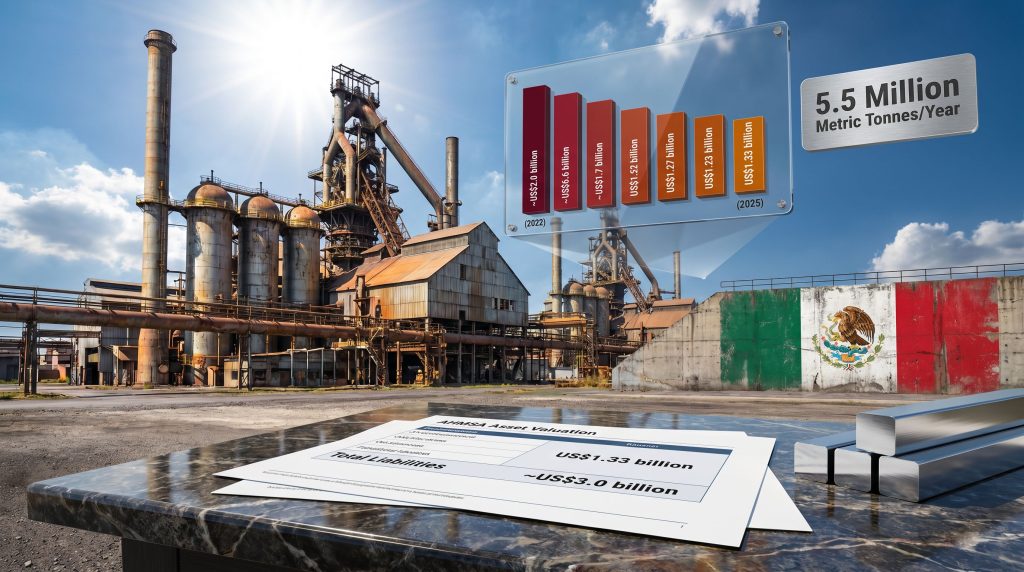
AHMSA, formally known as Altos Hornos de México S.A. de C.V., meets all of these criteria simultaneously. With a nameplate production capacity of 5.5 million metric tonnes of steel per year, it ranks among the largest integrated steelmakers in Latin America. Its Minosa subsidiary, which supplies iron ore directly to AHMSA's blast furnace operations, makes it one of the very few vertically integrated steel enterprises in the entire region — a distinction that creates both strategic value and extraordinary complexity for any liquidation process.
The Structural Path to Bankruptcy: Governance, Debt, and the Weight of Time
Understanding why AHMSA's AHMSA bankruptcy proceedings reached their current state requires looking beyond the immediate financial metrics. The company spent more than 31 years under the control of a single dominant shareholder, former owner Alonso Ancira Elizondo. Prolonged single-shareholder dominance over a capital-intensive industrial enterprise frequently produces a predictable pattern: governance structures designed to serve owner preferences rather than independent operational discipline, debt accumulation during periods of favourable commodity pricing, and insufficient balance sheet flexibility when market conditions shift.
A federal court formally declared AHMSA bankrupt on November 6, 2024, after conciliation attempts failed to produce a viable restructuring agreement. Five weeks later, on December 11, 2024, court-appointed trustee Víctor Manuel Aguilera Gómez assumed full administrative control of the company's assets, including its integrated steel plants and the Minosa iron ore complex.
The Balance Sheet Reality
The financial gap between AHMSA's asset base and its total obligations reveals why creditor recovery prospects are deeply constrained.
| Financial Metric | Estimated Value |
|---|---|
| Total Assets (2022 valuation) | ~US$2.0 billion |
| Total Liabilities (2022) | ~US$3.0 billion |
| Additional Tax Debts (SAT, declared 2024) | ~US$3.0 billion |
| Trustee-Submitted Asset Valuation (August 2025) | US$1.33 billion |
| Approximate Liability-to-Asset Ratio | 3:1 (including tax claims) |
The intervention of Mexico's federal tax authority, the Servicio de Administración Tributaria (SAT), fundamentally altered the creditor landscape. The SAT's declaration of approximately US$3.0 billion in additional tax obligations, layered on top of pre-existing private creditor claims, placed government tax recovery in direct competition with secured lenders and labour claim holders. This is not unusual under Mexican insolvency law, where tax authorities enjoy a privileged creditor status, but the sheer scale of the SAT claim relative to available assets compresses the realistic recovery horizon for all other creditor classes.
Equally significant is the gap between the 2022 asset estimate of approximately US$2.0 billion and the trustee's formal submission of US$1.33 billion in August 2025. That US$670 million reduction in apparent asset value over roughly three years reflects the accelerating depreciation that follows operational suspension: idle blast furnaces corrode, specialised equipment loses market value rapidly without maintenance, and the embedded goodwill of a vertically integrated production system diminishes when the supply chain linkages it depends on stop functioning. According to AHMSA's asset valuation filings, this decline underscores the urgency of reaching a timely resolution.
How Mexico's Trustee System Functions: The AHMSA Case as a Practical Examination
One of the less understood aspects of Mexico's insolvency framework is the breadth of authority granted to a bankruptcy trustee during the quiebra phase. Unlike a restructuring manager whose mandate is to preserve the enterprise as a going concern, a liquidation trustee holds full administrative rights over operating assets with the primary goal of maximising recovery value for creditors.
The trustee's mandate in the AHMSA case encompasses:
- Direct administrative control over integrated steel plant operations and the Minosa mining complex
- Authority to negotiate and execute asset sale agreements, subject to court confirmation
- Obligation to respect Mexican labour law provisions that place worker claims within a priority creditor class
- Legal capacity to structure sales in a manner that transfers assets free of prior financial encumbrances, a feature specifically designed to attract buyers who would otherwise avoid heavily liened industrial assets
This last point, known colloquially as a "clean transfer" mechanism, is one of the more strategically significant features of Mexican insolvency law for distressed industrial assets. By legally extinguishing financial and certain labour encumbrances at the point of transfer, the framework attempts to make otherwise unattractive assets commercially viable for prospective buyers.
The Unified Package Sale Strategy and Its Tradeoffs
The trustee chose to market AHMSA's steel operations and the Minosa iron ore complex as a single integrated package rather than pursuing piecemeal asset disposals. The strategic rationale is defensible: separating the iron ore supply chain from the steelmaking operations destroys the vertical integration premium that gives AHMSA much of its residual value. An acquirer purchasing only blast furnace capacity without assured raw material supply would face immediate and ongoing procurement costs that undermine the economics of any restart.
Within this unified approach, the trustee prioritised the electric arc furnace (EAF) operations, which carry a production capacity of 1.2 million metric tonnes per year, ahead of the larger blast furnace assets in the phased sale sequence. This sequencing reflects a global industry trend: EAF-based steelmaking requires significantly lower capital expenditure to restart, consumes scrap metal rather than iron ore, and carries a lower carbon intensity — making it more attractive to buyers with sustainability mandates or tighter capital constraints. Furthermore, the iron ore demand prospects for integrated steelmakers remain uncertain, reinforcing the EAF-first sequencing logic.
Industry Context: Electric arc furnace technology now accounts for approximately 30% of global steel production, and its share is growing as decarbonisation pressure intensifies across the sector. An EAF facility with established infrastructure offers a faster path to revenue generation than blast furnace operations, which require extended recommissioning timelines and sustained raw material supply chains.
Why the February 2025 Auction Failed: A Regulatory and Procedural Breakdown
The February 2025 auction collapse represents the most instructive episode of the AHMSA bankruptcy proceedings for anyone studying Mexican insolvency enforcement capacity. Two simultaneous failures voided the process entirely.
First: Secured creditors holding guarantees over specific asset tranches declined to formally endorse the unified sale structure. This exposed a fundamental misalignment between how the trustee designed the sale package and what secured creditors actually wanted — which was individual asset recoveries that prioritised their specific collateral positions rather than a collective unified-package outcome.
Second: The sole qualified bidder failed to submit the required garantía de seriedad, or seriousness guarantee, within the prescribed legal deadline. Under Mexican insolvency procedure, this financial deposit serves as both a signal of genuine buyer intent and a legal prerequisite for auction participation. Its absence rendered the entire process void.
The consequence under Ley de Concursos Mercantiles procedure is that a failed or deserted auction does not simply restart. It triggers a mandatory procedural reset requiring the trustee to submit a revised sale proposal within 20 business days, effectively adding months to an already protracted resolution timeline. Mexican courts granted a 10-business-day extension as a short-term procedural measure, however this offers limited relief against the deeper structural problem of creditor misalignment.
Comparative analysis with other jurisdictions highlights what Mexico's framework is missing. Under U.S. Chapter 11 proceedings, stalking horse bid agreements are routinely secured before an auction is publicly launched, ensuring at least one committed buyer is in place and that creditors have pre-negotiated the basic terms of any sale. The UK administration process similarly requires pre-marketing creditor consultation that surfaces conflicts before, not during, the auction itself. Mexico's framework does not mandate equivalent pre-auction alignment protocols for unified asset packages, and the AHMSA case has demonstrated the cost of that absence.
Human and Political Consequences: 14,000 Workers and Legislative Scrutiny
Behind every financial metric in the AHMSA bankruptcy proceedings in Mexico is a human reality centred on Monclova, Coahuila, the city where AHMSA's primary operations are located. Approximately 14,000 workers and their families depend either directly or indirectly on AHMSA's economic activity. In a regional economy built around steelmaking, the prolonged suspension of operations does not merely affect individual household incomes; it cascades through local suppliers, service providers, and municipal tax revenues.
The trustee has formally committed to recognising all labour claims regardless of the outcome of individual legal disputes, a commitment grounded in Mexican labour law's priority creditor protections. However, the practical timeline for fulfilling those commitments remains hostage to the pace of asset resolution.
Legislative attention has intensified as the timeline extends. Senator Luis Fernando Salazar Fernández, representing the Special Commission for Monitoring AHMSA's Bankruptcy, formally requested a public judicial hearing to inject greater transparency into proceedings that have largely been conducted outside public view. His concerns reflect a broader policy debate about whether Mexico's insolvency law should mandate enhanced public reporting for any case involving a workforce exceeding a defined minimum threshold — a reform that would bring Mexican practice closer to international standards for systemically significant insolvencies.
The Ancira Dimension: Criminal Proceedings and Political Risk Pricing
Any prospective buyer conducting due diligence on AHMSA's assets must account for the shadow cast by the legal proceedings involving former controlling shareholder Alonso Ancira Elizondo. The intersection of ongoing criminal investigations with a concurrent civil insolvency creates jurisdictional complexity that adds measurable uncertainty to asset title questions and the political risk profile of any acquisition.
This complexity is not merely theoretical. In markets where insolvency proceedings have become entangled with high-profile criminal cases, buyers routinely apply a political risk discount to asset valuations, effectively reducing the price they are willing to pay. For AHMSA, whose asset valuation has already declined significantly from 2022 estimates, any further buyer-side discount directly narrows the pool of creditors who can expect meaningful recovery. The ongoing US Steel acquisition debate offers a comparable illustration of how political scrutiny can reshape industrial asset valuations under contested ownership circumstances.
The next major ASX story will hit our subscribers first
What AHMSA's Collapse Means for Mexico's Steel Sector in 2025 and Beyond
The broader industrial policy implications of the AHMSA bankruptcy proceedings extend well beyond Coahuila. With 5.5 million metric tonnes of nameplate capacity sitting dormant, Mexico faces a structural gap in domestic flat steel supply at precisely the moment when nearshoring-driven manufacturing investment is expanding demand for locally produced steel in construction and industrial applications.
In addition, the broader context of steel and aluminium tariffs reshaping global trade flows adds further complexity to any assessment of who might credibly acquire AHMSA's assets and under what commercial terms. The scenarios for AHMSA's assets carry very different policy consequences depending on who ultimately acquires them:
| Acquisition Scenario | Buyer Profile | Key Policy Implication |
|---|---|---|
| Domestic industrial buyer | Mexican conglomerate or state entity | National ownership preserved; lower political risk |
| Foreign strategic investor | International steelmaker | Technology transfer potential; sovereignty debate likely |
| Financial buyer restructuring | Private equity | Asset stripping risk; worker protections under scrutiny |
| Partial state intervention | Federal or state government entity | Fiscal cost implications; sets institutional precedent |
Any acquisition will also require regulatory clearance from COFECE, Mexico's Federal Economic Competition Commission, given AHMSA's position as a dominant domestic integrated steel producer. The competitive concentration implications of a single buyer absorbing the full nameplate capacity of one of Latin America's largest steelmakers would require careful antitrust analysis regardless of the acquirer's nationality.
Frequently Asked Questions: AHMSA Bankruptcy Proceedings in Mexico
What is the current legal status of AHMSA's bankruptcy?
AHMSA was formally declared bankrupt by a federal court on November 6, 2024. A court-appointed trustee assumed full administrative control on December 11, 2024. As of mid-2026, the asset sale process remains active following the failed February 2025 auction and subsequent procedural extensions.
How much are AHMSA's assets worth in the current proceedings?
The court-appointed trustee formally submitted an asset valuation of US$1.33 billion in August 2025. This is materially lower than the approximately US$2.0 billion valuation recorded in 2022, reflecting depreciation from operational suspension and deteriorating market conditions for idle industrial assets.
Why did the February 2025 auction fail?
Two concurrent failures voided the process. Secured creditors declined to endorse the unified asset sale structure, and the sole qualified bidder failed to deposit the required seriousness guarantee before the legal deadline. Mexican courts subsequently required the trustee to submit a revised sale proposal within 20 business days.
What protections exist for AHMSA workers during the proceedings?
The bankruptcy trustee has formally committed to recognising all labour claims irrespective of ongoing litigation outcomes. Mexican insolvency law classifies worker claims within a priority creditor tier, though the practical timeline for payment remains tied to the overall pace of asset resolution.
How does the Ancira criminal case affect the bankruptcy?
Legal proceedings involving former controlling shareholder Alonso Ancira Elizondo, who controlled AHMSA for over 31 years, introduce jurisdictional complexity and political risk considerations that prospective buyers must weigh when assessing acquisition viability. Criminal asset investigations running concurrently with civil insolvency proceedings can complicate title clarity and depress buyer willingness to pay full valuation.
How large is AHMSA in the regional steel industry context?
AHMSA's nameplate capacity of 5.5 million metric tonnes per year, combined with the vertical integration of its Minosa iron ore supply operations, places it among the largest and most strategically complex steel enterprises in Latin America. Consequently, understanding the China steel and iron ore market is also relevant, as Chinese demand dynamics directly influence global steel pricing and the attractiveness of dormant assets such as AHMSA's.
Key Lessons and the Path Toward Reform
The AHMSA bankruptcy proceedings have surfaced several structural weaknesses in Mexico's Ley de Concursos Mercantiles that deserve legislative attention:
- Pre-auction creditor alignment protocols should be mandatory for unified asset sale packages above a defined asset threshold, preventing the kind of last-minute creditor non-confirmation that collapsed the February 2025 process.
- Statutory sale timelines tied to workforce size would create accountability mechanisms for trustees managing cases with significant social consequences, reducing the risk of indefinite procedural extension.
- Enhanced public transparency requirements for high-profile industrial insolvencies would address the concerns raised by legislative oversight bodies and bring Mexican practice closer to international standards.
For international investors and industrial partners monitoring Mexico's business environment, the AHMSA case functions as a credibility test. A prolonged, procedurally fractured resolution process raises legitimate questions about whether Mexico's insolvency framework can reliably handle the restructuring of large industrial assets within commercially viable timeframes. Furthermore, green steel pricing trends are increasingly shaping how prospective acquirers assess the long-term commercial viability of legacy integrated steelmaking assets — a consideration directly relevant to any future AHMSA transaction. These are questions with direct implications for foreign direct investment decisions in Mexico's manufacturing and industrial sectors for years to come.
Want to Stay Ahead of Major Mineral Discoveries on the ASX?
While Mexico's steel sector grapples with complex insolvency proceedings, commodity markets and resource discoveries continue to move fast — Discovery Alert's proprietary Discovery IQ model delivers real-time alerts on significant ASX mineral discoveries, turning complex geological data into actionable investment insights the moment they are announced. Explore historic examples of exceptional discovery returns and begin your 14-day free trial today to position yourself ahead of the broader market.