
August 6, 2026
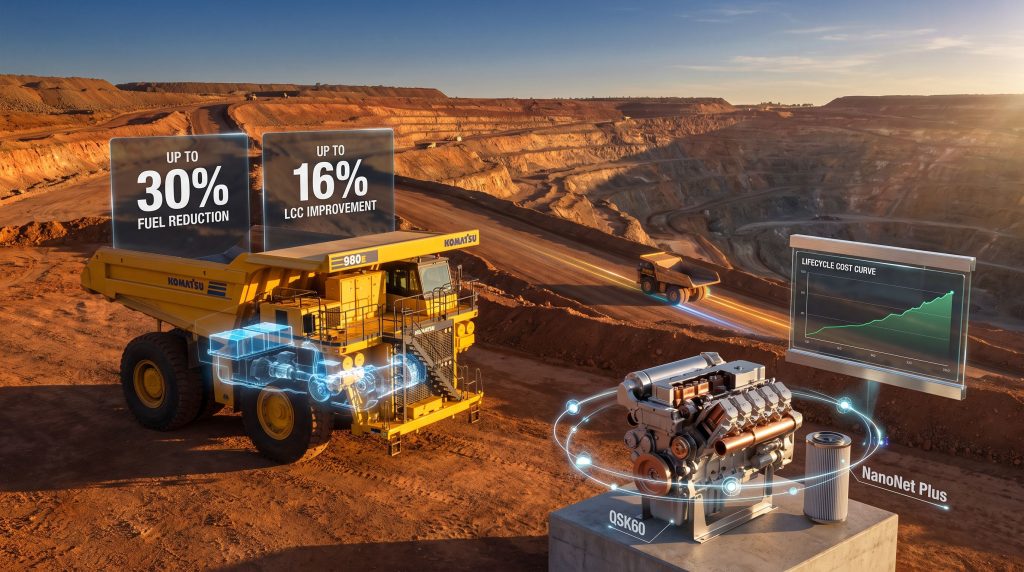
The Economics of High-Horsepower Mining Are Being Rewritten
Every decade or so, the mining equipment industry experiences a shift that transcends product updates and enters the territory of structural change. The current moment is one of those inflection points. Escalating operational costs, tightening emissions obligations, and the relentless pressure on mine productivity are converging to force a rethink of how power systems are engineered, maintained, and commercialised at scale.
Fleet operators managing ultra-class haul trucks and large excavators are no longer evaluating engines purely on upfront cost or raw horsepower output. The calculus has shifted toward total lifecycle economics, unplanned downtime exposure, and the ability to reduce Scope 1 emissions without wholesale fleet replacement. It is within this context that the latest Cummins mining developments carry particular significance, spanning engine upgrades, predictive maintenance platforms, hybrid-electric haulage, and a ground-up engine design that signals where high-horsepower mining power is heading next.
When big ASX news breaks, our subscribers know first
A Structured Approach to Engine Enhancement: The Model Year Change Programme
One of the more consequential but understated announcements in Cummins' 2026 mining technology rollout is the introduction of a formal model year change programme for industrial high-horsepower platforms. Rather than responding to field issues or market pressures reactively, this framework commits to proactively evaluating and delivering improvements within a defined three-year window.
For context, high-horsepower mining engines operate in a fundamentally different commercial environment than automotive powertrains. A haul truck engine may power a single asset through multiple rebuild cycles spanning fifteen to twenty years. Incremental improvements that appear modest on a percentage basis translate into millions of dollars of value across a fleet of even moderate size. A structured programme that embeds improvement within the product lifecycle, rather than waiting for a platform replacement, is a meaningful departure from conventional practice.
The 2027 QSK60 is the first engine to enter this programme. Cummins' 60-litre platform is a workhorse across large surface mining haul trucks globally, and the targeted updates being introduced from Q1 2027 onward, available through both new builds and engine rebuilds, are projected to deliver measurable gains across several dimensions.
QSK60 Performance Projections: Breaking Down the Numbers
The projected improvements attached to the 2027 model year update represent a compelling value case for fleet operators evaluating rebuild economics:
| Performance Metric | Projected Improvement |
|---|---|
| Total Cost of Ownership (TCO) | Up to 3% reduction |
| Lifecycle Cost (LCC) | Up to 16% reduction |
| Life to Overhaul Extension | 5-10% of fuel consumed |
| Mid-Life Maintenance Cost Reduction | 50%+ via NanoNet® Plus |
The LCC figure deserves particular attention. A 16% improvement in lifecycle cost is not achieved through a single change but through the compounding of several enhancements: extended overhaul intervals, the elimination of mid-life injector change-outs via NanoNet® Plus filtration technology now fitted as standard, and optional factory-installed FIT sensor suites that enable advanced analytics when paired with the PrevenTech platform.
The NanoNet® Plus development is technically noteworthy. Traditional high-horsepower mining engines require injector replacement at mid-life as a standard maintenance event, a costly and time-consuming procedure. By incorporating NanoNet® Plus as a standard feature, Cummins eliminates this requirement entirely, with projected mid-life maintenance cost reductions exceeding 50%. For operations running large fleets, this single change can represent a significant reduction in planned maintenance expenditure over each engine lifecycle.
The rebuild economics calculation matters here. When an operator factors in multiple rebuild cycles across a 15-20 year asset life, a 16% improvement in lifecycle cost is not a marginal gain. It reshapes the financial case for staying with an established platform versus pursuing new equipment procurement.
PrevenTech® and the Shift Toward Condition-Based Maintenance
The mining industry has long understood the difference between scheduled maintenance and reactive maintenance. What has proven more difficult is operationalising a third model — condition-based maintenance — at scale across a geographically dispersed fleet. This is the problem PrevenTech® is engineered to solve, and it reflects the broader shift toward data-driven mining operations that is reshaping how large mines are managed.
Cummins' connected monitoring platform aggregates sensor data across the installed base and, via its global service network, converts that data into prioritised maintenance guidance. The Q3 2026 platform update focuses specifically on improving how maintenance issues are identified and surfaced to operators, reducing the cognitive load of interpreting engine health data and enabling faster, more targeted intervention.
The practical significance of this update extends beyond software refinement. Mining operations in remote locations face real constraints on maintenance resource availability. Sending a service team to address an issue that turns out to be lower priority, while a developing fault elsewhere goes unaddressed, is a failure mode that condition-based monitoring is specifically designed to prevent.
Comparing Maintenance Approaches in High-Utilisation Mining
| Maintenance Model | Core Mechanism | Primary Risk | Cost Profile |
|---|---|---|---|
| Scheduled Preventive | Fixed time or hour-based intervals | Over-maintenance, component waste | Predictable but potentially inefficient |
| Reactive Breakdown | Event-triggered response | Catastrophic failure, extended downtime | Unpredictable, high peak costs |
| PrevenTech® Predictive | Condition and data-driven | Requires reliable connectivity | Optimised spend, reduced unplanned downtime |
The optional FIT sensor suite, available as a factory-fitted configuration on new QSK60 engines, strengthens this ecosystem further. When FIT sensors are paired with PrevenTech®, maintenance intervals can be extended beyond standard schedules based on actual engine condition rather than predetermined thresholds. In high-utilisation environments where every hour of uptime carries direct revenue implications, this capability represents a genuine operational advantage. Furthermore, advancements in AI mining efficiency are complementing these connected maintenance platforms to deliver even greater productivity gains across the sector.
Gbile Adewunmi, Vice President of Power Systems Industrial Markets at Cummins, has communicated that the company's intent is to make it progressively easier for operators to convert engine data into concrete maintenance priorities, framing connected insights as a foundational requirement rather than an optional feature for productive mining equipment.
Hybrid-Electric Haulage: From Concept to Commercial Reality
Of all the Cummins mining developments announced in 2026, the hybrid-electric haulage programme represents the most visible commercial milestone. The Caserones copper and molybdenum mine in Chile's Atacama Region is currently running what Cummins describes as the world's first commercial hybrid-electric ultra-class mining truck in production, a meaningful distinction that separates field validation from controlled testing.
Why Caserones Is the Right Test Environment
The Atacama Region presents operating conditions that genuinely stress-test hybrid systems. High altitude reduces combustion efficiency in conventional diesel engines. Significant grade variation across haul routes creates natural opportunities for energy recovery during descent, while demanding maximum power delivery during loaded climbs. The Caserones environment is not an easy operating setting, which makes successful performance validation there more commercially credible than results from lower-stress environments.
The hybrid retrofit platform, powered by First Mode technology, works by combining battery-electric energy storage with the existing diesel drivetrain. Rather than requiring fleet replacement, it integrates with current truck platforms and mine site infrastructure. The core energy cycle functions as follows:
- During descent and braking phases, kinetic energy is captured and stored in the battery system rather than being dissipated as heat through the braking system.
- During high-demand climb segments with a loaded truck, stored energy is redeployed to augment diesel power output.
- The net effect reduces total diesel consumption per cycle while also reducing thermal and mechanical stress on the braking system.
Hybrid Haulage Performance Targets
| Metric | Target Outcome |
|---|---|
| Fuel Consumption Reduction | Up to 30% |
| Emissions Reduction | Up to 30% |
| Supplemental Drivetrain Power (next-gen) | Up to 1 MW |
| Infrastructure Change Required | Minimal |
Beyond fuel savings, hybrid systems offer mechanical benefits that extend asset life. Reduced engine load across the haul cycle decreases thermal cycling stress on engine components. Regenerative braking reduces wear on conventional braking systems, which in ultra-class trucks are subject to significant stress on long descending grades. These compounding mechanical benefits mean that the total cost argument for hybrid adoption extends well beyond the fuel cost reduction headline.
The retrofit model is strategically important for mine operators who cannot afford multi-year fleet replacement programmes but need a viable near-term pathway to emissions reduction. Hybrid retrofit preserves existing capital while unlocking meaningful efficiency gains.
Additional pilot programmes are planned across the Americas throughout 2026, with a next-generation product release targeted for early 2027. That next-generation system is designed to deliver up to 1 MW of supplemental power to the drivetrain, enabling faster cycle times depending on site conditions and application profile. Cummins and Komatsu are advancing this work through a strategic collaboration, expanding the co-development surface for hybrid powertrain technology across a broader range of ultra-class truck platforms.
A USD 2.1 million federal grant secured in January 2026 is supporting continued hybrid haul truck development and testing at a proving grounds facility in Centralia, Washington State, with the programme running through 2027.
The Clean-Sheet Engine: Engineering the Next Decade of Mining Power
While the QSK60 upgrades and hybrid programme address the near-term needs of the installed base, Cummins is simultaneously developing a fundamentally new engine platform from the ground up. Field testing is currently underway, with full details expected to be released later in 2026.
The target application range centres on 90 to 120 tonne haul trucks and 150 to 220 tonne excavators, the equipment classes that define large-scale surface mining operations globally. Planned applicability extends further to surface miners, bulldozers, wheel loaders, and dewatering pumps, indicating a platform designed for breadth as well as depth within the mining equipment ecosystem.
Why a Clean-Sheet Design Matters
The difference between a clean-sheet engine platform and an evolved existing architecture is not merely technical — it is strategic. A clean-sheet design allows engineering teams to embed future-ready capability, including renewable diesel and HVO fuel compatibility, lower-emissions architecture as a baseline rather than a retrofit, and integration pathways with hybrid and eventually fully electrified drivetrain systems, from the foundation up rather than as modifications to a legacy structure.
For mine planners currently specifying equipment for projects with 20-plus year operating horizons, the timing of the clean-sheet platform release is relevant. Equipment procurement decisions made in 2026 and 2027 will need to account for where engine technology is heading, not just where it currently sits. In this regard, the broader push toward mining electrification trends is reshaping procurement strategy at the highest levels of the industry.
The 2026-2027 Mining Technology Roadmap: A Consolidated View
| Innovation Pillar | Current Status | Key Target Metric | Commercial Timeline |
|---|---|---|---|
| QSK60 Model Year Update | Confirmed for Q1 2027 | Up to 16% LCC improvement | New builds + rebuilds from Q1 2027 |
| PrevenTech® Platform Update | Q3 2026 rollout | Improved maintenance prioritisation | Existing fleet + new installs |
| Hybrid Retrofit (First Mode) | Commercial pilot active | Up to 30% fuel and emissions reduction | Next-gen release early 2027 |
| Clean-Sheet Engine Platform | Field testing underway | 90-220 tonne equipment coverage | Full details later in 2026 |
The next major ASX story will hit our subscribers first
What This Means for Fleet Operators and Mine Planners
The practical implications of these Cummins mining developments differ depending on where an operation sits in its asset lifecycle and strategic planning horizon.
For operations running existing QSK60-powered equipment, the rebuild pathway to access 2027 model year improvements is the most immediate consideration. The rebuild economics case is strong: accessing a 50%+ reduction in mid-life maintenance costs and a projected 16% lifecycle cost improvement through a rebuild rather than new unit procurement represents a capital-efficient approach to value extraction.
For ultra-class haul truck fleets evaluating hybrid transition, site suitability assessment should focus on grade profiles and haul distances, as operations with longer descending grades and higher loaded cycle demands will see the strongest energy recovery performance. Infrastructure compatibility is also worth early evaluation, given that the First Mode retrofit system is designed to integrate with existing platforms without requiring significant changes to site power infrastructure.
For mine planners working on longer-horizon procurement decisions, the clean-sheet engine platform and next-generation hybrid product timeline are both relevant inputs to equipment specifications being developed for 2027 and beyond.
Emissions Strategy: Near-Term Actions and Long-Term Pathways
Hybrid haulage functions as a credible near-term Scope 1 emissions reduction lever, delivering fuel consumption reductions of up to 30% without requiring new fleet investment or significant infrastructure change. The transition toward electric mining transport is gathering momentum across the sector, and hybrid systems represent a practical stepping stone toward that goal.
Renewable diesel and HVO fuel compatibility — a design consideration being embedded in next-generation Cummins platforms — offers a bridge fuel strategy for operations advancing toward deeper emissions reduction targets. Consequently, the longer-term trajectory points toward fully electrified haulage, with hybrid systems functioning as the transitional architecture that builds operational experience with electrified drivetrains while preserving productivity. In addition, renewable mining solutions are increasingly being integrated alongside these powertrain advancements to deliver more comprehensive decarbonisation outcomes at site level.
Disclaimer: Projected performance improvements, including TCO reductions, lifecycle cost savings, and fuel consumption targets, are subject to variation based on application, duty cycle, operating conditions, maintenance practices, and site-specific configuration. Forward-looking statements in this article are based on publicly available information from Cummins and should not be interpreted as guaranteed commercial outcomes.
Frequently Asked Questions: Cummins Mining Developments
What is the QSK60 and which mining equipment does it power?
The QSK60 is Cummins' 60-litre high-horsepower diesel engine platform, widely used in large surface mining haul trucks and high-load industrial applications globally.
When will the 2027 QSK60 model year updates be available?
The updates apply to new QSK60 engines produced after Q1 2027 and to engine rebuilds completed from that point forward.
How does the PrevenTech® platform update affect existing installations?
The Q3 2026 update impacts both the existing software population and new installations, improving maintenance issue identification across the installed base.
What mining sites are currently running Cummins hybrid haul truck pilots?
The Caserones copper and molybdenum mine in Chile's Atacama Region is currently running the world's first commercial hybrid-electric ultra-class mining truck in production. Additional pilots across the Americas are planned for 2026.
How much fuel can hybrid-electric mining trucks realistically save?
The hybrid retrofit system is designed to target up to 30% reductions in fuel consumption, with actual results varying by site grade profile, haul distance, and operating conditions.
What is the timeline for Cummins' new clean-sheet mining engine?
Field testing is currently underway. Full commercial details are expected to be released later in 2026.
Does the hybrid retrofit system require significant infrastructure changes?
No. The First Mode-powered retrofit system is designed to integrate with existing truck platforms and mine site infrastructure without requiring significant changes to fleet configuration or site power systems.
How does the Komatsu partnership expand Cummins' hybrid mining capabilities?
The strategic collaboration with Komatsu broadens the co-development scope for hybrid powertrain technology, extending applicability across a wider range of ultra-class truck platforms beyond those Cummins addresses independently.
Want to Know Which ASX Mining Companies Are Benefiting From These Technological Shifts?
Discovery Alert's proprietary Discovery IQ model scans ASX announcements in real time, instantly identifying significant mineral discoveries and actionable investment opportunities across the mining sector — from copper and molybdenum to the commodities underpinning next-generation mining equipment. Explore historic examples of major discoveries and their market returns on Discovery Alert's dedicated discoveries page, and begin your 14-day free trial today to position yourself ahead of the broader market.