August 6, 2026
The Industrial Logic Behind South Africa's Green Hydrogen Ambitions
When heavy industry transitions toward cleaner energy systems, the most overlooked advantage rarely lies in new technology or fresh capital. It lies in what already exists. Across the global green hydrogen landscape, the projects advancing fastest toward commercial scale are typically those built around existing industrial infrastructure rather than greenfield sites constructed from scratch. This fundamental dynamic places the Sasolburg green hydrogen hub in a genuinely distinctive position within the emerging continental hydrogen economy.
Sasol's Sasolburg complex in the Free State province has produced hydrogen commercially for decades. The feedstock has historically been coal, making the facility one of the world's most carbon-intensive industrial operations. Yet that same infrastructure, including electrolysis heritage, chemical processing units, ammonia and methanol synthesis equipment, and established utility connections, creates a foundation that would cost billions of rand to replicate elsewhere. The strategic pivot now underway at Sasolburg is not the construction of something new. It is the deliberate repurposing of something proven.
When big ASX news breaks, our subscribers know first
What Is the Sasolburg Green Hydrogen Hub and Why Does It Matter?
The Sasolburg green hydrogen hub represents Sasol's flagship initiative to transform its existing Free State industrial complex into a renewable-powered hydrogen production centre. Rather than simply reducing emissions at the margins, the project targets the wholesale substitution of coal-derived hydrogen with electrolytic green hydrogen produced using solar and wind electricity.
The downstream ambition is equally significant. Green hydrogen produced at Sasolburg is intended to serve as the primary feedstock for e-methanol synthesis, a low-carbon synthetic fuel with growing demand in maritime transport. Sustainable aviation fuel (SAF) has also been identified as a longer-term production target, driven directly by tightening European Union regulatory mandates on aviation sector decarbonisation. The energy transition in mining and heavy industry more broadly mirrors the same regulatory pressures now shaping the Sasolburg initiative.
Core Project Parameters at a Glance
| Parameter | Detail |
|---|---|
| Location | Sasolburg, Free State, South Africa |
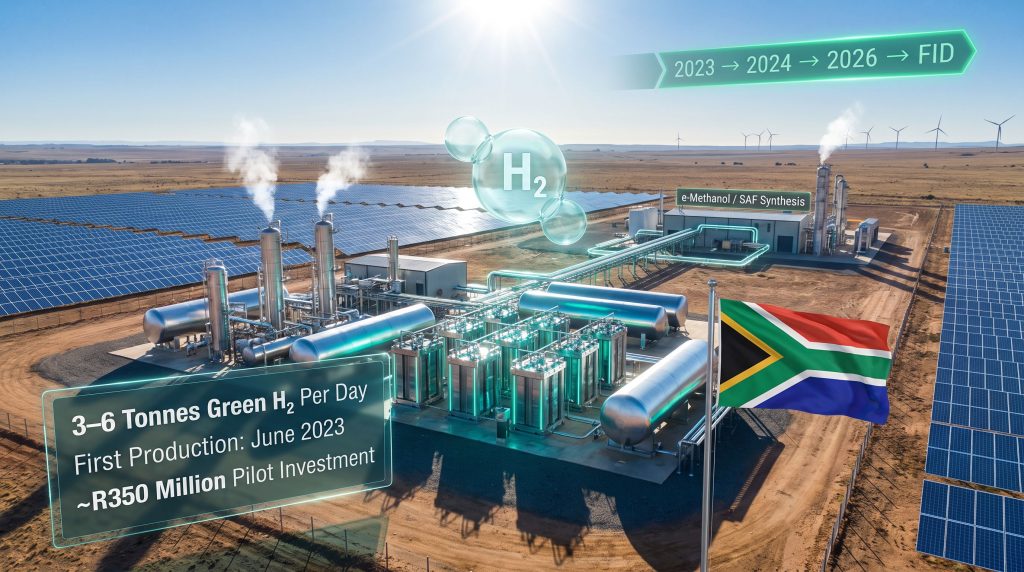
| Initial Production Target | ~3 to 6 tonnes of green hydrogen per day |
| On-Site Renewable Power | ~3 MW solar PV (operational) |
| First Green Hydrogen Produced | June 2023 |
| Pilot Capital Investment | ~R350 million |
| Engineering Study Deadline | October 2026 |
| Key International Partner | Envision (China) |
| Financial Backer | Industrial Development Corporation (IDC) |
| Downstream Products Targeted | E-Methanol, Sustainable Aviation Fuel (SAF) |
How Does Green Hydrogen Production at Sasolburg Actually Work?
Understanding the technical value chain at Sasolburg requires breaking the process into its distinct stages. Each stage carries its own cost profile, infrastructure dependency, and commercial risk. Together, they form a fully integrated pathway from sunlight to synthetic fuel.
The Electrolyser-to-Fuel Value Chain Explained
Step 1: Renewable Electricity Generation
- An on-site 3 MW solar photovoltaic installation currently supplies electricity to pilot electrolysers at the Sasolburg campus
- This capacity is operational but represents only a fraction of what commercial-scale hydrogen production will require
- Future phases will necessitate significantly expanded procurement of both solar and wind energy, either through on-site generation or long-term power purchase agreements
Step 2: Water Electrolysis and Hydrogen Separation
- Electrolysers pass direct electrical current through water, separating hydrogen and oxygen molecules through a process called electrolysis
- The Sasolburg campus hosts both legacy industrial electrolysis equipment and newly installed pilot-scale units
- A locally manufactured 2 kW proton exchange membrane (PEM) electrolyser was inaugurated at the Sasolburg research and technology campus in 2026 as part of the Hydrogen South Africa (HySA) programme, marking the first domestically produced electrolyser of its kind in South Africa
- PEM technology offers advantages in dynamic response to variable renewable electricity supply, making it well-suited to solar-heavy generation profiles
Step 3: Downstream Synthesis
- Purified green hydrogen is combined with captured carbon dioxide through catalytic conversion to produce e-methanol
- E-methanol is gaining rapid traction as a maritime fuel, particularly as the International Maritime Organisation tightens emissions regulations on global shipping
- Longer-term pathways involve Fischer-Tropsch synthesis or methanol-to-jet conversion processes to produce SAF
Key Insight: Sasol's core advantage at Sasolburg is not access to superior technology. It is the elimination of greenfield capital expenditure. Existing ammonia and methanol synthesis units, chemical handling infrastructure, and decades of electrolyser operational expertise compress the project timeline and reduce development risk in ways that competing projects built on empty land simply cannot replicate.
What Are the Commercial Drivers Behind the Sasolburg Green Hydrogen Strategy?
European Regulatory Mandates as the Primary Demand Catalyst
The commercial logic underpinning the Sasolburg green hydrogen hub is anchored less in technology optimism and more in hard regulatory economics. European Union frameworks are progressively mandating higher proportions of renewable and low-carbon fuels across both aviation and maritime sectors. The EU's ReFuelEU Aviation regulation and the FuelEU Maritime initiative collectively create binding demand floors for certified green fuels including e-methanol and SAF.
African producers capable of supplying certified renewable hydrogen derivatives gain direct, legally-mandated access to premium European import markets. This is not speculative demand. It is regulatory-driven procurement with statutory timelines. Furthermore, the pricing premium attached to compliant green fuels over conventional fossil alternatives is already measurable and is expected to widen as compliance deadlines approach.
Sasol's industrial policy specialist Jak Koseff has indicated publicly that the scale of renewable energy investment will determine the company's ability to compete in hydrogen markets, while noting that certain downstream products already attract pricing premiums driven specifically by European regulatory requirements. In addition, EU-backed green hydrogen programmes are reinforcing this demand signal, further strengthening the project's investment case during its pre-commercial phase.
The Role of the Industrial Development Corporation
The IDC's financial involvement in the Sasolburg engineering study phase serves a function beyond simple capital provision. Development finance institutions such as the IDC reduce the effective cost of capital during pre-final investment decision (FID) phases, when commercial lenders typically demand risk premiums that can render early-stage feasibility work uneconomical. By absorbing a portion of that early-stage risk, the IDC strengthens the project's bankability profile for subsequent private co-investors.
This structure, using public development finance to de-risk pre-FID work before transitioning to private capital at project execution, has become a standard template in emerging market energy transition financing. Its presence at Sasolburg signals institutional confidence in the project's technical foundations, though it does not constitute confirmed government backing for commercial-scale development.
Who Are the Key Partners Shaping the Sasolburg Green Hydrogen Hub?
Envision: The Chinese Renewable Energy Partner
Envision is a Chinese renewable energy technology group with significant global capabilities across wind turbine manufacturing, battery energy storage, and electrolyser systems. The partnership between Sasol and Envision was formalised during South African Energy Minister Kgosientsho Ramokgopa's visit to Chifeng, Inner Mongolia, reflecting the diplomatic and industrial dimension of the agreement beyond its purely technical scope.
Envision will lead the front-end engineering study (FEED), which is scheduled for completion by October 2026. The study will determine:
- Optimal electrolyser technology type and capacity configuration for the Sasolburg site conditions
- Renewable energy supply architecture required to sustain commercial-scale hydrogen output
- Technical integration pathways between electrolysis output and existing downstream methanol synthesis units
- Commercial feasibility thresholds and financial metrics required to trigger a positive FID
It is worth noting that Sasol has not yet publicly disclosed the planned electrolyser capacity for the commercial phase of the project. This omission is itself informative. The engineering study outcome will effectively determine that figure, making premature capacity announcements commercially and contractually premature at this stage.
Hydrogen South Africa: The National Programme Framework
HySA provides the overarching national technical and policy framework within which the Sasolburg initiative operates. The programme's acknowledgement that large-scale electrolysers remain capital-intensive is not merely a cautionary note. It is a directional signal that the South African green hydrogen sector is being deliberately developed through sequenced, phased investment rather than high-risk large-scale commitments before technology costs sufficiently decline.
The HySA-affiliated inauguration of the first locally manufactured electrolyser at Sasolburg in 2026 carries additional strategic significance. Domestic electrolyser manufacturing capability, even at small scale initially, creates the foundation for a local clean energy equipment supply chain that could reduce long-term project costs and reduce dependence on imported hardware. For further context on how renewable energy solutions are reshaping industrial operations, the parallels with the mining sector are particularly instructive.
What Infrastructure Gaps Could Delay the Sasolburg Green Hydrogen Hub?
A Structured Assessment of Key Barriers
| Barrier | Current Status | Risk Level |
|---|---|---|
| Electrolyser capital cost | High per-unit cost at commercial scale | High |
| Renewable power supply | Only ~3 MW operational; major expansion needed | High |
| Hydrogen transport infrastructure | No dedicated national pipeline or logistics network | Medium to High |
| Final Investment Decision | Pending engineering study results due October 2026 | Medium |
| Planned electrolyser capacity | Not yet publicly disclosed by Sasol | Medium |
| Grid reliability | Eskom supply constraints remain a systemic risk | High |
Warning: The absence of dedicated hydrogen transportation infrastructure across South Africa represents one of the most consequential systemic barriers to scaling operations beyond the Sasolburg site boundary. Without pipeline connectivity or specialised logistics networks, green hydrogen offtake will remain structurally constrained to on-site industrial consumption in the near to medium term, limiting addressable market size until national infrastructure investment occurs.
A further technical challenge that receives insufficient public attention is the interaction between South Africa's electricity grid instability and electrolyser operational efficiency. PEM and alkaline electrolysers are sensitive to power interruptions. Load-shedding events, which have historically disrupted industrial operations across South Africa, impose operational stress on electrolysis systems and reduce capacity factors below design specifications. Consequently, on-site renewable generation with storage is not simply preferable. For reliable hydrogen output, it may ultimately be a technical prerequisite rather than an optional cost reduction measure.
The next major ASX story will hit our subscribers first
How Does Sasolburg Fit Into Sasol's Broader National Green Hydrogen Strategy?
Mapping Sasol's Two-Site Hydrogen Architecture
Sasol's green hydrogen programme is structured as a deliberate sequencing of risk across two geographically and operationally distinct sites.
Site 1: Sasolburg as the Proof-of-Concept Node
- Most operationally advanced phase of Sasol's hydrogen programme nationally
- Focused on pilot-scale production, technology validation under South African operating conditions, and downstream product pathway development
- First green hydrogen produced in June 2023, providing over two years of operational learning ahead of the October 2026 engineering study completion
- Designed to generate the commercial and technical evidence base required to de-risk larger capital commitments at Secunda
Site 2: Secunda as the Industrial-Scale Ambition
| Parameter | Secunda HySHiFT Consortium |
|---|---|
| Planned Electrolyser Capacity | 200 MW |
| Renewable Energy Supply | 450 MW |
| Annual SAF Production Target | 50,000 metric tons |
The sequencing logic is commercially sound. Committing to a 200 MW electrolyser investment at Secunda before proving the technology stack, cost profile, and regulatory certification pathways at Sasolburg's smaller scale would represent an unjustifiable risk concentration. The Sasolburg pilot effectively functions as a commercial insurance mechanism for the far larger Secunda bet.
What Is the Timeline for the Sasolburg Green Hydrogen Hub?
Development Milestones: Past, Present, and Projected
| Milestone | Date |
|---|---|
| First green hydrogen produced at Sasolburg | June 2023 |
| First renewable hydrogen volume certification targeted | 2024 |
| Envision partnership agreement signed | August 2026 |
| Locally manufactured PEM electrolyser inaugurated at Sasolburg | 2026 |
| Front-end engineering study completion target | October 2026 |
| Final investment decision | Post-October 2026, contingent on study outcomes |
| Commercial-scale production | To be determined following FID |
The October 2026 engineering study deadline is a genuine inflection point. A positive outcome would make Sasolburg one of the first industrial-scale green hydrogen facilities in sub-Saharan Africa to reach a confirmed FID, establishing a replicable financing and development model with continental implications.
Frequently Asked Questions: Sasolburg Green Hydrogen Hub
What is the Sasolburg green hydrogen hub?
The Sasolburg green hydrogen hub is Sasol's initiative to repurpose its existing Free State industrial complex into a facility producing renewable-powered hydrogen, targeting e-methanol and sustainable aviation fuel as primary commercial outputs.
How much has been invested in the pilot phase?
Approximately R350 million has been committed to the Sasolburg pilot, covering renewable energy infrastructure and electrolyser installation at the site.
When was green hydrogen first produced at Sasolburg?
Green hydrogen was first produced at the site in June 2023, using electricity from the operational 3 MW solar photovoltaic installation on the Sasolburg campus. The Sasolburg Green Hydrogen Programme profile on Infrastructure South Africa provides further detail on the project's national strategic classification.
Who is conducting the engineering study?
Chinese renewable energy group Envision has been appointed to conduct the front-end engineering study, with completion targeted for October 2026.
What downstream products will the hub produce?
The primary near-term target is e-methanol for maritime transport applications. Sustainable aviation fuel is identified as a longer-term output pathway, both driven by EU decarbonisation mandates.
What role does the IDC play?
The Industrial Development Corporation provides financial backing for the engineering study phase, functioning as a development finance institution to reduce early-stage capital risk on the path toward a final investment decision.
The Bigger Picture: What the Sasolburg Hub Signals for Africa's Green Industrialisation
South Africa's Competitive Position in the Global Green Hydrogen Race
Structural Advantages:
- Abundant solar irradiance across the Free State and Northern Cape, among the highest capacity factor zones globally for utility-scale photovoltaic generation
- Existing industrial hydrogen infrastructure at Sasolburg eliminates the most capital-intensive elements of greenfield development
- Decades of chemical and fuel manufacturing operational expertise within the Sasol ecosystem, including Fischer-Tropsch process knowledge directly applicable to synthetic fuel production
- Proximity to European import markets relative to competing Pacific exporters, reducing hydrogen carrier shipping costs
Structural Challenges:
- Electricity grid instability imposes operationally significant constraints on electrolyser continuous running hours
- Hydrogen transport and distribution infrastructure is effectively non-existent at national scale, limiting near-term market reach
- High electrolyser capital costs continue to require sustained development finance support to achieve bankable project economics
- Competition from established green hydrogen export development programmes in Australia, Chile, Namibia, and Morocco is intensifying rapidly
Why the Repurposing Model Matters Beyond Sasolburg
The Sasolburg approach carries a lesson extending well beyond South Africa's borders. Across sub-Saharan Africa, ageing industrial facilities in chemicals, fertilisers, and refining represent stranded asset risks as global carbon pricing mechanisms tighten. The broader trajectory of mining electrification and decarbonisation across the continent reflects the same structural logic at work in Sasolburg's repurposing model.
The Sasolburg model demonstrates a capital-efficient pathway: rather than writing off legacy industrial value, strategic repurposing can convert high-carbon liabilities into low-carbon assets aligned with the regulatory direction of major export markets. Furthermore, the mining decarbonisation benefits documented elsewhere in South Africa's industrial economy suggest the financial case for such transitions is strengthening, not weakening, as carbon costs rise.
If the October 2026 engineering study confirms commercial viability and a positive FID follows, the Sasolburg green hydrogen hub will not merely be another pilot project milestone. It will represent the first replicable proof point that Africa's industrial heritage can be structurally redirected toward the hydrogen economy without the prohibitive capital requirements of building entirely new infrastructure from the ground up. The Green Hydrogen Organisation's South Africa country profile offers useful broader context on where Sasolburg sits within the national hydrogen landscape.
Readers seeking broader context on South Africa's green hydrogen economy and African energy transition developments can explore ongoing coverage at Ecofin Agency.
Want to Identify the Next Major Resource Discovery Before the Market Does?
Discovery Alert's proprietary Discovery IQ model scans ASX announcements in real time, instantly converting complex mineral data across more than 30 commodities into clear, actionable insights for both short-term traders and long-term investors. Explore historic discoveries and their returns to understand the opportunity, then begin your 14-day free trial to position yourself ahead of the broader market.