July 9, 2026
The Quiet Revolution Happening Inside the World's Most Power-Hungry Buildings
Battery storage technology has followed a surprisingly linear path for most of the past two decades. Lithium-ion dominated the conversation, attracted the capital, and captured the imagination of engineers and investors alike. But linear paths rarely persist when the underlying demand profile transforms fundamentally. Right now, the ESS Tech sodium-ion battery for data centers represents exactly the kind of disruption the energy storage industry has been building towards — driven not by policy change but by the raw computational appetite of artificial intelligence infrastructure.
The data center sector is no longer a passive consumer of electricity. It has become one of the most demanding and unpredictable loads on modern power grids, with AI training clusters and inference workloads pulling power in dense, irregular bursts that legacy uninterruptible power supply systems were never designed to handle. Understanding why this matters requires looking past the surface-level narrative of rising electricity consumption and examining the deeper structural mismatch between how data centers need power and how conventional battery systems deliver it.
When big ASX news breaks, our subscribers know first
Why AI Workloads Are Exposing the Limits of Conventional Battery Storage
Traditional data center UPS systems were engineered around a predictable assumption: power demand would be relatively stable, with storage serving primarily as a bridge during grid outages. That assumption has collapsed. AI compute workloads operate differently at a fundamental level, cycling through intense processing bursts followed by periods of relative dormancy. This variability creates peak demand events that strain both grid connections and onsite backup systems simultaneously.
Lithium-ion batteries, while technically capable of responding to these demands, carry an uncomfortable set of trade-offs that become harder to accept as data center scale increases. Furthermore, the battery raw materials market continues to introduce procurement complexity that only compounds these challenges:
- Thermal runaway risk introduces genuine fire hazard into facilities housing irreplaceable compute hardware worth hundreds of millions of dollars.
- Liquid cooling requirements add mechanical complexity, preventive maintenance burdens, and additional failure points that erode uptime guarantees.
- Critical mineral dependencies on lithium, cobalt, and nickel expose procurement teams to geopolitical sourcing volatility that has repeatedly disrupted supply chains.
- Duration limitations mean most lithium-ion deployments are optimised for short discharge cycles, leaving a structural gap in the one-to-sixteen-hour storage range that data center resilience planning increasingly demands.
"The fundamental problem is not just total power consumption. It is the shape of that consumption, and whether energy storage systems can match the new rhythms that AI infrastructure imposes on every facility it occupies."
Introducing the ESS Tech Bridge: A Purpose-Built Sodium-Ion Answer
Oregon-based energy storage company ESS Tech has moved directly into this gap with the launch of its Bridge Battery Energy Storage System, the company's first sodium-ion product and a deliberate strategic expansion beyond its established iron flow battery portfolio.
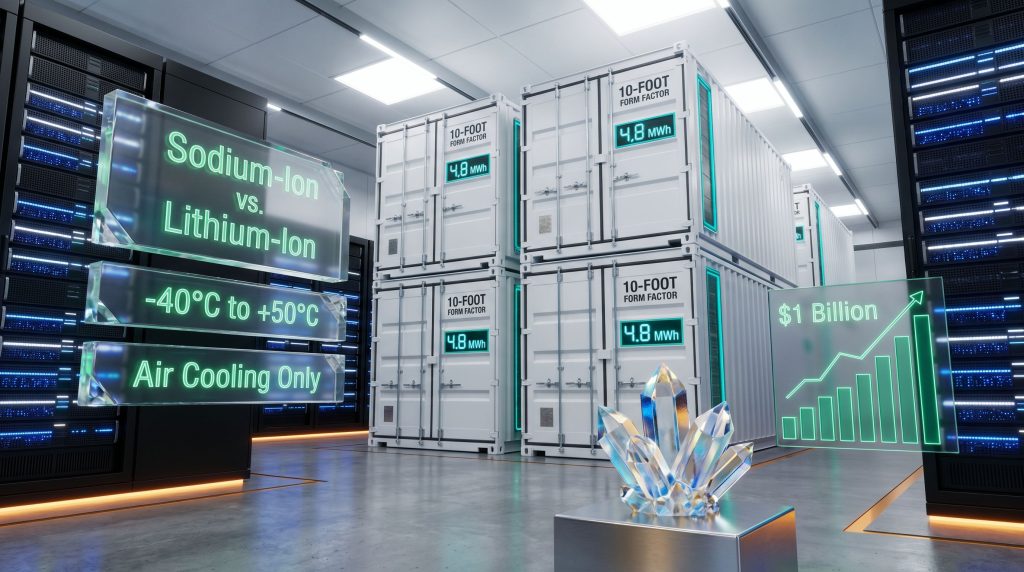
The Bridge system is architecturally distinct from what has come before in this market. Each module is built around a 1.2 MWh sodium-ion building block delivered inside a pre-integrated 10-foot container unit. Four modules combined produce 4.8 MWh of storage capacity within the same physical footprint that a conventional 20-foot battery container would occupy. That volumetric efficiency is not a minor technical footnote; it directly affects land costs, facility layout constraints, and the practical feasibility of retrofitting storage into existing data center campuses.
The plug-and-play design philosophy removes a traditionally painful deployment bottleneck. All hardware components arrive pre-integrated, eliminating the custom assembly processes that have historically extended commissioning timelines and increased the risk of integration errors. Complete energy management software ships with the hardware, enabling operators to configure charge and discharge profiles dynamically from day one.
What Plug-and-Play Really Means for Data Center Operators
For facilities operating under aggressive AI buildout timelines, deployment speed matters as much as technical specifications. The Bridge modular architecture allows operators to:
- Deploy initial capacity quickly without overbuilding for future demand.
- Scale incrementally by adding modules as workloads grow.
- Right-size storage to match actual power draw profiles rather than speculative peak projections.
- Reduce commissioning risk by relying on factory-integrated units rather than field-assembled systems.
How Sodium-Ion Compares to Lithium-Ion for Data Center Applications
The technical case for sodium-ion in critical infrastructure environments rests on several properties that are genuinely differentiated from lithium-ion chemistry — not just incrementally better on familiar metrics. In addition, the broader conversation around critical minerals and energy security makes sodium-ion's reduced dependency on scarce resources a strategically compelling advantage.
| Feature | Sodium-Ion (Bridge) | Conventional Lithium-Ion |
|---|---|---|
| Thermal Runaway Risk | Significantly reduced | Elevated and well-documented |
| Cooling System Required | Air cooling only | Liquid cooling or HVAC typically required |
| Operating Temperature Range | -40°C to +50°C | Narrower thermal tolerance |
| Discharge Duration Flexibility | 1 to 16+ hours | Typically optimised for shorter durations |
| Critical Mineral Dependency | Low (salt, non-rare metals) | High (lithium, cobalt, nickel) |
| Geopolitical Supply Chain Risk | Substantially reduced | Significant historical exposure |
| Volumetric Storage Efficiency | 4.8 MWh per 10-ft container equivalent | Variable, typically lower at comparable scale |
Why Thermal Safety Is the Most Underappreciated Advantage
The elimination of thermal runaway risk is easy to present as a marketing point and equally easy to dismiss as theoretical. In the context of data centers, it is neither. Battery fire events in critical infrastructure facilities carry consequences that extend well beyond physical damage: they destroy compute hardware that cannot be replaced quickly, they trigger regulatory investigations, and they can permanently impair the insurance viability of a facility.
Sodium-ion chemistry is inherently more thermally stable than lithium-ion at the electrochemical level. A notable Chinese battery recycling breakthrough has further advanced this field by developing novel sodium-ion electrolyte formulations incorporating phase-change materials that polymerise under high-temperature exposure. In practical terms, this creates a self-arresting chemical response: when a cell begins approaching dangerous thermal conditions, the electrolyte transitions to a solid-like state that interrupts the chain reaction before it can propagate.
The Bridge system's reliance on air cooling rather than liquid thermal management compounds this safety advantage. Liquid cooling loops introduce pumps, hoses, heat exchangers, and coolant fluid — each of which represents an additional failure mode. Removing that entire subsystem does not just reduce cost; it removes a category of operational risk from facilities where uptime is measured in fractions of a percentage point.
The $1 Billion Demand Signal and What It Reveals About Market Timing
Since ESS Tech announced its sodium-ion cell sourcing partnership with U.S.-based manufacturer Alsym Energy in April 2026, the company has identified commercial interest approaching $1 billion in sodium-ion storage demand. That figure is not a sales forecast or a contracted pipeline; it represents the volume of interest the company has encountered in response to signalling its intention to enter the market.
The scale of that interest matters for what it reveals about the state of buyer psychology among data center operators. These are not early adopters chasing novelty. Data center procurement teams are among the most conservative technology buyers in any industry, prioritising operational continuity above virtually every other consideration. When that cohort begins expressing demand at the billion-dollar scale for an emerging battery chemistry, it indicates that the perceived risks of staying with conventional lithium-ion have risen above the perceived risks of adopting something new.
ESS Tech's CEO Drew Buckley has described the Bridge launch as the company's direct commercial response to this identified demand, noting publicly that AI workloads are fundamentally changing what data centers require from energy storage systems, and that the ESS Tech sodium-ion battery for data centers is better positioned than conventional technologies to serve those requirements. The Bridge product exists because the demand signal arrived before the product did.
The Alsym Partnership as a Supply Chain Strategy
The decision to source Bridge cells exclusively from Alsym Energy carries strategic weight beyond simple supplier selection. Alsym is a U.S.-based manufacturer, which means the Bridge supply chain operates outside the geopolitical exposure that has historically complicated lithium-ion procurement for American infrastructure operators.
Sodium-ion batteries rely primarily on salt and commonly available metals for their core material inputs. This stands in sharp contrast to lithium-ion supply chains, where lithium, cobalt, and nickel procurement involves exposure to concentrated production in politically complex geographies. Consequently, for data center operators serving U.S. federal agencies, defence-adjacent clients, or any customer with supply chain provenance requirements, this domestic sourcing arrangement represents a procurement advantage that is increasingly difficult to replicate with lithium-ion alternatives.
ESS Tech's Dual-Chemistry Portfolio: Covering the Full Duration Spectrum
Prior to the Bridge launch, ESS Tech's entire commercial offering consisted of iron flow batteries — a long-duration energy storage technology that uses liquid electrolytes composed of iron, salt, and water. These systems are engineered for discharge durations of 8 to 22 hours, positioning them primarily for grid-scale renewable integration and long-duration backup applications.
The Bridge system occupies an entirely different segment of the duration curve, targeting the 1 to 16+ hour range that commercial and data center operators require. The result is a complementary two-product architecture rather than a cannibalistic one.
| Product | Chemistry | Target Duration | Primary Market |
|---|---|---|---|
| Iron Flow BESS | Iron flow (liquid electrolyte) | 8 to 22 hours | Grid-scale, long-duration renewable integration |
| Bridge BESS | Sodium-ion (modular) | 1 to 16+ hours | Data centers, critical infrastructure, C&I |
For large infrastructure operators managing multiple facility types, the ability to source both long-duration grid-scale storage and short-to-medium commercial storage from a single vendor simplifies procurement, contract management, and technical integration. That simplification has real economic value in large-scale infrastructure deployment.
The next major ASX story will hit our subscribers first
Operational Specifications That Matter in Practice
The Bridge system's certified operating temperature range of -40°C to +50°C deserves specific attention. This is not a laboratory specification; it reflects real-world deployment flexibility that opens geographies and facility types that narrower-tolerance systems cannot serve.
Edge computing infrastructure increasingly operates in thermally challenging environments — from high-latitude northern facilities seeking natural cooling economies to industrial edge deployments in hot-climate regions. A battery system that maintains certified performance across that full temperature band removes a design constraint that has historically forced operators into expensive climate control infrastructure.
The Bridge is well suited for the following end-user categories:
- Hyperscale and colocation data centers scaling AI inference and training workloads requiring flexible discharge profiles.
- Edge computing nodes in remote or thermally extreme environments where liquid cooling infrastructure is impractical.
- Telecommunications and healthcare operators requiring fire-safe, high-reliability backup power with reduced regulatory exposure.
- Commercial and industrial users pursuing energy cost arbitrage through demand charge management and time-of-use optimisation.
Sodium-Ion's Position in the Global Storage Landscape
ESS Tech is not operating in isolation. The sodium-ion battery sector is entering an accelerated global commercialisation phase, with major Chinese manufacturers including CATL, BYD, and Huawei advancing their own sodium-ion product lines. The critical distinction is market positioning: Chinese sodium-ion development has concentrated predominantly on electric vehicle and grid applications, while the ESS Tech sodium-ion battery for data centers represents the first purpose-built sodium-ion BESS explicitly architected for this segment.
The broader battery metals investment landscape provides compelling context for the scale of opportunity. India's commercial and industrial energy storage market is projected to exceed 31 GWh of deployments by 2032, with advances in battery-grade lithium refining playing a supporting role in shaping how storage technologies compete globally. Research from German renewable energy associations has separately concluded that expanded battery storage deployment could reduce electricity system costs by up to 3.9 billion euros annually, reinforcing the economic logic driving BESS adoption across commercial sectors globally.
"Sodium-ion is not competing to replace lithium-ion across every application. It is carving out a structurally distinct position in applications where lithium-ion's thermal risk profile, cooling requirements, and critical mineral dependencies have become unacceptable constraints rather than manageable trade-offs."
Disclaimer: This article is intended for informational purposes only and does not constitute financial or investment advice. Forward-looking statements, market projections, and demand figures referenced in this article involve inherent uncertainty and should not be relied upon as guarantees of future performance or outcomes. Readers should conduct their own due diligence before making any investment or procurement decisions.
Frequently Asked Questions: Sodium-Ion Batteries for Data Centers
What is the ESS Tech Bridge BESS?
The Bridge is a modular sodium-ion battery energy storage system developed by Oregon-based ESS Tech, designed specifically for data centers, critical infrastructure, and commercial users requiring flexible short-to-medium duration storage between 1 and 16+ hours.
How much storage capacity does the Bridge system deliver?
Each Bridge module provides 1.2 MWh of storage. Four modules combined deliver 4.8 MWh within the footprint of a standard 20-foot battery container, using a more space-efficient 10-foot container form factor per module.
Why is sodium-ion safer than lithium-ion for data centers?
Sodium-ion chemistry exhibits significantly lower thermal runaway risk compared to lithium-ion at the electrochemical level. The Bridge system uses air cooling rather than liquid thermal management, further reducing fire risk and mechanical complexity in sensitive data center environments.
What supply chain advantages does sodium-ion offer?
Sodium-ion batteries rely on abundant, widely available materials — primarily salt and common metals — rather than lithium, cobalt, or nickel. This reduces exposure to critical mineral shortages and geopolitical supply chain disruptions that have historically affected lithium-ion procurement timelines and costs.
How does Bridge complement ESS Tech's existing iron flow battery products?
ESS Tech's iron flow batteries are optimised for long-duration storage spanning 8 to 22 hours in grid-scale applications. Bridge fills the short-to-medium duration gap of 1 to 16+ hours for commercial and data center markets, giving the company a complementary dual-chemistry portfolio without internal product overlap.
What level of demand has ESS Tech identified for sodium-ion storage?
Since announcing its sodium-ion cell partnership with Alsym Energy in April 2026, ESS Tech has identified commercial interest approaching $1 billion in potential sodium-ion storage demand from data center and critical infrastructure operators.
Want to Spot the Next Big Opportunity in the Energy Storage Revolution?
Discovery Alert's proprietary Discovery IQ model scans ASX announcements in real time, delivering instant alerts on significant mineral discoveries tied to the critical materials powering next-generation battery technologies — from sodium-ion to iron flow systems — so investors can act before the broader market catches on. Explore historic discoveries and the substantial returns they generated to understand the scale of opportunity, then start your 14-day free trial and gain a market-leading edge.