July 10, 2026
The Engineering Logic That Makes Physical Prototypes Obsolete
Heavy equipment manufacturing has followed the same fundamental development pattern for over a century: build something, break it, learn from the failure, and rebuild it better. This cycle is deeply embedded in the culture of industries like mining, where machines operate under conditions violent enough to destroy lesser engineering in months. However, the economic and competitive pressures reshaping the global mining sector are forcing a fundamental rethink of whether this approach remains viable at scale.
The compounding cost of physical prototyping is rarely appreciated in full until a design flaw surfaces after fabrication has begun. At that point, engineering change orders cascade through supply chains, tooling investments become partially sunk, and development timelines stretch by weeks or months. For an original equipment manufacturer producing machines that weigh hundreds of tonnes and cost millions of dollars each, a single late-stage design revision can consume R&D budgets at a rate that makes the initial engineering investment look modest by comparison.
This is the core problem that Caterpillar virtual machine design and testing methodology is engineered to solve, and the results suggest it is doing so with measurable precision.
When big ASX news breaks, our subscribers know first
Why Traditional Prototyping Is a Structural Liability in Mining Equipment Development
The Real Cost of Building Before You Know
The conventional prototype-build-test-revise cycle carries costs that extend far beyond raw materials and fabrication hours. Consider the sequencing challenge alone: a hydraulic routing error discovered during physical assembly requires disassembly, redesign, revised component sourcing, and reassembly. Each step consumes calendar time that translates directly into delayed market entry.
For mining OEMs operating in an environment where fleet operators demand faster access to next-generation technology, while simultaneously expecting lower lifecycle maintenance costs, the tolerance for extended development cycles has narrowed significantly. The pressure is not merely commercial. As data-driven mining operations become the norm, the interdependencies that must be validated before deployment have multiplied, making the traditional sequential prototyping model increasingly inadequate.
Physical prototypes also create a logistical problem for cross-functional design review. When specialists in hydraulics, operator ergonomics, serviceability, and electronic systems are distributed across multiple facilities or countries, reviewing a physical prototype requires either shipping the machine or flying the engineers. Neither option scales efficiently across multiple concurrent development programmes.
What Caterpillar's Virtual Design and Testing System Actually Does
Beyond the IT Meaning of the Term
It is worth being precise about terminology here, because the phrase virtual machine carries different meanings across different technical disciplines. In information technology, a virtual machine refers to a software-emulated computing environment running on a physical host. That is not what Caterpillar is building in South Dakota.
In Caterpillar's engineering context, virtual machine design and testing refers to a layered system of physics-accurate, life-size digital prototypes that can be interrogated, stress-tested, redesigned, and validated before a single physical component is manufactured. The system integrates virtual reality immersion, physics-based simulation engines, AI-driven generative design tools, and stress analysis methodologies into a unified development environment.
The Black Hills Engineering Design Centre
Caterpillar's Black Hills Engineering Design Centre, located in Rapid City, South Dakota, serves as the operational hub for this methodology. The facility employs approximately 100 engineering professionals drawn from disciplines including hydraulics, electronics, operator ergonomics, structural mechanics, and serviceability engineering.
What distinguishes Black Hills from a conventional engineering centre is its mandate: to advance machine designs to a state of validated readiness without constructing physical prototypes at the early and mid-stages of development. Cross-functional teams collaborate inside shared virtual environments, reviewing the same digital prototype simultaneously, regardless of where individual team members are physically located.
Core Technologies Powering the Virtual Testing Framework
Full-Scale Virtual Reality Prototyping
The virtual reality component of Caterpillar's system operates at true 1:1 scale, meaning engineers can physically navigate through a digital representation of a machine such as the D6 bulldozer at its actual dimensions. This is not a scaled-down visualisation on a screen. Engineers wearing VR headsets walk through virtual machine structures, inspect hydraulic routing, assess component clearances, and examine internal subsystems without any physical hardware being present.
A particularly powerful capability within this environment is the ability to cut through virtual components, exposing internal systems for inspection in the same way a cross-section engineering drawing would, but in an immersive three-dimensional space that can be explored from any angle.
Key validation activities performed within the VR environment include:
- Operator cab ergonomics: Testing sightline visibility, control placement, and human factors compliance before tooling investment
- Serviceability assessment: Simulating technician maintenance procedures to identify access constraints that would create costly field service problems
- Collaborative design review: Multiple specialists occupying the same virtual space simultaneously, enabling real-time cross-discipline feedback
- Component clearance verification: Confirming that hydraulic lines, wiring harnesses, and structural members do not conflict in assembled configuration
Traditional design reviews require physical prototypes to be transported between engineering facilities, sometimes internationally. Caterpillar's shared virtual environment compresses this multi-week logistical exercise into a single collaborative session, without any hardware leaving a building.
Physics-Based Simulation for Autonomous System Development
Caterpillar has collaborated with Applied Intuition to deploy physics-accurate simulation software specifically designed for autonomous equipment testing. This partnership targets one of the most technically demanding challenges in mining automation transformation: validating autonomous navigation algorithms against the unpredictable, unstructured conditions of active mining environments.
Physical field testing of autonomous systems is inherently constrained in two critical ways. First, the volume of unique scenarios that can be tested on a real site is limited by time, safety protocols, and equipment availability. Second, truly dangerous edge-case scenarios, such as unexpected pedestrian incursion or rapid environmental changes, cannot be deliberately induced in a live mining environment without unacceptable risk.
Physics-based simulation removes both constraints simultaneously.
| Testing Method | Scenario Volume | Safety Risk | Cost Per Cycle | Iteration Speed |
|---|---|---|---|---|
| Physical Field Testing | Low | High | Very High | Weeks |
| Physics-Based Simulation | Exponentially High | None | Low | Hours |
| Hybrid (Simulation + Field Validation) | High | Controlled | Moderate | Days |
Testing use cases within the simulation environment include pedestrian detection and avoidance, material pallet pickup and drop-off sequencing, site navigation across varied terrain gradients, and multi-machine coordination scenarios. Thousands of permutations can be evaluated in parallel runs that would require months of physical field time to replicate at even a fraction of the coverage depth.
Virtual Shake Technology and On-Machine Stress Analysis
Mining equipment endures some of the most mechanically aggressive operating conditions of any industrial machinery. Ground engagement forces, tyre impacts over uneven haul roads, and dynamic loading from payload cycles create complex vibration and fatigue profiles that must be thoroughly understood before a machine enters production.
Virtual Shake Technology replicates these mechanical conditions digitally, applying simulated vibration profiles, load cycles, and dynamic stress inputs to the virtual machine structure. Engineers can observe how different structural configurations respond to representative operational loading without constructing physical test rigs.
Complementing this is Virtual On-Machine Stress Analysis (VOMSA), which maps stress and strain distributions across entire machine structures in a virtual environment. VOMSA enables engineers to identify fatigue concentration points and structural weaknesses, then iterate the design immediately without any physical fabrication cycle intervening.
The governing principle behind both technologies is what Caterpillar refers to as an electrons before iron philosophy: exhaust all possible design iterations digitally before committing to physical manufacture. This approach is not merely about reducing prototype costs. It fundamentally changes the shape of the development risk curve by moving the most expensive discoveries from late-stage physical testing to early-stage virtual iteration where the cost of change approaches zero.
Artificial Intelligence and Generative Design
The AI layer within Caterpillar's virtual development system operates across multiple functions. Furthermore, AI-powered mining efficiency tools allow machine learning algorithms to automatically generate and evaluate structural design configurations against multi-variable performance targets, including weight, load capacity, fatigue life, and manufacturing complexity. This generative design capability allows engineering teams to explore solution spaces that manual iteration could not practically cover.
AI models trained on operational field data from deployed machines are also used to predict how new virtual designs will perform under real mining conditions. This creates a feedback loop between the field and the design centre: every hour of operational data from Caterpillar's deployed fleet informs the virtual models used to design the next generation of machines.
Generative AI tools are additionally being applied to automate design documentation processes, reducing administrative overhead and accelerating the pace at which design decisions can be formally captured and communicated across engineering teams.
Measurable Outcomes: What the Numbers Confirm
The business case for Caterpillar virtual machine design and testing is not theoretical. Caterpillar has reported concrete outcomes across multiple performance dimensions:
| Performance Metric | Reported Outcome |
|---|---|
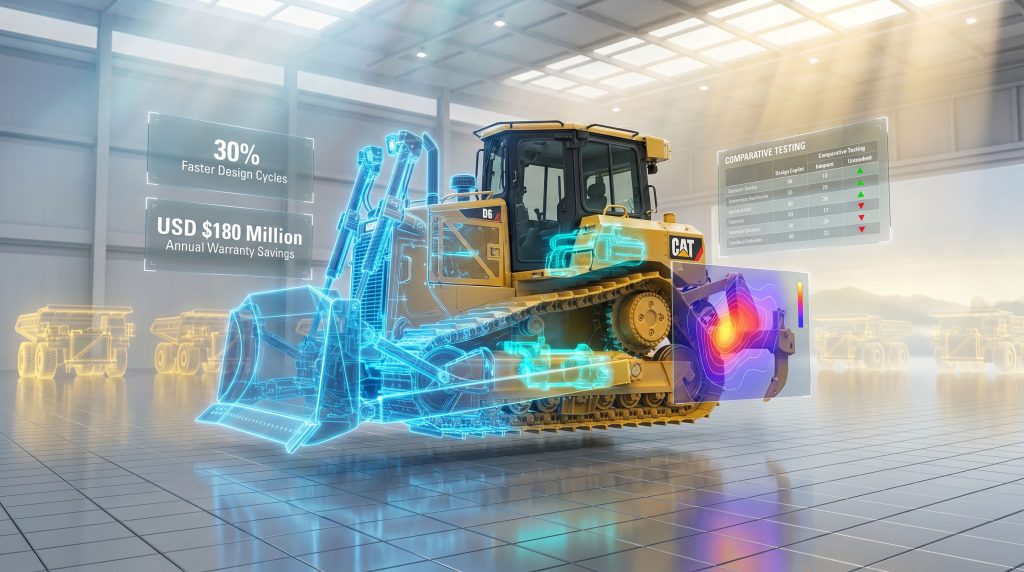
| Design Cycle Acceleration | 30% faster design cycles |
| Annual Warranty Claim Savings | USD $180 million per year |
| Connected Services Customer Retention | 98% retention rate |
| Autonomous Mining Trucks Deployed Globally | 500+ units in active operation |
The USD $180 million annual warranty saving is particularly significant as a validation metric. Warranty claims are the downstream financial consequence of design flaws that survive the development process and enter production. Reducing warranty exposure at that scale indicates that the virtual validation process is successfully identifying and eliminating failure modes that physical testing alone was previously missing or catching too late.
The deployment of more than 500 autonomous mining trucks globally reflects a further downstream outcome. That scale of autonomous fleet deployment requires a level of system reliability that only becomes achievable when autonomous algorithms have been validated against an enormous volume and variety of operating scenarios, precisely the kind of coverage that physics-based simulation uniquely enables.
Comparing Development Methodologies: A Structural View
| Development Phase | Traditional Approach | Caterpillar Virtual-First Approach |
|---|---|---|
| Early Design Validation | Physical clay or steel mock-ups | 1:1 scale VR digital prototypes |
| Stress and Load Testing | Physical test rigs and field trials | VOMSA and Virtual Shake Technology |
| Autonomous System Testing | Limited physical field scenarios | Physics-based simulation with unlimited scenarios |
| Cross-Team Design Review | Prototype shipping between facilities | Shared virtual environment sessions |
| Iteration Speed | Weeks to months per cycle | Hours to days per cycle |
| Cost of Late-Stage Design Changes | Extremely high | Significantly reduced |
The next major ASX story will hit our subscribers first
Implications for Mining Operators and the Broader Equipment Industry
Faster Access to Higher-Reliability Equipment
For mining fleet operators, the virtual-first development model has a direct commercial implication: machines reaching the market have undergone more thorough pre-deployment validation than was previously achievable within equivalent development timelines. The combination of faster cycles and more comprehensive testing does not require a trade-off between speed and quality. Done correctly, the virtual approach delivers both simultaneously.
Lower warranty exposure for the OEM also translates to lower total cost of ownership for the operator. Machines that fail less frequently in the field carry lower unplanned downtime costs, lower maintenance labour requirements, and longer productive asset lives.
Digital Twins Beyond the Design Phase
The virtual models created during development do not become obsolete once a machine enters production. Digital twin technology extends the value of these assets into the operational phase, where real-world sensor telemetry from deployed machines can be mapped back onto the digital model to support predictive maintenance, performance optimisation, and fleet management decisions.
This continuity between design-phase virtual data and operational-phase telemetry is where the long-term competitive differentiation of the digital-first development model becomes most visible. An OEM with high-fidelity digital twins of its deployed fleet can offer operators a fundamentally different quality of asset management support compared with competitors relying on conventional maintenance scheduling models.
The Autonomous Equipment Dependency on Simulation
One dimension of this story that receives insufficient attention in mainstream industry commentary is the structural dependency between autonomous mining fleet expansion and simulation infrastructure. Autonomous systems cannot be safely scaled to new sites, new machine types, or new operating conditions without prior validation against a representative library of edge-case scenarios.
Physical field testing alone cannot generate that library at the required speed or safety margin. This means that the pace at which the mining industry can expand its autonomous fleet is, in part, determined by the quality and scale of the physics-based simulation infrastructure that OEMs maintain. Caterpillar's investment in this infrastructure at Black Hills is consequently not only a product development efficiency play. It is a strategic enabler of the autonomous mining market segment itself.
Mining OEMs that underinvest in virtual validation capability risk finding themselves unable to bring autonomous systems to market with the reliability profile that risk-averse mining operators require. Furthermore, electrified mining fleets add yet another layer of system complexity that virtual validation must account for, regardless of how capable the underlying hardware might be.
Frequently Asked Questions
What does Caterpillar virtual machine design and testing actually involve?
It is an integrated engineering methodology combining life-size virtual reality prototypes, physics-based simulation, stress analysis tools such as VOMSA and Virtual Shake Technology, and AI-driven generative design. The system allows Caterpillar to design, validate, and refine machines through multiple development stages without building physical prototypes.
Where is Caterpillar's virtual design centre located?
The Black Hills Engineering Design Centre in Rapid City, South Dakota, employs approximately 100 engineers and serves as the primary facility for this work.
How does physics-based simulation support autonomous mining equipment?
By replicating the unstructured, dynamic conditions of active mining environments in a virtual space, simulation allows Caterpillar and its partner Applied Intuition to test autonomous navigation algorithms across thousands of scenarios, including edge cases that would be impractical or unsafe to induce during physical field testing.
What is VOMSA?
Virtual On-Machine Stress Analysis is a simulation methodology that maps stress and strain distributions across a complete machine structure in a virtual environment, enabling engineers to identify structural weaknesses and iterate designs before any physical component is manufactured.
What financial outcomes has Caterpillar attributed to this approach?
Caterpillar has reported approximately USD $180 million in annual warranty claim savings and a 30% acceleration in design cycle times as direct outcomes of its virtual design and testing capabilities.
How many autonomous mining trucks has Caterpillar deployed?
More than 500 autonomous mining trucks are currently in active global operation, a deployment scale that reflects the reliability gains made possible through rigorous virtual validation of autonomous systems.
Key Takeaways
- Caterpillar virtual machine design and testing is a multi-layered system, not a single technology, combining VR, physics simulation, stress analysis, and AI into an integrated development platform
- The electrons before iron philosophy drives measurable reductions in development cost, warranty exposure, and time to market
- Physics-based simulation, developed in partnership with Applied Intuition, is a structural prerequisite for safe and scalable autonomous mining fleet deployment
- The Black Hills Engineering Design Centre represents a replicable model for how heavy equipment OEMs can restructure product development around digital validation
- Annual warranty savings of USD $180 million and a 30% design cycle acceleration confirm the commercial validity of the investment at scale
- As simulation fidelity continues to improve, the boundary between virtual validation and physical testing will continue to narrow, with virtual methods increasingly substituting for, rather than merely supplementing, physical prototyping
This article is informational in nature. Financial figures and operational statistics referenced are drawn from publicly reported industry data. Readers should conduct independent verification before making investment or procurement decisions based on any figures cited.
Want to Know Which ASX Mining Companies Are Leading the Next Wave of Innovation?
Discovery Alert's proprietary Discovery IQ model scans ASX announcements in real time, delivering instant alerts on significant mineral discoveries so investors can identify actionable opportunities ahead of the broader market — explore the historic returns major discoveries have generated and begin your 14-day free trial at Discovery Alert today.