
June 22, 2026
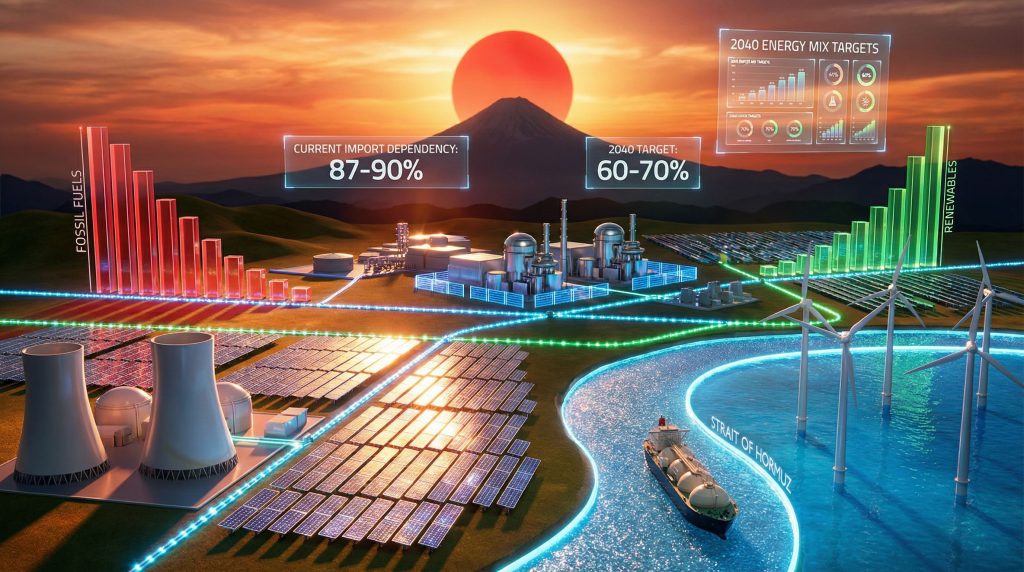
Japan's energy security landscape in 2026 represents a critical inflection point where traditional supply dependencies intersect with geopolitical instability and climate commitments. As one of the world's most energy-import-dependent developed nations, energy security Japan challenges require unprecedented policy coordination that simultaneously addresses immediate supply vulnerabilities and long-term decarbonisation objectives through strategic diversification and domestic capacity enhancement.
What Makes Japan's Energy Security Challenge Unique in 2026?
Japan's position as one of the world's most energy-dependent developed nations creates a unique vulnerability profile that extends far beyond typical import dependency concerns. With approximately 88% of primary energy needs sourced from foreign suppliers, the nation faces compound risks that simultaneously threaten economic stability, climate commitments, and strategic autonomy.
Critical Dependency Metrics:
- Primary Energy Imports: 88% of total consumption requiring foreign sourcing
- LNG Concentration: 37-38% of energy mix dependent on liquefied natural gas
- Coal Reliance: 27-28% share maintaining industrial baseload requirements
- Nuclear Capacity Factor: Currently 30.6% utilisation of available reactors
The comparison with regional neighbours reveals the extent of Japan's exposure:
| Country | Import Dependency | Primary Risk Factors |
|---|---|---|
| Japan | 88% | Middle Eastern chokepoints, LNG price volatility |
| South Korea | 82% | Similar regional risks, nuclear policy constraints |
| Taiwan | 98%+ | Extreme vulnerability, geopolitical isolation |
| Germany | 45%+ | Post-2022 Russian supply restructuring |
Geographic isolation compounds these challenges by eliminating pipeline diversification options available to European nations. Furthermore, Japan cannot access Central Asian gas networks, Russian pipeline systems, or North African energy corridors that provide alternative supply routes for other developed economies.
The nation's energy import structure reveals concentrated supplier dependencies that amplify geopolitical risks. Australia provides 32-34% of LNG imports, Qatar contributes 28-30%, while Malaysia and Brunei account for smaller but significant shares. This concentration means supply disruptions from any major source create immediate market stress.
Technical Supply Chain Vulnerabilities:
- Strait of Hormuz Transit: Approximately 30-35% of imports flow through this critical chokepoint
- Seasonal Demand Spikes: Winter heating drives 40% higher consumption peaks
- Storage Capacity Limits: Strategic reserves cover only 2-3 weeks of total consumption
- Infrastructure Bottlenecks: Port capacity constraints during supply disruptions
Japan's vulnerability differs fundamentally from other energy-importing nations through the intersection of multiple simultaneous constraints. These include limited domestic resources, geographic isolation preventing pipeline alternatives, historical nuclear capacity restrictions, and concentrated supplier relationships that create systematic rather than diversified risks.
When big ASX news breaks, our subscribers know first
Why Are Geopolitical Tensions Reshaping Japan's Energy Mix?
The effective closure of critical Middle Eastern shipping lanes and production facilities has triggered Japan's most significant energy policy reversal since the post-Fukushima nuclear moratorium. In addition, these disruptions have forced policymakers to abandon previously rigid climate-driven restrictions in favour of immediate supply security measures.
Recent regional conflicts have disrupted approximately 30-35% of Japan's traditional LNG supply routes, with particular impact on Qatari facilities that historically provided nearly one-third of imports. The Strait of Hormuz, through which significant portions of Middle Eastern energy exports flow, has experienced periodic closures that demonstrate the fragility of Japan's supply chain dependencies.
Moreover, these oil market volatility pressures have accelerated Japan's strategic pivot toward domestic energy sources. However, the immediate challenge requires balancing climate commitments with energy security imperatives.
Policy Response Framework:
The government's decision to allow less-efficient coal facilities into capacity auctions represents a calculated reversal of previous environmental priorities. This mechanism enables older power plants previously excluded from electricity markets to compete for backup generation contracts, providing financial incentives for continued operation during supply emergencies.
- Coal Plant Reactivation: Lower-efficiency facilities now eligible for capacity payments
- LNG Offset Projections: Estimated 500,000 tonnes annual natural gas demand reduction
- Nuclear Acceleration: Expedited restart procedures for certified reactors
- Regional Coordination: Enhanced emergency sharing protocols with South Korea
Prime Minister Sanae Takaichi has indicated that expanded coal utilisation combined with nuclear capacity restoration could offset approximately 40% of LNG imports previously received through Middle Eastern routes. This calculation reflects not total import replacement but rather substitution for the specific supply channels most vulnerable to regional disruption.
Comparative Regional Responses:
South Korea has implemented parallel measures, considering flexible coal power deployment during LNG delivery disruptions. Similarly, European nations have reactivated fossil fuel capacity following Russian supply cutoffs, establishing a pattern of developed economies temporarily prioritising security over climate goals during energy crises.
The technical implementation involves Japan's capacity auction mechanism, where electricity suppliers bid to maintain backup generation capacity. Historical exclusion of older coal plants reflected climate policy objectives, but current security pressures have reversed these restrictions to ensure adequate reserve margins during supply uncertainty.
How Is the Seventh Strategic Energy Plan Redefining Japan's Future?
Japan's comprehensive energy strategy overhaul establishes ambitious numerical targets that simultaneously address climate commitments and security vulnerabilities through parallel development of multiple energy sources. Furthermore, the plan represents a fundamental shift from post-Fukushima caution toward strategic maximisation of all available domestic options.
2040 Energy Mix Transformation:
The strategic framework establishes specific percentage targets that require substantial capacity expansion and policy coordination across multiple sectors. These energy transition challenges demand unprecedented coordination between government agencies and private sector investment.
- Nuclear Power: Target 20% generation share (current 8.5% operational level)
- Renewable Energy: 40-50% primary contribution becoming dominant source
- Fossil Fuels: Reduced to 30-40% from current approximately 70% dependence
- Energy Efficiency: Demand reduction through industrial and residential improvements
Implementation Mechanisms:
| Energy Source | Current Share | 2040 Target | Required Investment |
|---|---|---|---|
| Nuclear | 8.5% | 20% | Reactor restart acceleration |
| Renewables | 22-24% | 40-50% | ¥38 trillion through 2035 |
| Coal | 27-28% | 15-20% | Efficiency improvements |
| LNG | 37-38% | 15-25% | Import diversification |
The nuclear component requires increasing capacity factors from current 30.6% to approximately 50-60% levels, necessitating both reactor restarts and lifetime extensions beyond traditional 40-year limits. This represents Japan's most significant nuclear policy shift since the 1970s energy crisis.
Grid Modernisation Requirements:
Achieving renewable targets depends critically on electricity transmission infrastructure capable of managing distributed generation and intermittency challenges. The plan specifies grid investment priorities that enable renewable integration while maintaining system reliability.
- Transmission Capacity: Enhanced interconnection between regions
- Storage Integration: Battery systems for renewable intermittency management
- Smart Grid Deployment: Demand response and distributed resource coordination
- Backup Systems: Maintained fossil fuel capacity during renewable scaling
Policy Coordination Framework:
The strategy requires alignment across traditionally competing objectives: climate goals demanding fossil fuel reduction, security needs requiring supply diversification, and economic considerations emphasising cost-effective implementation. Success depends on simultaneous progress across all three dimensions rather than sequential prioritisation.
Independent energy analysts suggest that 80%+ clean power by 2040 is technically achievable through combined nuclear and renewable deployment, though this requires sustained policy commitment and substantial capital investment over the implementation period.
What Role Does Nuclear Power Play in Japan's Security Strategy?
Nuclear energy has undergone strategic rehabilitation from post-Fukushima liability to cornerstone of Japan's energy independence framework. The current policy approach emphasises reactor lifetime maximisation, safety approval acceleration, and capacity factor optimisation to extract maximum generation from existing infrastructure.
Current Nuclear Performance Metrics:
Japan's nuclear fleet currently operates at 30.6% capacity factor, significantly below international benchmarks that typically achieve 70-75% utilisation rates. This performance gap represents immediate generation potential without requiring new construction, making nuclear restart the fastest path to reduced import dependency.
Expected nuclear generation for fiscal year 2026 ranges between 92-107 TWh, representing approximately 25-40% increase from 2023 levels of 70-75 TWh. This expansion depends primarily on reactor restart approvals rather than new facility construction.
Critical Restart Timeline:
- Kashiwazaki-Kariwa Unit 6: Potential 600,000-tonne LNG savings annually when operational
- Onagawa Unit 2: December 2026 target restart date with possible 2028 delays
- Additional Reactors: Multiple facilities undergoing safety certification processes
- Capacity Additions: Combined potential 5,000+ MW additional generation capacity
Regulatory Framework Evolution:
Japan's Nuclear Regulation Authority has streamlined safety approval processes while maintaining comprehensive oversight standards. Reactor lifetime extensions beyond traditional 40-year limits now permit operation up to 60+ years for qualified facilities, maximising existing investment value.
The regulatory approach reflects lessons learned from Fukushima through enhanced safety systems, improved emergency response protocols, and strengthened containment capabilities. These improvements enable confident reactor restart approvals while addressing public safety concerns.
Technical Implementation Strategy:
| Reactor Status | Capacity (MW) | Projected Timeline | LNG Offset Potential |
|---|---|---|---|
| Under Review | 8,000+ | 2026-2028 | 1.2+ million tonnes |
| Approved/Starting | 3,000+ | 2026-2027 | 450,000+ tonnes |
| Long-term Planning | 5,000+ | 2028-2030 | 750,000+ tonnes |
Economic Security Benefits:
Nuclear restart provides immediate fuel cost savings through reduced LNG import requirements. Each 1,000 MW of nuclear capacity operating at 80% capacity factor eliminates approximately 150,000 tonnes of annual LNG imports, providing both cost savings and supply chain resilience.
The economic benefits extend beyond fuel savings to include price stability, reduced foreign currency exposure, and industrial competitiveness through predictable electricity costs. These factors make nuclear revival attractive from both security and economic perspectives.
Public acceptance of uranium market trends has shifted significantly since immediate post-Fukushima opposition. Current polling indicates growing acceptance of nuclear restart as necessary for energy security Japan objectives, though approval remains contingent on demonstrated safety improvements and transparent regulatory oversight.
How Are Renewables Contributing to Energy Independence?
Japan's renewable energy strategy emphasises domestic resource utilisation to reduce import dependencies while simultaneously addressing climate commitments. The approach prioritises technologies and deployment models that maximise energy security benefits alongside environmental performance.
Investment Scale and Targets:
The renewable sector requires approximately ¥38 trillion investment through 2035 to achieve targeted capacity levels. This represents one of Japan's largest infrastructure commitments, comparable to post-war reconstruction and high-speed rail development in economic scale and strategic importance.
Current renewable generation accounts for 22-24% of electricity production, including hydroelectric facilities. Solar power contributes 8-10%, wind provides 3-4%, and traditional hydroelectric supplies 7-9%. Achieving 40-50% renewable share by 2040 requires substantial acceleration across all technologies.
Domestic Manufacturing Strategy:
Japan's focus on manufacturing independence reduces dependence on Chinese solar panel imports while building domestic capacity. These lithium industry innovations support renewable energy deployment through improved storage technologies.
- Solar Panel Production: Rebuilding domestic manufacturing capacity to reduce Chinese import dependencies
- Component Localisation: Critical materials and manufacturing processes within Japan
- Technology Innovation: Advanced photovoltaic and storage system development
- Supply Chain Security: Reduced foreign sourcing vulnerabilities
Offshore Wind Development Framework:
Japan's Exclusive Economic Zone spanning 4.7 million square kilometers provides substantial offshore wind resource potential. However, commercial-scale deployment remains in early stages, with most projects in planning or preliminary phases rather than operational status.
Technical challenges include deep-water installation requirements, typhoon resistance specifications, and grid connection infrastructure for remote offshore facilities. Successful deployment requires specialised engineering solutions adapted to Japan's unique marine environment.
Grid Integration Requirements:
| Technology | Current Capacity | 2040 Target | Grid Requirements |
|---|---|---|---|
| Solar PV | 75+ GW | 150-200 GW | Distribution upgrades |
| Onshore Wind | 8+ GW | 25-35 GW | Transmission expansion |
| Offshore Wind | <1 GW | 30-45 GW | Marine grid connections |
| Hydroelectric | 50+ GW | 55-60 GW | Pumped storage enhancement |
Storage System Integration:
Battery storage deployment becomes critical for managing renewable intermittency while maintaining grid stability. Japan targets large-scale storage systems to support renewable integration without compromising electricity reliability during demand peaks or generation lulls.
The storage strategy includes lithium-ion battery systems, pumped hydro expansion, and emerging hydrogen storage technologies. In addition, battery recycling advancements provide sustainable solutions for long-term renewable energy integration.
Each provides different time scales of energy management, from short-term grid balancing to seasonal storage capabilities.
What Emergency Measures Are Being Implemented in 2026?
Fiscal year 2026 represents Japan's transition from energy planning to comprehensive implementation through coordinated policy measures that address immediate security needs while establishing long-term transformation frameworks. These initiatives span regulatory reform, market mechanisms, and infrastructure development.
Regulatory Implementation Timeline:
The designation of 2026 as Japan's "first year of decarbonisation implementation" reflects coordinated policy deployment across multiple government agencies and regulatory frameworks. Key measures include mandatory targets, market mechanisms, and infrastructure investment programs.
- Emissions Trading System: Coverage of 300-400 major industrial emitters
- Mandatory Solar Installation: Requirements affecting 12,000+ commercial buildings
- Grid Expansion Programs: Enhanced regional interconnection capacity
- Biomass Transition: Elimination of imported biomass fuel subsidies
Market Mechanism Reforms:
| Policy Measure | Implementation Date | Target Sectors | Expected Impact |
|---|---|---|---|
| Emissions Trading | April 2026 | Heavy industry | Carbon price discovery |
| Solar Mandates | April 2026 | Commercial buildings | 5-8 GW additional capacity |
| Grid Investment | FY2026-2030 | Electricity transmission | Renewable integration |
| Coal Plant Flexibility | April 2026 | Power generation | Supply security backup |
Infrastructure Development Acceleration:
The emergency measures prioritise infrastructure projects that provide immediate security benefits while supporting long-term transformation goals. Grid modernisation receives particular emphasis as the foundation for renewable integration and system resilience.
Transmission capacity expansion enables electricity trading between regions during supply disruptions, reducing localised shortage risks. Enhanced interconnection also facilitates renewable energy distribution from generation areas to consumption centers.
Industrial Sector Compliance:
The emissions trading system covers Japan's largest energy consumers, creating financial incentives for efficiency improvements and fuel switching. Covered sectors include steel production, cement manufacturing, chemicals, and electricity generation.
- Steel Industry: Energy efficiency targets and alternative fuel adoption
- Cement Production: Process optimisation and renewable electricity use
- Chemical Manufacturing: Heat recovery systems and grid demand management
- Power Generation: Fuel switching incentives and efficiency improvements
Technology Deployment Support:
Emergency implementation includes financial mechanisms that accelerate renewable energy deployment, energy storage installation, and efficiency improvement projects. These programs target both immediate capacity additions and long-term infrastructure development.
Government-backed financing provides capital access for renewable projects that might otherwise face investment delays during economic uncertainty. Loan guarantees and subsidised interest rates enable continued deployment despite global financial market volatility.
The next major ASX story will hit our subscribers first
How Does Japan's Strategy Compare to Regional Neighbours?
Japan's comprehensive energy security Japan approach reflects broader Asian trends toward supply diversification and domestic capacity enhancement, while maintaining unique characteristics driven by geographic constraints, technological capabilities, and political considerations that distinguish it from regional alternatives.
South Korea's Parallel Framework:
South Korea faces similar energy import dependencies and Middle Eastern supply vulnerabilities, leading to comparable policy responses including coal plant flexibility and nuclear capacity optimisation. Both nations recognise that geographic isolation limits pipeline diversification options available to continental countries.
Key similarities include reactor lifetime extension programs, renewable energy scaling commitments, and emergency cooperation agreements. However, South Korea maintains higher nuclear capacity factors and faces different public acceptance challenges regarding atomic energy deployment.
China's Alternative Model:
China pursues energy security through massive domestic renewable deployment combined with strategic petroleum reserves and diversified fossil fuel sourcing. The scale of Chinese renewable investment far exceeds Japan's capacity, but China also maintains substantial coal generation as baseload power.
| Country | Renewable Target | Nuclear Policy | Coal Strategy | Security Approach |
|---|---|---|---|---|
| Japan | 40-50% by 2040 | Restart + lifetime extension | Emergency backup role | Import diversification |
| South Korea | 35-40% by 2035 | Continued operation | Flexible emergency use | Regional cooperation |
| China | 50%+ by 2030 | Massive expansion | Gradual reduction | Domestic production |
| Australia | 80%+ by 2030 | Export focus | Export commodity | Resource export optimisation |
Australia's Resource Security Model:
Australia approaches energy security from the opposite perspective as a major fossil fuel exporter, balancing domestic renewable deployment with continued coal and LNG export revenues. This creates different policy tensions regarding domestic vs. export market optimisation.
Technology Cooperation Patterns:
Regional energy security Japan strategies increasingly involve bilateral and multilateral technology cooperation agreements that enable shared development costs, reduced individual country risks, and coordinated supply chain management.
- Japan-Australia: LNG supply agreements and hydrogen development partnerships
- Japan-South Korea: Emergency sharing protocols and nuclear technology cooperation
- Regional Storage: Battery technology development and critical materials sourcing
- Grid Interconnection: Submarine cable systems for electricity trading
The Japanese model emphasises energy security as a prerequisite for climate goals, contrasting with approaches that prioritise emissions reduction targets above supply reliability considerations. This reflects lessons learned from recent supply disruptions and their economic impacts.
What Are the Economic Implications of Energy Transformation?
Japan's energy security transformation involves substantial capital requirements offset by reduced import costs, enhanced industrial competitiveness, and technology export opportunities that collectively reshape the nation's economic energy profile over the implementation period.
Investment Requirements Analysis:
The total investment needed for Japan's energy transformation approaches ¥50-60 trillion over the 2026-2040 period, distributed across renewable infrastructure, nuclear facility upgrades, grid modernisation, and storage system deployment. This represents approximately 10-12% of Japan's annual GDP spread over 15 years.
- Renewable Infrastructure: ¥38 trillion for solar, wind, and hydroelectric capacity
- Nuclear Upgrades: ¥8-12 trillion for safety systems and lifetime extensions
- Grid Modernisation: ¥10-15 trillion for transmission and distribution improvements
- Storage Systems: ¥5-8 trillion for battery and pumped hydro capacity
Import Cost Reduction Benefits:
| Energy Source | Current Import Cost | Projected Savings | Timeline |
|---|---|---|---|
| LNG | ¥8-12 trillion annually | ¥3-5 trillion by 2040 | Progressive reduction |
| Coal | ¥3-4 trillion annually | ¥1-2 trillion by 2040 | Maintained for backup |
| Oil | ¥15-20 trillion annually | ¥5-8 trillion by 2040 | Transportation transition |
Industrial Competitiveness Framework:
Stable domestic energy pricing provides Japanese manufacturers with predictable operating costs, enabling long-term investment planning and competitive positioning against nations with volatile energy markets. This particularly benefits energy-intensive industries including steel, aluminium, chemicals, and semiconductors.
Enhanced energy security also supports Japan's position as a technology hub, providing reliable power for data centres, semiconductor fabrication facilities, and advanced manufacturing operations that require uninterrupted electricity supply.
The economic benefits extend beyond immediate cost savings to include strategic independence from global commodity market fluctuations. Moreover, domestic energy generation reduces exposure to currency exchange risks associated with energy imports.
Technology Export Development:
Japan's energy transformation creates opportunities for international technology exports, particularly in nuclear reactor systems, renewable energy components, and grid management technologies. These exports can partially offset domestic transformation costs through revenue generation.
- Advanced Nuclear Systems: Small modular reactors and safety technology
- Offshore Wind Technology: Deep-water installation and typhoon-resistant systems
- Grid Management: Smart grid systems and energy storage integration
- Manufacturing Equipment: Solar panel and battery production technology
Long-term effects strongly favour improved trade balance as domestic generation replaces imports. Furthermore, the development of exportable technologies creates additional revenue streams that support continued domestic investment.
What Does Success Look Like for Japan's Energy Security by 2040?
Japan's energy security transformation success will be measured across multiple dimensions including import dependency reduction, supply chain resilience enhancement, economic competitiveness maintenance, and climate goal achievement through a comprehensive framework that balances quantitative targets with qualitative system improvements.
Primary Success Metrics Framework:
Successful implementation would reduce Japan's energy import dependency from the current 88% to approximately 60-70% by 2040, representing the most significant improvement in energy autonomy since the country's industrialisation period. This reduction comes through domestic nuclear and renewable capacity rather than demand destruction.
- Import Dependency Target: 60-70% total energy imports (down from 88%)
- Electricity Generation Mix: 20% nuclear, 40-50% renewables, 30-40% fossil fuels
- LNG Import Reduction: 40-50% decrease from current consumption levels
- Carbon Emissions: 80%+ reduction from 1990 baseline levels
Supply Chain Resilience Indicators:
| Resilience Metric | Current Status | 2040 Target | Success Indicators |
|---|---|---|---|
| Supplier Concentration | 5 countries = 80% | 10+ countries = 70% | Geographic diversification |
| Strategic Reserve Capacity | 2-3 weeks | 6-8 weeks | Extended supply security |
| Domestic Generation Share | 12% | 30-40% | Reduced import exposure |
| Grid Backup Capacity | 15% margin | 25% margin | Enhanced system reliability |
Economic Competitiveness Outcomes:
Success includes maintaining Japan's industrial competitiveness through stable, predictable energy costs that enable long-term business investment planning. Energy-intensive industries should experience cost stability rather than the price volatility characteristic of import-dependent systems.
Manufacturing sectors including steel, chemicals, semiconductors, and automotive production benefit from reliable domestic electricity supply that reduces operational risks and provides competitive advantages over nations with less stable energy systems.
Technology Leadership Development:
Japan's energy transformation should establish the nation as a technology leader in nuclear reactor systems, offshore wind development, grid management, and energy storage integration. These capabilities support domestic energy goals while creating export opportunities.
Consequently, successful energy security Japan implementation requires sustained political commitment, coordinated policy implementation, and substantial private sector investment over the 15-year transformation period. The integration of immediate security measures with long-term decarbonisation objectives represents a complex challenge that demands unprecedented coordination across government agencies, private companies, and international partners.
Japan's approach to balancing energy security with climate commitments offers lessons for other energy-importing nations facing similar challenges. The success or failure of this comprehensive strategy will influence global energy policy development as nations worldwide grapple with the intersection of energy independence, economic competitiveness, and environmental responsibility in an increasingly uncertain geopolitical landscape.
The Japanese Ministry of Economy, Trade and Industry continues to refine implementation strategies based on emerging challenges and opportunities. Additionally, the International Energy Agency's collaboration with Japan demonstrates global recognition of these energy security challenges and their broader implications for international stability and cooperation.
Want to Capitalise on Japan's Energy Security Transformation?
Japan's massive ¥50-60 trillion energy transformation creates unprecedented opportunities in critical minerals, nuclear technologies, and renewable infrastructure companies. Discovery Alert's proprietary Discovery IQ model delivers instant notifications on significant ASX mineral discoveries, helping investors identify actionable opportunities in the companies supplying Japan's energy security revolution. Start your 14-day free trial today to position yourself ahead of the market as these transformative energy policies unfold.