August 11, 2026
The Chemistry Problem Sitting at the Heart of the Battery Supply Chain
Every lithium-ion battery contains graphite. Specifically, the anode of a standard lithium-ion cell is overwhelmingly composed of graphite, and the purity standard required for that material sits above 99.95% carbon. Achieving that threshold at industrial scale has, for decades, depended almost exclusively on one of the most dangerous reagents in industrial chemistry: hydrofluoric acid. Renascor HF-free graphite processing represents one of the most credible emerging alternatives to this entrenched dependency.
HF is extraordinarily effective at dissolving silicate minerals and non-carbon impurities from graphite concentrates. It is also acutely toxic, capable of penetrating skin tissue and binding to calcium ions in the body, causing systemic toxicity even from small exposures. Industrial handling requires specialist containment infrastructure, rigorous safety protocols, and regulatory compliance frameworks that make deployment outside China commercially and logistically challenging in most Western jurisdictions.
This is not a minor technical footnote. It is one of the central structural reasons why China currently dominates global graphite purification and purified spherical graphite (PSG) production. Replicating Chinese-style HF-based processing in Australia, North America, or Europe faces compounding barriers: strict occupational health and safety regulations, environmental handling costs for highly toxic effluent streams, and community opposition to HF facilities near residential or industrial zones.
The global graphite shortage has further intensified scrutiny of these structural bottlenecks. The CSIRO has identified this dynamic explicitly, concluding that establishing viable graphite purification capacity outside China will require widespread adoption of HF-free processing methods, given the health, safety, and environmental risks associated with conventional HF-based approaches in Western regulatory environments.
When big ASX news breaks, our subscribers know first
Understanding How HF-Free Purification Actually Works
The Caustic Roasting Mechanism Explained
Rather than using acid to dissolve impurities, HF-free purification inverts the chemical logic. The caustic roasting approach applies sodium hydroxide-based reagents at elevated temperatures to chemically transform silicate and aluminosilicate mineral phases within the graphite matrix. These transformed phases are then water-soluble and can be removed through multi-stage leaching without generating the hazardous waste streams associated with HF processing.
The simplified process sequence runs as follows:
- Graphite concentrate feed is introduced into the caustic bake circuit, where reagents react with non-carbon mineral phases at controlled temperatures.
- Water leaching dissolves the transformed silicate phases, removing a substantial proportion of impurities.
- Acid leaching using either hydrochloric or sulfuric acid targets residual mineral phases that were not removed in the water leach stage.
- Washing and filtration produce a high-purity graphite product ready for spheroidisation and surface treatment.
The transition from hydrochloric acid to sulfuric acid in the leaching stage is itself a meaningful engineering refinement. Sulfuric acid leaching offers advantages in reagent recyclability within a closed-loop circuit, reducing both operating costs and the volume of chemical waste requiring external disposal or treatment.
Purity Outcomes and Independent Validation
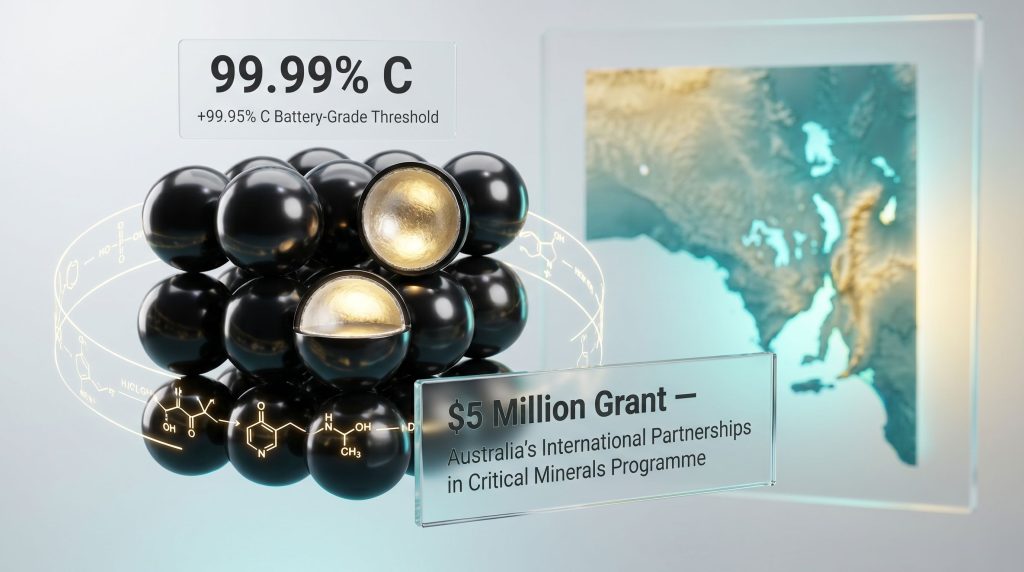
Laboratory and pilot-scale testing of HF-free caustic roasting has demonstrated carbon purity levels of 99.98% to 99.99% C, which meets or exceeds the +99.95% C threshold required for lithium-ion battery anode qualification. Critically, this performance benchmark has been independently verified at 99.99% purity, and the process has received endorsement from leading global anode manufacturers, which is a significant commercial signal for downstream offtake discussions.
Independent validation from anode manufacturers carries substantial weight. These are the customers who ultimately qualify PSG against exacting electrochemical performance specifications, meaning their technical endorsement suggests the HF-free process produces material that performs in real battery cells, not just in laboratory purity assays.
HF-Free vs. Conventional HF Purification: A Direct Comparison
| Attribute | Conventional HF Purification | HF-Free Caustic Roasting |
|---|---|---|
| Primary reagent | Hydrofluoric acid (HF) | Sodium hydroxide-based caustic system |
| Maximum carbon purity | Up to 99.99% C | Up to 99.99% C |
| Environmental risk | High: acutely toxic waste streams | Significantly reduced |
| Regulatory burden | Strict: specialist HF handling required | Lower hazard classification |
| Reagent recyclability | Limited | Designed for closed-loop recycling |
| Feasibility outside China | Constrained by regulatory and safety barriers | Compatible with Western frameworks |
| Downstream acceptance | Established but facing growing scrutiny | Growing: endorsed by major anode producers |
The parity in achievable purity is the critical commercial insight. Western battery manufacturers seeking supply chain diversification no longer face a quality trade-off when evaluating HF-free alternatives. The question has consequently shifted from can it match purity? to can it match cost and scale?
Renascor HF-Free Graphite Processing: The Siviour Foundation
Why the Deposit Characteristics Matter
The Siviour graphite plant and its underlying deposit in South Australia are not a generic graphite occurrence. Siviour is one of the largest known graphite deposits globally by contained graphite resource, and its flake size distribution and total graphitic carbon (TGC) grades are well-suited to producing the spherical graphite morphology required by lithium-ion battery anode manufacturers.
Spheroidisation is the mechanical process by which flake graphite is shaped into rounded particles optimised for lithium-ion intercalation in battery anodes. The efficiency of spheroidisation, and the yield of usable spherical product, is partly a function of the incoming flake characteristics. Deposits with appropriate flake size distributions require less processing energy and generate less fines waste during spheroidisation, improving both economics and material utilisation.
The Integrated Mine-to-PSG Architecture
Renascor's strategic model is built around vertical integration within a single jurisdiction. Rather than selling graphite concentrate to offshore processors, the project design encompasses:
- Mining of the Siviour deposit in South Australia
- Concentration of run-of-mine ore to produce graphite concentrate
- Purification of concentrate using the HF-free flowsheet to achieve battery-grade purity
- Spheroidisation and coating to produce finished PSG ready for anode manufacturing
This end-to-end structure within Australia is strategically distinct from most other projects globally, where graphite mining and purification occur in different countries and often different regulatory environments. Furthermore, co-location eliminates one of the principal risks of fragmented supply chains: the dependency on Chinese intermediate processing even when mine-side production is domestic.
The PSG Demonstration Plant: What It Is and Why It Matters
From Laboratory Chemistry to Operating Conditions
The PSG demonstration plant in Adelaide is not a laboratory-scale or pilot-scale apparatus. It is a large-scale integrated processing facility specifically engineered to continuously produce tonne-scale quantities of battery-grade purified spherical graphite under real operating conditions.
This distinction is commercially meaningful. Battery manufacturers and potential offtake partners require qualification samples at sufficient scale to validate PSG performance across multiple battery formats and cell chemistries. Laboratory-scale material, even at the correct purity, cannot fulfil this qualification function. Tonne-scale production under continuous operating conditions is the minimum threshold for meaningful customer qualification programmes.
The facility was constructed with support from a $5-million grant under Australia's International Partnerships in Critical Minerals Programme, a funding mechanism designed to support downstream processing technology development within Australia.
The Current Processing Campaign: Key Milestones
Renascor has confirmed that graphite feedstock and reagents have been introduced into the integrated purification flowsheet under live operating conditions at the demonstration plant. Specific milestones confirmed as achieved include:
- All major process systems have operated with graphite at target operating parameters
- Processing activities have advanced through the full integrated purification flowsheet sequence
- The caustic bake circuit has been commissioned with reagents, representing a critical validation step in the HF-free process architecture
The current phase is focused on validating integrated flowsheet performance under real operating conditions, with this validation phase expected to extend into the following quarter. The subsequent phase will target generation of optimised operating data and larger-scale qualification samples for prospective customers.
Qualification samples are the commercial gateway between technology demonstration and binding offtake agreements. Their generation at demonstration scale is what converts technical credibility into commercial relationships with battery manufacturers.
The Supply Chain Diversification Imperative Driving Demand for HF-Free PSG
China's Structural Dominance and Its Fragility
China currently accounts for the overwhelming majority of global graphite purification and PSG processing capacity. Estimates from industry and government sources consistently place China's share of global PSG supply above 90%, making it one of the most concentrated battery raw materials supply chains in the battery sector.
This concentration creates compounding vulnerabilities for battery manufacturers and electric vehicle OEMs operating outside China:
- Geopolitical risk: export controls, trade tensions, or policy shifts can disrupt supply with limited lead time
- Price risk: single-jurisdiction dominance reduces competitive pricing pressure in supply negotiations
- ESG risk: Chinese HF-based processing does not align with the environmental supply chain standards increasingly demanded by institutional investors and downstream automotive customers
- Regulatory risk: potential future trade restrictions on Chinese-origin battery materials in key markets including the United States and European Union
However, China's battery supply chain pressures are accelerating the search for credible alternatives, and projects with validated HF-free processing are increasingly well-positioned to fill that gap.
What Battery-Grade Actually Means for Anode Qualification
The +99.95% C purity threshold is the entry-level requirement, but it is not the only qualification criterion. Anode manufacturers evaluate PSG across multiple dimensions:
- Carbon purity: minimum 99.95% C, with leading specifications pushing to 99.99% C
- Particle size distribution (d50): typically in the 14 to 20 micron range for standard lithium-ion anode applications
- Sphericity: high sphericity improves packing density and electrochemical performance in the anode
- Tap density: a measure of how efficiently PSG particles pack together, affecting volumetric energy density
- BET surface area: influences initial capacity loss (first-cycle coulombic efficiency) in the battery cell
Qualification samples from the demonstration plant will need to satisfy all of these parameters, not just purity, for prospective customers to advance toward commercial supply agreements.
The next major ASX story will hit our subscribers first
The Environmental and Commercial Logic of Eliminating HF
Quantifying the Environmental Advantage
The environmental case for Renascor HF-free graphite processing rests on multiple compounding factors:
- HF-based processing generates highly toxic fluoride-containing waste streams requiring specialist neutralisation and disposal, typically via lime treatment to produce calcium fluoride sludge that must be managed as hazardous waste
- Caustic roasting produces waste streams with significantly lower acute toxicity and lower regulatory handling requirements
- Reagent recycling within the closed-loop sulfuric acid leach circuit reduces raw reagent consumption and minimises liquid waste volumes
- Reduced environmental handling costs translate directly into a lower operating cost structure compared to HF-based processing in a Western regulatory environment
In addition, these environmental advantages directly support the critical minerals demand narrative driving policy support for Australian battery materials projects.
The Cost Competitiveness Argument
The conventional assumption is that China's dominance in graphite purification reflects an insurmountable cost advantage. The HF-free approach challenges this assumption on structural grounds. When HF-based processing is evaluated in a Western jurisdiction, the full cost burden includes:
- Specialist HF containment and handling infrastructure
- Trained HF safety officers and emergency response protocols
- Fluoride effluent treatment systems
- Hazardous waste disposal costs
- Ongoing regulatory compliance and reporting
None of these cost categories apply at the same scale to HF-free caustic roasting operations. The result is a processing cost profile that may be more competitive in Western jurisdictions than a simple comparison with Chinese operating costs would suggest. Furthermore, Renascor's ESG credentials and commitment to environmentally responsible processing strengthen its commercial positioning with ethically-minded offtake partners.
Frequently Asked Questions: Renascor HF-Free Graphite Processing
What is HF-free graphite purification?
It is a chemical processing methodology that achieves battery-grade carbon purity above 99.95% C without using hydrofluoric acid, relying instead on caustic roasting followed by multi-stage leaching with recyclable reagents.
What purity levels has the HF-free process achieved?
Independent validation has confirmed purity levels of 99.98% to 99.99% carbon, exceeding the standard lithium-ion battery anode qualification threshold.
Where does Renascor's graphite feedstock originate?
From the wholly-owned Siviour graphite deposit in South Australia, one of the largest graphite deposits globally by contained resource.
What does the demonstration plant produce?
The facility is designed to continuously produce tonne-scale quantities of battery-grade purified spherical graphite under integrated operating conditions.
Who funded the demonstration plant?
Construction was supported by a $5-million grant under Australia's International Partnerships in Critical Minerals Programme.
Why can't Western jurisdictions simply replicate Chinese HF processing?
The CSIRO has identified health, safety, and environmental risks as primary barriers, with regulatory frameworks in Western countries making HF-based industrial processing substantially more complex and costly to establish and operate.
What Demonstration-Scale Success Could Mean for the Broader Market
The Replicability Question
One underappreciated dimension of Renascor's demonstration programme is its potential implications beyond a single project. A validated, commercially competitive HF-free purification flowsheet represents intellectual property and process engineering knowledge that could serve as a reference model for other graphite projects globally seeking non-Chinese processing pathways.
The battery supply chain is not looking for one alternative source of PSG. It is, consequently, looking for a structurally diversified supply base, which means multiple projects in multiple jurisdictions need to develop viable non-HF processing capabilities. A proven flowsheet reduces the technical risk premium attached to every subsequent project that considers adopting similar chemistry.
Monitoring Progress: What Investors and Offtake Partners Should Watch
The timeline from demonstration-scale validation to commercial-scale production involves several observable milestones that both investors and prospective customers will monitor:
- Completion of the integrated flowsheet validation phase (currently extending into the next quarter)
- Generation of optimised operating data confirming cost and energy consumption parameters at scale
- Production of larger-scale qualification samples suitable for customer anode qualification programmes
- Offtake discussions advancing from technical qualification to commercial term negotiations
- Commercial-scale feasibility studies incorporating demonstration plant cost data
Each stage reduces technical and commercial uncertainty, and each reduces the discount that markets and counterparties apply to the project's potential value.
Disclaimer: This article is intended for informational purposes only and does not constitute financial advice. Statements regarding project timelines, purity outcomes, and commercial development pathways involve forward-looking elements subject to risk and uncertainty. Readers should conduct their own due diligence before making any investment decisions.
Want to Stay Ahead of the Next Major Battery Materials Discovery?
Discovery Alert's proprietary Discovery IQ model scans ASX announcements in real time, instantly identifying significant mineral discoveries across graphite, lithium, and more than 30 other commodities — converting complex data into actionable investment opportunities before the broader market reacts. Explore historic discoveries and their returns to understand the potential upside, then begin your 14-day free trial to position yourself at the forefront of Australia's critical minerals story.