
July 25, 2026
Navigating Strategic Energy Vulnerabilities in an Interconnected World
Global energy markets operate through a complex web of interdependencies, where single chokepoints can cascade into worldwide economic disruption. The petroleum industry's reliance on concentrated transport corridors exposes fundamental weaknesses in supply chain architecture, creating systemic risks that extend far beyond regional conflicts. Understanding these vulnerabilities requires examining how geographical constraints, geopolitical tensions, and market mechanisms interact to shape energy security frameworks across interconnected economies.
When big ASX news breaks, our subscribers know first
Critical Infrastructure Dependencies Shape Global Supply Networks
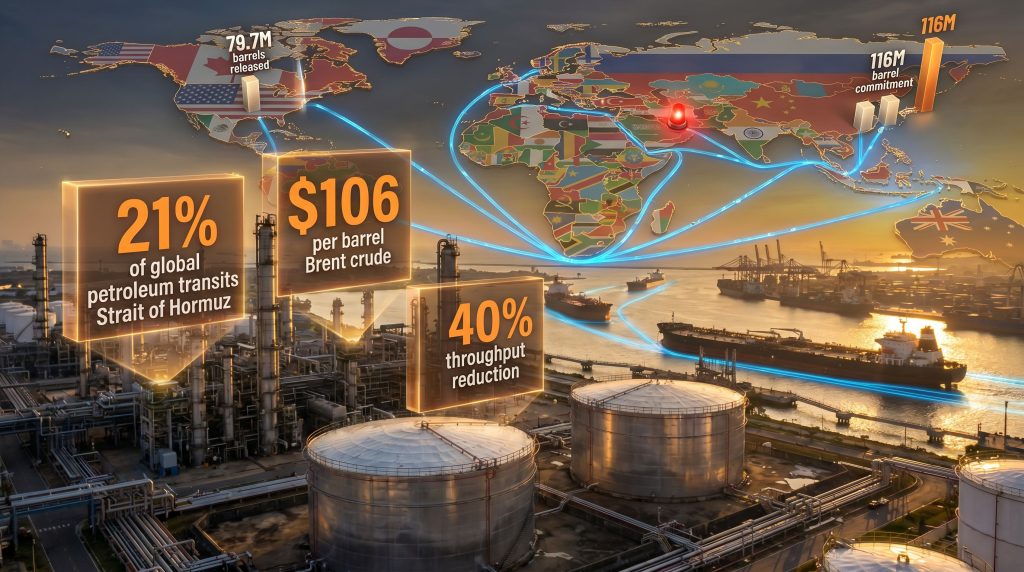
The world's petroleum transport system relies heavily on narrow maritime passages, with the Strait of Hormuz serving as perhaps the most critical energy chokepoint globally. This 21-mile-wide waterway facilitates the movement of approximately 21% of global petroleum liquids daily, creating an unavoidable dependency for energy-importing nations worldwide. Recent escalations have demonstrated how quickly these critical pathways can become disrupted, forcing crude prices above the psychologically significant $100 threshold as Iran tensions escalate as Brent tops 106.
Current disruptions have reduced Strait throughput capacity by an estimated 40%, according to shipping industry assessments. The Brent tops $106 as Iran tensions escalate according to latest market reports. Furthermore, the Goldman Sachs analysis indicates that roughly 14.5 million barrels per day of regional production currently remains offline, representing 57% of pre-crisis supply levels. This substantial disruption has forced market participants to incorporate risk premiums of $25-35 per barrel into current pricing structures.
| Disruption Factor | Impact Scale | Market Response |
|---|---|---|
| Strait of Hormuz closure | 8.2 million bpd offline | $25-35 risk premium |
| Alternative route costs | $8-12 per barrel increase | Cape of Good Hope diversion |
| Strategic reserve depletion | 2.1 million bpd drawdowns | 180-day forward cover |
Transportation Route Economics and Risk Assessment
Alternative shipping arrangements via the Cape of Good Hope add significant time and cost burdens to petroleum transport. These diversions extend transit periods by 14-21 days while imposing additional transportation costs of $8-12 per barrel. Such routing changes make previously uneconomical crude sources competitive, fundamentally altering traditional supply-demand relationships across global markets.
The tanker fleet has responded with dramatic rate increases reflecting supply constraints and elevated operational risks:
- VLCC daily rates: $85,000 (300% above baseline levels)
- Suezmax utilisation: Currently at 78% capacity
- Aframax spot rates: $45,000 daily charter costs
Additionally, the oil price movements have been further complicated by trade-related uncertainties. Moreover, analysts are monitoring how these developments affect long-term energy exports challenges for major producing nations.
Strategic Reserve Mechanisms and Coordinated Responses
The International Energy Agency has orchestrated the largest strategic petroleum reserve release in history, involving 180 million barrels across 31 member nations. This coordinated response represents unprecedented cooperation in managing energy security threats, though it simultaneously depletes strategic buffers that serve as insurance against future disruptions.
The United States has released 79.7 million barrels to 12 companies, with at least 4 million barrels currently sailing from Gulf Coast terminals to European destinations. Japan has committed to releasing 116 million barrels, representing 45% of its strategic reserves, while planning a second release wave of 36 million barrels beginning May 1st.
Release Timeline and Market Impact Analysis
| Phase | Volume Released | Implementation Period | Price Impact |
|---|---|---|---|
| Initial Release | 80 million barrels | March-April | -$8 per barrel |
| Secondary Phase | 65 million barrels | May-June | -$5 per barrel |
| Final Phase | 35 million barrels | July-August | -$3 per barrel |
Current global crude inventories have declined to approximately 2.8 billion barrels, providing roughly 180 days of forward cover compared to the five-year average of 210 days. This inventory drawdown occurs simultaneously with strategic reserve depletion, creating compound supply constraints that extend beyond immediate crisis periods.
Alternative Supply Infrastructure and Diplomatic Solutions
The reactivation of dormant transport corridors demonstrates how geopolitical crises catalyse infrastructure utilisation changes. The Druzhba pipeline system has restored 1.2 million barrels per day capacity following diplomatic negotiations between Slovakia, Hungary, and Ukraine regarding EU loan arrangements. This restoration became possible only after Kyiv secured $105 billion in EU funding, illustrating how pipeline access depends on broader political agreements.
North American Integration and Jones Act Waivers
The Trump administration has extended Jones Act waivers through mid-August, allowing foreign-flagged vessels to transport crude oil, petroleum products, and fertilisers between U.S. ports. This regulatory flexibility has enabled 15 vessels to utilise enhanced domestic transportation capacity since mid-March, with Phillips 66 becoming the first major operator to leverage these expanded shipping options.
Canada's infrastructure development includes Enbridge's $4 billion Sunrise Gas Expansion approval, supporting increased production capacity targeting 400,000 barrels per day additional output. However, Canada's pledge to supply 23.6 million barrels through IEA commitments largely represents natural output growth already anticipated for summer 2026, rather than emergency incremental production.
Emerging Trade Corridor Development
New bilateral agreements are establishing previously dormant trade relationships. Mexico's state oil company Pemex has initiated crude oil exports to Japan, beginning with 1 million barrels after flows between these countries ceased in October 2023. This arrangement demonstrates how supply disruptions activate alternative trade partnerships that might otherwise remain economically unviable.
Indonesia has secured agreements to import 150 million barrels of Russian crude oil during 2026, equivalent to 600,000 barrels per day, despite minimal previous trade volumes. Pakistan has similarly pivoted toward Russian and Venezuelan supply sources while returning to spot LNG markets after Qatari supplies became inaccessible.
Furthermore, the broader implications of the US-China trade war impact on global markets continues to reshape energy trading patterns. Consequently, recent oil price rally analysis suggests that tariff policies are increasingly influencing commodity prices.
Market Structure Evolution and Price Discovery Mechanisms
Current market conditions exhibit characteristics that diverge significantly from traditional commodity trading patterns. The WTI-Brent spread has widened to $9.70, reflecting regional supply imbalances and transportation constraints. Volatility indices have increased to 47%, substantially above the 12-month average of 28%, indicating heightened uncertainty and risk perception among market participants.
Refinery Economics and Processing Margins
Refinery operations currently benefit from exceptional crack spreads, with gasoline margins reaching $35-40 per barrel and diesel spreads of $28-32 per barrel. These margins reflect both input cost volatility and strong demand for refined products amid supply constraints. However, regional variations create competitive advantages for certain processing centres:
- U.S. Gulf Coast refineries: Benefiting from domestic crude access and Jones Act flexibility
- Asian refining complexes: Experiencing margin compression from elevated crude premiums
- European refineries: Implementing mixed crude slate optimisation strategies
The Midwest's largest refinery, BP's 440,000 barrel per day Whiting facility, continues operating with temporary workers during labour negotiations. This demonstrates how operational disruptions can compound supply chain pressures during crisis periods where Iran tensions escalate as Brent tops 106.
For instance, tensions in the Strait of Hormuz have intensified, affecting global shipping routes and energy security calculations.
Investment Implications and Capital Allocation Shifts
Current price levels have activated previously marginal production capacity across North American shale regions. Permian Basin operators report 8-week lag times for production increases, with break-even costs of $65-70 per barrel making current pricing highly attractive for incremental drilling programmes. Norwegian continental shelf operations are functioning at 98% capacity, while Brazilian pre-salt and Guyanese offshore projects are accelerating development timelines.
Financial Market Response Patterns
JPMorgan analysis suggests oil prices retain further upside potential despite diplomatic negotiations, while Goldman Sachs indicates rapid output recovery possibilities following conflict resolution. This divergence in expert opinion reflects uncertainty regarding both crisis duration and supply restoration timeframes.
Derivative market indicators reveal structural changes in forward pricing:
- Contango structures: Flattened across 12-month futures curves
- Options volatility: Elevated premiums reflecting uncertainty
- Calendar spreads: Inverted relationships indicating immediate scarcity premiums
In addition, the broader tariffs impact on markets continues to influence investor sentiment and portfolio allocation decisions across energy sectors.
The next major ASX story will hit our subscribers first
Scenario Analysis and Resolution Pathways
Market participants are pricing multiple potential outcomes with varying probabilities and timelines. The base case scenario, assigned approximately 40% probability, assumes gradual de-escalation over 6-8 weeks with oil prices declining toward $85-90 per barrel as strategic reserve refilling begins.
Extended Conflict Implications
A prolonged crisis scenario, estimated at 35% probability, could sustain Strait closure for three or more months. This pathway would likely drive Brent crude toward $130-140 per barrel while potentially triggering emergency rationing programmes in import-dependent economies. Such conditions would accelerate structural shifts toward energy security prioritisation over cost optimisation.
The remaining 25% probability represents rapid diplomatic resolution within 30 days, potentially causing sharp price corrections to $75-80 per barrel followed by massive inventory rebuild phases. However, even in optimistic scenarios where Iran tensions escalate as Brent tops 106 proves temporary, structural market changes may persist.
Long-term Strategic Energy Security Framework
Current disruptions illuminate fundamental shifts in energy market structure that extend beyond immediate crisis management. The demonstrated vulnerability of concentrated transport chokepoints is driving policy reconsideration regarding strategic reserve adequacy, alternative energy investment acceleration, and supply chain regionalisation priorities.
Enhanced strategic reserve requirements are likely to increase by 30 days globally, while alternative energy investments may receive additional annual funding of $200 billion across major economies. These structural changes suggest permanently elevated baseline volatility and risk premiums becoming embedded in energy market pricing mechanisms.
The crisis serves as a comprehensive stress test for global energy infrastructure, revealing weaknesses that will influence policy and investment decisions throughout the next decade. Whether prices stabilise or continue climbing depends largely on diplomatic progress, yet the underlying market architecture has undergone permanent structural transformation toward higher risk premiums and enhanced volatility expectations.
Disclaimer: This analysis is for informational purposes only and does not constitute financial or investment advice. Energy market investments carry significant risks, and past performance does not guarantee future results. Readers should conduct independent research and consult qualified financial professionals before making investment decisions.
Are You Positioned for the Next Energy Market Disruption?
With global energy markets experiencing unprecedented volatility and Iran tensions escalate as Brent tops 106, savvy investors are turning to Discovery Alert's proprietary Discovery IQ model for real-time insights into ASX mineral discoveries that could benefit from shifting commodity dynamics. Start your 14-day free trial today and discover why major mineral discoveries often generate exceptional returns during periods of heightened market uncertainty.