
July 24, 2026
The Architecture of Risk: Understanding Environmental Permitting for Mining Projects in Brazil
Few regulatory environments in the world present the same combination of constitutional complexity, institutional layering, and ecological sensitivity as Brazil. For mining investors evaluating Latin American opportunities, environmental permitting for mining projects in Brazil is not merely a procedural checklist to be managed. It is a structural risk variable that has the capacity to reshape project timelines, capital allocation decisions, and long-term return profiles in ways that are rarely visible from the surface.
Understanding why environmental permitting for mining projects in Brazil operates the way it does requires looking beyond individual approval stages. The system's complexity is not accidental. It is the direct product of constitutional architecture, competing institutional mandates, decades of environmental policy evolution, and the physical reality of operating in one of the world's most biodiverse territories.
When big ASX news breaks, our subscribers know first
Why Constitutional Design Shapes Every Mining Licence in Brazil
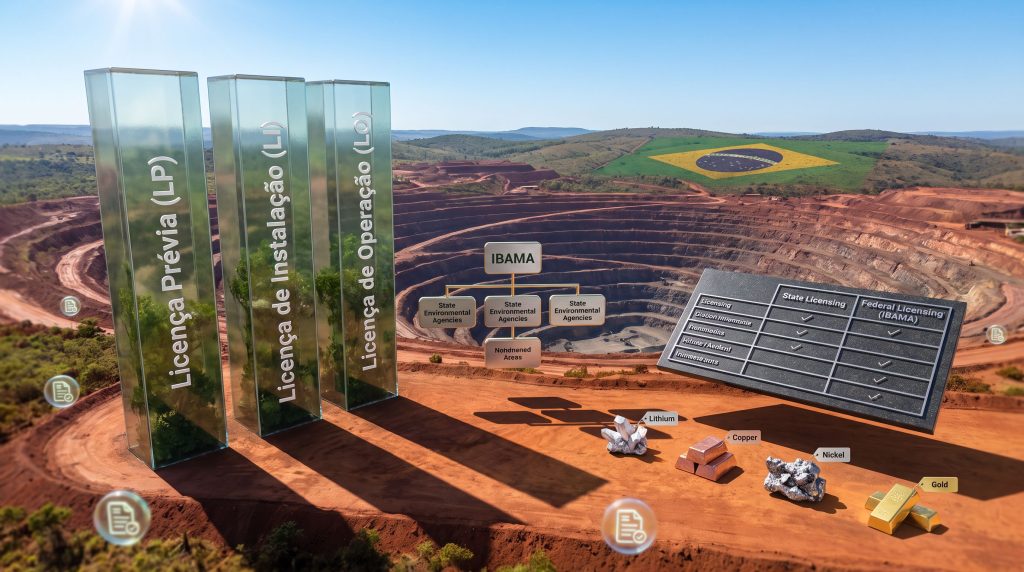
Brazil's 1988 Federal Constitution established a framework of shared environmental competence across three governmental tiers: federal, state, and municipal authorities. The guiding principle that determines which tier holds licensing authority for any given project is known as the predominância do interesse, or predominance of interest. In practical terms, this means that the geographic scale and ecological impact of a proposed operation determine which agency takes the lead.
For the majority of mining operations, state environmental agencies serve as the primary licensing authority. Federal jurisdiction through IBAMA, the Brazilian Institute of Environment and Renewable Natural Resources, is triggered when a project carries national or regional significance, crosses state boundaries, or sits within or adjacent to federally protected areas.
| Licensing Authority | Typical Jurisdiction | Common Project Types |
|---|---|---|
| State Environmental Agency | Most mining operations | Standard mineral extraction within a single state |
| IBAMA (Federal) | Nationally significant or high-impact projects | Large-scale, interstate, or protected-area operations |
| Municipal Authority | Limited, low-impact activities | Small-scale localised operations |
This tripartite structure creates an important early-stage decision for any mining company: correctly identifying which authority holds competence is itself a material risk-management task. Misidentifying the lead agency at the outset can result in misdirected applications, duplicated documentation costs, and timeline penalties that compound throughout the project lifecycle.
IBAMA also holds the power to delegate specific licensing tasks to state agencies in certain circumstances, creating a hybrid coordination model that requires applicants to maintain active relationships with multiple regulatory bodies simultaneously. Understanding mining permitting basics is therefore essential before any application is filed.
The Three-Stage Licensing Sequence Every Mining Company Must Navigate
Brazil's environmental licensing framework for mining operates through a sequential, three-permit structure. Each stage is a prerequisite for the next, and each carries its own documentation burden, compliance conditions, and assessment timelines.
Stage 1: Licença Prévia (LP)
The LP is an environmental feasibility determination. It confirms that a proposed mining project is compatible with applicable zoning classifications, watershed protections, and land-use designations. Critically, the LP does not authorise any physical works. It is a regulatory green light for the concept, not the construction.
At this stage, applicants must demonstrate that the project's location, design intent, and intended extraction activities align with the environmental and spatial planning frameworks applicable to the site. Typical documentation requirements include environmental characterisation studies, preliminary impact assessments, and evidence of engagement with applicable planning instruments.
Stage 2: Licença de Instalação (LI)
The LI authorises the physical construction of mining infrastructure. This encompasses access roads, ore processing facilities, water management systems, and tailings storage structures. Before any ground is disturbed, all conditions attached to the LP must be demonstrably satisfied.
Environmental management plans, ecosystem monitoring commitments, and mitigation measures are formally embedded as binding conditions within the LI. This is the stage at which the project's environmental obligations become legally enforceable operational requirements rather than conceptual commitments.
Stage 3: Licença de Operação (LO)
The LO is the final regulatory clearance required before active mining production can begin. Regulatory authorities verify that all conditions from the LP and LI phases have been fulfilled before issuance. The LO carries ongoing compliance obligations, renewal schedules, and performance monitoring requirements that remain active throughout the mine's productive life.
Operating without a valid LO exposes a mining company to regulatory, financial, and reputational consequences that extend well beyond simple administrative penalties.
Direct Answer: What are the three stages of environmental licensing for mining in Brazil?
Brazil's framework requires three sequential permits: (1) the Licença Prévia confirming environmental feasibility, (2) the Licença de Instalação authorising construction, and (3) the Licença de Operação permitting active mining production. Each stage carries distinct documentation requirements, and completion of each is a legal prerequisite for progressing to the next.
EIA Requirements: When Full Assessment Is Mandatory
Not every mining project requires a full Environmental Impact Assessment. The determining factor is the classification of the project's potential environmental impact. Operations assessed as carrying significant environmental impact trigger mandatory preparation of an Estudo de Impacto Ambiental (EIA) and its publicly accessible companion document, the Relatório de Impacto ao Meio Ambiente (RIMA).
The EIA is a comprehensive technical study examining the full spectrum of potential environmental effects. The RIMA is its simplified public-facing summary, designed specifically to support community consultation processes and public hearings. The two documents function together as the primary tools through which affected communities, civil society organisations, and regulatory bodies evaluate project impacts before any licence is granted.
Commodity types that most commonly trigger mandatory EIA/RIMA requirements include:
- Iron ore
- Copper and copper cathodes
- Nickel
- Gold
- Potash
- Lithium (including lithium carbonate and lithium hydroxide)
- Rare earth elements (REE)
Smaller or lower-risk operations may qualify for a simplified environmental study pathway, but the risk of misclassification is a genuine operational hazard. Projects initially assessed as qualifying for simplified review can be reclassified mid-process if emerging data suggests greater impact potential, triggering a restart of assessment procedures and significant timeline extensions.
Community Engagement as a Regulatory Variable
Public hearing obligations tied to the EIA/RIMA process introduce one of the most unpredictable variables in the entire permitting sequence. Where Indigenous territories, quilombola communities, or protected conservation units are located in proximity to a proposed operation, the scope and duration of consultation obligations expands substantially.
Indigenous consultation frameworks have demonstrated globally that community opposition can trigger extended public consultation periods, generate legal challenges during hearing processes, and suspend licensing timelines indefinitely. For investors assessing Brazilian mining assets, proximity to Indigenous territories and conservation units is not merely an environmental factor. It is a capital risk variable that belongs in project financial models from the earliest stages of feasibility assessment.
Beyond the Core Licence: Ancillary Permits That Investors Often Underestimate
A common and costly misconception among mining investors approaching Brazil for the first time is the assumption that the LP-LI-LO sequence represents the complete permitting burden. In reality, a parallel layer of ancillary authorisations must be obtained alongside the core licence, each carrying its own assessment requirements and approval timelines.
Vegetation Clearing and Forest Code Compliance
The removal of native vegetation requires separate authorisation under Brazil's Forest Code (Lei 12.651/2012). Legal Reserve and Permanent Preservation Area (APP) obligations constrain mine footprint design in ways that are frequently underestimated at pre-feasibility stage. Where vegetation removal is unavoidable, offset and compensation mechanisms must be activated, adding cost and timeline complexity.
Water Use Rights
Mining operations with significant water demand must obtain water use rights through the relevant state or federal water authority. This is a parallel administrative process, not an element of the environmental licence itself. Operations involving tailings dam construction near water bodies trigger additional hydrological review requirements.
The regulatory environment governing tailings storage facilities tightened substantially following the Brumadinho dam failure in January 2019, which killed 270 people and contaminated the Paraopeba River. Post-Brumadinho, scrutiny of tailings storage facility design, dam safety certification, and emergency response planning has intensified across all mining jurisdictions in Brazil, with direct consequences for both permitting timelines and capital expenditure requirements. Research into environmental impacts confirms that this disaster fundamentally reshaped Brazil's approach to mine safety regulation.
ANM's Separate Dam Safety Framework
The National Mining Agency (ANM) operates an independent dam safety and tailings management oversight framework that runs parallel to, but separately from, the environmental licensing system. Mining companies must satisfy both ANM requirements and environmental licensing conditions. These are not interchangeable obligations. Compliance with one does not satisfy the other, and the intersection between these two regulatory frameworks creates a dual-compliance burden that requires active management.
Exploration-Phase Authorisations
A frequently overlooked aspect of Brazil's regulatory framework is that environmental authorisations are required not only at production stage but throughout the exploration phase as well. Drilling programs, trenching operations, and bulk sampling activities each carry their own environmental clearance requirements. Understanding exploration phase risks is particularly important for junior mining companies conducting early-stage resource definition work, where the assumption that exploration is a pre-regulatory activity can lead to significant compliance exposure.
Furthermore, how a company manages its exploration-phase compliance obligations forms part of the evidentiary record that licensing authorities consider when assessing subsequent production licence applications. A poor compliance history during exploration can create headwinds during the LP assessment process.
Strategic Minerals Policy and What It Actually Means for Permitting
Brazil has established policy mechanisms to prioritise licensing processes for operations involving minerals classified as strategically important to the national economy. Lithium, copper, nickel, rare earth elements, and potash are among the commodity categories that can attract this designation.
Investor Caution: Strategic mineral designation in Brazil provides institutional processing prioritisation and inter-agency coordination support. It does not waive, reduce, or simplify the substantive environmental assessment requirements applicable to a project. The LP-LI-LO sequence, EIA/RIMA obligations, and ancillary permit requirements apply in full regardless of strategic classification.
What prioritisation actually delivers in practice is access to dedicated inter-agency coordination channels, potentially reduced administrative processing times, and more structured engagement with IBAMA, state agencies, and the Ministry of Mines and Energy. The distinction between faster processing and lighter-touch assessment is critical and is frequently misunderstood in investor communications about Brazilian mining projects. Broader mining permit reforms in other jurisdictions illustrate how strategic designation rarely equates to reduced scrutiny.
Industry observers have noted that Brazil's streamlined permitting ambitions have been met with scepticism from mining executives who note the gap between legislative intent and on-the-ground processing realities.
The next major ASX story will hit our subscribers first
State vs. Federal Licensing: A Framework Comparison
| Dimension | State Licensing | Federal Licensing (IBAMA) |
|---|---|---|
| Typical processing speed | Variable by state | Generally longer due to broader scope |
| Documentation complexity | Moderate | High, reflecting national significance threshold |
| Public consultation scope | State-level stakeholders | May include national stakeholder engagement |
| Appeal pathways | State administrative courts | Federal administrative and judicial system |
| Delegation possibility | Receives delegated tasks from IBAMA | Can delegate to states in certain circumstances |
Among Brazil's active mining jurisdictions, Minas Gerais, Pará, and Goiás carry the highest volumes of mining licensing activity. Regulatory capacity differs meaningfully between state agencies, and state government priorities and political cycles introduce additional variability into approval timelines that is difficult to model in advance.
The Most Common Causes of Permitting Delays
For investors seeking to understand where Brazilian mining projects most frequently lose time, the systemic bottlenecks cluster around a consistent set of structural and procedural factors:
- Understaffed environmental agencies relative to application volumes, creating backlogs that persist even when individual applications are well-prepared
- Incomplete EIA submissions that trigger formal requests for additional information, each of which resets internal assessment clocks
- Overlapping jurisdictional claims between state and federal authorities that create procedural uncertainty and delay formal acceptance of applications
- Legal challenges during public hearing processes that can suspend licensing timelines for extended periods
- Proximity to protected areas or Indigenous territories that expands consultation scope and attracts organised civil society attention
Legislative reform proposals aimed at streamlining the LP-LI-LO sequence for lower-risk projects have circulated within Brazil's Congress for several years. Industry bodies advocate for efficiency improvements while environmental organisations defend procedural rigour. This political tension means that regulatory reform, where it occurs, tends to be incremental rather than structural.
Step-by-Step Navigation Guide for Mining Permitting in Brazil
Phase 1: Pre-Application Strategic Assessment
- Determine which authority holds licensing competence based on project characteristics, location, and potential impact scope
- Assess whether a full EIA/RIMA or a simplified environmental study applies
- Map all ancillary permit requirements including vegetation clearing, water use rights, tailings management, and exploration-phase authorisations
- Conduct early stakeholder mapping to identify community engagement and Indigenous consultation obligations before any field activity begins
Phase 2: LP Application and Processing
- Prepare and submit the environmental study to the identified licensing authority
- Participate in mandatory public hearings where triggered by project classification
- Respond comprehensively to technical queries from the licensing authority within prescribed timeframes
- Receive the LP with its attached conditions, which form the compliance foundation for subsequent stages
Phase 3: LI Application and Construction Authorisation
- Demonstrate fulfilment of all LP conditions through documented evidence
- Submit detailed environmental management plans, monitoring frameworks, and mitigation measures
- Obtain vegetation clearing authorisations and water use permits concurrently to avoid sequential delays
- Receive the LI and commence construction with all conditions embedded as binding operational requirements
Phase 4: LO Application and Production Commencement
- Complete the construction phase with contemporaneous environmental compliance documentation maintained throughout
- Submit evidence of condition fulfilment from both LP and LI stages to the licensing authority
- Pass the operational readiness environmental audit required before production authorisation
- Receive the LO and commence production under ongoing monitoring and renewal obligations
Key Takeaways for Mining Investors Evaluating Brazilian Assets
Environmental permitting for mining projects in Brazil demands a level of regulatory sophistication that is frequently underestimated during initial asset evaluation. A definitive feasibility study that fails to account for the full permitting burden across all phases can materially misrepresent project economics and timelines.
The following principles should, consequently, inform any investor-level assessment of environmental permitting risk for mining projects in Brazil:
- The three-stage LP-LI-LO framework is non-negotiable for all significant mining operations, regardless of commodity, scale, or strategic classification
- Jurisdictional identification is itself a material risk task that must be completed before any application is filed
- EIA/RIMA requirements apply broadly across major commodity categories including iron ore, copper, nickel, gold, lithium, potash, and rare earth elements
- Ancillary permits for vegetation clearing, water use rights, tailings management, and exploration activities create a compliance burden that extends well beyond the core licence sequence
- ANM dam safety obligations and environmental licensing requirements are parallel frameworks requiring independent satisfaction
- Exploration-phase compliance history influences subsequent production licence assessments in ways that many junior companies underestimate
- Strategic mineral designation accelerates institutional coordination but does not reduce the depth of environmental scrutiny applied to a project
- Community engagement, Indigenous rights consultation, and proximity to protected areas remain the most difficult variables to model in project timeline forecasting
This article is intended for informational purposes only and does not constitute legal, regulatory, or investment advice. Environmental permitting requirements in Brazil are subject to legislative reform, judicial interpretation, and agency policy evolution. Investors and project developers should seek qualified legal and environmental advisory support specific to their project circumstances.
Want to Stay Ahead of Major Mineral Discoveries on the ASX?
While navigating Brazil's complex environmental permitting landscape demands patience and regulatory expertise, identifying transformative mineral discoveries closer to home requires speed and precision — Discovery Alert's proprietary Discovery IQ model scans ASX announcements in real time, delivering instant alerts on significant mineral discoveries across more than 30 commodities, so investors can act before the broader market reacts. Explore historic examples of major discovery returns and begin a 14-day free trial to secure a genuine market-leading advantage.