July 24, 2026
When the Barrel Breaks Three Figures: Understanding the Cascade Effect on Australian Equities
There is a threshold in global oil markets that functions less like a price point and more like a psychological tripwire. When crude oil crosses US$100 per barrel, the reaction across equity markets is rarely proportional to the underlying supply-demand shift. Instead, it triggers a layered chain of repricing events that ripple through inflation expectations, central bank calculus, bond yields, and ultimately the valuations assigned to everything from iron ore giants to software-as-a-service platforms. The ASX 200 falls as oil tops US$100 not simply because energy costs more, but because the entire architecture of forward earnings assumptions gets stress-tested simultaneously.
Understanding why this threshold carries such outsized weight requires looking beyond the commodity itself and into the transmission machinery that connects crude oil price trends to equity market outcomes.
When big ASX news breaks, our subscribers know first
The Three-Stage Transmission Cycle: How Oil Prices Reprice the ASX
The pathway from rising oil prices to falling equity valuations operates through three distinct but interconnected stages.
Stage one is energy cost inflation. When crude rises sharply, input costs across manufacturing, logistics, agriculture, and consumer services follow. This initial pressure compresses corporate margins, particularly for businesses that cannot immediately pass costs through to customers.
Stage two is the inflation expectation feedback loop. Markets begin pricing in a higher CPI trajectory, which forces central banks to reassess their rate settings. Research from the International Monetary Fund has historically suggested that a sustained 10% rise in oil prices adds approximately 0.4 percentage points to headline inflation in advanced economies over the following 12 months, though the effect can be larger during supply-shock events. For Australia, a country that imports a significant proportion of its refined petroleum products, the domestic inflation sensitivity to global crude movements is meaningfully elevated.
Stage three is equity de-rating. Higher anticipated interest rates push bond yields up, which mechanically increases the discount rate applied to future cash flows. This effect is most severe for long-duration growth assets, particularly technology stocks, where a disproportionate share of intrinsic value is theoretically generated years into the future.
The psychological weight of US$100 per barrel is partly anchored in historical precedent. The 2008 oil price spike above US$145, the 2011–2014 sustained high-price environment, and the post-Ukraine 2022 surge each coincided with significant equity market volatility. The US$100 level has become a heuristic boundary in institutional risk models.
What Pushed Oil Back Above US$100: A Supply Shock, Not a Growth Signal
The distinction between a supply-driven oil rally and a demand-driven one carries enormous consequences for how equity markets respond. When oil rises because the global economy is growing strongly and consuming more energy, the inflationary effect is partially offset by stronger corporate earnings and improved revenue outlooks. Supply-shock rallies carry no such cushion.
The most recent breach of the US$100 threshold was unambiguously supply-side in origin. Houthi militant attacks on Saudi Arabian oil tankers operating through the Red Sea shipping corridor, combined with escalatory rhetoric from US political leadership directed at Iran, injected a substantial geopolitical risk premium into crude pricing. The Red Sea is not merely a convenient trade route; it is one of the world's most critical energy transport arteries.
Approximately 10% of globally traded oil transits through this corridor, and disruption events there have historically produced immediate and outsized price responses. Furthermore, ASX under commodity pressure of this kind creates compounding challenges across multiple sectors simultaneously.
The table below illustrates how the origin of an oil price move shapes its market impact:
| Oil Price Driver | Market Impact Character | ASX Sector Beneficiaries | ASX Sectors Under Pressure |
|---|---|---|---|
| Geopolitical supply shock | Inflationary, risk-off | Oil and gas producers | Technology, gold miners, consumer stocks |
| Demand-driven growth rally | Reflationary, risk-on | Broad resources sector | Defensive and utility sectors |
| OPEC+ coordinated cuts | Inflationary, mixed signals | Domestic energy producers | Transport, industrials, airlines |
OPEC+ production discipline has further limited the global market's capacity to absorb sudden supply disruptions. With spare production capacity already constrained relative to historical norms, even modest supply interruptions carry disproportionate pricing power.
The ASX 200 Session: Index Performance and What the Numbers Reveal
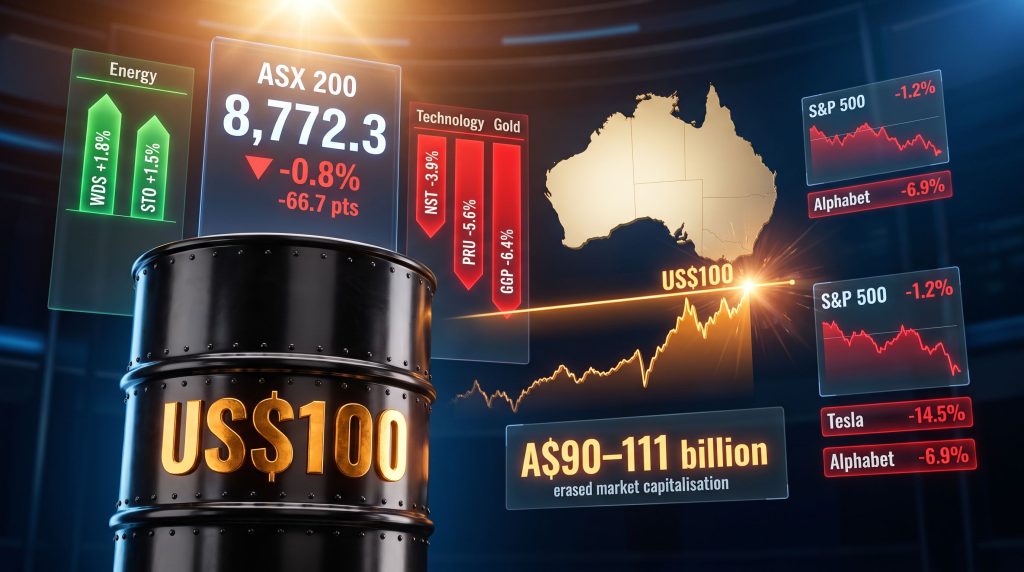
The ASX 200 closed the session at 8,772.3 points, recording a fall of 66.7 points or 0.8%. The weekly result deteriorated to -0.3% as seven of the eleven market sectors registered losses. Without the supportive performance of the energy sector, the index decline would have been materially steeper, illustrating an important structural characteristic of the ASX 200: its commodity-heavy composition provides a partial natural hedge during supply-driven oil shocks.
This partial hedge is worth understanding in greater depth. The ASX 200 carries one of the highest resource sector weightings among developed market indices. When oil prices spike on supply concerns, domestic oil and gas producers benefit directly, which mechanically supports index performance even as other sectors sell off. This dynamic differentiates the ASX 200 from indices like the S&P 500 or the Nasdaq, where technology dominance means oil price spikes deliver almost uniformly negative pressure.
The estimated market capitalisation erosion during this and preceding oil-driven sessions in early 2026 reached somewhere between A$90 billion and A$111 billion, reflecting how quickly energy-driven macro fears can reprice an entire equity market when investor sentiment shifts. As noted by financial market observers, the scale of such selloffs underscores the interconnectedness of global energy and equity markets.
Sector-by-Sector Breakdown: Winners, Losers, and the Mechanics Behind Each
Energy: The Structural Beneficiary of Higher Crude
Domestic oil and gas producers were the clear standout performers. Woodside (ASX: WDS) advanced 1.8% to $32.37 and Santos (ASX: STO) gained 1.5% to $7.97, both responding predictably to improved revenue assumptions at higher realised crude prices. For integrated energy producers with significant LNG exposure like Woodside, higher oil prices also flow through to LNG contract pricing, given that many long-term Asian supply agreements are indexed to crude benchmarks.
Technology: Caught in a Double Compression Event
The technology sector faced a uniquely severe session, not from oil price pressure alone, but from a compounding headwind arriving simultaneously from Wall Street. The S&P 500 fell 1.2% overnight, driven by a 14.5% collapse in Tesla and a 6.9% decline in Alphabet, both tied to growing investor concern that AI infrastructure expenditure is significantly outpacing near-term revenue generation.
The combined effect — domestic inflation fears from oil and Wall Street technology sentiment contagion — created an unusually painful session for ASX-listed technology names.
ASX Technology Sector Losses:
| Company | ASX Code | Session Change | Closing Price |
|---|---|---|---|
| WiseTech Global | WTC | Greater than -4% | N/A |
| Xero | XRO | Greater than -4% | N/A |
| Codan | CDA | Greater than -4% | N/A |
| NextDC | NXT | -3.6% | $13.42 |
| TechnologyOne | TNE | -3.9% | $27.11 |
| Megaport | MP1 | -3.3% | $18.47 |
| Life360 | 360 | -4.4% | $23.07 |
The technology sector's vulnerability during oil price spikes is frequently underappreciated by retail investors. Higher energy costs raise inflation expectations, which push bond yields upward, which in turn compresses the discounted cash flow valuations underpinning high-growth technology stocks. This is a rate-sensitivity mechanism, not a direct operational exposure.
Iron Ore Majors: A Secondary Pressure Channel
The iron ore producers experienced a different pathway to losses. Oil-driven inflation fears can dampen expectations for Chinese industrial activity, and China iron ore demand is particularly sensitive to any scenario in which elevated energy costs slow manufacturing output. This creates a secondary headwind for iron ore pricing and, by extension, Australian miners' revenue assumptions.
- BHP (ASX: BHP) fell 2.9% to $58.85
- Rio Tinto (ASX: RIO) declined 1.7% to $160.00
- Fortescue (ASX: FMG) dropped 1.0% to $18.57
Gold: The Counterintuitive Casualty
Gold's session performance challenged the conventional wisdom that precious metals serve as inflation hedges. The gold price fell by approximately 2.2%, dragging the entire ASX gold sector sharply lower.
The mechanism behind this counterintuitive outcome lies in the distinction between inflation itself and inflation-driven interest rate expectations. Gold is a non-yielding asset. When oil-driven inflation raises expectations of central bank rate hikes, the opportunity cost of holding gold increases relative to yield-bearing alternatives. Understanding gold and bond dynamics is therefore essential context for interpreting gold's behaviour in these environments.
ASX Gold Sector Performance:
| Company | ASX Code | Session Change | Closing Price |
|---|---|---|---|
| Northern Star | NST | -3.9% | $19.93 |
| Evolution Mining | EVN | -2.4% | $11.29 |
| Genesis Minerals | GMD | -4.4% | $5.87 |
| Perseus Mining | PRU | -5.6% | $4.76 |
| Greatland Resources | GGP | -6.4% | $10.00 |
| Capricorn Metals | CMM | -6.1% | $11.90 |
The AI Cost Debate: A Structural Shift in Technology Investor Sentiment
The AI-driven technology selloff carries implications that extend beyond a single session's volatility. A meaningful rotation is underway in how institutional investors evaluate large-cap technology companies. The reward framework that dominated 2023 and much of 2024 — where announcements of aggressive AI infrastructure investment were treated as unambiguously positive catalysts — appears to be undergoing a recalibration.
Investors are increasingly differentiating between companies demonstrating capital discipline in their AI deployment and those committing maximum capital to infrastructure buildout without clear near-term revenue payoff. This represents a maturation of AI investment thesis evaluation rather than a wholesale rejection of artificial intelligence as a growth driver.
For ASX-listed technology investors, this shift matters because of the strong directional correlation between Australian technology stocks and Wall Street technology sentiment. Four of the Magnificent Seven are scheduled to report results in the near term, including Microsoft, Meta, Apple, and Amazon. The market's reaction to AI capital expenditure disclosures within those results will likely establish the directional tone for global technology equities for weeks to come.
Apple's brief overtaking of Nvidia as the world's most valuable company has been interpreted by some analysts as a rotation into perceived AI-spending-efficient names rather than a pure fundamental revaluation, though this interpretation remains speculative and contested.
The next major ASX story will hit our subscribers first
Inflation Data, Rate Decisions, and the Policy Overhang
The timing of this oil price surge adds complexity to an already delicate inflation backdrop. Australia's Consumer Price Index release, due imminently, arrives precisely when energy price pressures are re-accelerating. If CPI data confirms that inflation is broadening beyond housing and services into energy and goods categories, the Reserve Bank of Australia's path toward rate normalisation becomes considerably more uncertain.
Historically, sustained oil prices above US$100 per barrel add between 0.5 and 1.5 percentage points to headline CPI in energy-importing economies over a 6 to 12 month lag period. Whether Australia experiences the lower or upper end of that range depends largely on the duration of the oil price spike and the pass-through velocity into petrol prices and transport costs.
The US Federal Reserve is expected to hold its target rate steady at 3.50 to 3.75% at its upcoming decision. However, any shift in the accompanying commentary toward acknowledging persistent energy-driven inflation risks would have immediate global consequences for risk asset pricing, including the ASX. In addition, two-year yield signals are already reflecting growing unease about the durability of the current rate pause.
| Rate Expectation Scenario | Most Exposed ASX Sectors | Least Exposed ASX Sectors |
|---|---|---|
| Rate hikes re-priced upward | Technology, REITs, growth equities | Energy producers, financials |
| Rates held steady | Broadly neutral across index | N/A |
| Rate cut pathway preserved | Consumer discretionary, technology | Energy, materials |
Bright Spots Amid the Selloff: Stock-Specific Catalysts Still Matter
Two isolated positive developments during the session serve as useful reminders that macro headwinds do not uniformly suppress stock-level outcomes.
Cochlear (ASX: COH) rose 0.5% to $111.61 after a US government investigation concluded in the company's favour, enabling duty-free importation of its bionic ear device into the United States. This outcome demonstrates that regulatory clearance events, when favourable, can generate meaningful positive returns even during broad market selloffs. Company-specific catalysts retain their power to cut through macro noise.
Insurance technology company Monvia (ASX: MNV) debuted on the ASX at $1.12, a 1.8% premium to its float price of $1.10. A successful IPO debut during a session characterised by negative sentiment carries a modest but meaningful signal about underlying investor appetite for new listings. IPO market resilience during volatile sessions is often cited by market observers as an indicator of latent investor confidence that broader index performance may not fully capture.
The Week Ahead: Key Catalysts and Reporting Events
Investors navigating the current environment should monitor several converging catalysts:
- Rio Tinto's quarterly results will provide a high-quality read-through on iron ore demand conditions, Chinese industrial activity signals, and capital allocation priorities under current commodity pricing.
- Australian CPI data will be the single most consequential domestic economic release, given its direct bearing on RBA rate trajectory expectations.
- US Federal Reserve rate decision will be parsed for any shift in tone regarding inflation persistence.
- Magnificent Seven earnings from Microsoft, Meta, Apple, and Amazon will set directional tone for global technology equities.
- Quarterly production updates from a broad sweep of Australian miners and energy companies, including Woodside Energy, Northern Star, Fortescue, Whitehaven Coal, Liontown, Mineral Resources, and Boss Energy, among others, will provide ground-level operational context.
Strategic Framework: Positioning During Oil Price Shock Environments
For investors seeking to navigate periods when the ASX 200 falls as oil tops US$100, several strategic frameworks merit consideration. Industry analysis of prior episodes provides useful historical grounding for understanding how these environments typically unfold.
-
Recognise the sector rotation pattern as historically consistent but not guaranteed. Energy producers tend to outperform; technology and gold miners tend to underperform. The magnitude varies significantly based on the duration and geopolitical origin of the oil spike.
-
Monitor the inflation-rate expectations channel as the primary transmission mechanism. The equity market impact of oil prices flows more powerfully through rate expectations than through direct operational cost exposure for most ASX-listed companies.
-
Distinguish supply shocks from demand rallies before adjusting portfolio positioning. Supply-driven oil spikes are structurally more damaging to equities than demand-driven ones, requiring a more defensive posture.
-
Do not conflate gold's short-term rate-driven weakness with a structural change in its long-term inflation hedge properties. Gold's underperformance during early-stage inflation surprises, when rate hike expectations surge, has been a recurring pattern across multiple historical cycles.
-
Maintain attention to company-specific catalysts as demonstrated by Cochlear's positive session. Macro conditions set the tide, but individual company developments retain their capacity to generate alpha regardless of index direction.
This article is intended for informational purposes only and does not constitute financial product advice. Past market behaviour is not a reliable indicator of future performance. Readers should consider their own financial circumstances and consult a licensed financial adviser before making any investment decisions. All prices and index levels referenced reflect the specific trading session discussed and may not reflect current market conditions.
Want to Stay Ahead of the Next Major ASX Mineral Discovery?
While macro forces like oil prices and rate expectations dominate headlines, Discovery Alert's proprietary Discovery IQ model cuts through the noise by delivering real-time alerts on significant ASX mineral discoveries the moment they are announced — explore historic discovery returns to understand the potential upside, then begin your 14-day free trial at Discovery Alert to position yourself ahead of the broader market.