
June 8, 2026
The Infrastructure Layer That Modern Mining Cannot Ignore
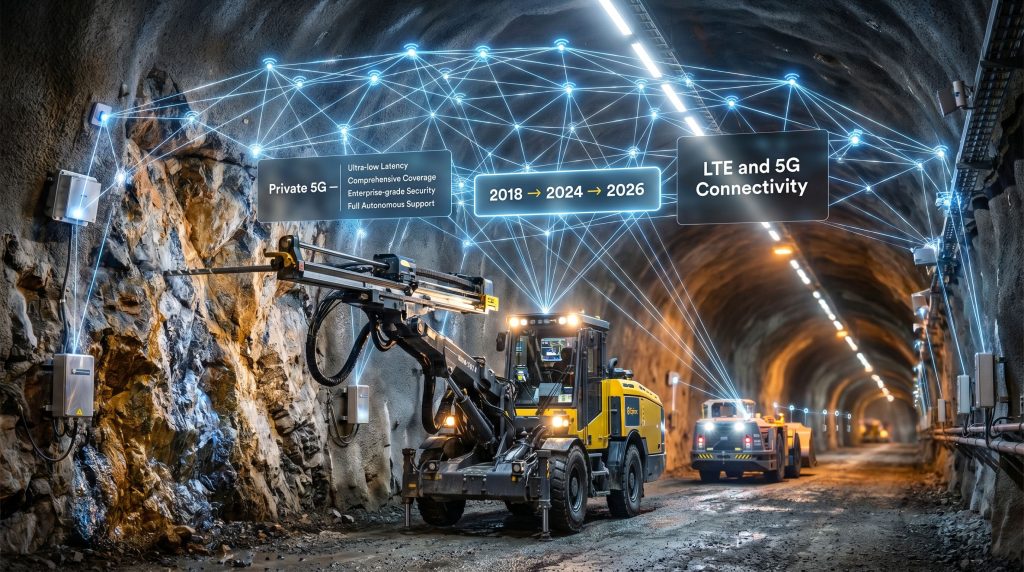
Across the global resources sector, a quiet but consequential shift is underway. The Epiroc and Ericsson mining LTE and 5G partnership sits at the centre of this transformation, as machines digging deeper, hauling further, and drilling with greater precision are no longer limited primarily by metallurgy or engineering. Increasingly, their effectiveness is bounded by something far less visible: the quality of the wireless network beneath and around them.
This reality is reshaping how mining companies think about technology investment. Connectivity is no longer a peripheral utility. It has become the foundational layer upon which automation, safety systems, remote operations, and real-time analytics all depend. Furthermore, as that understanding matures across the industry, the demand for purpose-built private cellular networks is accelerating at a pace that legacy radio infrastructure was never designed to meet.
When big ASX news breaks, our subscribers know first
Why Private Cellular Networks Are Becoming the Backbone of Modern Mining Operations
The Connectivity Gap in Traditional Mine Environments
For decades, underground and surface mines operated on wireless communication systems that were adequate for voice transmission but fundamentally unsuitable for the data-intensive demands of modern mining. Legacy radio systems and conventional Wi-Fi networks share a critical structural limitation: they were designed for relatively stable, controlled environments, not for the electromagnetic interference, irregular geometries, and extreme physical conditions characteristic of active mining operations.
In underground settings, conventional Wi-Fi systems experience significant signal degradation within tunnel configurations, with coverage dropping sharply beyond short distances from access points. This limitation is not merely inconvenient. It creates hard boundaries on where autonomous equipment can operate reliably, where telemetry data can be transmitted continuously, and where safety systems can function without interruption.
The operational cost of unreliable communications extends well beyond frustrated operators. Communication failures contribute to unplanned downtime, delayed emergency responses, degraded safety system performance, and the inability to fully utilise autonomous equipment investments. When a remote-controlled drill rig loses signal mid-operation, or when a collision avoidance system experiences latency spikes at a critical moment, the consequences can range from lost production time to serious safety incidents.
Industry Reality: Mining sites present among the most technically demanding environments for wireless signal propagation on earth. Irregular tunnel geometries, high-powered electromagnetic interference from heavy equipment, extreme temperature ranges, and dust and moisture exposure collectively defeat the performance assumptions built into commercial wireless infrastructure.
What Separates Private LTE and 5G from Legacy Mining Networks
The distinction between legacy wireless systems and private cellular networks is not simply a matter of speed. It involves fundamentally different architecture, security models, and operational capabilities.
| Network Type | Latency | Coverage Depth | Security | Automation Support |
|---|---|---|---|---|
| Legacy Radio/Wi-Fi | High (200-500ms) | Limited | Low | Minimal |
| Private LTE (4G) | Medium (30-50ms) | Strong | High | Moderate |
| Private 5G | Ultra-low (<10ms) | Comprehensive | Enterprise-grade | Full autonomous support |
Private LTE networks operate within licensed or shared spectrum bands specifically configured for industrial use, providing meaningfully better penetration characteristics through rock and concrete compared to standard Wi-Fi frequencies. Private 5G extends these advantages further, delivering sub-10 millisecond latency that approaches the real-time responsiveness required for autonomous equipment coordination and safety-critical data transmission.
Security architecture represents another decisive differentiator. Public networks and unsecured Wi-Fi systems expose mine operators to cybersecurity vulnerabilities that are increasingly unacceptable given the safety-critical nature of mining systems. Private cellular networks support network slicing, which creates isolated virtual networks for distinct operational functions such as safety communications, equipment control, and general data traffic, preventing potential interference between systems with radically different criticality levels.
For mines advancing toward higher levels of automation, the latency difference between legacy systems and private 5G is not academic. At 200-500 milliseconds of latency, real-time machine control becomes unreliable. At sub-10 milliseconds, the communication loop between an autonomous drill and its control system becomes functionally instantaneous, enabling the kind of precise coordination that safe autonomous operation demands. Consequently, mining automation trends are increasingly pointing toward private cellular as the default infrastructure choice.
What Is the Epiroc and Ericsson Mining LTE and 5G Partnership?
A Strategic Alliance Built Over Nearly a Decade
The Epiroc and Ericsson mining LTE and 5G partnership did not emerge suddenly. Its roots trace to 2018, when both companies signed a cooperation agreement specifically aimed at exploring how cellular wireless technologies could be applied to improve mining operations. At that stage, the collaboration was exploratory, focused on understanding the technical and operational requirements of mining environments rather than commercialising specific products.
That foundational research phase produced insights that shaped the subsequent development trajectory. Mining environments demand network solutions that go well beyond adapting commercial infrastructure. They require specialised antenna configurations, ruggedised hardware capable of operating in extreme conditions, network management protocols suited to remote and hazardous locations, and integration pathways that connect communications infrastructure to existing automation and safety systems.
The 2024 Mexico regional agreement marked the transition from research to commercial deployment. This regional arrangement focused on three interconnected priorities: worker safety improvements, enhanced data collection capabilities, and mine digitisation initiatives. The Mexico deployment functioned as a structured proof of concept, validating both the technical performance of the integrated solution and the operational model through which Epiroc could effectively deliver connectivity infrastructure alongside its existing digital portfolio.
The June 2026 global commercial agreement represents the scaling step, transitioning from regional pilot deployments to worldwide distribution through Epiroc's customer centre network.
What the Global Agreement Actually Delivers
Under the terms of the global agreement, Epiroc will offer Ericsson's private cellular technology through its customer centres worldwide. This structure positions Epiroc as the integration and distribution layer, combining Ericsson's enterprise-grade connectivity infrastructure with Epiroc's established expertise in mining applications, customer relationships, and digital solutions portfolio.
Ericsson contributes technology designed for business-critical, low-latency industrial environments, including private LTE and 5G network infrastructure validated for operational performance in demanding settings. The solution is intentionally technology-agnostic, designed to complement existing digital investments rather than replace them. This design philosophy reflects a recognition that most advanced mining operations have already made significant investments in automation platforms, data systems, and monitoring tools.
Paul Bergström, President of Epiroc's Digital Solutions division, has described the partnership as a direct response to the growing importance of connectivity as mining companies advance automation and digitalisation throughout their operations, with the combined offering specifically designed to help customers build the robust communications infrastructure needed to enable safer, more efficient, and more productive mining operations.
Pankaj Malhotra, Head of Product and Engineering for Ericsson Enterprise Wireless Solutions, frames the collaboration in operational impact terms, describing it as providing the connectivity foundation behind Epiroc's digital and automation solutions, helping mining companies modernise operations at scale and building the connected ecosystems that modern industrial enterprises depend on.
Key Insight: This partnership functions as more than a reseller arrangement. It integrates foundational communications infrastructure directly into Epiroc's broader automation and digital solutions portfolio, creating a unified deployment pathway that reduces integration complexity for mining operators.
How Does Private 5G Enable Autonomous and Digital Mining at Scale?
The Role of Connectivity as a Foundational Layer
A critical insight that shapes how advanced mining companies now approach technology investment is that connectivity is not simply one capability among many. It is the enabling layer beneath all other digital capabilities. Data-driven mining operations, autonomous drills, collision avoidance systems, remote operation centres, real-time telemetry networks, and environmental monitoring platforms all share a common dependency: they require reliable, low-latency wireless communication to function at their designed capacity.
When that communication layer is unreliable, every system built on top of it underperforms. Autonomous equipment operates with greater caution or requires human intervention. Safety systems introduce latency into their response cycles. Data analytics platforms receive incomplete or delayed information. The aggregate effect is that significant capital investments in digital and automation technology fail to deliver their anticipated return, not because the technologies themselves are flawed, but because their foundational communications requirement has not been met.
Private cellular networks address this dependency directly. By providing consistent, low-latency, secure communications across the entire mine footprint, they unlock the full operational value of technologies that have already been deployed, while simultaneously enabling more advanced capabilities that would not otherwise be viable.
Core Mining Use Cases Unlocked by LTE and 5G Infrastructure
Autonomous Drilling and Remote Machine Operation
Automation in drilling represents one of the most technically demanding applications for mine connectivity infrastructure. Real-time command-and-control for autonomous drill rigs requires continuous, high-bandwidth communication with latency low enough to enable responsive machine behaviour. Private 5G's sub-10 millisecond latency performance makes this level of real-time control viable across the full operational footprint of a mine, including areas where previous wireless infrastructure could not reach reliably.
Beyond performance, remote operation capability transforms safety profiles at mine sites. By enabling operators to control equipment from surface or remote operation centres rather than directly adjacent to drilling zones, private cellular networks allow mines to remove personnel from the highest-risk areas of underground operations without reducing operational capacity.
Real-Time Telemetry and Predictive Maintenance
Connected fleets transmitting continuous machine health data generate the information streams that predictive maintenance programmes require. Private LTE networks provide the reliable, secure pathway for this continuous telemetry, enabling maintenance systems to monitor equipment condition across entire fleets in real time. The operational benefit is a shift from reactive maintenance scheduling, which responds to failures after they occur, to predictive scheduling that intervenes before failures happen.
Worker Safety and Situational Awareness
Collision avoidance systems depend fundamentally on the real-time transmission of positional data for both equipment and personnel. Any latency or communication gap in that data stream creates a safety risk window during which the system cannot guarantee accurate situational awareness. Private cellular networks eliminate the coverage gaps and latency inconsistencies that compromise these systems in legacy infrastructure environments.
Personnel tracking in underground environments carries particular importance, both for routine operational coordination and for emergency response. Reliable two-way communication with workers in all areas of the mine, combined with accurate location tracking, creates the foundation for effective emergency management and significantly reduces response times when incidents occur.
Mine Digitalisation and Operational Intelligence
Centralised data collection from distributed sensors, machines, and monitoring systems requires a reliable communications backbone capable of handling dense sensor traffic simultaneously. Private cellular networks support this data infrastructure, enabling the creation of a comprehensive operational digital twin that provides management with accurate, real-time insight into production, equipment performance, safety conditions, and environmental metrics across the entire mine site. Furthermore, AI mining efficiency tools are increasingly reliant on this continuous data flow to deliver meaningful operational intelligence.
What Does This Partnership Mean for Mining Companies Evaluating Connectivity Investments?
The Business Case for Deploying Private Cellular Networks in Mining
The business case for private cellular network investment in mining operations operates across multiple value dimensions simultaneously. Productivity gains emerge from reduced communication latency and improved machine uptime. Safety compliance improvements follow from reliable personnel tracking and fully functional collision avoidance systems. Total cost of ownership calculations increasingly favour purpose-built private cellular infrastructure over continued investment in legacy systems that require growing maintenance expenditure to deliver declining performance.
Mining technology adoption decisions involve careful evaluation of integration complexity, vendor support structures, and upgrade pathway assurance. These concerns are particularly acute for connectivity infrastructure, where changes to the underlying communications layer can have cascading implications across every system that depends on it.
- Productivity impact: Reduced latency and improved uptime directly increase the percentage of scheduled operational time that generates actual production output.
- Safety outcomes: Reliable connectivity enables safety systems to function as designed, reducing the risk of safety incidents attributable to communication failures.
- Digital investment protection: Stable connectivity unlocks the full value of existing investments in automation, telemetry, and data analytics platforms.
- Scalability: Private cellular architecture supports expansion as mine operations grow or evolve, without requiring wholesale infrastructure replacement.
Evaluating the Unified Solution Model
One significant practical advantage of the Epiroc-Ericsson partnership structure is the reduction of integration complexity for mining operators. Sourcing connectivity infrastructure and digital automation solutions from a single integrated provider eliminates the compatibility uncertainty that arises when independently sourced systems must be made to work together. Pre-validated interoperability between Ericsson's network layer and Epiroc's digital solutions portfolio reduces the technical risk and implementation timeline for mines undertaking connectivity upgrades.
Vendor accountability structures are simplified under a unified solution model. Rather than managing separate support relationships for network infrastructure and the applications that run on it, mine operators have a single point of accountability for the integrated system's performance. For a practical overview of how private 5G is being brought to life in mining environments, industry analysis highlights a structured five-step deployment approach that reduces implementation risk considerably.
Considerations for Underground vs. Surface Operations
The technical requirements for private cellular deployment differ substantially between underground and surface mining environments, and this distinction shapes both the architecture selection and the implementation approach.
Underground operations present signal propagation challenges unique to enclosed, irregular environments. Distributed antenna systems placed at strategic intervals throughout decline and level-based mine layouts are typically required to maintain coverage continuity. Electromagnetic interference from heavy equipment operating in confined spaces adds complexity, and power supply availability for network infrastructure components must be carefully planned given the limited electrical distribution points present in underground workings.
Surface operations face different challenges. Open-pit mines may span several square kilometres, requiring tower placement and power infrastructure capable of providing consistent coverage across vast areas. Mobile equipment density in active pit environments creates interference management requirements, while weather resilience for network hardware must meet the specific environmental conditions of each site's geographic location.
Partnership Timeline: Epiroc and Ericsson's Journey Toward Connected Mining
Milestone Overview
| Year | Development | Significance |
|---|---|---|
| 2018 | Initial cooperation agreement signed | Established joint research into LTE and 5G mining applications |
| 2024 | Mexico regional agreement executed | First major commercial deployment focused on safety, digitisation, and automation |
| 2026 | Global commercial agreement formalised | Worldwide distribution through Epiroc customer centres |
The eight-year span between the initial cooperation agreement and the global commercial launch reflects both the complexity of delivering mission-critical communications infrastructure in mining environments and the deliberate development approach both companies adopted. Field validation in the Mexico deployment provided the operational evidence base needed to support a global commercial rollout with confidence. Indeed, Ericsson's case studies with Epiroc detail how the companies refined their approach through real-world operational feedback before scaling globally.
Why the Pace of Expansion Reflects Broader Industry Readiness
The shift from pilot-phase testing to global commercial deployment is not happening in isolation. It reflects a measurable acceleration in mining industry demand for advanced connectivity, driven by converging pressures that have intensified significantly since 2020.
Labour cost escalation, increasingly stringent safety regulations, productivity pressure from declining ore grades at mature operations, and the growing availability of autonomous equipment that requires reliable connectivity have collectively raised the urgency of connectivity infrastructure investment across the sector. This mining transformation is positioning both Epiroc and Ericsson ahead of what most industry analysts expect to be a rapid 5G adoption curve in the resources sector through the latter half of this decade.
The next major ASX story will hit our subscribers first
How Does This Compare to Other Mining Connectivity Strategies?
Competitive Landscape: Private Cellular in the Mining Sector
Mining operators evaluating connectivity investments currently encounter a range of alternative approaches, each with distinct performance and cost profiles.
Mesh radio networks offer relatively straightforward deployment and moderate coverage but deliver higher latency and lower data throughput than private cellular, limiting their ability to support advanced automation workloads. Satellite connectivity provides expansive geographic reach for surface operations in remote locations but introduces latency characteristics that disqualify it from supporting real-time equipment control or safety-critical communication systems. Hybrid solutions combining multiple technologies can address specific coverage gaps but introduce complexity in network management and potential inconsistencies in performance across different zones.
Private LTE and 5G outperform alternatives across the four dimensions most critical to advanced mining operations: latency, security architecture, scalability, and automation support capability. The private cellular approach is particularly decisive for underground operations, where satellite connectivity is not viable and mesh radio systems struggle to deliver the consistent performance required for autonomous equipment operation.
Epiroc's Broader Digital and Automation Portfolio Context
Understanding the strategic logic of the partnership requires situating it within Epiroc's broader portfolio positioning. The company has been expanding its identity from equipment supplier to what it describes as a productivity partner, building a suite of automation, situational awareness, collision avoidance, and data-enabled machine solutions that collectively support mine operators in advancing their digital transformation agendas.
Connectivity infrastructure represents the foundational capability that enables this entire portfolio to deliver its designed value. By integrating Ericsson's private cellular technology into its customer offering, Epiroc transforms connectivity from an external dependency that customers must independently source into an integrated element of its own solutions ecosystem. This positions Epiroc as a more comprehensive technology partner and creates a coherent pathway for customers to scale their digital capabilities with reduced integration risk.
The Strategic Outlook: Where Mining Connectivity Is Headed
From Infrastructure Investment to Competitive Differentiation
The framing of connectivity as a cost centre is dissolving rapidly. For mining companies operating in a competitive environment defined by productivity pressures, safety obligations, and ESG commitments, private cellular infrastructure is transitioning from an operational upgrade into a strategic asset that shapes competitive positioning.
Fully autonomous operational levels, remote operation centres capable of controlling equipment across multiple geographically separated mine sites, and AI-driven operational intelligence platforms that synthesise real-time data from thousands of distributed sensors represent the near-term horizon for advanced mining operations. Each of these capabilities requires connectivity infrastructure that can sustain high-throughput, low-latency communication continuously and across the full operational footprint of a mine.
The Broader Industry Digitisation Trajectory
Connectivity investment decisions in mining are increasingly being shaped by forces beyond pure operational efficiency. Safety compliance requirements in multiple jurisdictions now mandate real-time monitoring and communication capabilities that legacy infrastructure cannot reliably provide. Environmental and sustainability reporting obligations are driving demand for dense sensor networks that generate the continuous emissions and environmental impact data required for ESG disclosures.
These regulatory and ESG drivers function as structural accelerators for private cellular adoption, independent of the direct operational productivity case. For mining companies, the convergence of operational, safety, regulatory, and sustainability requirements around a single foundational capability creates a compelling investment logic that extends beyond the traditional cost-benefit framework.
Forward-Looking Perspective: As mining companies face intensifying pressure to improve safety outcomes, reduce operational costs, and meet ESG commitments, foundational connectivity infrastructure is emerging as a prerequisite rather than an optional upgrade for competitive mine operations. The Epiroc and Ericsson mining LTE and 5G partnership reflects this structural shift, positioning private cellular networks not as a technology trend but as an enduring operational necessity for the decade ahead.
Frequently Asked Questions: Epiroc and Ericsson Mining LTE and 5G Partnership
What is the Epiroc and Ericsson mining LTE and 5G partnership?
A global commercial agreement under which Epiroc distributes Ericsson's private LTE and 5G network technology through its worldwide customer centres, providing mining operators with integrated connectivity infrastructure designed to support automation, remote operations, and mine digitalisation.
When did Epiroc and Ericsson first begin working together?
The companies established an initial cooperation agreement in 2018, focused on exploring how cellular wireless technologies could be applied to improve mining operations. The relationship expanded through a 2024 regional agreement in Mexico before scaling to a global commercial partnership in 2026.
What mining operations does the partnership cover?
The partnership is designed for both underground and surface mining environments, addressing the distinct connectivity challenges present in each operational context.
Why is private 5G important for mining automation?
Private 5G delivers the ultra-low latency, high-bandwidth, and security characteristics required for autonomous equipment coordination, real-time telemetry, and remote machine operation. These capabilities are increasingly central to safe and productive modern mining operations.
What is the difference between private LTE and private 5G for mining?
Private LTE provides reliable, secure connectivity suitable for machine telematics and moderate automation workloads. Private 5G extends this with significantly lower latency and higher data throughput, enabling full autonomous equipment operation and dense sensor network integration across large mine footprints.
How does this partnership benefit mining operators directly?
Operators gain access to a unified solution combining Ericsson's enterprise-grade cellular infrastructure with Epiroc's digital and automation portfolio, reducing integration complexity and providing a validated connectivity foundation for scaling advanced mining technologies.
This article is intended for informational purposes only and does not constitute financial or investment advice. Projections and forward-looking statements regarding technology adoption, market growth, and operational outcomes involve inherent uncertainty and should not be relied upon as predictions of actual future results.
Want To Know Which ASX Mining Companies Are Leading The Digital Revolution?
Discovery Alert's proprietary Discovery IQ model scans ASX announcements in real time, instantly identifying significant mineral discoveries from companies embracing the kind of automation and connectivity transformation explored in this article — turning complex data across 30-plus commodities into clear, actionable investment insights. Explore how historic discoveries have generated substantial returns on Discovery Alert's dedicated discoveries page, and begin your 14-day free trial today to position yourself ahead of the market.