
June 8, 2026
The Accountability Vacuum Fuelling South Africa's Illegal Mining Crisis
Across the global mining industry, few challenges illustrate the dangers of institutional fragmentation quite as clearly as the illegal mining crisis unfolding in South Africa. When responsibility for a complex, multi-dimensional threat is distributed across agencies with overlapping mandates, competing priorities, and undefined boundaries, criminal networks exploit every gap. That is precisely the environment that has allowed illegal mining in South Africa to evolve from an informal subsistence activity into a sophisticated, violent, and economically devastating organised crime enterprise.
Understanding how this happened, who bears responsibility for addressing it, and what a credible national response looks like requires more than a surface-level examination of arrest statistics. It demands a structural analysis of institutions, legislation, criminal architecture, and the socioeconomic conditions that sustain the problem generation after generation.
When big ASX news breaks, our subscribers know first
How Big Is the Illegal Mining Problem in South Africa?
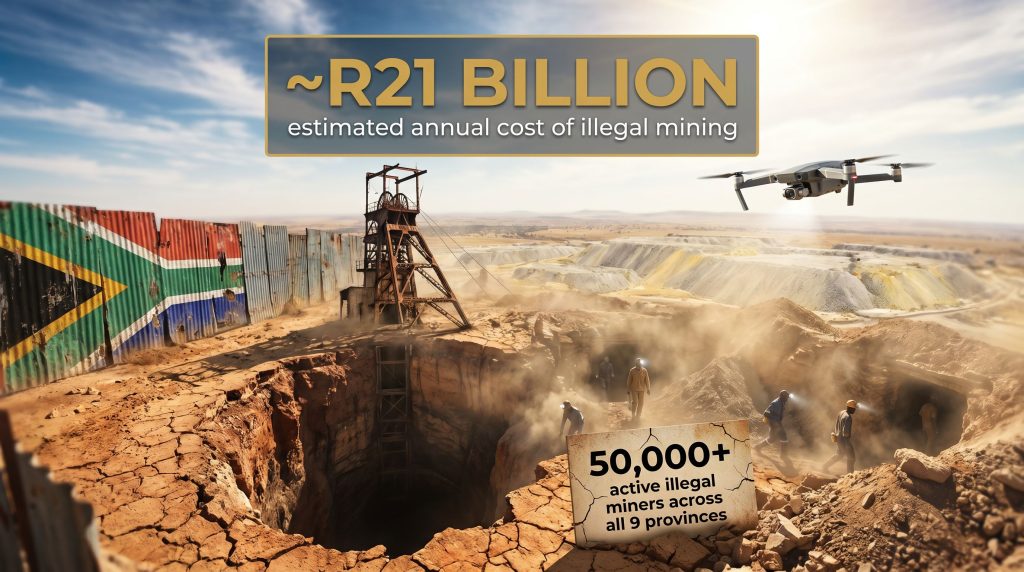
The scale of illegal mining in South Africa is frequently underestimated in public discourse. Estimates from the Minerals Council South Africa place annual losses attributable to illegal mining at approximately R21 billion, a figure that encompasses stolen mineral value, security expenditure, infrastructure damage, and productivity disruption across affected operations.
| Metric | Estimated Figure |
|---|---|
| Annual economic losses | ~R21 billion |
| Estimated active illegal miners (zama zamas) | 50,000+ |
| Provinces affected | All 9 |
| Primary minerals targeted | Gold, diamonds |
| Secondary minerals increasingly targeted | Copper, chrome |
| Key criminal activities linked | Illicit trading, border smuggling, infrastructure sabotage, violent crime, corruption |
More than 50,000 individuals are estimated to be actively engaged in illegal mining operations at any given time, with activity recorded across all nine provinces. The historic Witwatersrand goldfields remain the most heavily exploited zone, given the density of abandoned shafts and residual mineralisation that makes extraction viable without industrial-scale equipment.
Critical Context: Gold's high value-to-weight ratio makes it the primary target for illegal mining syndicates. A relatively small volume of extracted material, once refined and traded through illicit channels, can generate substantial criminal revenue, funding the broader syndicate infrastructure including arms, logistics, and corruption.
The Legislative Gap That Hampers Every Prosecution
South Africa's existing regulatory framework prohibits unauthorised mineral extraction clearly and comprehensively. Possession of unwrought precious metals, gold-bearing material, or rough diamonds without documented authorisation is explicitly illegal under current statutes. Regulatory oversight resides primarily within the Department of Mineral and Petroleum Resources (DMPR).
However, a critical structural flaw undermines enforcement at every level: illegal mining is not classified as a standalone criminal offence under South African law. Prosecutors must instead construct cases around adjacent charges, including trespassing, possession of stolen goods, and firearms violations.
This fragmented approach creates several compounding problems:
- Sentencing outcomes are significantly weaker than would apply under purpose-built illegal mining legislation
- Syndicate operators insulate themselves from the physical extraction activity, making it difficult to build direct criminal liability against upper-tier participants
- Evidence chains spanning multiple offence categories require greater prosecutorial resources and carry higher failure risk
- Deterrence is structurally undermined because the criminal consequences remain disproportionately low relative to the financial rewards
| Enforcement Dimension | Current Status | Gap Identified |
|---|---|---|
| Standalone illegal mining offence | Not legislated | High priority reform needed |
| Prosecution of syndicate leaders | Limited | Evidence-chain challenges |
| Financial crime tracking | Developing | FIC capabilities being expanded |
| Border interdiction of illicit minerals | Inconsistent | Customs identification weaknesses |
| Mine closure and shaft sealing | Underfunded | Abandoned mines remain exploitable |
Legal experts and industry observers have argued for years that purpose-built legislation targeting illegal mining as an organised crime activity, with sentencing frameworks proportionate to the economic and social harm caused, is the single most important reform available to policymakers. Furthermore, effective mining risk management strategies must account for this legislative gap when companies are designing their security frameworks.
Who Is Actually Responsible? The Institutional Accountability Problem
The most contested question in South Africa's illegal mining debate is deceptively simple: which institution is responsible for leading the national response?
The DMPR has publicly maintained that its regulatory mandate covers legal mining activities exclusively. This position, reiterated by Mineral and Petroleum Resources Minister Gwede Mantashe, has generated significant friction across industry, law enforcement, and civil society. Critics argue that a department constitutionally entrusted with the nation's mineral wealth cannot responsibly maintain institutional distance from the illegal extraction of those same resources.
Yet the DMPR's position reflects a genuine jurisdictional ambiguity. The accountability gap is distributed across multiple institutional layers, none of which possesses the full authority, operational capacity, or intelligence reach to address the problem independently:
- DMPR regulates legal mining and disputes ownership of the illegal mining enforcement mandate
- South African Police Service (SAPS) continues making arrests but lacks specialist mining crime capacity at scale
- National Prosecuting Authority (NPA) faces legislative and evidence-chain limitations in securing meaningful convictions
- Border Management Authority (BMA) is responsible for interdicting illicit mineral exports but confronts identification challenges at crossing points
- Financial Intelligence Centre (FIC) is developing forensic financial intelligence capabilities to trace criminal proceeds through illicit trade networks
- Mining companies bear direct operational losses and increasingly invest in private security but hold no enforcement authority
- Local communities are frequently caught between criminal networks and inadequate state protection, sometimes becoming complicit through coercion or economic necessity
Structural Reality: No single government department, law enforcement agency, or private sector body possesses the full jurisdictional authority, operational capacity, or intelligence reach to address illegal mining in South Africa independently. This is not a failure of individual institutions but a failure of systemic design.
This distributed accountability model creates what security specialists describe as a collective action problem: every stakeholder can reasonably argue that the primary responsibility lies elsewhere, while the criminal networks exploit the resulting inaction. Consequently, government intervention in mining at the legislative level has become increasingly urgent. Recognising this dynamic, industry leaders, security specialists, law enforcement agencies, prosecutors, and government representatives are convening at the 5th Annual Mine Security Conference, scheduled for 1-2 July 2026 at the Indaba Hotel in Johannesburg, to develop practical, cross-sector strategies aimed at breaking this institutional deadlock.
The Insider Threat: A Vulnerability Hiding in Plain Sight
One of the least publicly discussed dimensions of illegal mining in South Africa is the systematic exploitation of insider access. Criminal syndicates operating in and around mining operations do not rely solely on external force. They actively recruit, coerce, or compromise employees within mining companies, contractors, logistics providers, and in some cases regulatory personnel.
This insider threat dynamic fundamentally changes the security calculus for mine operators. Perimeter security, drone surveillance, and access control systems are all capable of being neutralised if individuals with legitimate access are working against the operation's interests from within.
The implications extend beyond operational security to intelligence integrity. If syndicate operators receive advance notice of planned security operations, law enforcement actions, or regulatory inspections through compromised insiders, the value of coordinated response efforts is dramatically reduced. Identifying, managing, and investigating internal vulnerabilities is therefore not a secondary security consideration but a foundational requirement for any credible counter-illegal-mining strategy.
Understanding the Criminal Architecture of Zama Zama Networks
The term zama zama, derived from a Zulu-Nguni phrase meaning those who try their luck, originally described opportunistic artisanal miners working in the margins of formal operations. That description no longer captures the reality of how these networks operate at scale.
Modern zama zama syndicates display clearly defined hierarchical structures:
- Upper-tier operators coordinate financing, mineral trading, and logistics while remaining physically removed from extraction sites, insulating themselves from arrest
- Mid-tier enforcers manage access to shafts, control the movements of lower-tier miners, and exercise armed enforcement within underground networks
- Lower-tier extractors perform the physical mining, often undocumented migrants or economically marginalised individuals who bear the greatest physical risk and receive the smallest share of proceeds
This tiered structure is deliberately designed to create legal separation between those who profit most from illegal mining and those most likely to be arrested. Prosecuting only lower-tier participants leaves the financial engine of the syndicate entirely intact.
The criminal ecosystem surrounding illegal mining extends well beyond the extraction activity itself:
- Illicit mineral trading networks process extracted gold and diamonds through informal dealers before export via unofficial channels
- Border smuggling routes exploit South Africa's extensive land borders, with multiple crossing points presenting identification challenges for customs authorities
- Infrastructure sabotage targeting power systems, water infrastructure, and mine equipment is used both to disrupt formal operations and to harvest materials for resale
- Violent crime and intimidation, including documented murders and community-level coercion, enforce syndicate control over territory and personnel
- Corruption penetrating regulatory, law enforcement, and private security structures undermines institutional responses at every level
The next major ASX story will hit our subscribers first
The Environmental Damage That Rarely Makes Headlines
Beyond the economic and security dimensions, illegal mining in South Africa generates significant and largely unquantified environmental harm. In regions such as Mpumalanga, unregulated extraction operations produce substantial sediment runoff into river systems, including catchments feeding into the Blyde River area.
Artisanal gold processing frequently involves unregulated chemical use, including cyanide, which contaminates water sources and causes measurable harm to aquatic ecosystems. Reduced dam capacity, fish population decline, and agricultural water quality degradation represent real, downstream consequences that are deeply connected to the broader environmental impacts on natural capital across affected regions.
The rehabilitation liability created by illegal mining workings is particularly problematic. Unlike authorised mining operations, which are legally required to provision for environmental rehabilitation, illegal workings leave no identifiable responsible party and no funded remediation pathway. In addition, effective mining waste management frameworks are fundamentally undermined when unregulated operators leave behind contaminated sites with no accountability structure.
Abandoned Shafts: The Gateway Nobody Is Closing
South Africa's industrial mining legacy has left hundreds of abandoned and ownerless shafts scattered across the Witwatersrand and other historic gold and coal mining regions. These structures represent the most persistent physical vulnerability in the fight against illegal mining because they provide ready-made underground access points requiring no excavation investment from syndicate operators. Abandoned mine reclamation is therefore not merely an environmental priority but a direct national security concern.
| Challenge | Current Status | Required Action |
|---|---|---|
| Ownership of abandoned shafts | Legally unresolved in many cases | Statutory clarification needed |
| Physical sealing of access points | Inconsistently implemented | Funded national programme required |
| Rehabilitation liability | Unfunded in most cases | Fiscally backed remediation framework |
| Monitoring of sealed sites | Minimal | Technology-enabled surveillance deployment |
The Junior Mining Council has been particularly vocal in highlighting the urgent need to resolve questions of legal ownership, financial responsibility, and physical closure for these sites. Until a statutory framework clarifies who bears responsibility for securing abandoned shafts and funds a national closure programme, these structures will continue to serve as the primary entry point for illegal mining operations.
Technology at the Frontline of Mine Security
Private sector investment in security technology is accelerating as mining companies seek to compensate for gaps in state enforcement capacity. Several technology categories are reshaping the operational security landscape:
- Drone surveillance (UAV systems): Aerial monitoring of mine perimeters, tailings facilities, and access roads provides real-time situational awareness across large surface areas that would be impractical to monitor through ground-based patrols alone
- Integrated security ecosystems: Converged platforms combining physical access control, CCTV networks, sensor arrays, and command-and-control software enable coordinated responses to simultaneous incidents across extended mine footprints
- Armoured tactical response vehicles: Deployed for rapid response to security incidents in high-risk environments where conventional vehicles would create unacceptable crew exposure
- Advanced risk management platforms: Data-driven threat assessment tools enabling predictive adjustments to security posture based on intelligence inputs and incident pattern analysis
The critical limitation of technology investment, however, is that hardware and software deliver maximum operational value only when integrated with human intelligence networks and functioning communication channels with law enforcement. Drone surveillance footage, for example, requires rapid handoff protocols to law enforcement agencies to translate surveillance observations into physical interdiction. Where these protocols are absent or underdeveloped, technology investments capture evidence without generating enforcement outcomes.
Building Prosecutable Cases: The Financial Intelligence Frontier
One of the most promising developments in the fight against illegal mining in South Africa is the growing deployment of financial intelligence capabilities to trace, disrupt, and ultimately dismantle the financial infrastructure of criminal syndicates.
The Financial Intelligence Centre (FIC) is actively developing methodologies to convert transaction data, financial flows, and asset records into court-ready forensic evidence. This approach targets the economic engine of illegal mining rather than its visible operational manifestations, which is a strategically superior intervention point because it attacks the syndicate's profitability rather than merely disrupting individual extraction episodes.
Strategic Insight: Successful criminal prosecution of syndicate operators remains one of the most powerful deterrents available against organised illegal mining. A single conviction of an upper-tier syndicate leader, supported by comprehensive financial intelligence, sends a deterrence signal that hundreds of lower-tier arrests cannot replicate.
The National Prosecuting Authority's Organised Crime Component has identified evidence compilation and witness protection as priority capability areas requiring investment. Building court-ready cases requires coordinated evidence collection spanning physical crime scenes, financial transaction records, telecommunications data, and digital intelligence, a multi-agency challenge that currently lacks a formal coordination framework in most jurisdictions.
The Community Dimension: Enforcement Without Development Will Fail
Any analyst examining illegal mining through a purely enforcement lens will consistently underestimate the problem's resilience. In many affected regions, illegal mining provides income in communities where formal employment alternatives are scarce or absent. Community members may provide logistical support, shelter, or operational silence to syndicate networks, sometimes voluntarily motivated by economic participation, sometimes under direct coercion.
As The Conversation has noted, enforcement-only responses, even when well-funded and operationally effective, consistently underperform against the structural driver: the economic calculation that makes illegal mining an attractive livelihood option relative to available alternatives.
Mining companies operating in high-risk areas increasingly face the dual challenge of protecting physical assets while simultaneously maintaining the social licence that sustains their operating environment. Protection services at large mining operations are incorporating community liaison functions alongside physical security roles, recognising that community relationships are themselves a security asset.
A Reform Roadmap: What Needs to Happen and When
Short-Term Priorities (0-12 Months)
- Enact standalone illegal mining criminal offence legislation with sentencing frameworks proportionate to economic and social harm
- Establish a formal inter-agency illegal mining task force with a defined mandate, clear accountability structures, and dedicated resourcing
- Accelerate Financial Intelligence Centre integration into active illegal mining investigations to begin building financial prosecution pipelines
- Deploy technology-enabled surveillance at the highest-risk abandoned shaft locations to reduce access without requiring physical sealing of every entry point
Medium-Term Priorities (1-3 Years)
- Develop and fund a national abandoned mine closure programme with statutory clarity on ownership and rehabilitation liability
- Implement real-time intelligence sharing protocols between mining companies and law enforcement, supported by formal data-sharing agreements
- Strengthen Border Management Authority identification capabilities for illegally traded mineral commodities at all major crossing points
- Expand community economic development programmes in highest-risk mining regions to address the structural drivers of participation in illegal mining
Long-Term Structural Reforms (3+ Years)
- Establish a dedicated organised mining crime prosecution unit within the NPA with specialist capabilities in financial crime, digital forensics, and witness protection
- Create a national mineral security framework integrating regulatory, enforcement, financial intelligence, and community dimensions under a unified coordination structure
- Develop international cooperation agreements to disrupt the cross-border illicit mineral trading networks that provide the export pathway for illegally extracted commodities
Frequently Asked Questions About Illegal Mining in South Africa
What is a zama zama?
A zama zama is an individual engaged in illegal or unauthorised mining in South Africa, typically operating in abandoned or active mine shafts without the required permits or mining rights. While the term originally described opportunistic artisanal miners working in residual mineralisation, it now encompasses participants at every level of highly organised criminal networks that span the full extraction-to-export supply chain.
Is illegal mining in South Africa classified as a specific criminal offence?
Despite clear prohibitions on unauthorised mineral extraction and possession of unwrought precious metals without documentation, South African law does not currently classify illegal mining as a standalone criminal offence. This legislative gap is widely identified by prosecutors, legal experts, and industry bodies as the single most significant barrier to effective prosecution, particularly of upper-tier syndicate operators.
Which government agencies share responsibility for combating illegal mining?
Responsibility is distributed across the South African Police Service, the National Prosecuting Authority, the Border Management Authority, the Financial Intelligence Centre, and the Department of Mineral and Petroleum Resources, with no single agency holding primary mandate for coordinating the national response. This structural fragmentation is itself identified as a key enabler of the ongoing crisis.
Bottom Line: Illegal mining in South Africa is simultaneously a policing problem, a legislative problem, a financial crime problem, an environmental problem, and a socioeconomic development problem. Treating it as any one of these in isolation will continue to produce insufficient results. What the evidence demands is a unified national framework that addresses all dimensions concurrently, led by a designated coordinating authority with the cross-departmental mandate and resourcing to match the scale of the challenge.
This article draws on publicly available industry reporting, including coverage published by Mining Weekly at miningweekly.com, which provides ongoing analysis of mine security, legislative developments, and organised crime dynamics within the South African resources sector. Figures cited, including the R21 billion annual loss estimate, reflect publicly available estimates from the Minerals Council South Africa and should be understood as indicative rather than precisely audited values. Forward-looking statements regarding legislative reform timelines and enforcement outcomes involve inherent uncertainty.
Want To Identify The Next Major ASX Mineral Discovery Before The Market Does?
Discovery Alert's proprietary Discovery IQ model delivers real-time alerts the moment significant mineral discoveries are announced on the ASX, translating complex geological data into clear, actionable investment insights for both short-term traders and long-term investors. Explore why historic discoveries have generated extraordinary returns and begin your 14-day free trial today to position yourself ahead of the broader market.