July 15, 2026
The Copper Supercycle Is Reshaping Who Wins in Mining Equipment
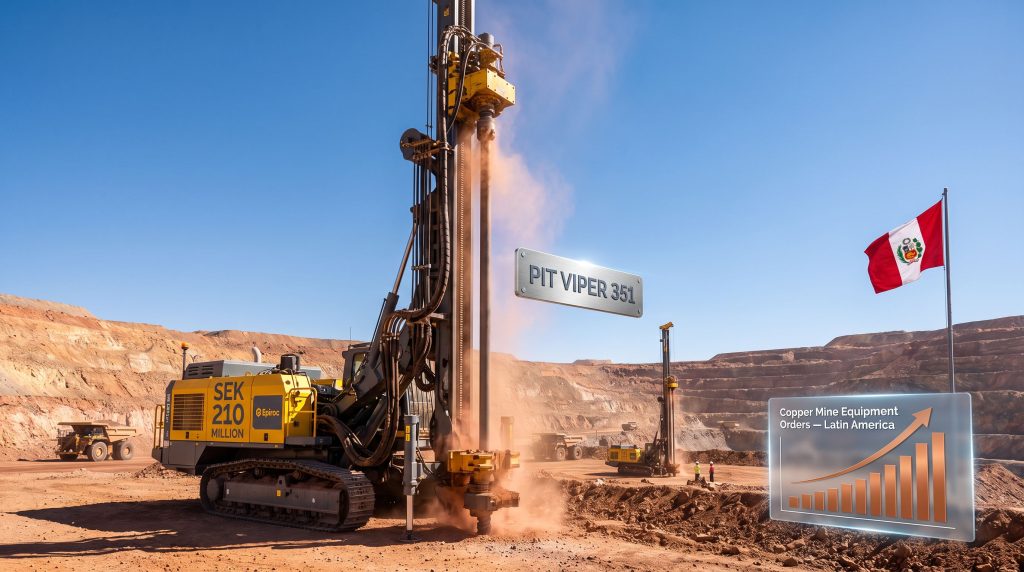
Long before a single drill rod turns in the ground, the real competition in large-scale copper mining is won or lost in the procurement room. In an industry where a single unplanned shutdown can cost millions of dollars per day, mine operators increasingly treat equipment selection as a multi-decade strategic commitment rather than a line-item capital decision. Understanding this dynamic is essential context for interpreting what it means when Epiroc wins large order for mining equipment in Peru, specifically a fleet of Pit Viper 351 surface blasthole drill rigs destined for a major copper operation.
This is not simply a transaction. It is a signal about how the world's top copper producers are thinking about automation readiness, total cost of ownership, and the supplier relationships that will carry them through the energy transition supercycle. Furthermore, the copper demand drivers shaping this decision extend well beyond any single equipment order.
When big ASX news breaks, our subscribers know first
Breaking Down the SEK 210 Million Peru Equipment Order
The order, formally booked in the second quarter of 2026, carries a value of approximately SEK 210 million, equivalent to roughly USD 20 million at current exchange rates. The scope extends well beyond the physical drill rigs themselves:
- A fleet of Pit Viper 351 surface blasthole drill rigs for open-pit copper mine expansion
- Drilling tools and spare parts to support sustained high-cycle operations
- On-site technical services and dedicated field support teams
- Specialised operator training programmes to maximise equipment performance and safety outcomes
Delivery is scheduled to begin in late 2026, with the full fleet handover continuing through the first half of 2027. The mine receiving this equipment is operated by a consortium structure combining leading Chinese investment entities with an Australian-headquartered global mining company that serves as the operational manager on site.
This ownership architecture is increasingly common across South America. Chinese capital provides the financial scale necessary for large greenfield and brownfield copper developments, while Australian and other Western operators contribute governance frameworks, environmental management systems, and technical depth built over decades of open-pit experience.
The blending of Chinese capital with Australian operational expertise reflects a structural shift in how cross-continental mining consortia are assembled, particularly in jurisdictions where project scale demands both deep pockets and proven operational credibility.
What the Pit Viper 351 Actually Does and Why Automation Readiness Matters
Engineering Profile of the Pit Viper 351
The Pit Viper 351 is purpose-built for large-diameter blasthole drilling in open-pit environments. In practical terms, this means the rig is designed to operate continuously in high-load, high-cycle conditions where uptime is not a preference but a financial necessity. Key engineering characteristics include:
- Capacity for large-diameter blastholes required in bulk-tonnage copper ore extraction
- Integration of Epiroc's proprietary Rig Control System (RCS), an automation-ready operating platform
- Modular architecture that allows progressive automation upgrades without requiring full fleet replacement
- Standardised operator interfaces that reduce training time and minimise human error exposure
The RCS Advantage: More Than a Software Layer
The Rig Control System is frequently described simply as an automation platform, but its operational implications run deeper than that framing suggests. For mine operators evaluating total cost of ownership over a ten-to-fifteen-year equipment lifecycle, RCS introduces several tangible performance levers:
| RCS Capability | Operational Impact |
|---|---|
| Remote operation readiness | Enables operator repositioning away from blast zones |
| Real-time performance telemetry | Reduces unplanned downtime through predictive maintenance signals |
| Centralised fleet monitoring | Allows a single operator to oversee multiple rigs simultaneously |
| Blast pattern optimisation | Improves fragmentation consistency, reducing downstream crushing costs |
| Modular automation upgrades | Protects capital investment as automation standards evolve |
What makes this particularly relevant to large copper operations is the downstream effect of blast quality. Inconsistent fragmentation from poorly drilled blast patterns forces processing plants to work harder, increasing energy consumption and reducing throughput. RCS-equipped rigs can measurably improve blast pattern accuracy, meaning the productivity benefit propagates through the entire value chain, not just the drilling phase.
Automation as a Hedge Against Labour Volatility
One dimension of automation readiness that receives less attention in mainstream commentary is its role as an operational hedge. In Peru and across Latin America, mining operations face recurring cycles of community engagement complexity, workforce availability constraints, and altitude-related productivity challenges in high-elevation open-pit environments.
Automation-capable rigs reduce the operator headcount required during periods of labour disruption, providing a resilience buffer that purely manual equipment cannot offer. This creates an interesting asymmetry: the upfront capital cost of RCS-equipped equipment is higher, but the risk-adjusted total cost of ownership often favours automation-ready platforms when labour volatility is factored into multi-year financial modelling.
A Decade of Supplier Continuity and What It Reveals About Procurement Logic
Epiroc's relationship with this particular Peruvian copper operation spans approximately ten years. That kind of supplier continuity in a capital-intensive industry rarely happens by accident. It reflects a procurement philosophy that prioritises total cost of ownership over single-cycle price competition.
The economics of long-term original equipment manufacturer (OEM) relationships in mining can be understood through several interconnected factors:
- Parts standardisation reduces inventory complexity and lowers procurement administration costs across large fleets.
- Institutional familiarity means maintenance teams already understand rig-specific service requirements, compressing downtime during scheduled maintenance windows.
- Performance data continuity allows the OEM to provide increasingly targeted maintenance recommendations as the operational dataset for a specific site accumulates over years.
- Training efficiency improves as operators build on established platform knowledge rather than relearning from zero.
For a high-tonnage copper producer where drilling productivity directly governs mine plan execution, these factors collectively translate into measurable financial outcomes. The decision to repeat an order of this scale is, in effect, a multi-year performance review expressed in capital allocation.
Epiroc's stated focus on simultaneously optimising safety, productivity, and total cost of ownership for its customers creates a three-pillar evaluation framework that aligns directly with how sophisticated mining operators assess supplier value over the long term.
Peru's Position in the Global Copper Landscape
Why Peru Attracts This Level of Capital Equipment Investment
Peru consistently ranks among the top two copper-producing nations globally, alongside Chile. Its geology is extraordinarily well-endowed with large-scale porphyry copper deposits across regions including Moquegua, Apurímac, Arequipa, and Cusco. Porphyry copper systems are the workhorses of global copper supply, characterised by large ore bodies with relatively consistent grades that suit bulk open-pit mining methods. In addition, the largest copper mines in the world are concentrated in precisely these kinds of geological settings.
| Peru Copper Sector Metric | Current Status |
|---|---|
| Global production rank | Top 2 globally |
| Primary mining method | Large-scale open-pit |
| Key mineral regions | Moquegua, Apurímac, Arequipa, Cusco |
| Primary equipment demand | Surface blasthole drilling, load-and-haul fleets |
| Capital investment trajectory | Active expansion phase across multiple major operations |
The Chinese Investment Dynamic in Peruvian Copper
Chinese state-affiliated and private capital has systematically increased its exposure to Peruvian copper assets over the past decade, acquiring stakes in some of the country's largest producing and development-stage operations. This creates a procurement dynamic that is often misunderstood by outside observers.
Chinese-backed mining consortia do not automatically default to Chinese equipment manufacturers. For production-critical surface drilling, where reliability and automation capability determine whether a mine plan is met or missed, operators frequently favour internationally established OEMs with proven large-fleet performance records. Consequently, Epiroc winning this order within a Chinese-Australian consortium is a meaningful competitive signal, indicating that the company's performance track record outweighed any preference that might otherwise tilt toward alternative suppliers.
Altitude, Geology, and the Technical Demands of Peruvian Open-Pit Operations
Many of Peru's major copper operations sit at elevations between 3,500 and 4,500 metres above sea level. At these altitudes, equipment faces reduced air density that affects diesel engine performance, hydraulic system behaviour in extreme temperature cycling, and operator fatigue profiles that differ materially from lower-elevation operations.
Drill rigs deployed in these environments require engineering tolerances and cooling systems calibrated for high-altitude performance, adding another layer of complexity to equipment selection that favours suppliers with demonstrated in-country operational experience.
The Services Model: Where the Real Margin Lives
The structure of this order, bundling hardware with drilling consumables, spare parts, technical services, and training, reflects a strategic evolution that has fundamentally changed how leading mining equipment OEMs generate and protect revenue.
Initial equipment sales, while significant in dollar terms, carry thinner margins than the aftermarket services and consumables streams that follow. For Epiroc, securing a long-term equipment relationship at a major copper operation creates a predictable, high-margin revenue stream that persists long after the initial fleet delivery:
- Drilling tools and consumables require frequent replacement and represent recurring revenue tied directly to production volumes
- Spare parts supply agreements generate consistent income while reducing operator procurement risk
- On-site technical services command premium pricing for specialised knowledge and guarantee uptime commitments
- Training programmes deepen operator dependency on OEM expertise, reinforcing switching costs for future procurement cycles
This services-led model also provides a natural buffer against commodity price cyclicality. When copper prices weaken and operators defer new capital equipment purchases, they simultaneously intensify focus on maximising the productive life of existing fleets, which directly accelerates demand for parts, services, and maintenance support.
The next major ASX story will hit our subscribers first
Competitive Dynamics and the Energy Transition Equipment Supercycle
Who Competes for Orders Like This?
The global surface blasthole drilling equipment market is concentrated among a small number of major OEMs: Epiroc, Sandvik, Komatsu Mining, and Caterpillar represent the primary competitive field. Winning a high-profile order of this scale in a tier-one copper jurisdiction carries reference-site value that extends far beyond the immediate revenue.
It signals to other major copper producers evaluating fleet renewals that the equipment has been validated in comparable operating conditions. Furthermore, the copper supply crunch intensifying through the late 2020s will only increase the urgency with which operators seek proven, automation-ready platforms.
Automation capability, once a differentiating premium feature, is rapidly becoming a baseline procurement requirement rather than an optional upgrade. OEMs that cannot demonstrate credible automation roadmaps are increasingly excluded from serious consideration at large-scale copper operations. For further context, autonomous equipment milestones in Australia illustrate how rapidly this standard is spreading across global operations.
Copper's Structural Role in the Energy Transition
The demand outlook for copper is underpinned by forces that are independent of any single economic cycle. Electric vehicles require roughly three to four times more copper than internal combustion equivalents. Grid infrastructure for renewable energy integration is intensely copper-dependent. The International Energy Agency has identified copper as one of the most supply-constrained critical minerals in the pathway toward accelerated electrification, with demand potentially doubling by 2040 under high-electrification scenarios.
Wood Mackenzie and other major commodity research organisations have flagged a structural supply deficit in copper emerging through the late 2020s and deepening into the 2030s, driven by the combination of rising demand and the long lead times required to bring new copper mines into production. From exploration discovery to first production, a greenfield copper project typically requires fifteen to twenty years and billions of dollars in capital.
The future of copper mining will therefore depend heavily on the kinds of automation and operational efficiency gains that equipment orders like this one are designed to deliver. Operators and investors alike are increasingly aligning their copper investment strategies around these structural supply dynamics.
Disclaimer: Commodity demand forecasts and supply deficit projections involve significant uncertainty. Actual outcomes will depend on technology adoption rates, economic growth trajectories, policy environments, and exploration success that cannot be reliably predicted. This article does not constitute financial or investment advice.
This structural backdrop ensures that capital investment in existing and expanding copper operations will remain robust across the equipment procurement cycle that the Pit Viper 351 fleet will serve. For mining equipment OEMs with established positions in major copper jurisdictions, the supercycle dynamic creates the potential for sustained order flow that transcends normal commodity market volatility.
Key Takeaways for Industry Observers
- Automation readiness has moved from premium differentiator to baseline requirement in major copper mine equipment procurement
- Bundled service models covering hardware, consumables, and technical support are redefining how OEM value is measured and captured over the equipment lifecycle
- Peru's geological endowment and active expansion pipeline position it as one of the most important equipment markets for surface drilling OEMs through the 2030s
- Cross-continental consortium structures blending Chinese capital with Western operational expertise are creating procurement dynamics that favour globally capable OEMs with verifiable performance track records
- Long-term supplier relationships anchored by performance data and total cost of ownership economics are proving more durable than price-competitive single-cycle bidding across the copper sector
- High-altitude operating conditions in Peru's major copper regions add a layer of technical complexity that rewards OEMs with proven in-country engineering experience
Readers seeking additional context on Peru's copper mining sector and surface drilling technology developments can find relevant industry coverage at Global Mining Review.
Want to Capitalise on the Next Major Copper Discovery Before the Broader Market Catches On?
Discovery Alert's proprietary Discovery IQ model delivers real-time alerts on significant ASX mineral discoveries — instantly translating complex mineral data into actionable opportunities for both short-term traders and long-term investors riding the copper supercycle. Begin your 14-day free trial today and explore historic mineral discovery returns that demonstrate just how transformative getting in early can be.