
May 19, 2026
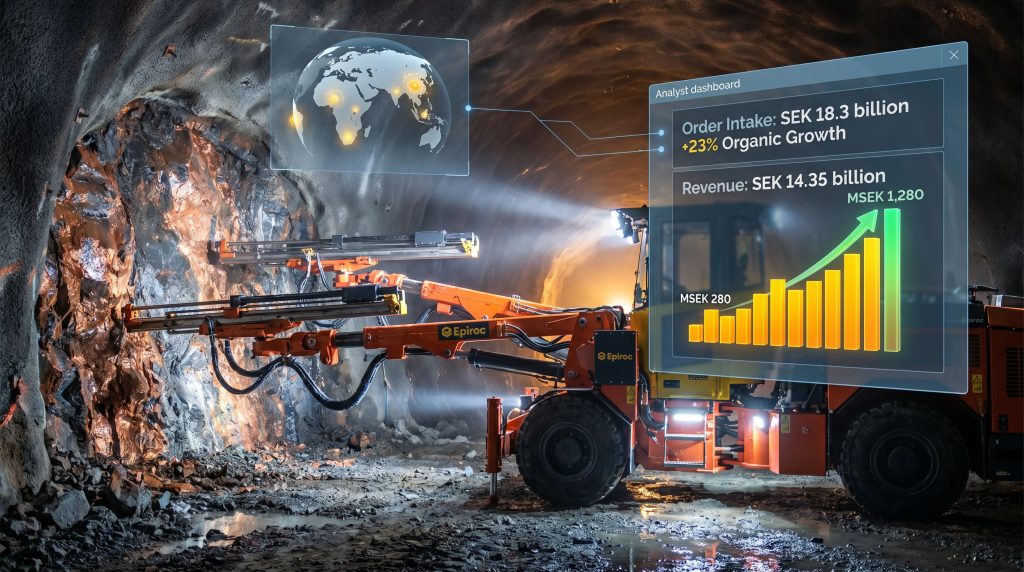
When Order Books Tell a Different Story Than Income Statements
Capital equipment markets have a peculiar habit of confusing investors who focus exclusively on current-period revenue. In industries where multi-million-dollar machines require months of engineering, manufacturing, and commissioning before delivery, the gap between commercial activity and financial recognition can span several reporting cycles. Understanding this structural lag is not merely an accounting technicality — it is the analytical lens through which Epiroc's March quarter 2026 results must be read.
On the surface, a simultaneous revenue decline and record-breaking order intake appears contradictory. In practice, it is one of the most reliable forward signals in the capital equipment sector. The orders flowing in today are the revenue being reported tomorrow, and when those orders reach historic levels, the implication for future financial performance is difficult to ignore.
When big ASX news breaks, our subscribers know first
Decoding the Order-Revenue Divergence in Q1 2026
The central tension in Epiroc's Q1 2026 results is straightforward once the mechanics of capital equipment cycles are understood. Order intake represents commercial commitments — customers placing binding purchase orders for equipment that has not yet been manufactured or delivered. Revenue recognition, under internationally accepted accounting standards, only occurs once the equipment is delivered and the performance obligation is satisfied.
The result is a timing asymmetry. When order intake surges, it reflects current commercial momentum. When revenue falls, it reflects the output of a prior period's weaker order pipeline now flowing through production and delivery schedules.
Q1 2026 Key Financial Metrics at a Glance
| Metric | Q1 2026 Value | Year-on-Year Change |
|---|---|---|
| Order Intake | SEK 18.3 billion (~USD 1.98 billion) | +11% reported; +23% organic |
| Net Revenue | SEK 14.35 billion | -8% reported; ~-2.5% organic |
| Large Orders | MSEK 1,280 | Up from MSEK 280 prior period |
| Full-Year 2025 Orders | SEK 62.974 billion | +1% reported; +7% organic |
| Trailing 12-Month Revenue | SEK 63.62 billion | Margin pressure noted |
A 23% organic order surge running concurrently with an 8% revenue decline is not a financial contradiction. It is a structural timing signal, with the revenue shortfall reflecting prior-period order softness now cycling through the income statement while the record order book pre-loads a future production ramp-up.
A critical distinction here is the difference between reported and organic growth. Organic growth strips out the effect of currency translation and acquisition contributions, isolating the underlying commercial performance of the business. In Q1 2026, the gap between Epiroc's reported revenue decline of 8% and its organic revenue decline of approximately 2.5% points directly to a substantial currency headwind masking what is, in operational terms, a modestly declining but far more resilient picture. Epiroc record orders offset revenue dip is precisely the kind of signal that rewards investors who look beyond headline figures.
The Swedish Krona Effect: Currency as a Financial Distortion Lens
Epiroc's financial statements are denominated in Swedish kronor, yet the company derives substantial revenue from markets that transact in US dollars, Australian dollars, Brazilian reais, and South African rand. When the krona appreciates against these currencies, the translation of foreign-denominated revenues back into SEK mechanically compresses reported figures, even when underlying operational performance is unchanged or improving.
In Q1 2026, this FX translation effect accounts for the majority of the difference between the reported 8% revenue decline and the organic decline of approximately 2.5%. Stripping out currency effects reveals a business that, at the operational level, is performing considerably closer to flat than the headline numbers suggest. Furthermore, according to Epiroc's 2025 Annual and Sustainability Report, these currency dynamics are well understood by management and factored into long-term strategic planning.
Why Organic Growth Metrics Matter More Than Reported Figures
For analysts and investors seeking to assess Epiroc's genuine commercial trajectory, organic growth figures carry materially more weight than reported metrics during periods of significant currency volatility. Key considerations include:
- Organic order growth of 23% eliminates the same FX headwind affecting revenue, revealing the true scale of commercial momentum
- Acquisition contributions added approximately 2% to full-year 2025 order growth, meaning the underlying organic expansion was broadly volume and pricing driven
- Currency effects are cyclical by nature and tend to reverse over multi-year periods, making current FX-driven revenue compression a timing issue rather than a structural one
- Procurement and capital allocation decisions by mining operators are made in local currencies, so organic growth more accurately reflects their investment commitments
The practical implication for observers is that Epiroc's Q1 2026 headline revenue figures should be interpreted through an organic lens, particularly when the same currency headwind is simultaneously inflating the apparent magnitude of order intake growth in USD-equivalent terms.
What Is Actually Driving Epiroc's Record Order Volumes
The leap from MSEK 280 to MSEK 1,280 in large-order values within a single reporting period is not organic fluctuation. It points to a confluence of structural forces reshaping demand patterns across the global mining equipment sector.
The Critical Minerals Investment Wave
The global transition toward electrification and low-carbon energy systems has dramatically accelerated capital investment in the minerals that underpin battery technology, power infrastructure, and advanced manufacturing. Critical minerals demand for copper, lithium, cobalt, and nickel is central to this investment cycle, and the exploration and development drilling required to bring new deposits into production represents exactly the kind of high-intensity equipment demand that drives Epiroc's order book.
Mining operators across Africa, Latin America, and Asia-Pacific have been committing capital to new projects and expansion programmes at a pace not seen consistently since the commodity supercycle of the early 2010s. What differentiates the current cycle from prior expansions is the nature of the demand: rather than bulk commodity extraction at scale, the focus is on technically complex underground deposits that require precision drilling equipment, electrified machinery, and automation-enabled fleet management — all higher-value categories within Epiroc's product portfolio.
Large Order Dynamics: A 4.5x Quarterly Surge
The increase in large-order intake from MSEK 280 to MSEK 1,280 quarter-on-quarter represents one of the most significant single-period jumps in recent reporting history. In Epiroc's financial reporting framework, large orders typically encompass contracts for major equipment fleet deployments, often involving underground drilling rigs, surface blast-hole drills, or comprehensive rock reinforcement systems at new or expanding mine sites.
Several factors help explain the concentration of large orders in Q1 2026:
- Fleet electrification commitments: Major mining operators converting underground fleets to battery-electric systems require simultaneous replacement of multiple units, generating large single orders rather than incremental purchases. The mine electrification shift is therefore a direct driver of elevated per-order values
- Greenfield project commissioning: New mine developments in Africa and Latin America require full equipment packages rather than incremental additions to existing fleets
- Automation bundle orders: Integrated automation systems are increasingly purchased as complete solutions rather than piecemeal, elevating per-order values. Indeed, mining automation trends are reshaping how procurement teams structure capital commitments
- Supply chain front-loading: Procurement teams concerned about extended delivery timelines are placing larger orders earlier in project cycles to secure delivery slots
Geographic Concentration and Construction Sector Contrast
The strength of Epiroc's mining-driven order pipeline stands in notable contrast to relative weakness in the construction segment, which reflects softer infrastructure investment conditions in certain developed markets. Africa's expanding copper and gold projects, Latin America's lithium triangle development programmes, and Asia-Pacific's iron ore and critical minerals activity have effectively offset this construction-side softness, highlighting the importance of geographic and end-market diversification in reading Epiroc's aggregate order performance.
The Aftermarket Flywheel: Built-In Revenue Stabilisation
One of the less frequently discussed structural advantages of Epiroc's business model is its substantial aftermarket and service revenue base. Approximately half of the company's total revenue derives from consumables, spare parts, maintenance contracts, and field service activities — a recurring income stream that is structurally less sensitive to capital expenditure cycles than equipment sales.
Epiroc's aftermarket model functions as a built-in revenue stabiliser. During periods of equipment revenue softness, the installed base of previously delivered machinery continues to generate service income. A record order quarter does not just signal future equipment revenue; it expands the installed base that will generate aftermarket income for years ahead.
This flywheel dynamic has a compounding quality that distinguishes equipment OEMs with large installed bases from pure-play capital goods manufacturers. Consider the economics:
- An underground drill rig sold today enters a maintenance cycle that generates parts and service demand across its operational life, which in underground mining can extend well beyond a decade
- Consumables such as drill bits, rods, and ground support materials are consumed continuously throughout the asset's working life regardless of market conditions
- Service contracts provide predictable revenue streams that smooth earnings volatility across equipment cycles
- The larger the installed base, the more resilient the total revenue base becomes to new equipment sales fluctuations
The implication of Q1 2026's record order intake for aftermarket revenue is therefore a multi-year one. Equipment ordered and delivered over the next two to four quarters will enter service and begin generating aftermarket demand that persists well into the next decade.
Execution Risk: Converting the Order Book to Revenue
Record orders are commercially meaningful only if they can be converted into delivered equipment within commercially reasonable timeframes. Three execution variables will determine how effectively Epiroc translates its historic Q1 2026 order backlog into reported revenue:
-
Manufacturing capacity scaling: Production ramp-up at Epiroc's Swedish and international facilities requires capital allocation decisions, workforce expansion, and supply chain coordination. Management has indicated intentions to scale production in response to the elevated backlog, but the timeline for this ramp-up relative to customer delivery expectations remains a key variable.
-
Component supply chain readiness: Modern drilling equipment incorporates complex electronic control systems, hydraulic assemblies, and in the case of battery-electric machines, proprietary drive train components. Availability constraints for these sub-systems can extend delivery timelines independently of Epiroc's own manufacturing capacity.
-
Customer site readiness and commissioning windows: Even when equipment is manufactured and ready for delivery, mine site construction delays, permitting timelines, or infrastructure deficiencies at customer locations can defer the commissioning milestone that triggers revenue recognition.
Historical patterns from Epiroc's performance during the 2021–2022 mining capex expansion cycle suggest that a significant portion of orders placed during high-activity periods convert to revenue within two to four quarters, with more complex fleet or automation packages often requiring longer lead times. If Q1 2026 follows similar conversion dynamics, the revenue impact of this record order quarter should become visible in reported figures through the second half of 2026 and into 2027.
Please note that forward-looking projections regarding order conversion timelines involve inherent uncertainty. Actual outcomes may differ materially from historical conversion patterns due to supply chain conditions, manufacturing capacity, and customer-specific factors.
The next major ASX story will hit our subscribers first
Peer Comparison: Where Epiroc Sits in the OEM Landscape
Examining Epiroc's Q1 2026 results within the broader context of the mining commodity outlook reveals a sector experiencing divergent outcomes by equipment category and market exposure.
| OEM | Recent Performance Signal | Key Theme |
|---|---|---|
| Epiroc | Record Q1 2026 orders; revenue timing lag | Order backlog build in drilling and automation |
| Sandvik | Strong March quarter performance | Parallel demand cycle in specialised mining tools |
| Komatsu | Profit decline; downward trend flagged | Margin compression in bulk equipment |
| Caterpillar | 10% sales increase in prior quarter | Broad mining and construction exposure |
The divergence between Epiroc and Sandvik on one hand, and Komatsu on the other, is analytically instructive. Both Epiroc and Sandvik are specialised in drilling, rock tools, and precision underground equipment. Komatsu's primary mining exposure centres on large surface mining machinery, including haul trucks and hydraulic excavators used in bulk material extraction.
The pattern suggests that mining operators are currently prioritising drilling and exploration-phase equipment over bulk material handling assets. This is consistent with the battery metals investment cycle, where the priority is finding, delineating, and developing new deposits rather than scaling up production at already-operational bulk mines.
The drilling equipment segment appears to be capturing a disproportionate share of current mining capex, reflecting the exploration and development intensity of the critical minerals investment cycle. This structural advantage may prove durable rather than cyclical for OEMs positioned in precision drilling and underground equipment.
Market Signals for Contractors, Developers, and Procurement Teams
For participants across the drilling and mining supply chain, Epiroc's Q1 2026 order performance carries practical implications beyond financial analysis. As Mining Magazine has noted, record OEM order performance typically precedes meaningful shifts in equipment availability and lead times across the sector.
For drilling contractors and equipment operators:
- Record OEM order backlogs typically translate into extended delivery timelines for new equipment procurement
- Forward-ordering strategies, where contractors place orders well ahead of actual operational need, become increasingly important during high-demand periods
- Aftermarket parts availability may experience some tightening as manufacturing capacity is directed toward new equipment production
For mining project developers and exploration companies:
- Strong equipment order volumes across the sector confirm that mining operators globally are making capital commitments to new projects
- Regions with concentrated order activity, including parts of Africa and Latin America, may see increased competition for available drilling crews and equipment
- Lead times for specialised underground equipment should be factored into project scheduling, particularly for developments targeting battery-electric fleet configurations
For market observers tracking mining investment cycles:
- Record equipment orders function as a leading indicator of drilling activity approximately two to four quarters ahead
- The concurrent strength of Epiroc and Sandvik order performance suggests that the current capex cycle is real, broad-based, and skewed toward the drilling and development phase of the mining investment spectrum
Frequently Asked Questions: Epiroc Q1 2026 Results
Why did Epiroc's revenue fall while orders hit record levels?
The decline in reported revenue reflects a timing lag between order placement and equipment delivery, compounded by currency translation headwinds from a stronger Swedish krona. Organic revenue declined by approximately 2.5%, materially less severe than the 8% reported figure. Orders placed in Q1 2026 will flow through to revenue in subsequent quarters as production capacity scales to meet demand.
How large were Epiroc's Q1 2026 orders in dollar terms?
Order intake reached SEK 18.3 billion, equivalent to approximately USD 1.98 billion, representing an 11% increase on a reported basis and a 23% increase when currency effects are excluded.
What share of Epiroc's revenue comes from aftermarket services?
Approximately half of Epiroc's total revenue base derives from aftermarket activities, including parts supply, maintenance contracts, and consumables. This recurring revenue stream provides structural stability against the cyclicality of new equipment sales.
What drove the large-order spike from MSEK 280 to MSEK 1,280?
The 4.5x increase in large-order values reflects a combination of fleet electrification commitments, greenfield mine commissioning packages, automation system deployments, and procurement front-loading by mining operators seeking to secure equipment delivery slots amid rising demand across the sector.
How does Epiroc's performance compare to Sandvik and Komatsu?
Both Epiroc and Sandvik reported strong order and revenue performance in the March 2026 quarter, reflecting strong demand for specialised drilling and rock tools equipment. Komatsu, by contrast, reported profit declines and flagged a continuing downward trend, highlighting a performance divergence between specialised drilling OEMs and broader heavy equipment manufacturers.
Reading the Signal Behind the Numbers
The summary picture emerging from Epiroc's Q1 2026 results is one where headline revenue metrics significantly understate the underlying commercial strength of the business. The key analytical takeaways are:
- Epiroc record orders offset revenue dip by signalling a future revenue pipeline that the current income statement does not yet reflect
- Currency effects of approximately 5.5 percentage points are masking organic operational resilience that analysts should weight more heavily than reported figures
- The aftermarket revenue base, representing roughly half of total income, continues generating cash regardless of the new equipment order cycle
- Production ramp-up execution is the single most important variable determining when the record Q1 2026 order book translates into visible revenue acceleration
- The structural alignment between Epiroc's core product portfolio and critical minerals investment demand suggests the current demand cycle has durability beyond a typical capex upswing
This article contains forward-looking assessments and market analysis based on publicly available information. It does not constitute financial advice. Readers should conduct independent due diligence and consult qualified advisers before making investment or procurement decisions. Order conversion timelines and revenue projections involve inherent uncertainty.
For ongoing coverage of drilling industry developments and mining equipment market dynamics, GeoDrilling International publishes daily industry news at geodrillinginternational.com.
Want to Capitalise on the Next Major Mineral Discovery Before the Broader Market?
When record equipment orders signal a new wave of mining exploration and development, the discoveries that follow can generate extraordinary returns — and timing is everything. Powered by its proprietary Discovery IQ model, Discovery Alert delivers real-time ASX mineral discovery alerts, turning complex data across more than 30 commodities into actionable insights for investors at every level — explore the historic returns major discoveries have generated and begin your 14-day free trial today to position yourself ahead of the market.