July 7, 2026
The Economics of Smaller, Faster, Cheaper: Why the North Sea Tieback Model Is Reshaping Offshore Development
The offshore oil and gas industry has spent decades wrestling with a stubborn paradox: the most prolific hydrocarbon basins in the world often contain their greatest remaining reserves in reservoirs too small or too complex to justify the capital cost of standalone development. The Norwegian Continental Shelf is a textbook case. After more than half a century of production, its mature infrastructure network has become both its greatest constraint and its most powerful enabler. The question is no longer whether hydrocarbons exist beneath the Norwegian Sea and North Sea, but whether operators can extract them economically enough to compete in an energy landscape defined by cost discipline and transition pressure.
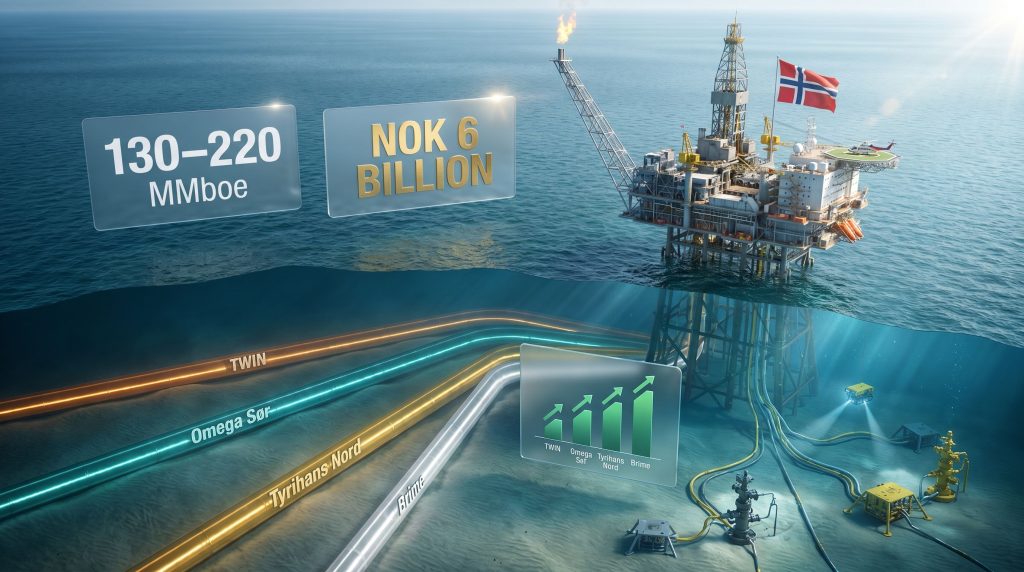
Equinor contracts for four Norwegian Continental Shelf subsea development projects, totalling approximately NOK 6 billion (roughly $610 million USD), is not simply a procurement announcement. It is a structural statement about how one of the world's most sophisticated offshore operators intends to unlock the next generation of NCS resources through a fundamentally different development model. Furthermore, it signals a broader shift in how the industry approaches oil in the global economy, particularly in mature, infrastructure-rich basins.
When big ASX news breaks, our subscribers know first
Four Projects, One Strategic Logic
The four developments at the centre of these Equinor contracts for Norwegian Continental Shelf subsea development projects share a common architectural principle: none of them require new host infrastructure. Every project is designed as a tieback to existing platforms, pipelines, or processing facilities, dramatically compressing the capital requirements compared to greenfield development.
Collectively, the four projects are projected to contribute between 130 and 220 million barrels of oil equivalent (boe) to future NCS production. The breadth of that range reflects the varying maturity of resource characterisation across the portfolio, from the relatively well-defined TWIN gas development to the early-stage Omega Sør oil discovery.
The table below summarises each project's key parameters:
| Project | Host Infrastructure | Fluid Type | Estimated Recoverable Volumes |
|---|---|---|---|
| TWIN (Troll West Phase 3) | Troll A to Kollsnes | Gas | ~11 billion cubic metres |
| Omega Sør | Snorre A via Gullfaks | Oil | 25 to 89 million bbl |
| Tyrihans Nord | Kristin Platform to Kårstø | Primarily gas | 20 to 30 MMboe |
| Brime | Gullfaks C via Visund Sør to Kårstø | Gas-weighted | 16 to 34 MMboe |
TWIN: Extending the Life of Norway's Most Prolific Gas Field
The Troll field is the backbone of Norwegian gas production, and the TWIN project represents its third phase of development targeting the Troll West gas cap. Sanctioned by the partnership in June 2026, it is the only one of the four projects to have received full final investment approval at the time of the contract announcement. Equinor has outlined detailed plans for Johan Sverdrup in a similar vein, demonstrating its continued commitment to maximising NCS platform value.
The development architecture is deliberately lean:
- Two wells drilled from a new subsea template connected to existing Troll infrastructure
- A monoethylene glycol (MEG) injection line and control cable extended to the new template to manage flow assurance
- Production routed via Troll A to the Kollsnes gas processing plant on the Norwegian coast
MEG injection is a critical operational detail often overlooked in high-level project summaries. In cold, deepwater subsea conditions, natural gas combined with water can form hydrates — solid crystalline structures that can plug flowlines and cause costly shutdowns. MEG acts as a thermodynamic inhibitor, lowering the hydrate formation temperature and keeping the produced gas flowing. Its inclusion in the TWIN design reflects the mature engineering discipline embedded in NCS subsea development.
The TWIN partnership is structured with Petoro AS holding the largest single interest at 55.93%, reflecting the Norwegian state's substantial financial stake in continued Troll gas production. Equinor operates with a 30.55% interest, alongside A/S Norske Shell (8.19%), TotalEnergies EP Norge AS (3.69%), and ConocoPhillips Skandinavia AS (1.64%).
Omega Sør: Fast-Tracking a 2026 Oil Discovery
Few projects in this development wave illustrate the ambition of the NCS2035 programme more vividly than Omega Sør. Discovered earlier in 2026, this oil accumulation near the Snorre field is moving from discovery to contract award within months — a timeline that would have been considered aggressive by historical NCS standards.
The wide resource estimate of 25 to 89 million barrels of recoverable oil is itself informative. In early-stage appraisal, such a range is not a failure of precision but a reflection of subsurface uncertainty before additional wells or seismic data narrow the distribution. The planned development includes a subsea template and a Cap-X production satellite tied back to Snorre A, with production export via Gullfaks.
Cap-X, short for Compact Xmas tree, is a relatively recent Norwegian subsea engineering innovation. Unlike conventional subsea trees, Cap-X trees are designed for horizontal installation, reducing the overall seabed footprint and installation vessel requirements. Their adoption across the NCS reflects the standardisation ethos that underpins the entire NCS2035 programme.
The Omega Sør partnership brings together five operators with significant NCS exposure: Equinor (31%), Petoro (30%), Harbour Energy Norge AS (24.5%), INPEX Idemitsu Norge AS (9.6%), and Vår Energi ASA (4.9%).
Tyrihans Nord: Four Decades from Discovery to Development
Perhaps the most revealing project in the portfolio is Tyrihans Nord, originally identified in 1984 and only now approaching development. Its progression from legacy discovery to active project illustrates one of the NCS's defining characteristics: a shelf so well-explored that even small, long-known accumulations can be revisited and developed economically once surrounding infrastructure reaches sufficient maturity.
The planned two-well tieback to the existing Tyrihans-to-Kristin production pipeline is a textbook example of infrastructure-led development. By sharing the existing pipeline corridor and leveraging Kristin platform processing capacity, the project avoids the capital expenditure that would have made it uneconomic as a standalone development decades ago.
Recoverable volumes are estimated at 20 to 30 MMboe, predominantly gas, with export via Kårstø. Equinor operates with a 36.32% interest alongside TotalEnergies EP Norge AS (23.15%), Petoro AS (22.52%), and Vår Energi ASA (18.02%).
Brime: Embedded Optionality Through the Nøkken Pathway
Brime is architecturally the most complex project in the first development wave, and strategically the most interesting. Planned as a four-well subsea development tied back to an existing template at Visund Sør, its gas-weighted production stream will be processed at Gullfaks C and exported via Kårstø.
What distinguishes Brime from a financial optionality perspective is the embedded pathway to the adjacent Nøkken discovery. Two of the four planned Brime wells are positioned to support sidetracks that could unlock Nøkken resources in a subsequent development phase. This design choice effectively creates a staged investment structure: the base case Brime development generates production and cash flow while preserving the capital-efficient option to expand into a neighbouring accumulation without requiring a separate well campaign.
Recoverable resources are estimated at 16 to 34 MMboe, with Equinor holding a dominant 74.66% interest and Petoro the remaining 25.34%.
The NOK 6 Billion Supply Chain: Who Is Building What
The contract allocation across this development programme reflects both the technical complexity of subsea work and the highly concentrated nature of the specialist supply chain capable of delivering it. A relatively small group of global contractors is absorbing the bulk of NCS subsea investment. In addition, DeepOcean has been awarded subsea contracts by Equinor as part of this broader NCS development push, further illustrating the depth of contractor engagement across the programme.
| Contractor | Scope | Projects |
|---|---|---|
| TechnipFMC | Subsea production systems + rigid pipeline installation | Brime, Omega Sør, Tyrihans Nord |
| Tenaris | Linepipe supply for rigid pipeline | Troll field |
| OneSubsea | Subsea production system + umbilicals | TWIN + all four projects |
| Ocean Installer | Marine operations: installation, tie-in, control cables, flexible pipelines | All four projects |
| NOV | Flexible pipeline supply | Omega Sør, Tyrihans Nord, Brime |
Ocean Installer's marine operations contract is valued between NOK 1 billion and NOK 2 billion, representing a significant single-award within the broader package. The scope covering installation and tie-in of subsea facilities, control cables, and flexible pipelines across all four developments requires both vessel capacity and specialised installation engineering that only a handful of contractors globally can deliver.
Umbilicals, which OneSubsea will supply across all four projects, deserve specific attention. A subsea umbilical is a bundled cable and tube assembly that carries hydraulic control fluid, electrical signals, chemical injection lines, and fibre optic communications from a surface control system down to the seabed production equipment. They are among the longest lead-time items in any subsea development, sometimes requiring 18 to 24 months to manufacture, which makes early procurement not just strategically sensible but operationally necessary.
Why Early Procurement Changes the Development Economics Equation
The decision to award contracts for equipment before all four projects have received final investment approval is the most operationally significant aspect of this announcement, and the least immediately obvious to observers outside the subsea sector.
Equinor's position on procurement sequencing is grounded in a practical reality: the manufacturing lead times for subsea production systems, umbilicals, and flexible pipelines are measured in years. If an operator waits for formal partnership sanctioning before ordering equipment, the manufacturing queue pushes first production further into the future, eroding the economics of time-sensitive, smaller accumulations.
The solution Equinor has structured is elegant in its logic. Standardised equipment is ordered across the development programme. If an individual project fails to receive partnership approval or regulatory sign-off, the pre-ordered hardware is redeployed to another project within the same wave. The risk of stranded procurement capital is substantially reduced by the fungibility of standardised components across multiple similar developments.
This approach also has a less-discussed cost benefit. Volume procurement of standardised equipment across multiple projects simultaneously improves Equinor's negotiating position with suppliers, drives unit cost reductions through scale, and allows manufacturers to optimise production schedules. The cumulative effect contributes directly to the stated ambition of cutting both costs and execution time by 50% compared to conventional development approaches.
The NCS2035 Programme: Scale, Structure, and the Standardisation Imperative
The four projects announced in July 2026 are explicitly framed as the first wave of a programme targeting approximately 75 subsea developments on the NCS by 2035. Understanding what that number means in practical terms requires some contextualisation.
The NCS currently has roughly 90 producing fields. Adding 75 subsea developments over the next decade does not mean 75 new fields; rather, it encompasses tiebacks, satellite developments, additional well campaigns on existing fields, and incremental recovery projects like TWIN. The cumulative production contribution of this pipeline, if fully executed, would be substantial in the context of Norwegian oil and gas output. Consequently, natural gas price trends will remain a key variable in assessing the long-term commercial viability of gas-weighted projects such as TWIN and Tyrihans Nord.
The three operational levers driving the cost and timeline reduction targets are:
- Tieback-first development philosophy that avoids the capital cost of new platforms or floating production systems by maximising use of existing host infrastructure
- Standardised subsea equipment specifications across the portfolio, enabling volume procurement, reduced engineering variation, and accelerated manufacturing cycles
- Multi-project contractor relationships that sustain workforce continuity, generate learning-curve efficiencies, and create shared incentives for execution performance
A fifth development, Sissel, also sits within this first wave. Discovered in January 2026, it was initially planned as a new Cap-X installation but was subsequently simplified to a single well drilled from the existing Utgard template — a direct embodiment of the standardisation principle. Recoverable resources are estimated at 6 to 28 MMboe, with Equinor (50%) and Orlen Upstream Norway AS (50%) sharing the partnership equally.
Petoro's Cross-Portfolio Presence and the State Participation Dimension
Norway's state participation company Petoro holds interests across every project in the first development wave. Its stakes range from 25.34% in Brime to 55.93% in TWIN. This consistent presence reflects Norway's structural approach to NCS resource development, where state participation through Petoro ensures that a significant share of resource value flows directly to the Norwegian state, independent of Equinor's own equity position.
From an analytical perspective, Petoro's cross-portfolio exposure also means the Norwegian state has a concentrated financial interest in the success of the NCS2035 cost reduction programme. Lower development costs per boe directly improve the economics of state participation returns across the entire NCS resource base. For context, oil price movements will inevitably influence the pace at which marginal projects in this portfolio proceed through sanctioning. Similarly, the global steel outlook carries relevance for pipeline and structural fabrication cost assumptions embedded in project budgets across the NCS2035 programme.
Furthermore, North American mining trends in critical metals — including those used in subsea equipment manufacturing — add another layer of supply chain risk that operators and contractors must manage carefully within the standardisation framework.
The next major ASX story will hit our subscribers first
Frequently Asked Questions
What is the total value of Equinor's four NCS subsea contracts?
The combined contract package is valued at approximately NOK 6 billion, equivalent to roughly $610 million USD, covering subsea production systems, flexible and rigid pipelines, umbilicals, and marine installation operations across four development projects.
Which of the four projects has received final investment approval?
As of the July 2026 contract announcement, only the TWIN project has received full partnership sanctioning. The partnership has also formally notified Norway's Ministry of Energy. Omega Sør, Tyrihans Nord, and Brime remain in standard sanctioning processes.
Why is Equinor ordering equipment before all projects are formally approved?
Subsea long-lead items carry manufacturing timelines of 18 to 24 months or more. Ordering standardised equipment early compresses overall development schedules. If a specific project is not sanctioned, the pre-ordered hardware can be redeployed to other developments within the same programme, protecting the procurement investment.
What is the combined production potential of the four projects?
The four developments are collectively expected to contribute between 130 and 220 million barrels of oil equivalent to future NCS production.
What is Equinor's broader NCS development target through 2035?
Equinor has stated its intention to execute approximately 75 subsea developments on the NCS by 2035, with the Equinor contracts for four Norwegian Continental Shelf subsea development projects announced in July 2026 forming the first wave of this programme.
Key Takeaways
- The NOK 6 billion contract award is the financial foundation of a development programme targeting 75 NCS subsea projects through 2035
- Standardised equipment, tieback architecture, and multi-project contractor relationships are the three levers driving a 50% cost and timeline reduction target
- Only TWIN has formal final investment approval; the other three projects are progressing through sanctioning, with early equipment procurement de-risking schedule exposure
- The Brime project carries embedded expansion optionality into the adjacent Nøkken discovery through strategically positioned sidetracks
- Omega Sør demonstrates the NCS2035 programme's ambition to compress the discovery-to-development timeline to a scale previously uncommon on the Norwegian shelf
- Petoro's presence across all four projects underlines the Norwegian state's direct financial alignment with the success of infrastructure-led NCS development economics
This article is intended for informational purposes only and does not constitute financial or investment advice. Resource estimates, production projections, and project timelines referenced herein are subject to change based on partnership sanctioning outcomes, regulatory processes, and subsurface appraisal results. Investors should conduct independent due diligence before making investment decisions.
Want to Capitalise on the Next Major Resource Discovery Before the Market Does?
Discovery Alert's proprietary Discovery IQ model delivers real-time alerts on significant ASX mineral discoveries, transforming complex resource data into actionable investment insights — explore historic discoveries and their extraordinary returns to understand the potential, then begin your 14-day free trial at Discovery Alert to position yourself ahead of the broader market.