
July 7, 2026
The Energy Procurement Revolution Reshaping How Aluminium Is Made
Across the global metals industry, a structural transformation is underway that has little to do with process chemistry and everything to do with electrons. The Hydro Eviny renewable power agreement for low-carbon aluminium production exemplifies how energy procurement has become the most consequential strategic decision a producer can make in a decarbonising economy. The carbon intensity of primary aluminium is not fixed by smelting technology — it is determined almost entirely by the source of electricity powering the electrolytic cells.
The Hall-Héroult electrolysis process, which has underpinned commercial aluminium production for over a century, consumes between 13 and 15 MWh of electricity per tonne of metal produced. At that consumption level, connecting smelters to coal-fired grids pushes lifecycle carbon footprints to 16-18 tonnes of CO₂ per tonne of aluminium. Connect the same smelter to renewable hydropower, and that figure collapses to a fraction of the global average. It is this single variable that is now reshaping competitive positioning across the entire industry.
When big ASX news breaks, our subscribers know first
Why Norwegian Hydropower Creates a Structural Competitive Moat
Norway's geography has inadvertently engineered one of the world's most defensible industrial advantages. The country's extensive hydropower network delivers dispatchable, baseload renewable electricity at a scale and consistency that wind and solar generation cannot currently match. Unlike intermittent renewable sources, hydropower reservoirs act as stored energy, enabling continuous supply to energy-intensive industrial operations regardless of weather conditions.
This distinction matters enormously in aluminium smelting. Production interruptions are not merely inconvenient — they carry significant equipment risk and restart costs. A smelter's electrolytic cells must remain operational continuously, making reliable baseload supply a non-negotiable operational requirement.
Norway's electricity grid is divided into five bidding zones. The NO5 zone in Western Norway hosts substantial hydropower generation capacity and several of the country's largest primary aluminium smelting facilities. Proximity between generation assets and industrial consumers minimises transmission losses and simplifies the logistics of large-volume renewable power delivery. For producers operating in this zone, long-term power purchase agreements with local renewable generators represent a near-ideal energy procurement model.
The vulnerability of European energy markets was exposed painfully during the 2021 to 2023 energy crisis, when spot electricity prices reached extraordinary levels and squeezed aluminium smelter margins across the continent. Producers with long-term, price-structured renewable contracts were insulated from much of this volatility. That lesson has since accelerated appetite for decade-scale power agreements among industrial consumers throughout the region. Furthermore, renewable energy solutions adopted across heavy industry more broadly are demonstrating the same logic at scale.
Inside the Hydro Eviny Renewable Power Agreement: Structure and Scale
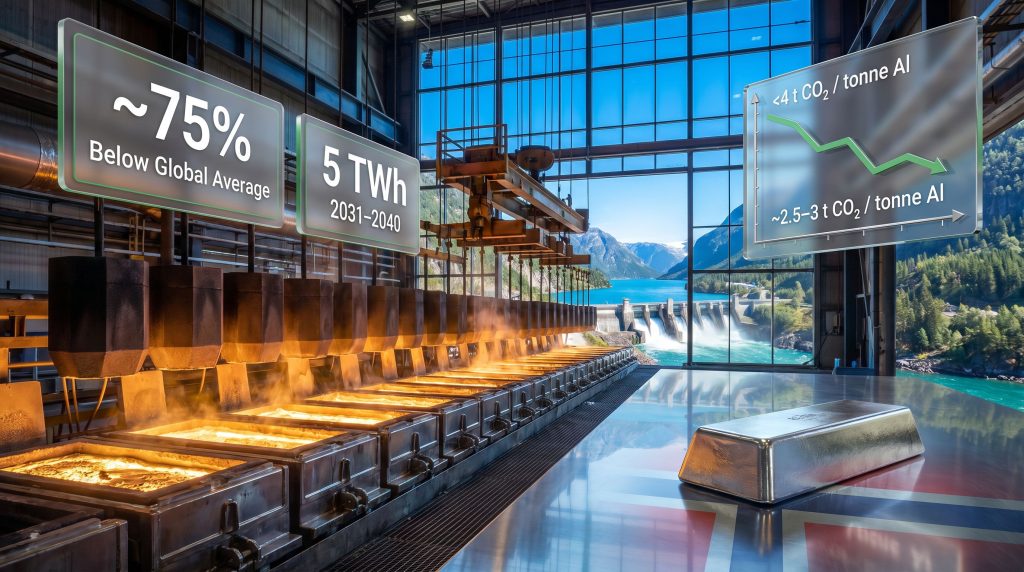
The Hydro Eviny renewable power agreement for low-carbon aluminium production is structured as a 10-year power purchase agreement, running from 2031 through to 2040. Under its terms, Eviny Fornybar will supply 0.5 TWh of renewable electricity annually, with all delivery occurring within Norway's NO5 electricity price area. Over the full contract period, the agreement commits a total of 5 TWh of renewable energy to Hydro's Norwegian smelting operations.
| Parameter | Detail |
|---|---|
| Agreement Type | Long-term Power Purchase Agreement (PPA) |
| Annual Supply Volume | 0.5 TWh of renewable electricity |
| Contract Duration | 10 years (2031 to 2040) |
| Total Energy Commitment | 5 TWh over the contract period |
| Delivery Zone | Norway's NO5 electricity price area |
| Energy Source | Renewable (hydropower-backed) |
| Carbon Outcome | Approximately 75% below global aluminium average |
The financial logic of this structure extends well beyond carbon accounting. A decade-long energy contract at structured pricing creates the cost predictability that capital-intensive smelter operations require to justify upgrade investment. Spot market exposure introduces budget uncertainty that is incompatible with multi-year technology roadmaps. For a company pursuing net-zero commitments by 2050, locking in renewable supply through 2040 provides a stable operational foundation from which more ambitious technological transitions can be planned.
Kari Ekelund Thørud, Executive Vice President of Hydro Energy, has stated that predictable long-term access to renewable power is essential for the company's operations and will support continued delivery of low-carbon aluminium to European customers from its Norwegian facilities.
Eviny Fornybar's Role as an Expanding Renewable Energy Platform
Eviny is among Norway's major renewable energy utilities and is actively expanding its generation portfolio beyond its established hydropower base. The company has been acquiring wind energy assets in the Rogaland region, which sits within the NO2 price zone and contributes to a broader Norwegian renewable capacity build-out. This expansion reinforces Eviny's ability to honour large-volume, long-duration industrial supply commitments.
The mutual investment logic of industrial PPAs deserves emphasis here. Long-term contracts provide energy developers with bankable, predictable revenue streams that are critical for securing project financing on new generation infrastructure. New hydropower and wind developments require substantial upfront capital, and without anchor industrial customers providing contracted offtake, many projects would struggle to reach financial close.
Sonja Chirico Indrebø, Executive Vice President of Eviny Fornybar, has noted that long-term power agreements deliver the certainty needed to support investments in new renewable energy generation while ensuring industry retains access to reliable electricity supply. This reflects a genuinely symbiotic relationship: aluminium producers need renewable power certainty, and renewable developers need the revenue certainty that industrial-scale customers provide. According to analysis from Hydro's own reporting, this model of co-dependent energy investment has been central to the company's long-term planning.
How This Agreement Fits Hydro's Broader Net-Zero Architecture
Hydro's decarbonisation strategy operates across three distinct but interdependent pillars. Understanding where the Eviny PPA sits within this architecture clarifies its strategic significance.
- Renewable energy procurement secures the clean power foundation for existing electrolytic smelting operations. Long-term PPAs are the primary mechanism here.
- Process technology development encompasses the pursuit of inert anode smelting and other next-generation technologies that would eliminate process-derived CO₂ emissions entirely, taking the carbon footprint of aluminium production to near-zero when paired with renewable electricity.
- Asset portfolio management covers the upgrading of existing renewable generation infrastructure and the development of proprietary new capacity to reduce reliance on third-party supply.
The Eviny agreement directly fortifies Pillar 1 through 2040, providing the stable energy base that makes Pillars 2 and 3 financially viable. Without long-term renewable supply certainty, investment in inert anode technology or smelter upgrades carries unacceptable energy cost risk. In addition, the mining decarbonisation benefits observed across adjacent sectors confirm that this approach generates measurable economic returns beyond carbon reduction alone.
Carbon Performance: Hydro's Norwegian Operations vs. Global Industry
The carbon intensity gap between Norwegian hydropower-backed smelting and the global average is not marginal. It is transformational.
Global Average (coal-heavy grids):       ~16-18 t CO₂ per tonne Al
World Average (all grids combined):      ~10-12 t CO₂ per tonne Al
First Movers Coalition Threshold:        <4 t CO₂ per tonne Al
Hydro Norwegian Operations (estimated):  ~2.5-3 t CO₂ per tonne Al
The First Movers Coalition, a public-private initiative supported by major corporations and governments, has defined aluminium produced at less than 4 tonnes of CO₂ per tonne as meeting the threshold for near-zero classification. Hydro's Norwegian operations are estimated to already operate well below this benchmark.
Hydro has confirmed that its Norwegian aluminium production, powered by renewable energy, carries a carbon footprint approximately 75% lower than the global industry average. That performance positions the company's Norwegian output at the frontier of what is commercially achievable today using existing smelting technology. The zero-carbon metals push gaining momentum across the broader metals sector suggests this competitive bar will continue to rise.
The Regulatory Forces Driving Demand for Low-Carbon Aluminium
The commercial case for renewable-powered aluminium is no longer dependent solely on voluntary corporate sustainability commitments. A convergence of regulatory frameworks is progressively embedding carbon costs into the economics of aluminium trade and procurement.
- EU Carbon Border Adjustment Mechanism (CBAM): Fully operational from 2026, CBAM imposes carbon costs on aluminium imports based on their embedded emissions profile. Producers operating at high carbon intensity face rising import cost disadvantages in European markets, while low-carbon producers gain a structural pricing advantage.
- EU Green Deal industrial procurement standards: Green public procurement frameworks increasingly specify certified low-carbon materials in infrastructure, construction, and transport supply chains, creating direct demand signals for verified renewable-energy aluminium.
- Science-Based Targets initiative (SBTi): Downstream manufacturers with SBTi-aligned supply chain commitments are embedding carbon intensity thresholds and emissions transparency requirements into upstream supplier qualification criteria.
These frameworks collectively create a carbon price signal that flows back through the aluminium supply chain, rewarding producers with renewable energy credentials and penalising those dependent on carbon-intensive grid power. Industrial demand trends across global metals markets further illustrate how policy-driven carbon costs are reshaping procurement decisions at scale.
Downstream Commercial Demand: The Customer-Pull Dynamic
Regulatory pressure is reinforced by direct customer demand. European automotive original equipment manufacturers, aerospace suppliers, and construction sector buyers are incorporating carbon intensity thresholds into supplier selection criteria. Aluminium carrying verified renewable energy provenance now commands a premium in spot and contract markets, creating direct revenue incentives for producers to secure and certify renewable power supply.
The energy transition sector itself has emerged as a rapidly growing demand centre for low-carbon aluminium. Offshore wind turbine components, power transmission cables, and electrical grid infrastructure all require significant aluminium volumes, and procurement specifications in this sector are increasingly incorporating sustainability credentials. As IRENA's analysis on reaching zero emissions in aluminium makes clear, scaling renewable-backed production is central to meeting these emerging supply requirements.
Hydro's recently announced 85,000-tonne supply agreement with Nexans for low-carbon aluminium destined for European power grid infrastructure illustrates how renewable energy procurement and downstream commercial contracts have become structurally linked. Securing renewable power is no longer merely an environmental strategy — it is a prerequisite for winning certain industrial supply contracts. Furthermore, the low-carbon aluminium venture model emerging elsewhere in the industry signals that this approach is becoming an industry-wide standard rather than an exception.
The next major ASX story will hit our subscribers first
Long-Term PPAs as Multi-Dimensional Value Creation Tools
The value generated by decade-scale power purchase agreements extends across multiple dimensions simultaneously, making simple carbon reduction accounting an incomplete measure of their strategic worth.
| Benefit Category | Mechanism | Operational Impact |
|---|---|---|
| Price Stability | Structured tariffs over 10 years | Shields margins from European spot market volatility |
| Capital Justification | Revenue certainty enables upgrade investment | Supports technology roadmap execution |
| Green Product Certification | Renewable provenance documentation | Enables premium pricing and EU market access |
| Regulatory Compliance | Documented low-carbon power sourcing | Reduces CBAM liability and ESG reporting burden |
| Supplier Partnership | Long-term relationship with energy provider | Preferred access to future generation capacity |
One dimension that receives insufficient attention in mainstream coverage is the role of industrial anchor tenants in enabling renewable energy project development. When Hydro commits to purchasing 0.5 TWh annually for a decade, it is not merely securing supply for itself. It is providing Eviny with the contracted revenue certainty required to finance new renewable generation assets. This creates a positive feedback loop: industrial demand enables new renewable supply, which in turn supports further industrial decarbonisation.
Hydro's Multi-Channel Power Diversification Strategy
The Eviny PPA represents one component of a broader, multi-channel approach to power sourcing that Hydro is actively developing. The company has indicated it will continue pursuing:
- Additional long-term power purchase agreements with other renewable generators
- Development of proprietary new renewable energy projects
- Upgrades and capacity expansions across its existing renewable energy asset base
This diversification strategy is not incidental. Concentrating energy supply within a single counterparty relationship introduces operational and financial risk over a decade-plus horizon. A multi-channel approach distributes this risk while maintaining the long-term price stability and carbon certification benefits that structured PPAs deliver.
It also provides commercial flexibility as Norway's energy market evolves through the 2030s. New generation technologies, grid infrastructure development, and evolving electricity pricing dynamics could reshape the optimal procurement mix. A diversified supply base positions Hydro to adapt without abandoning the core renewable commitment underpinning its low-carbon product offering.
Scenario Pathways: Low-Carbon Aluminium Through 2040
Looking forward, three credible scenarios shape the commercial environment in which the Hydro Eviny renewable power agreement for low-carbon aluminium production will operate.
Scenario A: Accelerated Green Premium Adoption. European downstream manufacturers rapidly embed carbon intensity thresholds into procurement frameworks, driving a meaningful price premium for aluminium certified below 4 tonnes of CO₂ per tonne. Producers with long-term renewable PPAs already in place capture disproportionate margin expansion as competitors struggle to retrofit their energy supply arrangements.
Scenario B: CBAM-Driven Import Substitution. Rising carbon border costs progressively erode the price competitiveness of coal-powered aluminium imports from outside the EU. European demand redirects toward Nordic and other low-carbon producers. Hydro's Norwegian operations benefit from structural volume growth as the arbitrage between low-carbon and high-carbon aluminium widens.
Scenario C: Inert Anode Technology Deployment. Commercial deployment of inert anode smelting technology eliminates process CO₂ emissions, reducing aluminium's carbon footprint to near-zero when combined with renewable electricity. Producers already operating on renewable power, with long-term supply agreements extending through the deployment window, are best positioned to adopt this technology at industrial scale without energy supply disruption. Research into decarbonising aluminium consistently identifies renewable power procurement as the foundational enabler for this transition.
Across all three scenarios, the common thread is clear: producers with renewable power secured at scale and over long timeframes hold a structural advantage that grows more valuable as carbon constraints tighten.
Frequently Asked Questions
What is covered under the Hydro Eviny power purchase agreement?
Hydro Energy and Eviny Fornybar have entered into a 10-year agreement under which Eviny will supply 0.5 TWh of renewable electricity annually from 2031 to 2040, totalling 5 TWh across the contract period. Delivery is within Norway's NO5 electricity price area.
How does renewable electricity reduce aluminium's carbon footprint so significantly?
The Hall-Héroult electrolysis process is extraordinarily electricity-intensive, consuming 13 to 15 MWh per tonne of metal produced. Because electricity is the dominant input, its carbon content determines the product's overall emissions profile. Replacing coal-grid power with renewable hydropower can reduce the carbon footprint of aluminium production by more than 80% on a like-for-like operational basis.
Why does the location of power delivery within Norway matter?
Norway's grid is divided into distinct bidding zones with different generation profiles and pricing dynamics. The NO5 Western Norway zone hosts both significant hydropower capacity and major smelting operations. Localised delivery reduces transmission losses, aligns generation with consumption patterns, and simplifies the logistics of large-volume renewable energy accounting and certification.
What is inert anode technology and why is it relevant here?
Conventional Hall-Héroult smelting uses carbon anodes that react during electrolysis to produce CO₂ as a process byproduct. Inert anode technology replaces carbon anodes with non-consumable materials, eliminating this process CO₂ emission entirely. When combined with renewable electricity, inert anode smelting could theoretically reduce aluminium's carbon footprint to near-zero. Hydro is among the producers actively developing this technology. Long-term renewable power contracts are foundational to making inert anode deployment commercially viable.
How does CBAM affect aluminium producers differently based on their power source?
The EU Carbon Border Adjustment Mechanism prices aluminium imports based on their embedded carbon content. Producers operating on renewable power carry far lower embedded carbon and therefore face minimal CBAM liability. Producers relying on coal or mixed-grid power face progressively higher import costs as CBAM rates increase. This mechanism effectively transfers a structural cost advantage to low-carbon producers in EU markets over time.
Want to Identify the Next Major ASX Mineral Discovery Before the Market Moves?
Discovery Alert's proprietary Discovery IQ model delivers real-time alerts on significant ASX mineral discoveries, transforming complex geological data into actionable investment insights for both short-term traders and long-term investors — begin your 14-day free trial today. Explore why major mineral discoveries can generate extraordinary returns by visiting Discovery Alert's dedicated discoveries page, where historic examples illustrate just how transformative early positioning can be.