July 7, 2026
When a Pipeline Becomes a Legal Frontier: The Global Stakes of EACOP
The global energy transition demand has produced an unexpected consequence: courts in wealthy nations are increasingly being asked to rule on the environmental conduct of multinational corporations operating on the other side of the world. This is not a minor procedural quirk. It represents a fundamental restructuring of how corporate accountability works across borders, and it is reshaping the risk calculus for every major energy project in the developing world.
The lawsuit filed on 7 July 2026 by four Ugandan farmers against EACOP Ltd at the High Court of England and Wales is the latest, and perhaps most consequential, expression of this trend. Ugandan farmers sue East African Crude Oil Pipeline in a UK court — and the case sits at the intersection of African sovereign development ambitions, global climate litigation strategy, and the increasingly contested question of whether a company's place of incorporation determines where it can be held legally responsible for its actions.
When big ASX news breaks, our subscribers know first
What Is the East African Crude Oil Pipeline and Why Does It Matter?
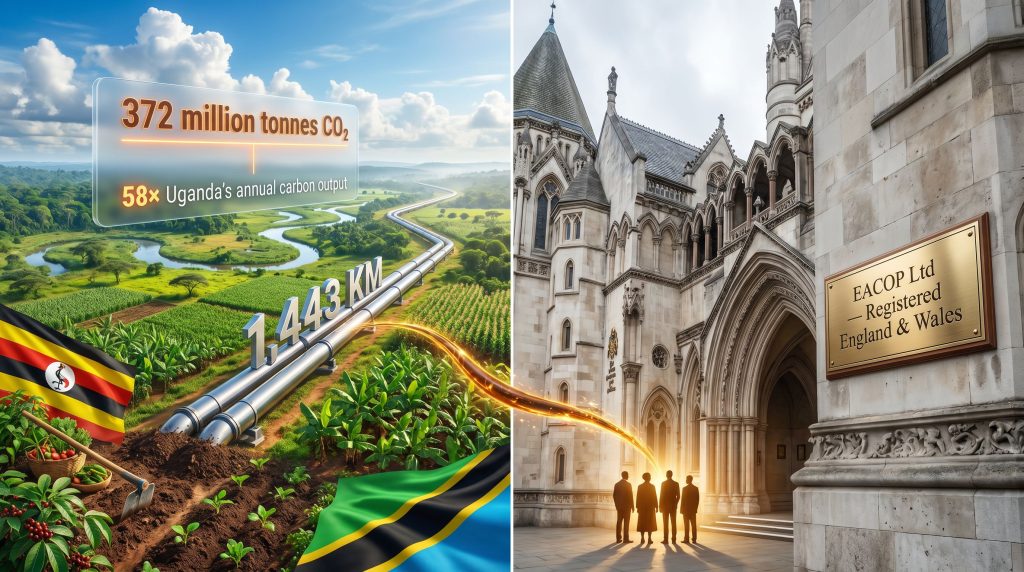
The East African Crude Oil Pipeline is one of the most technically complex and geopolitically significant infrastructure projects on the African continent. At 1,443 kilometres in length, it will connect Uganda's oil-producing Albertine Graben region to Tanzania's Port of Tanga, creating the first commercially viable export route for Uganda's landlocked crude reserves.
Key Infrastructure Facts at a Glance
| Metric | Detail |
|---|---|
| Total Project Value | $5.6 billion |
| Pipeline Length | 1,443 kilometres (897 miles) |
| Route | Hoima, Uganda to Port of Tanga, Tanzania |
| Daily Capacity | Up to 230,000 barrels per day |
| Operating Temperature | Approximately 50°C |
| Construction Completion | Approximately 75–80% complete as of mid-2026 |
| First Export Target | October 2026, Port of Tanga |
| Uganda's Estimated Reserves | 6.5 billion barrels of crude oil |
The pipeline's operating temperature is not an incidental engineering detail. Uganda's Albertine Graben crude is classified as waxy, meaning it solidifies at ambient temperatures and must be kept at around 50 degrees Celsius throughout its entire journey to remain fluid enough to flow. This makes EACOP not just the world's longest heated crude oil pipeline once completed, but one of the most technically demanding pipeline projects ever constructed in a tropical environment.
Who Owns and Operates EACOP?
The project is structured as a joint venture with several major stakeholders:
- TotalEnergies (France): Lead developer and majority equity partner
- Uganda National Oil Company (UNOC): Ugandan state interest
- Tanzania Petroleum Development Corporation (TPDC): Tanzanian state interest
- CNOOC (China): Chinese equity partner
- EACOP Ltd: The UK-registered operating entity incorporated under English and Welsh law and listed at Companies House in London
The registration of EACOP Ltd under English and Welsh law is not merely an administrative formality. It is the single jurisdictional fact that makes the entire UK legal strategy viable. Without it, the case would have no standing in British courts regardless of the environmental or constitutional arguments being advanced.
Why Ugandan Farmers Are Suing in the UK Rather Than East Africa
The decision to file this lawsuit in London rather than Kampala or Dar es Salaam reflects a sophisticated understanding of how transnational corporate accountability litigation works in practice. Ugandan farmers sue East African Crude Oil Pipeline in a UK court not as an act of legal desperation, but as a calculated jurisdictional choice built on precedent. Furthermore, the geopolitical mining risks that shape energy infrastructure decisions across Africa make this case all the more significant.
The Procedural Logic Behind the UK Filing
Because EACOP Ltd holds its corporate registration in England and Wales, it falls within the jurisdiction of the English legal system. This means English courts have the procedural authority to hear claims against it, regardless of where the pipeline physically operates or where the alleged harm is occurring.
This approach has a formal name in international legal practice: transnational corporate accountability litigation. Its core premise is that the home jurisdiction of a multinational's operating entity carries legal obligations that extend to that entity's conduct anywhere in the world.
Why the East African Court of Justice Could Not Hear the Case
A prior legal challenge was filed at the East African Court of Justice before the UK action was initiated. However, it was dismissed entirely on procedural grounds. The appeal had been submitted outside the mandatory 60-day filing window, meaning the substantive environmental and constitutional arguments were never examined on their merits by that court.
This dismissal, rather than discouraging the plaintiffs, appears to have sharpened the strategic pivot toward the UK judiciary. Lawyers at British firm Leigh Day, which has built a substantial track record in international environmental and human rights cases, identified the UK registration of EACOP Ltd as the jurisdictional opening required to bring the case before an English tribunal.
Key reasons the UK forum was selected include:
- The UK's developed body of case law on corporate duty of care across international subsidiaries
- Established precedent from prior transnational cases confirming English court jurisdiction over UK-registered entities operating abroad
- Greater procedural accessibility for this category of constitutional and environmental claim
- EACOP Ltd's verified status on Companies House as an England and Wales incorporated entity
The Legal Arguments at the Core of the Claim
Constitutional and Statutory Grounds
The four Ugandan farmers, represented by Leigh Day, have constructed a multi-layered argument that draws on Ugandan domestic law while leveraging the jurisdictional reach of English courts over a UK-incorporated company. The claim rests on three primary legal grounds:
- Ugandan Constitutional Violation — The plaintiffs argue the pipeline infringes Article 39 of Uganda's Constitution, which establishes every citizen's right to a clean and healthy environment as a justiciable constitutional protection
- National Environment Act Breach — Allegations that the project fails to meet statutory environmental standards mandated under Uganda's national environmental legislation
- National Climate Change Act Violation — The claim asserts that the pipeline's projected lifetime emissions are fundamentally incompatible with Uganda's own statutory climate commitments
The Emissions Calculation That Underpins the Climate Argument
Independent estimates cited in the legal claim place EACOP's projected lifetime CO2 emissions at approximately 372 million tonnes — a volume calculated to be more than 58 times Uganda's total annual carbon output. This figure forms the quantitative backbone of the plaintiffs' argument that the project cannot be reconciled with any credible national climate framework.
This is not merely a rhetorical point. It creates a specific legal tension with Uganda's National Climate Change Act, which was enacted as binding domestic legislation. If a court finds that the pipeline's emissions trajectory is incompatible with that statute, the legal implications for the project's operational licence could be significant.
The Human and Environmental Dimension
Land Displacement at Scale
The lawsuit's human rights component is grounded in documented displacement data. More than 100,000 people have already been affected by land acquisition and resettlement processes linked to the pipeline's construction corridor, making this one of the largest involuntary displacement events associated with a single infrastructure project in recent East African history.
The affected population is predominantly composed of smallholder farmers whose agricultural land, water access, and livelihoods sit directly within the pipeline's physical footprint. For communities whose food security depends on the land beneath which the pipeline now runs, the disruption extends well beyond temporary construction inconvenience.
Ecological Exposure Along the 1,443-Kilometre Route
The environmental case presented by the plaintiffs addresses several distinct categories of ecological risk:
- Freshwater contamination from potential pipeline ruptures at river crossings and lake basin zones along the route
- Biodiversity corridor disruption across protected and semi-protected habitat areas, including zones within the Albertine Graben
- Long-term climate contribution through the combustion of extracted crude, compounding existing regional climate vulnerabilities
The Albertine Graben region, where Uganda's oil reserves are concentrated, is widely recognised by conservation scientists as one of Africa's most biodiverse zones. It harbours significant concentrations of endemic species found nowhere else on Earth, including unique primate populations and freshwater fish species. This ecological context adds a layer of scientific weight to the environmental arguments being made in court.
The Economic Counterweight: What EACOP Means for Uganda and Tanzania
No honest analysis of this legal dispute can ignore the economic stakes on the other side of the argument. Both Uganda and Tanzania have anchored significant portions of their medium-term development strategies on EACOP becoming operational. In addition, African mining finance trends illustrate how deeply resource extraction is woven into the economic planning of sub-Saharan nations.
Uganda holds an estimated 6.5 billion barrels of crude reserves in the Albertine Graben, confirmed since the mid-2000s. Without EACOP, those reserves have no commercially viable export route. The pipeline is not a peripheral energy project for Uganda — it is the prerequisite condition for the country's entry into the global crude market.
Tanzania's economic stake, while different in character, is already tangible. Tanzanian authorities have recorded approximately 50 billion Tanzanian shillings (roughly $19.5 million USD) in tax revenues, levies, and construction-related economic activity generated by the project before a single barrel has been exported.
What Different Legal Outcomes Could Mean
| Scenario | Potential Consequence |
|---|---|
| Injunction granted before October 2026 | First oil exports delayed; financing arrangements under pressure |
| Ruling in favour of plaintiffs on constitutional grounds | Legal precedent requiring environmental remediation or project redesign |
| Case dismissed or deferred | Pipeline proceeds; plaintiffs' legal options significantly narrowed |
| Partial ruling on procedural grounds only | Temporary operational uncertainty without structural project halt |
The next major ASX story will hit our subscribers first
How This Case Fits the Global Pattern of Transnational Climate Litigation
A Body of Precedent That Has Been Building for Years
The case in which Ugandan farmers sue East African Crude Oil Pipeline does not emerge from a legal vacuum. It is the latest chapter in an accelerating global pattern where communities in lower-income countries seek legal remedies against multinational energy companies in the courts of the countries where those companies are headquartered or incorporated.
Several landmark cases have established and reinforced the principle that corporate registration in a high-income jurisdiction creates justiciable obligations regardless of where operational harm occurs:
- Shell Nigeria / Ogale Community (UK Supreme Court, 2021): Nigerian communities successfully argued that English courts held jurisdiction over Shell's UK parent entity for environmental damage caused by its Nigerian subsidiary, opening the door for similar claims
- Milieudefensie v. Shell (Netherlands, 2021): A Dutch court ordered Shell to reduce its global CO2 emissions by 45% by 2030, citing human rights and environmental obligations that extended across the company's entire operations
- Vedanta / Zambian Copper Belt Communities (UK, 2019): The UK Supreme Court confirmed that English courts had jurisdiction over a UK-listed mining company for environmental harm caused by its Zambian subsidiary, providing the clearest precedent for the EACOP strategy
Each of these cases contributed to a legal architecture that the Ugandan plaintiffs are now seeking to apply to East Africa. The pattern is consistent: identify the jurisdiction of incorporation, establish the link between that entity and the operational harm, and use the host country's legal system as the enforcement mechanism.
The Crowdfunding Infrastructure Behind Climate Litigation
One dimension of this case that deserves particular attention is its financing model. The litigation is being funded through a crowdfunding campaign coordinated by Avaaz, a global civic advocacy organisation, which has mobilised contributions from more than 40,000 individual donors worldwide.
This democratisation of climate litigation funding is itself a relatively new phenomenon. Consequently, it significantly lowers the barrier for communities in low-income countries to pursue legal remedies against well-resourced multinational corporations in foreign courts. The mining energy transition debate mirrors these broader tensions between development imperatives and environmental accountability.
Critical Dates and Decision Points
For anyone tracking the intersection of African energy development and international climate law, the following timeline represents the key milestones in the months ahead:
| Date / Period | Event |
|---|---|
| Prior to 2026 | Challenge filed at the East African Court of Justice |
| Pre-2026 | EACJ dismisses case on procedural grounds |
| 7 July 2026 | Lawsuit filed at the High Court of England and Wales |
| October 2026 (projected) | First crude exports targeted through Port of Tanga |
| Ongoing | Court scheduling; potential interim injunction applications; TotalEnergies legal response |
The window between the July filing date and the October export target represents the period of maximum legal leverage for the plaintiffs. Any interim relief obtained before the first oil flows through the pipeline would represent a disruption to the project's commercial timeline of a magnitude that financing partners and equity holders would need to factor into their assessments. For context on how green transition minerals and fossil fuel investments are increasingly viewed through competing legal lenses, this case offers a telling illustration.
Frequently Asked Questions: EACOP UK Lawsuit
Why does UK incorporation give English courts jurisdiction over a pipeline in Africa?
When a company is incorporated under the laws of England and Wales, it becomes subject to the English legal system's procedural authority. This means that claims can be filed against it in English courts even when its physical operations are located entirely outside the United Kingdom. EACOP Ltd's Companies House registration is the specific legal fact that establishes this connection.
Could a UK court actually halt pipeline construction?
A court could theoretically grant an interim injunction that prevents the pipeline from becoming operational or delays first oil exports. However, obtaining such relief requires meeting a high legal threshold. More likely in the near term is a substantive hearing that generates binding legal obligations, remediation requirements, or constitutional findings over a longer timeframe.
What are the pipeline's projected lifetime emissions?
Independent estimates cited in the legal claim put EACOP's total lifetime CO2 emissions at approximately 372 million tonnes — a figure that exceeds Uganda's annual national carbon output by a factor of more than 58. According to reporting on the case, this emissions calculation is central to the plaintiffs' constitutional argument.
How was the lawsuit funded?
The litigation is crowdfunded through the global campaign platform Avaaz, which has coordinated contributions from more than 40,000 individual donors to cover the costs of UK High Court proceedings on behalf of the four Ugandan farmer-plaintiffs.
What is waxy crude and why does it matter for EACOP's design?
Ugandan crude from the Albertine Graben has a high wax content, which causes it to solidify at ambient temperatures. The pipeline must therefore maintain the oil at approximately 50 degrees Celsius throughout its entire 1,443-kilometre length to keep the crude in a fluid, pumpable state. This heating requirement is one of the primary technical and cost factors that distinguishes EACOP from conventional unheated pipelines.
Disclaimer: This article is intended for informational purposes only and does not constitute legal, financial, or investment advice. Legal proceedings involve inherent uncertainty, and outcomes cannot be predicted with confidence. Readers should consult qualified professional advisers before making decisions based on information contained in this article.
Want to Stay Ahead of the Resource Discoveries Reshaping Global Markets?
As legal and geopolitical pressures intensify around major energy and resource projects like EACOP, Discovery Alert's proprietary Discovery IQ model delivers real-time alerts on significant ASX mineral discoveries, transforming complex resource data into actionable investment insights — explore historic discoveries and their market returns to understand the scale of opportunity, and begin your 14-day free trial at Discovery Alert to position yourself ahead of the next major find.