July 7, 2026
The Iron Ore Grade Advantage That Makes Arctic Shipping Worth It
In the global iron ore trade, grade is everything. While the world's largest producers compete on volume, a select group of operations compete on chemistry. The iron content of ore shipped to a blast furnace directly influences energy consumption, slag generation, and ultimately the carbon footprint of every tonne of steel produced. This is the lens through which Baffinland Mary River iron ore shipments deserve to be understood, not simply as a remote Canadian curiosity, but as a strategically positioned supply source at a moment when European steelmakers are under mounting pressure to clean up their production processes.
The economics of high-grade direct shipping ore, or DSO, are fundamentally different from those of lower-grade operations that require beneficiation. No flotation circuits. No magnetic separation. No tailings ponds. Ore is blasted, crushed, screened, and trucked to port. That simplicity carries profound cost and environmental implications, and it explains why the Mary River deposit attracted serious development capital despite sitting on one of the most logistically unforgiving coastlines on the planet.
When big ASX news breaks, our subscribers know first
What Makes the Mary River Deposit Geologically Unusual
The Mary River Mine property on northern Baffin Island in Nunavut sits within a Precambrian iron formation that has undergone extensive natural enrichment over geological time. This enrichment process, driven by supergene alteration and groundwater leaching of silica, concentrates iron content far above the levels found in typical banded iron formations. The result is ore that can be loaded directly onto bulk carriers and delivered to European blast furnaces without any intermediate processing step.
The property contains five distinct iron ore deposits, though commercial production has centred exclusively on Deposit #1. This selective focus is not accidental. Deposit #1 offers a combination of ore quality, geometry, and surface accessibility that makes it the logical starting point for what was originally conceived as an 18-million-tonne-per-year long-term operation.
Key characteristics of the Mary River ore body include:
- Exceptionally high iron content classifying the product as premium DSO suitable for direct charge into blast furnaces
- Low impurity levels that reduce slag volumes and improve energy efficiency at the steelmaking stage
- Near-surface geometry amenable to conventional open-pit truck-and-shovel mining methods
- Rock competency that allows the use of portable crushing equipment positioned directly at the mine site rather than a fixed processing plant
The absence of a processing plant is not a limitation. It is a deliberate and economically rational choice that eliminates an entire category of capital expenditure and ongoing operating cost.
From Concept to First Shipment: A Decade of Arctic Development
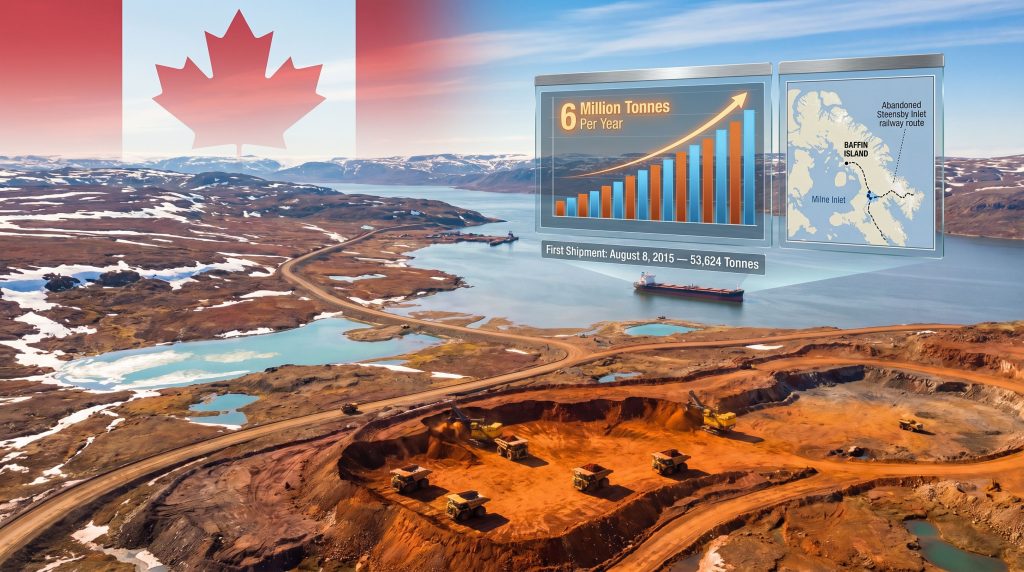
Commercial Baffinland Mary River iron ore shipments began on August 8, 2015, when the first bulk carrier departed Milne Inlet carrying approximately 53,624 tonnes of iron ore bound for Germany. That single shipment represented the culmination of years of exploration, feasibility work, regulatory review, and infrastructure construction in one of the most challenging operating environments in the world.
Ore reaches Milne Port via an approximately 100-kilometre tote road that connects the mine site to the seasonal bulk loading facility on the inlet. Haul trucks operate this route continuously during the mining season, delivering crushed and screened ore to stockpiles at the port. The logistical intensity of this arrangement is not insignificant, but it has proven reliable across multiple operating seasons.
The shipping season itself is constrained by Arctic sea ice, with the operational window typically running from approximately July through October. Outside this window, ice conditions at Milne Inlet prevent safe vessel navigation, meaning the entire annual production programme must be executed and exported within roughly four months.
How Annual Shipping Volumes Have Evolved
The trajectory of approved shipping volumes at Mary River reflects a regulatory philosophy that prioritises incremental, evidence-based expansion over wholesale transformation.
| Phase or Period | Annual Volume | Key Context |
|---|---|---|
| Initial production from 2015 | 3.5 million tonnes | Baseline approved shipping rate at project launch |
| Record single season (2018) | 5+ million tonnes | Highest volume achieved to that point |
| Previous approved cap | 4.2 million tonnes | Regulatory ceiling prior to 2023 decision |
| Current approved cap | 6 million tonnes | Approved by Northern Affairs Minister Dan Vandal |
| Contingency allowance | Exceeds 6 million tonnes | Permitted when prior-season stockpiles remain at port |
| Phase 2 proposal (rejected) | 12 million tonnes | Required 110 km railway and Steensby Inlet port |
| Original long-term vision | 18 million tonnes | Full-scale development target from Deposit #1 |
The contingency provision within the current approval is worth understanding carefully. In seasons where heavy sea ice forces an early end to shipping and ore stockpiles remain at Milne Inlet from the prior year, Baffinland is permitted to ship volumes exceeding the standard 6-million-tonne cap. This is not a loophole but a practical acknowledgement that Arctic weather events can compress shipping seasons unpredictably, and that penalising operators for circumstances beyond their control would be commercially irrational.
The Regulatory Architecture Governing Arctic Iron Ore
All operational changes at Mary River pass through the Nunavut Impact Review Board (NIRB), which serves as Canada's primary environmental and social assessment mechanism for projects operating within Nunavut. The NIRB process is comprehensive, incorporating scientific review, community consultation, and traditional knowledge assessment before any recommendation is forwarded to the federal level.
In the case of the increase from 4.2 million to 6 million tonnes per year, the NIRB had already recommended acceptance of the proposal before Northern Affairs Minister Dan Vandal issued formal ministerial approval. The two-step structure of this decision process, NIRB recommendation followed by ministerial sign-off, reflects the layered nature of Arctic resource governance under the Nunavut Land Claims Agreement framework.
Environmental considerations that receive ongoing scrutiny in the context of increased vessel traffic through Milne Inlet include:
- Potential disruption to narwhal and bowhead whale migration corridors that intersect with shipping lanes
- Noise pollution and physical disturbance from icebreaker-assisted bulk carrier movements
- Cumulative effects on Inuit harvesting rights and traditional land use patterns
- Seabed and water column impacts from vessel traffic in shallow coastal areas
The approved shipping increase carries associated environmental monitoring and reporting obligations, ensuring that any impacts on marine mammals or Inuit subsistence activities can be identified and addressed in real time.
Why Phase 2 Failed and What That Reveals About Policy Thresholds
The federal rejection of Baffinland's Phase 2 expansion proposal represents one of the more instructive regulatory outcomes in recent Canadian Arctic mining history. The proposal would have scaled annual output to 12 million tonnes through the construction of a 110-kilometre railway connecting the mine to a new deep-water port facility at Steensby Inlet on the western coast of Baffin Island. Furthermore, it was explicitly framed as a mechanism to sustain and expand employment opportunities for Inuit workers in Nunavut.
Critically, the Phase 2 application contained no changes to mining or crushing operations at the mine site itself. The objection was centred entirely on the scale and footprint of the proposed infrastructure. Consequently, layoffs and scaled-back shipping followed as Baffinland refocused its strategy around the Steensby railway alternative.
The contrast between the Phase 2 rejection and the subsequent approval of the incremental 6-million-tonne shipping increase reveals something important about how Canadian regulators approach Arctic resource development. Operational improvements that work within existing infrastructure corridors receive a materially different level of scrutiny than proposals requiring transformational new infrastructure.
The Steensby Inlet strategy was strategically significant because a western Baffin Island deep-water port would have offered fundamentally different ice conditions and potentially a longer annual shipping window than Milne Inlet. Its abandonment, at least for now, means that Milne Inlet remains the sole export pathway and that seasonal shipping efficiency will remain the single most important operational variable at Mary River for the foreseeable future.
The next major ASX story will hit our subscribers first
Inuit Community Interests and the Social Licence Question
The Mary River project operates within a social and legal framework that gives Inuit communities meaningful influence over its trajectory. Nunavut Tunngavik Incorporated (NTI) and regional Inuit associations hold formal consultation rights under the Nunavut Land Claims Agreement, and Baffinland maintains specific obligations around Inuit employment and procurement from Inuit-owned businesses.
The Phase 2 rejection complicated the social licence narrative in an interesting way. The expansion was partly justified on economic grounds as a driver of long-term employment and community benefit in Nunavut. Its rejection therefore removed a proposed source of economic opportunity that had been presented to communities as a reason to support expanded operations. How this tension resolves over the medium term may shape the regulatory appetite for any future incremental increases beyond 6 million tonnes.
Mary River Ore in a Decarbonising Steel Market
The timing of the 6-million-tonne approval intersects with a structural shift in European steel markets that may increase demand for premium iron ore grades over time. The European Union's Carbon Border Adjustment Mechanism (CBAM), which places a carbon cost on imported steel based on embedded emissions, creates an incentive for European steelmakers to optimise raw material inputs for lower carbon intensity per tonne of steel produced.
High-grade, low-impurity ores like those from Mary River reduce the energy input required per tonne of hot metal, which translates directly into lower carbon emissions at the steelmaking stage. This dynamic positions premium DSO from Arctic Canada as a material that aligns with, rather than conflicts with, the decarbonisation agenda of European steel producers. In addition, iron ore price trends in China are also shaping global demand signals that influence where premium-grade supply is directed.
Global iron ore supply is dominated by Australian and Brazilian producers including BHP, Rio Tinto, and Vale, whose enormous volumes dwarf what any single Canadian Arctic operation can deliver. At 6 million tonnes per year, Mary River is a mid-scale producer by global standards. However, its grade positioning in a market increasingly sensitive to carbon intensity per unit of output gives it a competitive relevance that pure volume comparisons do not capture. Furthermore, Australia's iron ore advantages in scale and logistics infrastructure serve as a useful benchmark for understanding where Arctic producers must differentiate on quality rather than cost.
How Does Mary River Compare Within the Broader Decarbonisation Push?
The broader push towards lower-emissions steelmaking is reshaping raw material preferences globally. For instance, green iron production initiatives in Australia are exploring how high-grade ores can feed directly into hydrogen-based reduction processes. Similarly, advances in hydrogen iron ore reduction technology are increasing the premium that steelmakers are willing to pay for chemically suitable feedstocks. Mary River's ore chemistry positions it well within this evolving demand landscape.
Consequently, the China steel and iron ore outlook also remains relevant, given that Chinese mills are increasingly attentive to ore quality as they face domestic emissions reduction targets. Premium DSO grades from operations like Mary River may find growing relevance in Asian markets as well as European ones over the coming decade.
Climate Change as a Dual Variable for Arctic Shipping
The relationship between Arctic climate change and Mary River's operational outlook is more complex than a simple narrative about melting ice opening new opportunities. Two competing dynamics are at work simultaneously.
On one side, gradual long-term reduction in Arctic sea ice extent has the potential to extend the navigable season at Milne Inlet over coming decades, allowing Baffinland to push ore volumes higher within approved caps and reduce the per-tonne cost of seasonal operations.
On the other side, increasing weather variability in a warming Arctic creates greater year-to-year unpredictability in ice conditions. The same season that saw ore stockpiled at Milne Inlet due to early ice closure, triggering the contingency provision within the current approval, is a product of this variability rather than a contradiction of warming trends. The Arctic is not uniformly or predictably becoming more navigable. It is becoming more variable, and that distinction matters for operational planning.
Frequently Asked Questions: Baffinland Mary River Iron Ore Shipments
What is the current approved annual shipping volume from Mary River?
The federally approved shipping limit from Milne Inlet currently stands at 6 million tonnes per year. A contingency allowance permits higher volumes in years where stockpiled ore from a previous season remains at port due to early ice closure.
When did commercial iron ore shipments from Mary River begin?
Commercial operations commenced on August 8, 2015, when the first bulk carrier left Milne Inlet carrying approximately 53,624 tonnes of iron ore destined for Germany.
What shipping season does Mary River operate within?
Arctic sea ice conditions constrain the shipping window to approximately July through October each year.
Why was the Phase 2 expansion rejected?
The federal government rejected the Phase 2 proposal, which would have increased production to 12 million tonnes per year via a 110-kilometre railway and a new port at Steensby Inlet, based on the scale of environmental and social impacts associated with the proposed infrastructure.
How many iron ore deposits exist at the Mary River property?
The Mary River property contains five iron ore deposits, with current production focused on Deposit #1.
Who regulates iron ore shipments from Mary River?
Operational changes are assessed through the Nunavut Impact Review Board (NIRB), with final approval authority held by the federal Minister of Northern Affairs.
Key Strategic Takeaways for Industry Observers
- The step from 4.2 million to 6 million tonnes per year is commercially meaningful but represents a fraction of the originally envisioned production scale
- Milne Inlet remains the sole export pathway following the Phase 2 rejection, concentrating operational and weather risk at a single logistics node
- DSO grade quality positions Mary River favourably in a European market increasingly attentive to the carbon intensity of steelmaking inputs
- The contingency stockpile provision reflects sophisticated regulatory design that balances environmental protection with operational realism in an Arctic context
- Long-term expansion ambitions remain structurally constrained until a pathway beyond Milne Inlet is either revived or a new regulatory strategy is developed
- The interplay between Inuit community interests, environmental obligations, and commercial production goals will remain the defining governance challenge for the project's next phase
This article contains forward-looking observations regarding market trends, regulatory outcomes, and operational scenarios. Such statements involve inherent uncertainty and should not be construed as investment advice. Readers are encouraged to consult independent sources and conduct their own due diligence before making any financial or investment decisions related to the companies or commodities discussed.
Want to Stay Ahead of the Next Major Mineral Discovery on the ASX?
Discovery Alert's proprietary Discovery IQ model delivers real-time alerts on significant ASX mineral discoveries across iron ore and 30+ other commodities, instantly translating complex geological data into actionable investment insights — explore historic discovery returns to understand the opportunity, then begin your 14-day free trial at Discovery Alert to position yourself ahead of the broader market.