July 7, 2026
The Infrastructure Beneath the Energy Transition
Every offshore wind turbine, every high-voltage transmission line, and every electric vehicle charging network shares a common dependency: conductive metal capable of carrying power across vast distances at minimal loss. While lithium, cobalt, and rare earths attract most of the strategic conversation, aluminium wire rod quietly underpins the physical architecture of the energy transition. It is not glamorous, but it is indispensable.
Europe's grid modernisation ambitions are enormous in scope. The International Energy Agency has estimated that global electricity grids need to expand by more than 80 million kilometres by 2040 to accommodate the scale of renewable energy integration required to meet net-zero targets. Aluminium wire rod is the feedstock that makes this physically possible. Against this backdrop, a NOK 1.65 billion (~USD 156 million) capacity expansion at a Norwegian smelter carries far greater strategic weight than its balance sheet figure suggests.
When big ASX news breaks, our subscribers know first
What the Karmøy Wire Rod Plant Is and Why It Matters
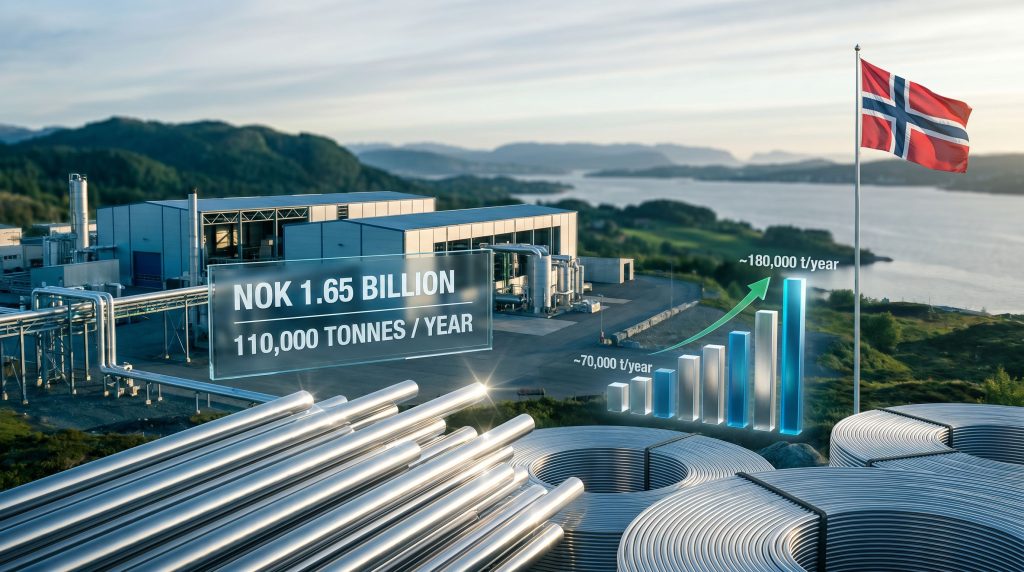
Norsk Hydro ASA is advancing a major casthouse expansion at its Karmøy aluminium smelter in western Norway, adding a dedicated wire rod production facility capable of generating 110,000 tonnes of aluminium wire rod annually. Skanska has been awarded the construction contract, valued at approximately NOK 1.1 billion (~USD 111 million), with the completed facility scheduled for handover in Q1 2028.
The project parameters in full:
| Parameter | Detail |
|---|---|
| Operator | Norsk Hydro ASA |
| Location | Karmøy, Rogaland County, Norway |
| Total Investment | NOK 1.65 billion (~USD 156 million) |
| Construction Contract | NOK 1.1 billion (~USD 111 million) |
| Builder | Skanska |
| New Annual Capacity | 110,000 tonnes of aluminium wire rod |
| Existing Wire Rod Capacity | ~70,000 tonnes/year (EC Grade) |
| Post-Expansion Wire Rod Output | ~180,000 tonnes/year combined |
| Scheduled Completion | Q1 2028 |
Construction is already underway, with Skanska confirming the contract will appear in its Nordic order bookings for the third quarter of 2026. This is described as Hydro's largest single investment in Norway in over a decade, a signal of conviction about long-term demand rather than short-term market opportunism. The Hydro wire rod expansion represents a defining moment for European aluminium supply strategy.
Understanding Aluminium Wire Rod as a Product
Aluminium wire rod is a precision-grade intermediate material, not a commodity. It is produced through continuous casting and rolling of high-purity aluminium, resulting in a coiled rod typically between 9 and 12 millimetres in diameter that serves as the primary feedstock for electrical conductors and power cables.
The dominant specification is EC Grade, shorthand for electrical conductor grade, which requires very low levels of impurities to ensure consistent electrical conductivity. Even small deviations in alloy composition can degrade conductivity performance, making this a tightly controlled production process rather than a straightforward metallurgical operation.
The preference for aluminium over copper in large-scale transmission infrastructure is driven by several practical factors:
- Aluminium carries roughly 61% of the conductivity of copper but at approximately one-third the weight, making it significantly more efficient per kilogram in overhead and submarine cable applications
- The cost differential between aluminium and copper is substantial, with aluminium trading at a fraction of copper's price on a per-tonne basis
- Aluminium is infinitely recyclable without loss of conductivity properties, supporting circular economy requirements increasingly embedded in infrastructure procurement contracts
- For high-voltage overhead transmission lines, the weight advantage of aluminium is critical because it determines tower spacing, foundation requirements, and overall infrastructure cost
Aluminium wire rod is not positioned at the commodity end of the aluminium value chain. It occupies a precision intermediate tier where material quality directly determines end-product performance in safety-critical energy infrastructure.
Europe's Wire Rod Supply Gap: Structural, Not Cyclical
The investment rationale for the Karmøy expansion cannot be understood without appreciating the structural nature of European aluminium wire rod demand growth. This is not a capacity bet placed on a commodity cycle upturn. It is a response to identifiable, policy-driven demand acceleration across multiple infrastructure segments simultaneously.
The primary demand drivers converging through the late 2020s include:
- Grid modernisation programmes across EU member states, particularly in Germany, France, and the Iberian Peninsula, requiring significant replacement and expansion of transmission and distribution networks
- Offshore wind interconnection, where submarine export cables require large volumes of high-conductivity aluminium conductors capable of operating reliably in marine environments
- EV charging infrastructure rollout, expanding low-voltage distribution capacity in urban and suburban networks across Europe
- Replacement of ageing copper-heavy infrastructure installed during the mid-twentieth century buildout of European electricity networks, much of which is now approaching or exceeding design lifespans
Europe currently sources approximately 40% of its primary aluminium from Norway, a concentration that reflects Norway's unique combination of abundant low-cost hydroelectric power and established smelting infrastructure. However, primary metal supply and downstream wire rod production capacity are distinct bottlenecks, and the latter has not kept pace with projected demand growth.
Furthermore, the challenges surrounding European raw materials supply have intensified pressure on domestic producers to scale up capacity rapidly. The competitive landscape for European wire rod production remains fragmented:
| Producer | Country | Estimated Capacity |
|---|---|---|
| Norsk Hydro (existing) | Norway | ~70,000 t/year |
| Norsk Hydro (post-expansion) | Norway | ~180,000 t/year |
| Other European producers | Various | Fragmented, smaller scale |
The scale of Hydro's capacity addition is meaningfully differentiated from typical European capacity additions, which have historically fallen in the 30,000 to 80,000 tonne per year range. By more than doubling its own wire rod output in a single investment cycle, Hydro is positioning to absorb a dominant share of European demand growth rather than incrementally participating in it.
The Physical Scope of What Skanska Is Building
The construction contract awarded to Skanska encompasses a purpose-built production building integrated into Karmøy's existing smelter complex. The new facility will house:
- Industrial furnaces for aluminium melting and precise alloy composition control
- A continuous wire rod casting and rolling production line
- Maintenance workshops and dedicated technical service areas
- Storage and logistics infrastructure
- Office and administrative facilities
Beyond the primary production building, the scope includes civil construction works, underground utilities, installation of technical systems, and full integration with Karmøy's existing smelter operations. This integration requirement adds complexity to the project, as the new plant must synchronise with upstream molten metal supply from the primary smelting circuit.
Skanska's selection reflects its established track record in large-scale industrial construction across the Nordic region and its demonstrated capability in technically complex manufacturing facility builds. The contractor's performance against its Q1 2028 target will be an important operational milestone for Hydro, given the demand-driven urgency of the capacity addition.
Hydro's Downstream Integration Strategy
Karmøy is already one of Europe's most energy-efficient primary aluminium facilities, producing approximately 270,000 tonnes of primary aluminium per year alongside roughly 220,000 tonnes of casthouse products annually in its current configuration. The Hydro aluminium wire rod plant in Norway deepens the company's vertical integration by converting more of its primary metal output into higher-margin value-added products rather than selling commodity ingot into the open market.
The economics of this shift are significant. Commodity aluminium ingot trades at a relatively tight margin above the London Metal Exchange cash price. Wire rod, by contrast, commands a meaningful premium reflecting processing complexity, quality certification, and the logistical convenience offered to cable manufacturers who receive a ready-to-use feedstock rather than a semi-finished input requiring further processing.
By capturing more of this value chain within Norway, Hydro achieves several strategic objectives simultaneously:
- Margin improvement through downstream value capture rather than commodity exposure
- Customer stickiness by embedding itself as a preferred supplier in European cable manufacturers' qualified supply chains
- Carbon differentiation by delivering a wire rod product with a demonstrably lower lifecycle carbon footprint than alternatives sourced from coal-powered production regions
- Demand resilience by linking output to infrastructure investment programmes with multi-decade spend horizons rather than cyclical industrial demand
The Carbon Advantage: Harder to Replicate Than It Appears
Karmøy's energy supply is derived from Norwegian hydroelectric power, which carries a carbon intensity orders of magnitude below the global average for aluminium smelting. The global average carbon footprint for primary aluminium production is approximately 16.5 tonnes of CO2-equivalent per tonne of metal, driven heavily by coal-powered smelters in China and other developing economies. Norwegian hydropower-smelted aluminium can achieve carbon intensities below 2 tonnes of CO2-equivalent per tonne, a differential that is increasingly commercially material.
The EU Carbon Border Adjustment Mechanism (CBAM), now in its transitional implementation phase, creates a direct financial mechanism translating this carbon advantage into a cost differential. As CBAM reaches full implementation, imported aluminium wire rod from higher-carbon production regions will face an incremental cost reflecting their embedded emissions. Hydro's Karmøy output is structurally positioned to benefit from this pricing shift without requiring any operational changes.
The carbon intensity of Norwegian hydropower-smelted aluminium is not merely a sustainability credential. Under CBAM, it becomes a hard cost advantage embedded in import pricing that competitors in coal-dependent production regions cannot replicate without fundamental energy infrastructure investment.
Consequently, the broader push toward energy transition minerals and low-carbon industrial inputs is accelerating demand for precisely the kind of certified-green aluminium that Karmøy produces. In addition, renewable-powered mining operations across the supply chain are reinforcing the low-carbon credentials of Norwegian aluminium from extraction through to finished wire rod.
Benchmarking the Investment Against European Peers
| Project Dimension | Karmøy Wire Rod Plant | Comparable European Projects |
|---|---|---|
| Investment Scale | USD 156 million | Typically USD 40-100 million |
| Capacity Addition | 110,000 t/year | Typically 30,000-80,000 t/year |
| Carbon Intensity | Very low (hydropower) | Mixed (grid-dependent) |
| Primary End Market | Energy cables, grid infrastructure | Automotive, packaging, construction |
| Build Type | Brownfield expansion | Varies |
| Strategic Demand Alignment | EU energy transition infrastructure | Sector-dependent |
The brownfield nature of the Karmøy expansion is a further differentiator. Greenfield aluminium wire rod facilities require site development, utility connection, permitting, and extended ramp-up periods. By building within an existing, operating smelter complex with established upstream metal supply, Hydro eliminates much of this execution risk and compresses the timeline from investment commitment to commercial production.
The next major ASX story will hit our subscribers first
Economic Implications for Norway and the Region
Rogaland County, where Karmøy is located, has maintained a strong industrial base anchored by the oil and gas sector and, increasingly, by the transition toward clean energy industries. The Karmøy expansion reinforces Norway's position as a supplier of processed industrial materials to European markets, extending beyond raw metal exports into precision-grade downstream products.
Norway's hydropower abundance creates a durable competitive advantage in energy-intensive manufacturing that is genuinely difficult for other European nations to replicate at scale. The mining decarbonisation benefits of operating in a renewables-rich environment are increasingly translating into tangible commercial advantages for Norwegian producers. The Karmøy investment demonstrates how this advantage can be leveraged not just at the primary smelting level but further downstream into value-added product segments where the energy cost per tonne remains significant.
Frequently Asked Questions: Hydro Karmøy Wire Rod Plant
What is the Hydro aluminium wire rod plant in Norway?
The Hydro aluminium wire rod plant in Norway is a new production facility being constructed at Hydro's Karmøy smelter in Rogaland County. Key facts:
- Location: Karmøy municipality, western Norway
- Capacity: 110,000 tonnes of aluminium wire rod per year (new addition)
- Total investment: NOK 1.65 billion (~USD 156 million)
- Builder: Skanska (NOK 1.1 billion contract)
- Completion target: Q1 2028
What products will the plant produce?
The facility will produce EC Grade aluminium wire rod for electrical conductor applications, primarily serving European power cable and transmission infrastructure manufacturers. According to Hydro's official product information, this grade is specifically engineered to meet the demanding conductivity requirements of modern grid infrastructure.
How does this expansion change Karmøy's total output?
Existing wire rod capacity at Karmøy stands at approximately 70,000 tonnes per year. Post-expansion, combined wire rod output will reach approximately 180,000 tonnes per year, within a total casthouse output of roughly 220,000 tonnes across all product forms.
Why is Karmøy strategically significant for European aluminium supply?
Karmøy combines low-cost hydroelectric power, existing world-class smelting infrastructure, and geographic proximity to European cable manufacturers. This combination makes it one of the few locations in Europe capable of producing large volumes of low-carbon wire rod at globally competitive economics. As Reuters reported, the investment underscores Norway's strategic importance to European green industrial supply chains.
What This Investment Signals to the Broader Market
A USD 156 million capacity commitment of this scale is not made on speculative demand assumptions. It reflects Hydro's view that European wire rod demand growth through the late 2020s and beyond is both large enough and durable enough to justify long-lived fixed capital investment. The signals embedded in this decision extend well beyond a single company's capital allocation:
- Demand conviction: European grid modernisation and renewable energy connectivity are generating identifiable, bankable wire rod demand at a scale not previously seen in the region
- Vertical integration imperative: Producing commodity primary metal is increasingly insufficient as a competitive strategy; downstream value capture is becoming structurally necessary
- Carbon as a commercial variable: Low-carbon provenance is transitioning from a marketing attribute to a procurement specification and, under CBAM, a direct cost factor
- Norway's industrial positioning: The country is consolidating its role as Europe's preferred source of green aluminium across both primary and downstream product categories
Industry participants and infrastructure investors should monitor the Karmøy commissioning timeline, European cable manufacturer procurement strategies, and competitor responses from other regional aluminium producers as the Hydro aluminium wire rod plant in Norway moves toward its Q1 2028 target completion date.
Readers seeking further context on aluminium wire rod markets and European energy infrastructure demand trends may find value in exploring AL Circle's specialist industry report, Aluminium Wires and Cables: Insights and Forecast to 2030, which provides forward-looking analysis of this product segment.
This article contains forward-looking statements and market projections based on publicly available information and industry analysis. Actual outcomes may differ materially from projections due to changes in policy, market conditions, or operational factors. Nothing in this article constitutes financial or investment advice.
Want to Identify the Next Major Resource Discovery Before the Market Does?
Discovery Alert's proprietary Discovery IQ model scans ASX announcements in real time, instantly alerting subscribers to significant mineral discoveries across the commodities powering the energy transition — from aluminium to copper and beyond. Explore historic discoveries and the returns they generated, then begin your 14-day free trial to position yourself ahead of the broader market.