July 7, 2026
Why Environmental Assessment Has Become the Most Consequential Step in Mine Development
Across the global mining sector, a quiet but profound recalibration is underway. Regulatory frameworks are tightening, Indigenous rights are being codified into law, and capital markets are demanding greater environmental certainty before committing to long-cycle projects. Against this backdrop, environmental assessment decisions in mining have evolved from bureaucratic milestones into the single most consequential gateway in a project's entire lifecycle. How a proponent navigates this process can determine whether a project reaches production in five years or becomes stranded in a decade of litigation.
Understanding what these decisions actually involve, how they differ across jurisdictions, and what separates a durable approval from a contested one has become essential knowledge for anyone operating in or investing in the extractive sector.
When big ASX news breaks, our subscribers know first
What Is an Environmental Assessment Decision in Mining?
An environmental assessment decision in mining is the formal regulatory determination — made following a structured evaluation of a project's predicted environmental, social, and economic impacts — that either permits, conditions, or rejects a mining project's right to proceed.
This definition sounds straightforward. In practice, it encompasses years of technical work, multi-agency coordination, legal scrutiny, and community engagement, each capable of compressing or collapsing project timelines depending on how well the proponent prepares.
EIA vs. SEA: Understanding the Two Primary Assessment Instruments
Two distinct instruments form the backbone of environmental assessment frameworks in most mining jurisdictions.
| Assessment Type | Scope | Applied To | Typical Duration |
|---|---|---|---|
| Environmental Impact Assessment (EIA) | Project-level | Individual mines or expansions | 3-5 years |
| Strategic Environmental Assessment (SEA) | Policy/sector-level | Government plans, programs, mining regions | Varies by jurisdiction |
While EIAs dominate project-level decision-making, SEAs increasingly shape the regulatory environment within which individual project assessments occur, particularly in jurisdictions pursuing critical minerals strategies.
What an Environmental Impact Statement Must Demonstrate
The Environmental Impact Statement sits at the heart of any project-level review. It must satisfy three fundamentally different audiences simultaneously.
- Regulatory bodies: Evidence that predicted impacts fall within acceptable thresholds and that enforceable monitoring mechanisms are in place
- Public and affected communities: Transparent disclosure of pre- and post-mitigation outcomes, project alternatives, and residual uncertainties
- Project proponents and capital markets: A clear articulation of environmental risk exposure and performance obligations tied to project financing
Failing to speak credibly to any one of these three audiences is enough to derail an otherwise technically sound assessment. Many project delays trace back not to scientific deficiencies but to communication failures, particularly with communities and Indigenous groups.
How Does the Environmental Assessment Process Actually Work?
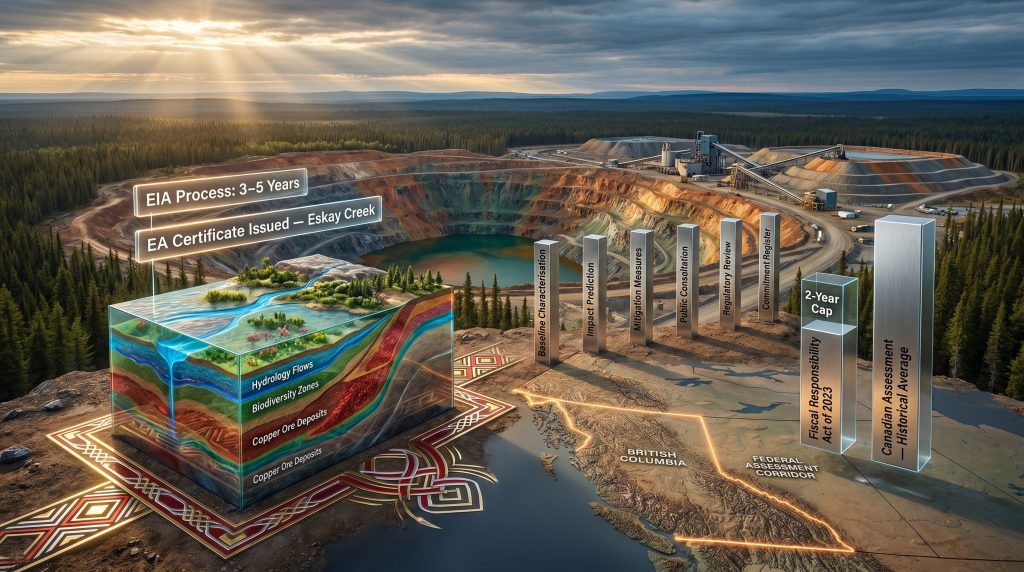
The assessment process is best understood as a six-stage analytical sequence, each building directly on the last. Shortcuts at any stage propagate forward as vulnerabilities, either in the regulatory decision itself or in post-approval enforcement actions.
Stage 1 — Baseline Characterisation: Establishing the environmental starting point before any disturbance. This includes multi-year datasets covering hydrology, biodiversity, air quality, soil chemistry, and cultural heritage. Inadequate baselines are among the most frequently litigated outcomes in mining regulatory history.
Stage 2 — Regulatory Mapping: Identifying every applicable legal obligation across federal, provincial, territorial, and Indigenous governance frameworks. In Canada, this step alone can involve dozens of overlapping instruments.
Stage 3 — Impact Identification: Stress-testing the project design against baseline conditions to predict where, when, and how significant adverse effects may occur.
Stage 4 — Mitigation Design: Applying the mitigation hierarchy — avoidance first, reduction second, and offsetting as a last resort. Regulators increasingly scrutinise whether proponents have genuinely exhausted higher-order mitigation options before defaulting to offsets.
Stage 5 — Residual Effects Analysis: Determining what remains after all feasible mitigation has been applied, and assessing whether those residual effects are significant under the applicable regulatory standard.
Stage 6 — Commitment Register: Translating all mitigation and monitoring obligations into named responsibilities with enforceable completion timelines.
A commitment register is not a formality. Regulators and courts increasingly treat these documents as legally binding instruments. Failure to maintain, update, or act on registered commitments has resulted in licence revocations and project suspensions across multiple jurisdictions.
How Do Regulatory Frameworks Differ Across Key Mining Jurisdictions?
No two jurisdictions approach environmental assessment decisions in mining identically. The divergence is widening as political priorities, Indigenous rights frameworks, and critical minerals pressures pull in different directions.
Canada: Federal-Provincial Complexity and the Reconciliation Imperative
Canada's assessment landscape is among the most legally complex in the world. British Columbia mining claims legislation, restructured in 2018, fundamentally redefined how First Nations participate in project reviews, elevating Indigenous involvement from a consultation obligation to something closer to co-governance. Federal oversight layers additional requirements, including fish habitat protections, species-at-risk obligations, and Indigenous well-being considerations.
Recent assessments across the country illustrate the range of outcomes currently moving through the system.
| Project | Jurisdiction | Decision Type | Significance |
|---|---|---|---|
| Wheeler River | Federal (CNSC) | EA Approved + Site Licence Issued | Nuclear regulatory milestone for uranium sector |
| Eskay Creek | British Columbia | EA Certificate Issued | Major economic endorsement from Mining Association of BC |
| Highland Valley Copper Extension | British Columbia | EA Certificate Issued | Life extension for established copper operation |
| Yellowhead Copper | Federal (IAAC) | IPD Accepted — Assessment Initiated | Triggers formal federal review process |
| Baptiste Nickel (FPX) | Federal (IAAC) | IPD Accepted — Assessment Triggered | Positions critical minerals project for review |
In British Columbia, the Eskay Creek decision drew particular attention, with the Mining Association of BC characterising it as a major economic win for the province. The project received its EA certificate subject to legally binding conditions and safeguards — a reminder that conditional approval is the norm rather than the exception for large-scale operations.
The pattern emerging across Canadian assessments reveals a persistent set of weaknesses: missing or insufficient baseline data, fragmented coordination between federal and provincial agencies, and inconsistent timelines that frustrate both proponents and affected communities.
United States: NEPA Reform and Statutory Deadlines
Under the National Environmental Policy Act, federal mining decisions on public lands require either an Environmental Assessment or a full Environmental Impact Statement. The Fiscal Responsibility Act of 2023 introduced a significant structural change, capping Environmental Assessments at one year and full EIS processes at two years. These are hard statutory limits, not guidelines, and they represent a substantial compression of what were previously open-ended review periods.
Furthermore, mining permit reform at the federal level has added another layer of complexity for proponents operating across multiple jurisdictions. For project proponents, faster federal decisions reduce carrying costs and improve capital planning certainty. However, if the compressed timeline results in scientifically incomplete assessments, the resulting approvals become vulnerable to legal challenge — a scenario that can ultimately extend total project timelines far beyond the old baseline.
Deep-Sea Mining: International Law as the Assessment Framework
Offshore mineral extraction introduces a structurally different challenge. Environmental assessment is a customary international law obligation under the UN Convention on the Law of the Sea for any mineral exploration activity that exceeds research-scale dimensions. The deep-sea mining concerns documented by researchers highlight that baseline data gaps in deep-ocean environments are fundamentally different in character from those encountered in terrestrial mining, given that scientific knowledge of these ecosystems often lags exploration ambition by decades.
Quebec's Accelerated Review Proposal
Quebec has signalled legislative intent to introduce faster environmental review timelines for mining projects. Industry groups have broadly welcomed the direction. Environmental and Indigenous advocacy organisations have raised substantive concerns about whether compressed timelines allow adequate scientific and community input, particularly for projects near sensitive ecosystems or Indigenous territories.
The Most Significant Challenges Facing Environmental Assessment Decision-Making
Challenge 1: The Baseline Data Problem
Decisions made on incomplete environmental baselines are among the most frequently litigated outcomes in mining regulatory history. Without robust pre-disturbance data, proponents cannot credibly demonstrate impact magnitude, and regulators cannot set defensible monitoring thresholds.
Insufficient characterisation of hydrology, biodiversity, and soil chemistry remains endemic across both developed and frontier mining jurisdictions. This is not a resource problem alone; it reflects the difficulty of collecting multi-year ecological datasets in remote environments before capital is committed to a project. The EPA's environmental impact assessment framework outlines the minimum data standards regulators expect proponents to meet at the baseline stage.
Challenge 2: The Speed vs. Scientific Rigour Tension
Governments across Canada, the United States, and Australia are under political pressure to accelerate critical minerals supply chains. Streamlining mechanisms — including phased assessments, pre-application engagement, and statutory time caps — can improve efficiency without compromising scientific standards when properly designed.
However, poorly designed fast-tracking produces a paradox: decisions made faster in the short term generate litigation exposure that causes delays far longer than the original process would have required.
Federal fast-tracking legislation in Ontario faced formal opposition from the Chiefs of Ontario, who released a comprehensive statement challenging the constitutional validity of provisions that bypassed Indigenous consultation obligations. Legal challenges to fast-tracked approvals routinely extend project timelines by years.
Challenge 3: The Multi-Dimensional Decision Problem
Environmental assessment decisions are not purely scientific determinations. Final outcomes integrate environmental science, socioeconomic modelling, political priorities, Indigenous rights frameworks, and community values simultaneously. No single agency or discipline can resolve this complexity alone, which is why multi-party coordination failures represent one of the most common sources of assessment delay and post-approval contest.
Challenge 4: Post-Decision Monitoring Failures
Approval does not end the assessment obligation; it marks the beginning of a long-term performance commitment. Monitoring programmes must be actively maintained and updated following operational changes, extreme weather events, or regulatory amendments. The mine reclamation importance cannot be overstated in this context, as incidents must feed back into the assessment record. Failure to do so has resulted in enforcement actions and licence suspensions — a consequence that capital markets are only beginning to price into project valuations.
How Indigenous Participation Is Reshaping Environmental Assessment Outcomes
From Consultation to Co-Governance
The legal standard for Indigenous participation in environmental assessment decisions in mining has shifted materially over the past decade. In British Columbia, the 2018 Environmental Assessment Act restructuring moved Indigenous involvement toward co-governance. Federal processes under the Impact Assessment Act impose requirements for meaningful consultation that go well beyond information sharing.
Indigenous-Led Assessment: A Parallel Framework Gaining Formal Recognition
The First Nations Major Projects Coalition and Firelight released a joint primer in September 2025 providing the first structured introduction to Indigenous-led assessment methodology. This document establishes key considerations for how First Nations communities can conduct their own evaluations, independent of or alongside government-led processes.
Simultaneously, the Impact Assessment Agency of Canada has funded Indigenous community participation in assessments such as the Strange Lake Project. This funding signal suggests that government policy is beginning to treat Indigenous engagement as a funded right rather than a voluntary consultation step.
What Indigenous Co-Assessment Means for Project Timelines
Proponents who treat Indigenous-led assessments as a parallel track requiring early and substantive engagement consistently achieve more durable approvals than those who engage only at formal consultation stages. The inverse is also true: projects that minimise Indigenous engagement at the assessment stage frequently encounter post-approval legal challenges that compress the practical value of their regulatory approval.
The next major ASX story will hit our subscribers first
What Does a Strong Environmental Assessment Decision Look Like?
Checklist: Indicators of a Decision-Ready Environmental Assessment
- Comprehensive multi-year baseline dataset covering hydrology, ecology, air quality, and cultural heritage
- Fully mapped regulatory obligations across all applicable federal, provincial, and Indigenous governance frameworks
- Quantified impact predictions with confidence intervals and sensitivity analysis
- Mitigation hierarchy applied: avoidance first, reduction second, offset as last resort
- Residual effects assessed against significance thresholds with documented justification
- Commitment register completed with named responsible parties and enforceable completion timelines
- Monitoring and adaptive management plan with trigger thresholds for escalation
- Stakeholder and Indigenous engagement record demonstrating meaningful participation, not procedural compliance
In addition, innovative extraction methods such as in-situ leaching benefits are increasingly factored into mitigation design, as they can significantly reduce surface disturbance and improve residual effects outcomes in certain geological settings.
Frequently Asked Questions: Environmental Assessment Decisions in Mining
What triggers an environmental assessment for a mining project?
The trigger varies by jurisdiction but typically includes project scale thresholds measured by area disturbed, tonnes processed, or proximity to sensitive ecosystems, as well as commodity type and land tenure. In Canada, filing and receiving acceptance of an Initial Project Description with the IAAC formally initiates the federal assessment process, as demonstrated by both the Yellowhead copper and Baptiste nickel projects in 2025.
How long does a mining environmental assessment take?
Timelines range from under one year for smaller projects in streamlined jurisdictions to more than five years for complex, multi-jurisdictional reviews. The United States Fiscal Responsibility Act of 2023 caps federal EAs at one year and EIS processes at two years. Canadian assessments have historically exceeded these timelines, though reform proposals in provinces including Quebec aim to reduce this gap.
Can a mining project be approved with conditions?
Yes, and conditional approval is the most common outcome for large-scale projects. Conditions may include operational restrictions, monitoring obligations, financial assurance requirements, habitat offsets, and mandatory Indigenous engagement protocols. The Eskay Creek project received its EA certificate subject to legally binding conditions and safeguards — a structure that has become standard practice in British Columbia.
What happens if environmental conditions are not met after approval?
Regulators retain authority to issue compliance orders, suspend operations, revoke licences, or require remediation at the proponent's expense. Post-approval monitoring is a legal obligation, not a discretionary activity, and the commitment register is increasingly treated as an enforceable instrument rather than an administrative record.
What is the difference between an EIA and an EA certificate?
An EIA is the analytical process through which environmental impacts are evaluated. An EA certificate is the formal regulatory instrument issued upon successful completion of that process, granting the proponent conditional authority to proceed to the next development phase.
What role do Indigenous communities play in environmental assessments?
Indigenous communities hold constitutionally protected consultation rights and, in many jurisdictions, consent rights that go beyond procedural participation. Their role ranges from formal participant in government-led processes to co-assessor conducting independent evaluations under frameworks such as the FNMPC-Firelight Indigenous-led assessment model. The weight given to Indigenous assessments in final regulatory decisions is an actively evolving area of Canadian and international law. The IISD's strategic environmental assessment guidance for mining provides a useful comparative reference for how different jurisdictions are integrating Indigenous considerations into formal review processes.
The Strategic Outlook: Where Environmental Assessment Policy Is Heading
Three Scenarios for the Future of Mining Environmental Assessment
| Scenario | Driver | Likely Outcome |
|---|---|---|
| Streamlined but Rigorous | Statutory time caps with maintained scientific standards | Faster decisions, legally durable approvals |
| Fast-Tracked but Contested | Political pressure overrides consultation requirements | Short-term speed gains, long-term litigation exposure |
| Indigenous Co-Governance Integration | Formal recognition of parallel assessment frameworks | More complex initial processes, stronger social licence and approval durability |
Critical minerals pressure is the dominant force reshaping environmental assessment policy across Canada, the United States, and Australia. However, the policy response is not uniform. Some jurisdictions are pursuing genuine process modernisation — including earlier proponent engagement, phased review mechanisms, and better-resourced agency capacity. Others are pursuing legislative compression that risks constitutional challenge and ultimately achieves the opposite of its intended efficiency goals.
What the Next Generation of EA Decisions Will Demand from Mining Companies
The companies best positioned to navigate the evolving environmental assessment landscape share several characteristics. They invest in baseline data collection years before filing project descriptions. They engage Indigenous communities as genuine partners rather than consultation checkboxes. They design monitoring programmes that function as operational management tools rather than regulatory compliance records. And they treat the commitment register not as a document produced for approval but as a governance instrument that shapes how the operation runs.
As the Wheeler River uranium approval, Eskay Creek certificate, and Highland Valley copper life extension demonstrate, durable environmental assessment outcomes are achievable. Consequently, they require a fundamentally different preparation mindset than the compliance-focused approach that characterised the sector a decade ago.
Key Takeaways
- Environmental assessment decisions are multi-dimensional regulatory determinations that integrate science, law, economics, and community values — not purely technical sign-offs
- The EIA process typically spans 3–5 years and produces a legally binding commitment register that extends obligations well beyond the approval date
- Jurisdictional frameworks are diverging: the US is compressing timelines through statute, Canada is navigating reconciliation obligations, and Quebec is pursuing accelerated review models
- Indigenous-led assessment is emerging as a structurally significant parallel process that proponents and regulators must engage with proactively
- Post-decision monitoring is a legal obligation, not an administrative afterthought, and failures in this area carry significant enforcement consequences
- The tension between critical minerals supply urgency and assessment rigour is the defining policy challenge of the current decade in mining regulation
Readers seeking additional context on Canadian mining regulatory developments and environmental assessment case studies can explore ongoing coverage at the Canadian Mining Journal (canadianminingjournal.com), which tracks project-level EA decisions, policy shifts, and Indigenous engagement developments across Canadian mining jurisdictions.
Want to Identify the Next Major ASX Mineral Discovery Before the Market Does?
Discovery Alert's proprietary Discovery IQ model scans ASX announcements in real time, delivering instant alerts on significant mineral discoveries — including in the exploration and resource sectors reshaping environmental assessment timelines — so investors can act on actionable opportunities ahead of the broader market. Explore historic discovery returns that demonstrate what's possible, and begin your 14-day free trial at Discovery Alert today to position yourself ahead of the next major find.