
July 7, 2026
When a Mine Goes Silent: The True Cost of Social Licence Failure in Gold Mining
The economics of gold mining are deceptively simple on paper: find ore, extract it, refine it, sell it. But the lived reality of operating in communities with deep ancestral ties to the land tells a far more complicated story. Across Latin America, the single greatest threat to a gold mine's production continuity is not geological uncertainty, commodity price volatility, or processing failures. It is the collapse of trust between operator and community. The Equinox Gold Los Filos land access agreement, signed on June 25, 2026, is arguably one of the most significant community-mining resolutions in Mexico's recent history, and understanding why requires examining the structural failures that made it necessary in the first place.
When big ASX news breaks, our subscribers know first
Los Filos: A Giant Asset With a Fractured Social Foundation
Resource Scale and Production Significance
By any technical measure, Los Filos is a world-class gold asset. Located in the Eduardo Neri municipality of Guerrero state, the mine ranks as Mexico's fourth-largest gold producer and the second-largest in Guerrero itself. Its resource base is substantial:
| Metric | Detail |
|---|---|
| Mineral Reserves (2022 estimate) | 5.4 million ounces |
| Measured and Indicated Resources | 7.9 million ounces |
| Inferred Resources | 3.2 million ounces |
| 2023 Gold Production | 159,100 ounces |
| National Ranking | Fourth-largest gold mine in Mexico |
| State Ranking | Second-largest gold mine in Guerrero |
Those numbers represent enormous embedded value, but they also illustrate why a mine of this scale sitting idle for over a year is such a damaging outcome for every stakeholder involved. The suspension that began in April 2025 halted approximately US$340 million in planned investment and eliminated around 800 direct jobs, according to figures from the Guerrero state government, which mediated the dispute. In a region like the upper Guerrero mountain zone, where formal employment options are limited, those job losses reverberate far beyond the mine gate.
The Three Host Communities and Why Each One Matters
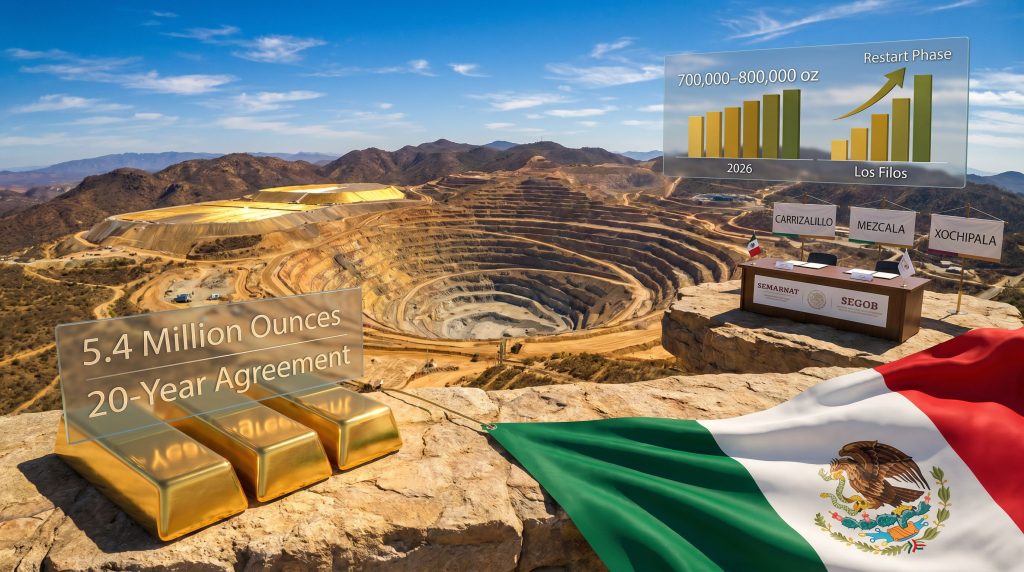
Los Filos operates across land belonging to three distinct communities in Eduardo Neri: Carrizalillo, Mezcala, and Xochipala. Each holds separate communal land rights under Mexican agrarian law, meaning that operational continuity requires maintaining three independent relationships simultaneously. This multi-community structure is a defining feature of the Los Filos operating environment that is often underappreciated by outside analysts.
In Mexican mining law, communal lands, known as ejidos, are governed by collective agrarian councils whose consent cannot be bypassed or transferred. This legal architecture creates a situation where a single community's decision to withhold land access can halt an entire operation, regardless of how cooperative the other communities remain. It was precisely this dynamic that triggered the 2025 suspension.
A History of Short-Term Fixes and Recurring Friction
Why the Conflict at Los Filos Was Predictable
The 2025 suspension was not an isolated incident. It was the most severe expression of a conflict pattern that stretches back nearly two decades. A timeline of key flashpoints illustrates the recurring nature of the friction:
-
2007: An 83-day work stoppage under previous operator Goldcorp, triggered by disputes over community compensation terms.
-
Mid-2010s: Contested health studies emerged linking elevated rates of respiratory illness in Carrizalillo to mine dust exposure, alongside concerns about potential water contamination affecting the Balsas River watershed.
-
2020: Equinox Gold inherits the asset through its merger with Leagold, along with the legacy of unresolved community grievances.
-
Ongoing: A cycle of short-term land access renewals, each expiry creating leverage for communities to renegotiate terms from scratch and compressing the mine's operational planning horizon.
This pattern reveals a structural problem that is common across Latin American mining but rarely addressed head-on: short-term land agreements create a perverse incentive structure. Communities rationally maximise leverage at each renewal point, operators face mounting uncertainty, and the underlying relationship never matures beyond transactional bargaining. Neither side builds genuine institutional trust because neither side is ever truly committed beyond the next renewal date.
The 2025 Suspension: Environmental Dimensions
When the Carrizalillo agreement lapsed in April 2025, the resulting dispute carried environmental dimensions that complicated the path to resolution. The community's agrarian council alleged that following the operational halt, the site lacked adequate environmental controls. This claim gained credibility when Mexico's federal environmental protection agency temporarily closed certain facilities over identified risks.
Carrizalillo's council also halted operation of an acid-solution irrigation system, citing responsible management to prevent potential contamination of the Balsas River, and called on federal authorities to uphold community rights in their oversight response. This environmental dimension is important because it elevated the dispute from a purely commercial disagreement into a matter of federal regulatory attention, drawing in SEMARNAT and raising the stakes for both Equinox Gold and the Mexican government. Furthermore, broader shifts in mining permits and regulatory frameworks across North America have made environmental compliance an increasingly non-negotiable operational condition.
Anatomy of the Equinox Gold Los Filos Land Access Agreement
Core Structure of the 20-Year Deal
The Equinox Gold Los Filos land access agreement, formalised at a ceremony attended by senior federal and state officials, represents a fundamental departure from the short-term renewal model that historically governed the site. Key structural features include:
| Agreement Component | Detail |
|---|---|
| Duration | 20 years across all three communities |
| Communities Covered | Carrizalillo, Mezcala, Xochipala |
| Agreement Type | Formalized temporary land occupation arrangements |
| Signing Date | June 25, 2026 |
| Witnessing Authority | Interior Minister Rosa Icela Rodríguez |
| Labor and Supply Policy | Overarching framework for employment and local procurement |
The 20-year horizon is particularly significant from an operational planning perspective. At Los Filos' current reserve life and production rate, a two-decade commitment aligns the land access framework with the actual productive life of the asset, eliminating the renewal-cycle leverage dynamic that repeatedly destabilised operations.
Community Benefit Commitments Built Into the Framework
The agreements are not simply land occupation licences. They incorporate binding commitments across multiple dimensions of community welfare:
-
Social investment and community infrastructure funding tied to operational milestones
-
Healthcare access provisions for residents in all three communities
-
Environmental protection and independent monitoring obligations
-
Local procurement and supplier development programmes designed to build economic capacity within the municipality
-
Employment guarantees with stipulated fair wage standards
Mexico's Interior Minister Rosa Icela Rodríguez stated at the signing that the deal demonstrates how dialogue and consensus-building can create conditions for projects that genuinely strengthen community wellbeing, pointing specifically to commitments covering social investment, healthcare, environmental protection, infrastructure, local procurement, and fair-wage employment. Rodríguez also noted that restarting operations would deliver tangible benefits to residents across the broader upper mountain region surrounding the mine.
SEMARNAT's Role as a Non-Negotiable Oversight Mechanism
SEMARNAT Minister Alicia Bárcena framed the agreement at the signing as the beginning of a new phase built on trust and the mutual fulfilment of commitments, stressing that Mexico views investment as only legitimate when it generates genuine social benefits for host communities and rests on environmental protection and collective rights. She confirmed that SEMARNAT would maintain close oversight of the mine's operations to verify compliance with environmental standards and ensure that the promised community benefits are delivered in practice throughout the life of the agreement.
Regulatory Reality Check: SEMARNAT's active monitoring role is not a ceremonial commitment. Given that the agency temporarily closed certain Los Filos facilities during the 2025 dispute, its ongoing oversight function carries real enforcement teeth. Operators and investors should treat environmental compliance at Los Filos as a non-negotiable operating condition, not a box-ticking exercise.
The Mine Restart: What Investors and Analysts Need to Understand
A Phased, Gradual Recovery Starting With Heap Leach
The restart strategy at Los Filos reflects the complexity of resuming a large-scale open-pit operation after a prolonged suspension. The initial phase centres on heap-leach processing, which involves stacking crushed ore on lined pads and applying a cyanide solution that percolates through the material, leaching gold into a pregnant solution for recovery. Heap leach is operationally simpler to restart than milling circuits and requires less capital expenditure to bring back online, making it the logical entry point for production resumption.
Alongside the heap-leach restart, Equinox Gold is advancing technical studies to evaluate a potential carbon-in-leach (CIL) processing facility. CIL processing involves treating a slurry of finely ground ore with cyanide in agitated tanks, with activated carbon adsorbing the dissolved gold. CIL typically achieves higher gold recoveries than heap leach, particularly for lower-grade or more complex ore types, and could significantly expand both annual throughput and total output at Los Filos over the medium term. The gold price outlook at elevated levels relative to historical averages could materially improve the project's expansion case.
Why Los Filos Is Absent From 2026 Guidance
Equinox Gold's consolidated 2026 production guidance of 700,000 to 800,000 ounces of gold excludes any contribution from Los Filos. This is a critical point for investors to internalise correctly.
Investor Framing: The absence of Los Filos from 2026 guidance should not be read as a negative signal about the asset's long-term value. Rather, it reflects operational prudence: restarting a large mine after a 14-month suspension requires environmental remediation work, workforce rehiring and retraining, and supplier contract renegotiation, none of which can be rushed without creating new risks. Los Filos is better understood as a medium-to-longer-dated production option embedded within the Equinox Gold portfolio, with the 20-year land access framework providing the security needed to justify the capital required to fully realise its value.
The restart process also involves permitting work and regulatory approvals that must align with SEMARNAT's oversight timeline. Investors accustomed to immediate production recovery following community resolutions elsewhere may need to recalibrate expectations for the Los Filos timeline. Consequently, the market's response to the agreement should be evaluated against the phased nature of what lies ahead rather than any expectation of immediate output.
Why This Agreement Reframes the Rules for Mexican Mining Investment
The Structural Shift From Transactional to Relational Engagement
The Equinox Gold Los Filos land access agreement is not simply a bilateral commercial deal between a miner and three communities. It is a federally witnessed, multi-stakeholder compact that formally acknowledges communal rights, environmental obligations, and social benefit delivery as preconditions for operational continuity. This framing reflects a meaningful evolution in how the Mexican state conceptualises the relationship between mining investment and host communities.
Since 2022, Mexico has implemented a series of federal reforms that tightened concession terms, strengthened environmental reporting obligations, and embedded community benefit requirements more deeply into the regulatory architecture governing the mining sector. The Los Filos resolution represents one of the most visible outcomes of this evolved regulatory environment applied to a major operating asset. In addition, the agreement's structure has drawn attention in the context of broader gold M&A activity, as long-horizon community frameworks can materially affect asset valuations in consolidation scenarios.
Comparing Los Filos to Other Community-Mining Disputes
The Los Filos resolution also offers a useful reference point relative to other recent community-mining conflicts in Mexico and Latin America more broadly:
| Case | Country | Outcome | Approximate Duration of Disruption |
|---|---|---|---|
| Los Filos (Equinox Gold) | Mexico | 20-year land access agreement secured | ~14 months |
| Camino Rojo (Orla Mining) | Mexico | Operations resumed after illegal blockade | Several weeks |
| Various regional precedents | Latin America | Varies by jurisdiction and community structure | Months to years |
The 14-month duration of the Los Filos suspension stands out as a lengthy and costly disruption, but the depth of the resolution achieved arguably reflects the time invested. A multi-community, 20-year agreement with federal witness authority and embedded environmental oversight mechanisms is a more durable outcome than a short-term resumption achieved under pressure.
What Social Licence Now Means in Practice Under Mexican Law
The concept of social licence to operate, once a largely informal measure of community goodwill, has become increasingly formalised under Mexico's regulatory framework. Indigenous and agrarian communities hold legally enforceable collective rights over their lands under Mexican law, and federal courts have repeatedly upheld those rights against mining operators who sought to proceed without genuine consent. The Los Filos agreement formalises social licence into a contractual and regulatory structure with specific, measurable commitments and a designated enforcement body in SEMARNAT.
For operators holding community-adjacent assets across Guerrero and broader Mexico, this agreement establishes a de facto benchmark for what genuine, durable community engagement looks like. Companies that continue to rely on short-term transactional arrangements are not simply managing a communications risk. They are accumulating a structural operational liability that, as Los Filos demonstrates, can crystallise into hundreds of millions of dollars in halted investment and lost production without warning. Furthermore, responsible mine reclamation practices are increasingly being incorporated into community agreements as additional evidence of operator good faith.
The next major ASX story will hit our subscribers first
Frequently Asked Questions: Equinox Gold Los Filos Land Access Agreement
What Communities Signed the Land Access Agreement With Equinox Gold?
The three communities are Carrizalillo, Mezcala, and Xochipala, all located in the Eduardo Neri municipality of Guerrero, Mexico.
How Long Do the Land Access Agreements Last?
Each of the three agreements runs for 20 years, replacing the previous pattern of short-term arrangements that repeatedly created leverage disputes at each renewal point.
Why Were Operations at Los Filos Suspended in the First Place?
Operations were suspended in April 2025 after the land access agreement with the Carrizalillo community expired and could not be renewed on acceptable terms. The shutdown halted approximately US$340 million in planned investment and eliminated around 800 direct jobs.
Is Los Filos Included in Equinox Gold's 2026 Production Guidance?
No. The company's 2026 guidance of 700,000 to 800,000 ounces of gold does not include any contribution from Los Filos, reflecting the phased and gradual nature of the restart.
What Processing Method Will Be Used During the Restart Phase?
The initial restart will focus on heap-leach operations. Technical studies are separately underway to evaluate a potential carbon-in-leach processing facility that could expand annual throughput and total gold recovery over the longer term.
Which Government Bodies Are Overseeing the Agreement?
Mexico's Secretariat of the Interior (SEGOB) witnessed the signing, while SEMARNAT holds the primary mandate to monitor environmental compliance and verify that community benefit commitments are fulfilled throughout the life of the agreement. According to Mining Weekly, the active involvement of multiple federal agencies signals the broader significance attached to this resolution by the Mexican government.
Key Takeaways: What Los Filos Tells the Wider Mining Sector
The Equinox Gold Los Filos land access agreement carries implications that extend well beyond a single mine in Guerrero. However, several broader lessons emerge for investors, operators, and policymakers when the resolution is examined carefully. These lessons touch on duration, environmental compliance, resource value, and evolving regulatory expectations. Notably, the agreement's structure is also likely to influence how gold mining equities with community-adjacent assets are assessed by institutional investors going forward.
-
Duration matters in community agreements. Twenty-year frameworks align operator and community incentives in ways that short-term renewals structurally cannot. The market should expect Mexico's regulatory environment to increasingly favour long-horizon commitments.
-
Environmental compliance is an operational prerequisite, not a reputational add-on. SEMARNAT's role as an active monitoring body with demonstrated enforcement willingness changes the risk calculus for operators whose environmental controls are marginal.
-
The resource base at Los Filos justifies patient capital. With 5.4 million ounces in reserves and nearly 11 million ounces in measured, indicated, and inferred resources, the asset provides a long runway for production once the restart ramp-up is complete.
-
Mexico's mining framework is evolving toward conditional investment. Concession holders who treat community benefit as optional or secondary to production targets are accumulating risk in an environment that is explicitly moving in the opposite direction.
-
The CIL expansion optionality is underappreciated. If technical studies confirm the economics of a carbon-in-leach facility at elevated gold prices, Los Filos could materially shift Equinox Gold's long-term production profile in ways not yet reflected in current guidance.
The resolution at Los Filos is neither a simple victory nor a template that can be copy-pasted across every contested mining jurisdiction in Latin America. But it does demonstrate that when regulators, operators, and communities invest the time required to build a genuinely structural agreement, the outcome can deliver something far more valuable than a resumed production schedule: a foundation stable enough to support decades of shared economic activity.
Want to Track the Next Major Gold Discovery Before the Market Moves?
Discovery Alert's proprietary Discovery IQ model scans ASX announcements in real time, instantly identifying significant mineral discoveries and translating complex data into actionable insights for both short-term traders and long-term investors — explore historic discoveries and their returns to understand what's at stake, then begin your 14-day free trial at Discovery Alert to position yourself ahead of the broader market.